Best Master's in Data Analytics Programs
Compare 360+ accredited Data Analytics programs, with graduate earnings, cost, debt, and completion data from IPEDS and the U.S. College Scorecard.

Can a $6,541 net price master's in data analytics deliver the same career lift as a $41,704 one from a bigger name? That spread, from the University of Florida to Boston College, is institution-wide average net price after aid, not a program-specific total, but it frames the decision sharpest for applicants comparing data analytics and business analytics degrees.
The ranked list below leads with graduate earnings and net price rather than prestige. Cost tables, earnings and debt comparisons, online status, specializations, and GRE and prerequisite requirements follow for quick side-by-side checks.
For most students, the real question is whether a larger monthly loan payment buys enough additional salary to justify the name.
Key Points
- Published tuition and net price differ, so compare total program cost, not annual rates.
- University of South Dakota's AACSB status covers its business school, not the analytics degree.
- Program-level earnings are mostly unreported, so use school-level data and confirm 2027 GRE policies.
The 10 Best Master's in Data Analytics Programs, Ranked
Each spot on this list was earned on outcomes and affordability, weighing what graduates earn after finishing against what they pay to get there. The programs below stand out for pairing rigorous analytics training with realistic cost and career value. Compare format, concentration, tuition, and aid-adjusted price side by side.
Georgia Institute of Technology
#1Atlanta, GA · ~$16,000/yr (est.)
Best for: Career changers needing interdisciplinary analytics training
Georgia Tech's one-year Master of Science in Analytics blends statistics, operations research, computing, and business into an integrated curriculum that prepares students for data-heavy roles. The intensive campus format suits recent graduates or working professionals ready to refocus, and a fully online option offers the same degree with more scheduling flexibility. In-state graduate tuition is $12,058 and out-of-state $34,484; the institution-wide average net price after aid is $12,116.
- 1-year on-campus or online option
- Combines statistics, operations research, computing, business
- Same degree online as on campus
- No GRE or GMAT required
- MicroMasters advanced-standing credit available
Columbia University in the City of New York
#2New York, NY · ~$58,000/yr (est.)
Best for: Aspiring leaders blending analytics with management
Columbia University's Master of Science in Applied Analytics joins rigorous data analytics with leadership, management, and communication training. Students can follow a flexible core track or concentrate in Emerging Technologies or Quantitative Management Analytics, with full-time, part-time, campus, and online paths. Graduate tuition is $71,845; the institution-wide average net price after aid is $21,590.
- 36 total credit hours
- Full-time and part-time options
- Fully online option available
- Concentrations: Emerging Technologies, Quantitative Management Analytics
- Core track for maximum flexibility
- Blends data analytics with leadership and communication
University of Florida
#3Gainesville, FL · ~$13,000/yr (est.)
Best for: Technical managers seeking data science specialization
The University of Florida's Data Analytics specialization within the Master of Science in Engineering Management prepares technical professionals to lead data-driven organizations. The three-course series spans data architecture, data engineering, data science, machine learning, and AI, while emphasizing communication skills for explaining analytics to executives. In-state graduate tuition is $6,381 and out-of-state $28,659; the institution-wide average net price after aid is $6,541.
- Three-course data analytics series
- Taught from a middle technology manager's perspective
- Covers machine learning and AI fundamentals
- Hands-on Python and SQL work
- ETL pipeline management
- Business case and ROI focus
The University of Texas at Austin
#4Austin, TX · ~$12,000/yr (est.)
UT Austin's Data Analytics concentration within the Master of Science in Operations Research and Industrial Engineering offers rigorous training in data science and decision analytics. Coursework spans linear programming, statistical modeling, data mining, and decision analysis, with an applied projects course and a choice between a master's report or thesis. In-state graduate tuition is $11,688 and out-of-state $44,908; the institution-wide average net price after aid is $19,857.
- 2-year program, 30 total credit hours
- Thesis or capstone option
- Focus on data and decision analytics
- Electives across engineering, business, economics, statistics
- Thesis supports journal publication
- Report may detail summer internship
University of Southern California
#5Los Angeles, CA · ~$72,000/yr (est.)
USC's Master of Science in Analytics trains students to become data analysts and data scientists by combining data management, mining, visualization, machine learning, decision analysis, and statistics. Students work with Python, R, and SAS Visual Analytics and may choose electives in financial analytics, natural language processing, consulting, and big data. Graduate tuition is $72,097; the institution-wide average net price after aid is $32,740.
- Fully online option available
- On-campus and online formats
- Same faculty and lectures for online students
- Tools include Python, R, SAS Visual Analytics
- Electives in financial analytics, NLP, big data
- Careers as data analysts and data scientists
University of Wisconsin-Madison
#6Madison, WI · ~$12,000/yr (est.)
UW-Madison's Engineering Data Analytics MEng is a fully online master's for engineers who want to convert big data into high-impact actions. Coursework covers data capture, storage, cleaning, querying, visualization, modeling, and machine learning, with a structure that fits around a current job. In-state graduate tuition is $11,603 and out-of-state $42,103; the institution-wide average net price after aid is $17,354.
- 30 total credit hours
- Fully online option available
- No entrance exam required
- Test optional
- Machine learning and modeling techniques covered
- Named option within Engineering MEng
Carnegie Mellon University
#7Pittsburgh, PA · ~$51,000/yr (est.)
Carnegie Mellon's MS in Data Analytics for Science is a one-year program for scientists from biology, physics, chemistry, math, and similar fields who want to move into data-driven work without starting over in computer science. It layers statistical modeling, machine learning, computational modeling, parallel computing, and data visualization onto existing scientific knowledge. Graduate tuition is $66,246; the institution-wide average net price after aid is $31,944.
- 1-year program
- No computer science background needed
- Builds on scientific expertise
- Capstone with industry partners
- Access to Pittsburgh Supercomputing Center
- Covers Python, SQL, R
University of Maryland-College Park
#8College Park, MD · ~$18,000/yr (est.)
The University of Maryland's Master of Professional Studies in Data Science and Analytics is a non-thesis, 30-credit graduate program focused on probability and statistics, data science principles, machine learning, big data systems, and algorithms. A communication course prepares students to present findings clearly, and nine elective credits allow customization. In-state graduate tuition is $11,809 and out-of-state $41,186; the institution-wide average net price after aid is $15,678.
- 30 total credit hours
- No thesis or capstone required
- Core spans probability, statistics, machine learning
- Big data systems and algorithms
- 9 elective credits for customization
- Communication course included
Boston University
#9Boston, MA · $65,000 – $70,000/yr (est.)
Boston University's Master of Science in Applied Data Analytics, offered online or on campus through Metropolitan College, is a STEM-designated program that can be completed in 8 to 20 months. Coursework spans Python, R, SQL, machine learning, data mining, visualization, and cloud services, with optional concentrations in AI & Machine Learning or Data Engineering. Graduate tuition is $68,102; the institution-wide average net price after aid is $24,402.
- Complete in 8-20 months
- Full-time and part-time options
- Fully online option available
- Concentrations: AI & Machine Learning, Data Engineering
- No entrance exam required
- STEM-designated, OPT extension up to 24 months
Boston College
#10Chestnut Hill, MA · ~$38,000/yr (est.)
Boston College's Master of Science in Applied Analytics is a 30-credit, 10-course STEM-designated degree that can be finished in as few as 12 months full-time or 20 months part-time. Students develop machine learning, AI, predictive analytics, and natural language processing skills while also building storytelling and communication abilities, with hands-on projects and a capstone-style course. Graduate tuition is $70,702; the institution-wide average net price after aid is $41,704.
- 30 total credit hours, 10 courses
- Complete in as few as 12 months
- Full-time and part-time options
- Evening and online options
- No entrance exam required
- Test optional
- STEM-designated with extended OPT
- Dual degree with M.S. in Applied Economics
Cost & outcomes by school
Federal data for the highest-earning Data Analytics programs, independent of the ranking above. Earnings are this field's master's graduates four years after completing, where the Scorecard reports them.
| School | Earnings | Tuition / yr | Debt | Grads/yr | Format |
|---|---|---|---|---|---|
| University of North Texas TX | — | $9,091 | — | 356 | Campus |
| East Texas A&M University TX | — | $7,338 | — | 257 | Hybrid |
| University of the Cumberlands KY | — | $3,195 | — | — | Online |
| Middle Georgia State University GA | — | $4,534 | — | — | Online |
| Fort Hays State University KS | — | $4,949 | — | — | Online |
| University of Massachusetts-Amherst MA | — | $17,410 | — | 271 | Hybrid |
| Texas A&M University-Texarkana TX | — | $6,036 | — | — | Online |
| University of the Potomac-Washington DC Campus DC | — | $5,850 | — | — | Hybrid |
| University of the Potomac-VA Campus VA | — | $5,850 | — | — | Hybrid |
| Texas A&M University-Kingsville TX | — | $6,157 | — | — | Campus |
| New Mexico State University NM | — | $6,605 | — | — | Hybrid |
| Texas A & M International University TX | — | $6,650 | — | — | Campus |
Sources: U.S. Department of Education. Tuition and graduates: IPEDS. Earnings and debt: College Scorecard, this field's master's graduates; a dash means no figure is reported.
Behind Our Rankings: Earnings, Cost, and Accreditation Checks
The University of South Dakota has held AACSB accreditation since 1949, yet that credential covers its business school, not a data analytics degree specifically. That gap between what a school holds and what a program carries is the most useful thing to understand before you compare options.
The Numbers Behind the Comparison
We looked at federal College Scorecard figures for graduate earnings and debt, published graduate tuition, institution-wide net price, and each school's overall graduation rate. Net price and graduation rate describe the whole institution, not the master's program. Program-level earnings and debt are not yet available for most of the programs listed here, so treat those comparisons as incomplete.
Why Accreditation Matters
Institutional accreditation comes from a regional accreditor and affects federal aid eligibility, credit transfer, and how employers view your degree. Examples among the ranked schools: Georgia Tech is accredited by SACSCOC, Columbia by MSCHE, Wisconsin-Madison by HLC, Boston University by NECHE, and USC by WSCUC. Confirm the current status on the accreditor's own site.
Specialized Accreditation
No dedicated programmatic accreditor exists for data analytics degrees, a reality common across Computers & IT Master's Programs. When a program sits inside a business school, that school may hold AACSB accreditation. Kansas State, UT Chattanooga, and Stonehill are examples. AACSB reviews the business unit, so it does not automatically certify the analytics degree. Programs housed in engineering, statistics, or professional studies units may not fall under it at all.
What the Data Cannot Tell You
Federal data cannot measure curriculum quality, job placement rates, or outcomes for specific student groups. Request placement reports, employer lists, and course syllabi from the admissions office before you commit.
Data Analytics Master's Program Cost: Published Tuition vs. Net Price
Annual published graduate tuition is the sticker price a school charges for one year of enrollment, and it can differ sharply between in-state and out-of-state students at public universities. Total program cost is the per-credit rate multiplied by required credits plus mandatory fees, which matters because credit loads vary across data analytics master's programs. Institution-wide net price is the average amount students actually pay after federal, state, and institutional grant aid, pulled from IPEDS and College Scorecard data, so it is typically much lower than published tuition. For example, Northwest Missouri State's online M.S. in Data Analytics charges $432 per credit over 30 credits for a $12,960 total, while Augusta University's online M.S. in Data Science charges $405 per credit over 36 credits for a $14,580 total. University of Illinois Springfield's 36-credit program totals $13,834, University of Wisconsin-Whitewater's 30-credit online program totals $21,660 at $722 per credit, and Southern New Hampshire University's 36-credit online program totals $23,724 at $659 per credit. The table below shows how out-of-state tuition can erase the public-school discount: University of Florida's out-of-state rate is more than four times its in-state rate, and University of Maryland-College Park's out-of-state rate exceeds $41,000. Online programs such as Northwest Missouri State and Southern New Hampshire University charge the same per-credit rate regardless of residency, making the cost predictable.
| School | Format | In-State Tuition | Out-of-State Tuition | Net Price |
|---|---|---|---|---|
| CUNY Bernard M Baruch College | Online | $7,464 | $15,414 | $3,033 |
| University of Florida | Campus | $6,381 | $28,659 | $6,541 |
| University of Central Florida | Campus | $6,368 | $22,467 | $10,411 |
| Georgia Institute of Technology | Campus | $12,058 | $34,484 | $12,116 |
| San Jose State University | Hybrid | $8,410 | $21,010 | $13,760 |
| University of Houston | Campus | $9,717 | $22,547 | $14,276 |
| University of Maryland-College Park | Campus | $11,809 | $41,186 | $15,678 |
| University of Wisconsin-Madison | Online | $11,603 | $42,103 | $17,354 |
| University of Delaware | Online | $16,810 | $41,400 | $17,799 |
| State University of New York at New Paltz | Hybrid | $8,572 | $18,822 | $18,809 |
Graduate Earnings and Debt: Which Data Analytics Master's Programs Pay Off
A growing number of states now require graduate programs to publish debt and earnings outcomes, yet most data analytics master's programs still list program-level earnings as not available. That makes school-level proxies the most useful starting point for comparing payoff.
What Program-Level Data Is Missing
Program-specific earnings for one year, four years, and five years after completion are not yet reported for the data analytics programs in this ranking. Median program debt and the estimated 10-year monthly payment are also not published. Because those figures are missing, we use institution-wide outcomes as a rough guide, not as the program's own return.
Two High-Value Starting Points
CUNY Bernard M Baruch College shows the strongest school-level ROI proxy in this group, at 6.6. Its median graduate debt across all master's programs is $11,512, while institution-wide median earnings 10 years after entry are $75,971. San Jose State University follows with a school-level ROI proxy of 5.27, median graduate debt of $15,000, and institution-wide earnings of $78,988. Both pair relatively low debt with solid institution-wide earnings, which is a useful signal even if program-level outcomes remain unpublished.
The school-level ROI proxy is built from institution-wide median earnings 10 years after entry and median graduate debt across all graduate programs. It is not a data analytics program-specific return and should not be read that way.
One Thinner Payoff
Columbia University illustrates the other side. Institution-wide median earnings are high at $102,491, but median graduate debt is $21,500, and the school-level ROI proxy is 4.77. That is not a bad outcome, but the payoff cushion is thinner than at lower-debt public options once you weigh the full cost of attendance in New York.
The Debt Rule of Thumb
A practical rule of thumb for any master's program: keep total borrowing at or below your expected first-year earnings. Since program-level first-year earnings are not yet published here, anchor to institution-wide median earnings as a conservative benchmark, and be cautious if a program's advertised cost pushes your projected debt well above that line.
Related Articles
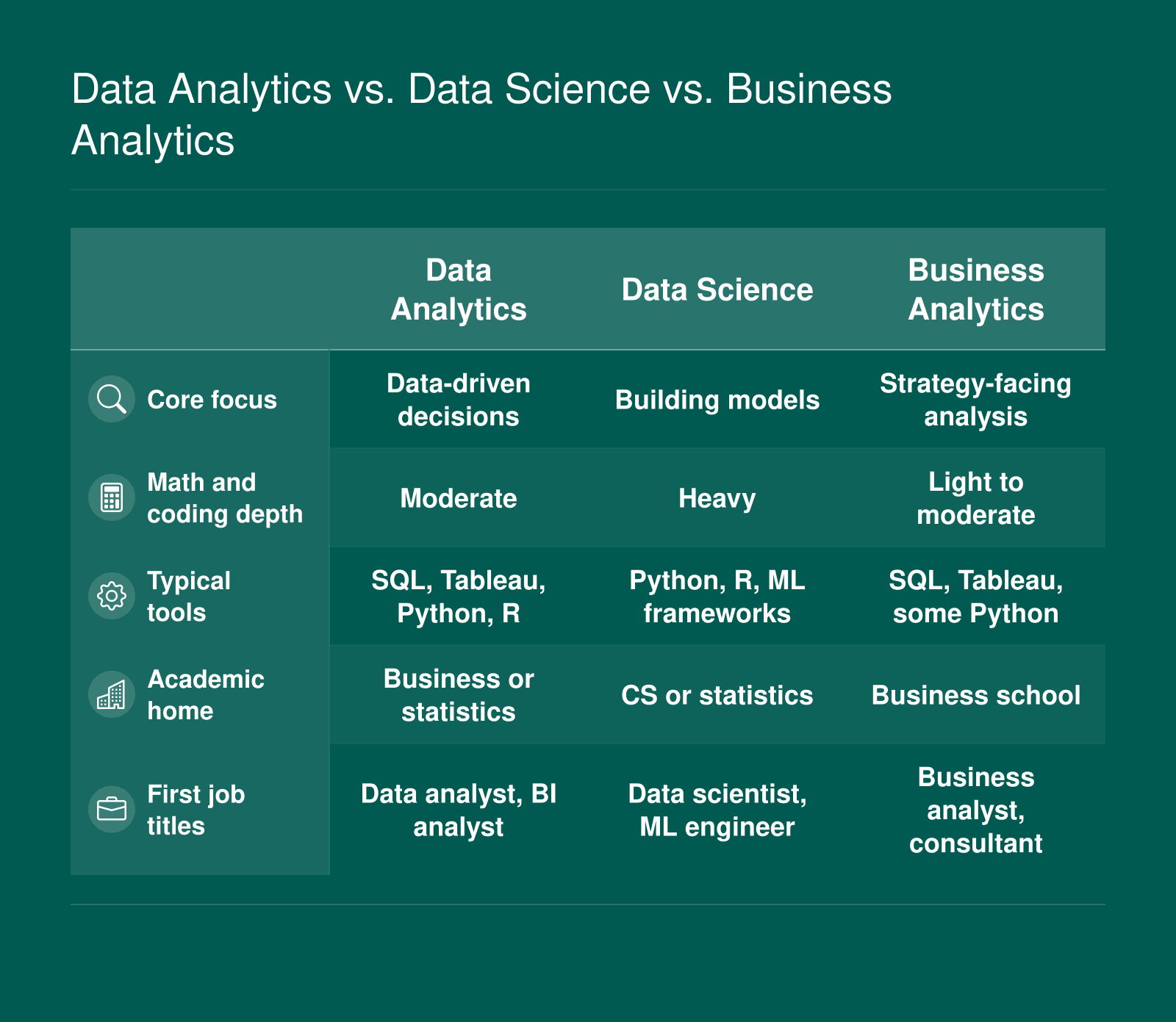
Data Analytics vs. Data Science vs. Business Analytics
Degree titles overlap across schools, so check the curriculum rather than the name on the diploma. Data analytics programs usually teach you to query, clean, and interpret data so managers can act on it. Data science programs lean harder on statistics and programming, with the goal of building predictive models and putting them into use. Business analytics programs sit closest to the business side, pairing analysis with strategy, operations, and communication. Course catalogs vary, so a program labeled one way may look like another. A quick rule for choosing: pick analytics if you want to interpret data to drive decisions, data science if you want to build models, and business analytics if you want a strategy-facing role. Before you apply, compare each program's required courses, the tools it teaches, and the department that houses it. Those details predict your daily work more reliably than the degree title does.
Admissions Checklist: GRE Waivers and Prerequisite Courses
Requirements vary widely, and 2026 policies change often. Confirm each item on the program's own admissions page before you apply.
- Bachelor's degree and minimum GPAA 3.0 is the common benchmark, but floors differ: University of Houston-Downtown cites 3.0, while Capella lists 2.3. We could not confirm formal conditional-admission paths at the programs we reviewed, so ask admissions whether a lower GPA can be offset by coursework or experience.
- GRE policyWe found no complete 2026 count of GRE-optional programs, so we won't cite one. Stanford requires the GRE. Georgia Tech considers the GRE or GMAT. UC Berkeley does not require it. Columbia and NYU are reported as optional. University of Houston-Downtown waives the GRE for a 3.0 GPA in the last 60 hours, or for STAT 5301 and CS 5301 with a B+. Waivers based on work experience or a prior graduate degree were not established.
- Statistics, calculus, or linear algebraMost programs expect some mix of these. Formal bridge courses are rare in our research. University of Houston-Downtown's STAT 5301 and CS 5301 are preparatory courses, and Capella lists ANLT5030 as a prerequisite. Ask whether self-paced or MOOC credit is accepted.
- Programming backgroundPython, R, or SQL is commonly expected. We did not identify pre-program bootcamps, so ask each school about them.
- Resume or work experienceShow quantitative or technical work, though most programs don't set a fixed minimum.
- Statement of purposeTie your goals to the program's curriculum and your intended career path.
- Recommendation lettersChoose recommenders who can speak to your analytical or quantitative ability.
Data Analytics programs by state
Quick Answers Before You Compare Programs
These two questions come up most often when students start comparing programs. The answers below reflect published program requirements, so check each school's current catalog before you plan around a timeline.
How long does a master's in data analytics take?
What jobs do data analytics master's graduates typically land?
Which data analytics master's programs can be completed online?
Compare Data Analytics programs on the data that matters
Explore more Computers & IT specializations or browse every graduate field.
All Computers & IT programs