Most Affordable Master's in Data Analytics Programs
Compare 360+ accredited most affordable Data Analytics programs, with graduate earnings, cost, debt, and completion data from IPEDS and the U.S. College Scorecard.

Public universities have turned the analytics master's into a volume product, and prices have scattered as a result. Net price after aid, measured across each institution, runs from $4,831 at the University of Texas Rio Grande Valley to $14,107 at the University of the Cumberlands, a private school.
Cheap is not automatically good value. Net price only means something next to what a program's graduates earn and borrow, so the two are weighed together here, along with format, funding, and the line between data analytics and data science.
Even the low end is a real commitment. UTRGV's online program lists $15,583 in total tuition for 33 credits, a five-figure bill before fees or software.
Key Points
- Net price after aid comes first, then graduate earnings and debt.
- WGU's flat-rate term costs $4,425, unlike per-credit billing.
- Out-of-state tuition at Florida runs about $17,393 above in-state.
10 Best Affordable Data Analytics Master's Programs, Ranked by Value
The ten programs below keep the bill low without letting outcomes drop off. Each card pairs an institution-wide net price after aid with graduate tuition and fees for in-state and out-of-state students, then adds the delivery format and concentration that shape real cost and fit.
The University of Texas Rio Grande Valley
#1Edinburg, TX · $5,000 – $10,000/yr (est.)
Best for: Working professionals needing accelerated online analytics
An AACSB-accredited business school that packages analytics, machine learning, and AI into a one-year online format. The curriculum pairs tools such as R, Python, and Tableau with decision optimization and data visualization. Seven-week courses make it feasible for working professionals to finish quickly without leaving their jobs.
- AACSB accredited
- 33 total credit hours
- 12-month accelerated format
- Fully online option
- Seven-week course sessions
- Learn R, Python, and Tableau
- 3.0 GPA minimum
- $0 application fee
California State University-Northridge
#2Northridge, CA · ~$9,000/yr (est.)
Best for: Engineers seeking technical leadership training
A technical management degree built for engineers who want to lead analytics initiatives. The data analytics option adds nine units covering programming for data science, analytics for engineering managers, and knowledge discovery. The school's long history of producing engineering leaders and its cohort structure give the program a practical, career-focused edge.
- 33 total credit hours
- Fully online cohort option
- Cohort-based structure
- 2.5 GPA minimum
- Statement of purpose required
- Data analytics option adds 9 units
- For engineering and technical degree holders
University of Florida
#3Gainesville, FL · ~$13,000/yr (est.)
Best for: Mid-career managers blending engineering and data
A three-course data analytics specialization inside an engineering management degree aimed at middle managers. Students work with Python and SQL to assess model feasibility, manage ETL pipelines, and translate analytics into business cases. The focus on executive communication and ROI makes it a fit for technical leaders advancing into data strategy.
- Three-course data analytics series
- Designed for middle technology managers
- Machine learning and AI fundamentals
- Python and SQL data manipulation
- ETL pipeline management
- Business cases for AI integrations
- Executive communication focus
California State University-Sacramento
#4Sacramento, CA · $10,000 – $20,000/yr (est.)
A STEM-designated business analytics master's that connects Python, R, SQL, and Tableau to finance, marketing, operations, HR, and accounting. Evening courses and flexible one-to-three course enrollment support working students. The AACSB-accredited program's career services and capstone experience round out a practical path to analyst and data scientist roles.
- AACSB accredited
- STEM-designated graduate degree
- Fully online option
- Evening classes once a week
- Flexible one-to-three course enrollment
- 2.5 GPA minimum
- Capstone required
- Applied to finance, marketing, HR
California State Polytechnic University-Pomona
#5Pomona, CA · $5,000 – $10,000/yr (est.)
A business analytics master's with strong CPT support for international students and recommended early internships. The curriculum applies data science technology directly to business problems. English proficiency can be met through TOEFL, IELTS, or CPELI level 6, and the program offers online info sessions and financial aid guidance.
- Strong CPT support for international students
- Internships recommended early
- TOEFL or IELTS accepted
- CPELI level 6 meets English proficiency
- Financial aid and scholarships available
- Online MSBA info sessions
- Data science technology and applications
University of Central Florida
#6Orlando, FL · ~$9,000/yr (est.)
A 30-credit data analytics degree combining parallel programming, machine learning, data mining, database systems, and text mining. Evening and weekend classes, paid internships with Fortune 500 companies, and Orlando's growing tech scene give students real experience. No GRE is required, and an AI track adds depth for aspiring data scientists and engineers.
- 30 total credit hours
- No GRE required
- Evening and weekend classes
- Paid internships with Fortune 500 companies
- Capstone required
- 3.0 GPA minimum
- Machine learning and data mining
- Orlando recognized as tech hub
University of North Texas at Dallas
#7Dallas, TX · ~$6,000/yr (est.)
A fully online MBA with a data analytics concentration delivered in eight-week terms for working professionals. The 30-credit program has no GMAT requirement and no prerequisite courses, and it folds analytics into leadership, finance, and strategy coursework. Capstone projects and service learning connect the degree to workplace decisions.
- 30 total credit hours
- 12-month program
- Fully online option
- No entrance exam required
- Eight-week course terms
- Capstone required
- Three start dates per year
- Service learning component
University of the Cumberlands
#8Williamsburg, KY · ~$3,000/yr (est.)
A private, faith-based university offering a low-cost online business analytics master's with small classes capped at 30. The 31-credit program covers data exploration, database management, business intelligence, data mining, and AI, with electives in financial analytics, marketing analytics, supply chain, and digital health. Its per-credit price and certificate pathway keep the degree accessible.
- 31 total credit hours
- Fully online
- Capstone required
- Max class size of 30
- 18 core credit hours
- 12 elective credit hours
- Certificate pathway into master's
University of North Florida
#9Jacksonville, FL · $10,000 – $15,000/yr (est.)
A specialized accounting and data analytics master's for students who want to blend financial reporting with analytics tools. Core requirements cover data analytics, data visualization, and business analytics applications, while major courses span advanced accounting, auditing, taxation, and accounting information systems. The program draws on both the Coggin College of Business and the School of Computing.
- 30 total credit hours
- Core requirements include data analytics and visualization
- Major courses in advanced accounting and auditing
- Accounting or tax electives
- Finance electives available
University of Nevada-Las Vegas
#10Las Vegas, NV · ~$7,000/yr (est.)
An interdisciplinary data analytics master's built from six colleges, with applications in healthcare, hospitality, engineering, business, and government. The curriculum focuses on programming, database management, machine learning, and statistics, with clear communication of results. Online and on-campus options and Las Vegas's hospitality analytics scene give students flexible, applied training.
- Fully online option
- Interdisciplinary across six colleges
- Covers programming, database, machine learning
- Applications in healthcare, hospitality, business
- Data analysis, visualization, predictions
- Skills for data scientist roles
Cost & outcomes by school
Federal data for the highest-earning Data Analytics programs, independent of the ranking above. Earnings are this field's master's graduates four years after completing, where the Scorecard reports them.
| School | Earnings | Tuition / yr | Debt | Grads/yr | Format |
|---|---|---|---|---|---|
| University of the Cumberlands KY | — | $3,195 | — | — | Online |
| Middle Georgia State University GA | — | $4,534 | — | — | Online |
| Fort Hays State University KS | — | $4,949 | — | — | Online |
| University of the Potomac-Washington DC Campus DC | — | $5,850 | — | — | Hybrid |
| University of the Potomac-VA Campus VA | — | $5,850 | — | — | Hybrid |
| Texas A&M University-Texarkana TX | — | $6,036 | — | — | Online |
| Texas A&M University-Kingsville TX | — | $6,157 | — | — | Campus |
| University of North Texas at Dallas TX | — | $6,379 | — | — | Online |
| New Mexico State University NM | — | $6,605 | — | — | Hybrid |
| Texas A & M International University TX | — | $6,650 | — | — | Campus |
| Kennesaw State University GA | — | $6,702 | — | — | Hybrid |
| Youngstown State University OH | — | $6,848 | — | — | Campus |
Sources: U.S. Department of Education. Tuition and graduates: IPEDS. Earnings and debt: College Scorecard, this field's master's graduates; a dash means no figure is reported.
What Earned a Spot: Net Price First, Outcomes Close Behind
Sticker tuition tells you what a school charges. Net price tells you what students actually pay after grants. The data analytics master's programs here lean on the second number first, then check it against what graduates earn and borrow.
Sticker Price vs. Net Price
Both figures appear because they answer different questions. In-state and out-of-state tuition is the published rate for your residency status, so it shows what a program bills you directly. After grants and scholarships, net price averages what students pay across the institution, so it shows how generous a school is in practice. A school with a high sticker price and heavy aid can land below a cheaper-looking rival. Neither number tells the whole story alone.
Outcomes Come Second
After cost, the list weighs College Scorecard earnings and median debt for graduates. These show whether a low price comes with a payoff worth having. A bargain that leaves graduates with weak pay and heavy loans is not much of a bargain.
Where the Data Runs Out
Graduation rates and net price describe the whole institution, not the data analytics program itself. Earnings and debt are program-level only where Scorecard publishes them, and smaller or newer programs often lack those figures. Where they are missing, the school is judged on cost and institution-wide measures, and no estimates fill the gap.
What the Numbers Leave Out
Books, software licenses, technology fees, and changes in residency status are not captured in tuition or net price. Any of them can shift your real bill over the length of an online master's in data analytics program. The next section breaks down those costs so you can build a realistic budget before you apply.
What You'll Actually Pay: Tuition, Fees, Software, and Residency Rules
The real price of a data analytics master's is the per-credit tuition multiplied by the credits you must complete, plus every fee, textbook, and device the program assumes you already have. Sticker tuition is only the first line of that bill.
Fees That Sit Outside Tuition
Most universities quote tuition without fees. Expect some mix of mandatory per-credit or per-term fees, technology fees, and distance-learning charges. Georgia Tech, for example, adds an online-learning fee of $212 to $531 per semester, and Oregon State lists a $15 per-credit distance education fee for 2026-27.
Software usually costs less than students fear. Python and R are free, and SAS and Tableau both offer free academic access, though an individual course may still call for a paid add-on or cloud credits. Textbook costs vary by course. Budget for a reliable laptop that can run data tools comfortably, and check the program's minimum specs before you buy.
Worked Examples From the Ranking
- UT Rio Grande Valley: $472 per credit across 33 credits comes to about $15,576, in line with the school's listed $15,583 total. Annual tuition runs $8,589 in-state versus $15,971 out-of-state, and the 12-month format, common in accelerated master's in data analytics programs, packs the full cost into one year.
- Sacramento State: $825 per credit, with a listed program total of $24,750. Annual tuition runs $9,542 in-state and $19,622 out-of-state, so confirm which rate applies before you budget for the business analytics master's degree cost.
- Northern Kentucky University: $572 per credit across 30 credits equals $17,160, yet the school lists $17,640 in total. Gaps like that often reflect fees or rate updates, which is why rate times credits is a starting estimate, not a final number.
How Residency Changes the Math
At public universities, nonresidents can pay roughly double. Kansas State's 2026 rates show $479.16 per credit for residents versus $1,071.49 for nonresidents. Some schools set one flat e-tuition rate for online students wherever they live: UMGC charges $694 per credit to in-state and out-of-state students alike. Reclassifying as a resident commonly takes about 12 months of domicile, usually by petition and applied going forward, and enrolling online from another state generally won't qualify you on its own. Rules vary by state, so verify before counting on a lower rate.
Before You Commit
Request the program's official cost-of-attendance sheet, and ask directly which fees apply to fully online students. Some campus fees are waived for distance learners; others are not.
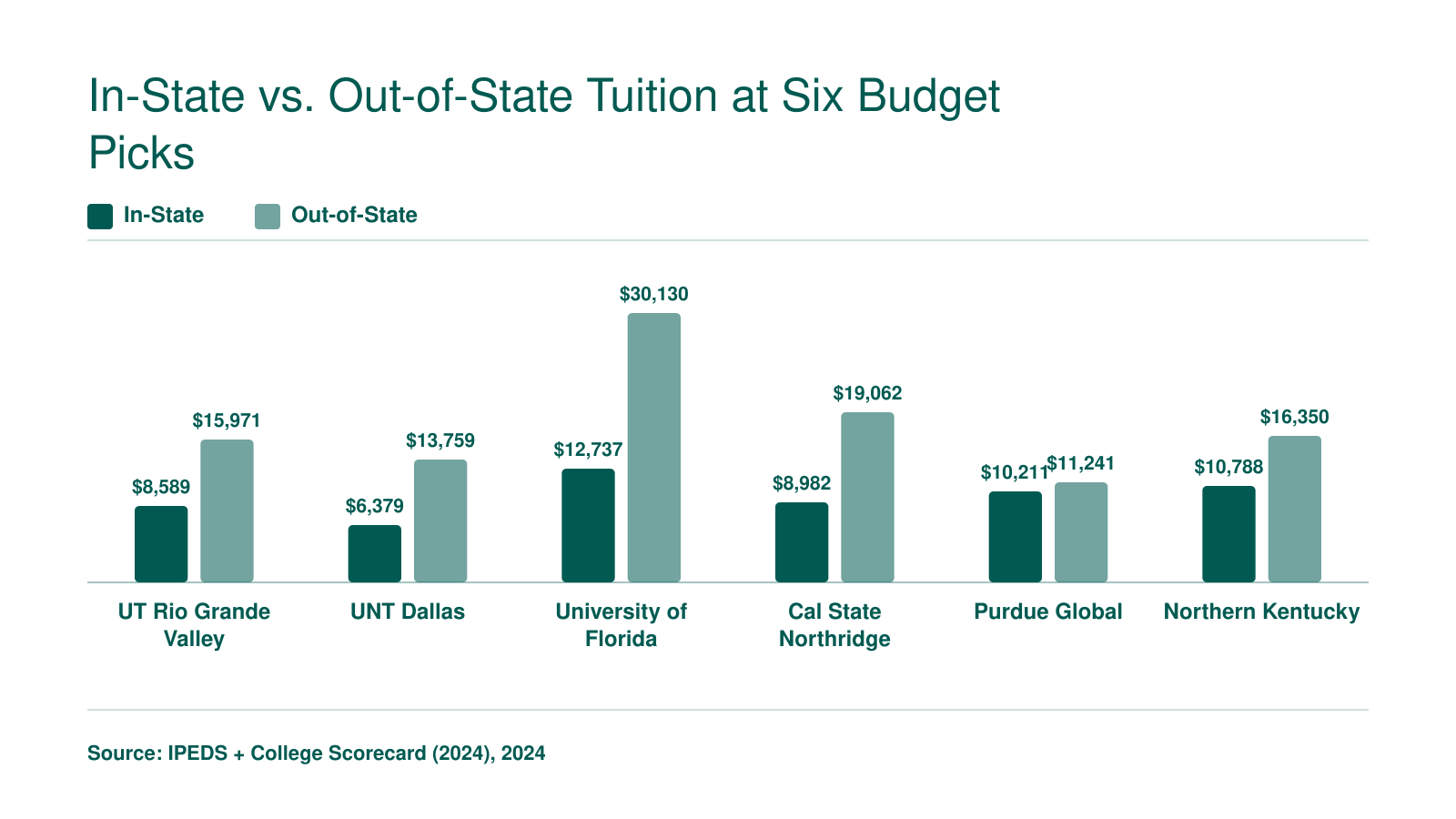
In-State vs. Out-of-State Tuition at Six Budget Picks
Residency can add thousands of dollars to the same graduate degree. Across these budget data analytics programs, the gap between published in-state and out-of-state tuition and fees is widest at the University of Florida, where out-of-state students pay about $17,393 more; it nearly disappears at Purdue Global, where the two rates differ by only $1,030. Some online public programs publish a single distance rate for all students, so confirm your residency status before budgeting.
Flat-Rate Terms vs. Per-Credit Billing: Which Model Costs Less?
WGU's MS in Data Analytics uses a flat-rate six-month term at $4,425, while programs such as SNHU, UMGC, and Penn State World Campus charge per credit. The real cost difference comes down to pace: a flat-rate term rewards acceleration, while per-credit tuition stays fixed across the required credits.
| Comparison | Flat-Rate Term Pricing | Per-Credit Billing |
|---|---|---|
| How charges are billed | One price per six-month term, regardless of how many credits are attempted | Tuition is charged at a set rate per credit hour |
| Representative price for a data analytics master's | $4,425 per six-month term at WGU | $659 per credit at SNHU; $1,089 per credit at Penn State World Campus |
| Total for a 30 to 36 credit program | Depends on the number of terms; WGU states completion in less than 24 months | $20,820 for 30 credits at UMGC; $23,724 for 36 credits at SNHU; $32,670 for 30 credits at Penn State |
| How pace changes cost | Finishing faster lowers total cost; slowing down adds another term at $4,425 | Total stays fixed by credits, so faster or slower pacing does not lower tuition |
| Predictability | Less predictable if your schedule changes; every added term adds another $4,425 | Predictable once you know the required credits and the per-credit rate |
| Best suited for | Self-directed working professionals who can accelerate through material | Students who want structured semesters and predictable federal aid timing |
| Example programs | WGU's competency-based MS in Data Analytics | SNHU, UMGC, Penn State World Campus, and McDaniel College |
Related Articles
Graduate Earnings, Debt, and Return on Investment
Sticker price tells you what a program costs to enter; earnings and debt tell you what it costs to finish. Whether you are weighing a data analytics degree or a Master's in Business Analytics, the first number is easy to find. The second is the one that decides whether the degree pays off, and it is also the harder one to pin down for data analytics specifically.
What the Published Figures Actually Cover
The cleanest way to judge value is to compare program-level earnings against the debt graduates carry out the door, always paired with the time window those earnings reflect. A figure for one year after completion means something very different from a figure measured four or five years out, when analysts have moved past entry-level titles. Whenever you see an earnings number, including for best data analytics master's programs no GRE, confirm the window before you compare it to anything else.
For the data analytics programs ranked here, that program-specific pairing is thin. Outcome figures reported at the degree-and-field level are not yet published for most of these programs, so we will not dress up institution-wide averages and call them data analytics salaries. A university's overall graduate earnings or its campus-wide median debt describe the whole school, not the analytics cohort, and treating them as a program outcome would mislead you. Where you see those broad figures elsewhere, read them as context about the institution, not a forecast of your paycheck.
How to Run the Math Yourself
Until program-level earnings fill in, you can still estimate return on investment using the lever you control: debt. Several of the public programs below keep in-state tuition low enough that a resident can finish for well under $15,000 in total tuition. On a standard ten-year repayment plan, roughly $15,000 in loans runs near $160 a month. Against a realistic entry-level analyst salary, that payment lands comfortably under the 8-to-10 percent of gross income that lenders treat as manageable.
Are Cheap Programs Worth It?
Yes, when the ratio works. Value is not the lowest sticker price; it is the smallest gap between what you borrow and what you earn afterward. A $9,000 degree that leads to the same analyst role as a $60,000 one is the better investment, full stop. Run your own numbers: estimate total debt at your residency rate, divide the monthly payment into a conservative first-year salary, and let that ratio, not the brand on the diploma, guide the decision.
Before You Apply: Accreditation, STEM Status, and Prerequisites Checklist
Run through these checks before you pay an application fee.
- Confirm regional accreditationVerify the school holds institutional regional accreditation (such as HLC, SACSCOC, NWCCU, or MSCHE). National-only accreditation can limit employer tuition benefits and transferability.
- Check STEM designation and CIP codeFor international students, a STEM-designated program can extend Optional Practical Training by 24 months beyond the initial 12. Many data analytics programs use CIP 30.7101 or 27.0501, but Georgia Tech's M.S. Analytics lists CIP 52.1399, so confirm the exact code.
- Prerequisites for non-technical applicantsTypical prerequisites include undergraduate statistics, programming (Python, R, or SQL), and sometimes calculus or linear algebra. WGU requires either a STEM bachelor's or a bachelor's plus college statistics and programming with a B- or better, and offers bridge courses for $25. Georgia Tech expects calculus, probability/statistics, linear algebra, and programming, with Python preferred; prerequisites may be completed before the program starts.
- GPA, GRE, and experience policiesPolicies vary. WGU does not require the GRE and does not publish a minimum overall GPA; it also lists a third-party data certification as an alternative admission route. Georgia Tech's online M.S. Analytics lists a 3.0 minimum GPA and no GRE, while its on-campus program requires the GRE with no waivers.
Data Analytics programs by state
Compare Data Analytics programs on the data that matters
Explore more Computers & IT specializations or browse every graduate field.
All Computers & IT programs