Best Master's in Cybersecurity Programs
Compare 440+ accredited Cybersecurity programs at 380+ schools, with graduate earnings, cost, debt, and completion data from IPEDS and the U.S. College Scorecard.

A master's degree in cybersecurity is a graduate program of roughly 30 credit hours, sometimes built as a security track inside a computer science MS, that covers cryptography, network defense, secure software, and risk management. Full-time students often finish in three to four semesters.
Cost is the harder question. Published annual tuition at the schools ranked below runs from $9,992 for Indiana residents at Purdue to $71,515 at USC. That is a sevenfold gap for degrees that feed many of the same analyst and security engineering roles.
The rankings put completion, net price, and earnings ahead of name recognition. That matters because program-level earnings for most cybersecurity master's degrees remain unpublished, leaving prestige to fill a gap that outcome data should occupy.
Key Points
- Residency can double tuition: Cal State San Bernardino charges California residents about $9,612 and nonresidents about $19,692 yearly.
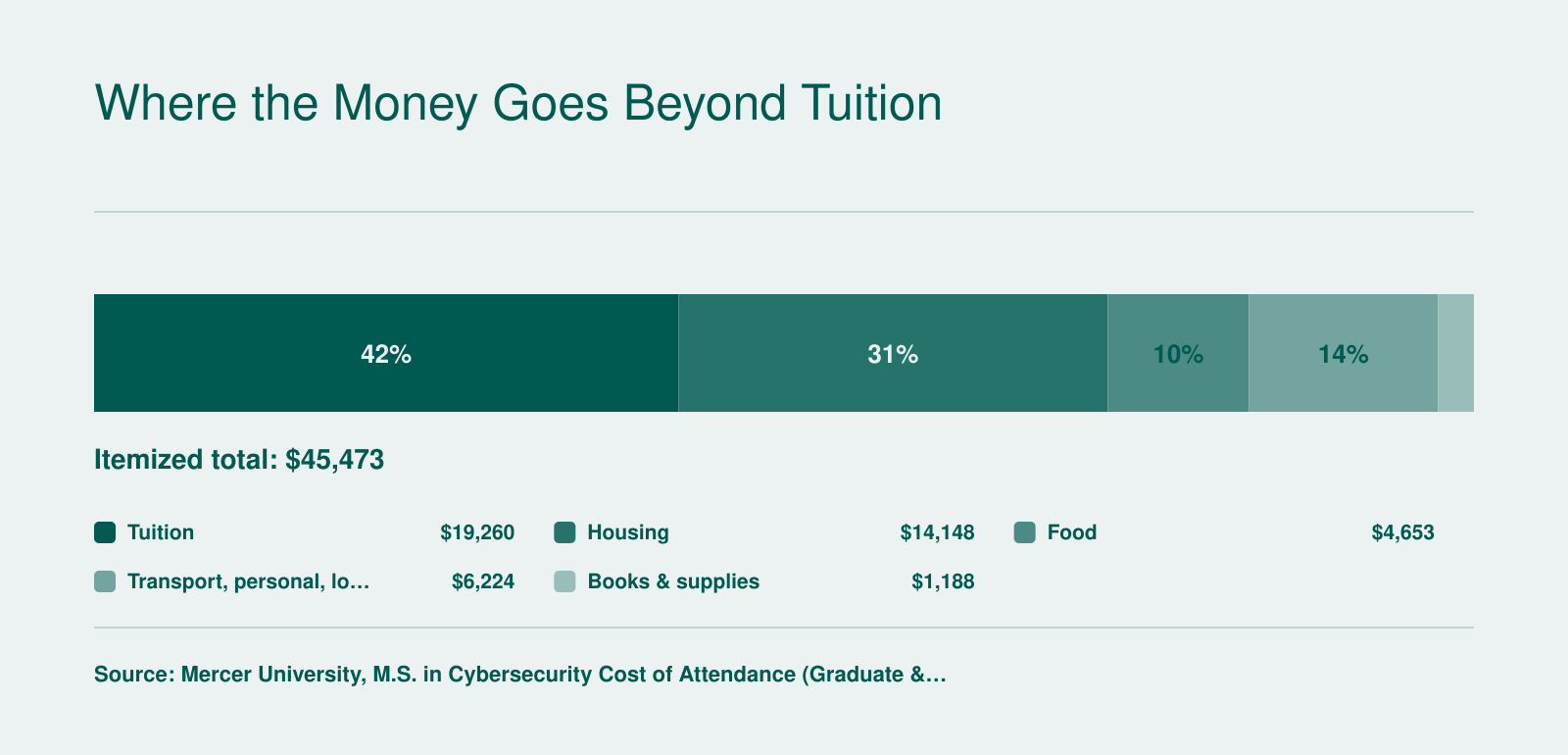
- Mercer's tuition is only about 42% of its itemized total budget for the 2026-2027 cybersecurity master's.
- Online formats vary widely: Middlebury and Shenandoah require no live attendance, while other programs schedule weekly sessions or campus residencies.
Best Master's in Cybersecurity Schools: 2027 Rankings
These ten cybersecurity master's programs hold up under scrutiny of graduate earnings, debt, and school completion records, not just reputation. Use the cards to compare tuition, delivery format, and program focus side by side before narrowing your list.
Columbia University in the City of New York
#1New York, NY · ~$58,000/yr (est.)
Best for: Research-minded students seeking urban lab connections
Columbia's MS in Computer Science offers a Computer Security pathway inside a rigorous graduate program. Students complete 30 points with most courses at the 4000 level or above, plus at least 6 points of advanced 6000-level technical work. A faculty pathway advisor guides course selection, and research opportunities with labs are encouraged.
- 10 concentration options, including computer security
- 30 credit hours required
- 2.7 GPA minimum to remain in good standing
- Courses at 4000 level or above; 6 points of 6000-level technical work
- Faculty pathway advisor and research lab options
- Dual MS with Journalism available
Georgia Institute of Technology
#2Atlanta, GA · ~$16,000/yr (est.)
Best for: Working professionals seeking flexible online cybersecurity training
Georgia Tech's Master of Science in Cybersecurity gives students deep technical training in information security. The program sits in the College of Computing and the School of Cybersecurity and Privacy, known for prolific cybersecurity research. Graduates prepare for roles such as security analyst, network defender, and privacy engineer.
- Fully online option available
- Housed in the School of Cybersecurity and Privacy
- Covers applied cryptography, network security, and secure systems
- First U.S. college of computing
- Leading cybersecurity research environment
University of California-Davis
#3Davis, CA · $15,000 – $20,000/yr (est.)
Best for: Campus-focused students seeking California research connections
UC Davis offers a Master of Science in Computer Science with a concentration in Computer and Information Security. Admission requires a bachelor's degree, a 3.0 GPA, and three recommendation letters, and does not require the GRE. Students complete 30 to 36 units with thesis, project, or exam options.
- Campus-based program with security concentration
- Admission requires 3.0 GPA and three recommendation letters
- GRE scores not required
- TOEFL 80 or IELTS 7.0 for international applicants
- 30 to 36 units depending on thesis, project, or exam plan
Carnegie Mellon University
#4Pittsburgh, PA · ~$51,000/yr (est.)
Carnegie Mellon's Information Security & Assurance track builds cybersecurity leaders with an emphasis on risk management, cybersecurity, and data privacy. The part-time program runs six to eight semesters and welcomes both technical and non-technical professionals. Students gain exposure to practitioners from the CERT Division of CMU's Software Engineering Institute.
- Fully online, part-time program with fall, spring, and summer starts
- Complete in six to eight semesters while working full-time
- Exposure to CERT Division practitioners from the Software Engineering Institute
- Welcomes technical and non-technical professionals
- Focus on risk management, cybersecurity, and data privacy
Brown University
#5Providence, RI · $65,000 – $70,000/yr (est.)
Brown's Master of Science in Cybersecurity, computer science track, pairs technical security training with policy, legal, and economic context. It is a two-year, eight-course degree with fall and spring starts. The program is built for working professionals and includes applied projects and close faculty collaboration.
- Two-year, eight-course degree offered on campus or online
- No entrance exam required; TOEFL or IELTS for international applicants
- Synchronous and asynchronous online options
- Scholarships cover 50% or 25% of tuition
- Fifth-year path available for Brown undergraduates
- Applied projects, case studies, and simulations
Purdue University
#6West Lafayette, IN · ~$10,000/yr (est.)
Purdue offers two distinct master's paths in information security and cybersecurity. The Information Security MS is research-driven and interdisciplinary, working with the CERIAS research center and drawing coursework from at least three graduate programs. The Master of Science in Cybersecurity and Trusted Systems uses asynchronous 8-week modules, requires work experience, and can be completed in 12 to 24 months.
- 30 credit hours required
- 3.0 GPA minimum
- Thesis or capstone option
- Research-driven interdisciplinary program
- Partners with CERIAS research center
- Courses drawn from at least three graduate programs
- Fully online, asynchronous 8-week course modules
- $800 per credit; non-resident $825 per credit
- 30 total credit hours, complete in 12 to 24 months
- 4 concentration options
- Work experience required
- No thesis or capstone required
Johns Hopkins University
#7Baltimore, MD · ~$65,000/yr (est.)
Johns Hopkins University's Master of Science in Security Informatics is a full-time, three-semester flagship program in information security and assurance. It combines security informatics coursework with research and professional development. Students have 24/7 access to a state-of-the-art lab and can take course assistant or funded head TA roles.
- Full-time, three-semester program
- Flagship graduate program in information security and assurance
- 24/7 access to a state-of-the-art lab
- Course assistant and funded head TA positions
University of Southern California
#8Los Angeles, CA · ~$72,000/yr (est.)
USC Viterbi's Master of Science in Cyber Security Engineering is a 28-unit program concentrated on secure information systems, security policy, cryptography, and network operations. No thesis is required, though directed research is available. Admissions do not require the GRE for 2026.
- 28-unit program focused on secure information systems
- No thesis required; directed research available
- Covers security policy, cryptography, and network operations
- GRE not required for 2026
- Available online via DEN@Viterbi with same tuition as on-campus
Florida State University
#9Tallahassee, FL · ~$11,000/yr (est.)
Florida State offers an MS in Computer Science with a Cybersecurity major requiring 30 semester hours of graduate computer science courses. Students complete prerequisites in computer organization, data structures, and security fundamentals, and the curriculum includes core courses in computer security, cryptography, network security, and offensive security. The program awards a Cyber Security Major Certificate.
- 30 semester hours required
- Undergraduate prerequisites in computer organization and data structures
- Core courses in computer security, cryptography, and network security
- Cyber Security Major Certificate awarded
- No separate application to the general MS needed
Binghamton University
#10Vestal, NY · $10,000 – $15,000/yr (est.)
Binghamton University's MS in Information Systems with a Cybersecurity concentration trains students in networking, databases, software configuration, and data analytics. The program emphasizes the user and application side of information systems, including data mining and large-scale system building. Students can pursue internships on campus, around New York City, or out of state with career support from Watson Connections.
- Concentration in Cybersecurity within the MS in Information Systems
- Focus on systems integration, databases, and data mining
- Programming and scripting skills from basics to software testing
- Internships on campus, in NYC, or out of state
- Career coaching through Watson Career and Alumni Connections
Cost & outcomes by school
Federal data for the highest-earning Cybersecurity programs, independent of the ranking above. Earnings are this field's master's graduates four years after completing, where the Scorecard reports them.
| School | Earnings | Tuition / yr | Debt | Grads/yr | Format |
|---|---|---|---|---|---|
| Embry-Riddle Aeronautical University-Prescott AZ | $145,240 | $22,770 | — | 3 | Campus |
| Embry-Riddle Aeronautical University-Daytona Beach FL | $145,240 | $22,870 | — | 3 | Campus |
| Excelsior University NY | $144,427 | — | — | 60 | Online |
| University of San Diego CA | $137,533 | $31,240 | $48,077 | 39 | Hybrid |
| Champlain College VT | $134,853 | $10,710 | $35,971 | 45 | Online |
| University of Maryland Global Campus MD | $106,787 | $9,882 | $39,520 | 109 | Online |
| Kennesaw State University GA | — | $6,702 | — | 185 | Online |
| Nichols College MA | — | $1,200 | — | — | Online |
| Turtle Mountain College ND | — | $3,938 | — | — | Online |
| Columbia Southern University AL | — | $3,936 | — | — | Online |
| Middle Georgia State University GA | — | $4,534 | — | — | Online |
| Fort Hays State University KS | — | $4,949 | — | — | Online |
Sources: U.S. Department of Education. Tuition and graduates: IPEDS. Earnings and debt: College Scorecard, this field's master's graduates; a dash means no figure is reported.
Cost, debt & payoff
Median earnings of this field's master's graduates (4 yrs after completing) vs. their median federal loan debt · U.S. College Scorecard
Across these programs the median graduate earns about $89,165 and finishes with roughly $41,000 in debt — a ratio that clears a common rule of thumb (keep debt below first-year salary). Tuition and debt vary widely school to school, so check the per-school figures in the table above before you shortlist.
Inside Our Ranking Method: Outcomes Over Prestige
Outcomes predict whether a cybersecurity master's pays off far better than reputation does, so this ranking of Computers & IT Master's Programs rests on four measurable pillars instead of campus prestige.
The Four Pillars
- Program-level earnings: What graduates of the specific cybersecurity program earn after finishing, not what the university's alumni earn on average.
- Median federal debt: The typical federal loan balance a graduate carries at completion.
- Net price after aid: What students pay once grants and scholarships are subtracted from the sticker price.
- Completion and retention: How many students finish and how many return after their first year, a sign of whether a school keeps students on track.
Where the Numbers Come From
Earnings and debt come from the U.S. Department of Education's College Scorecard, which reports by field of study (CIP code) and credential level. That keeps master's-level results separate from bachelor's results. Tuition figures come from IPEDS. Everything reflects the most recent data release available as of October 2026.
What the Data Can't Tell You
Because the net price reflects the whole institution, your own cost will depend on your aid package and program. Completion and retention rates describe the whole school, not the cybersecurity program alone. When a small program has too few graduates to publish earnings, we say so instead of estimating.
Why Prestige Is Left Out
We skipped brand surveys and reputation scores on purpose. A cybersecurity hiring manager looks for demonstrated skills, hands-on lab experience, and credentials, not a campus rank. A lesser-known school with strong earnings and low debt can be a better value than a famous one, and a fair ranking should be able to show that.
Cybersecurity Master's Degree Cost and Financial Aid
Residency Can Double the Bill
Cal State San Bernardino charges California residents about $9,612 a year in graduate tuition for its cybersecurity master's, while nonresidents pay about $19,692. The same gap appears across the lowest-cost public options here:
- Purdue: about $9,992 in-state vs. $28,794 out-of-state
- Florida State: about $10,553 vs. $26,707
- Georgia Tech: about $15,962 vs. $32,144
- UW Tacoma: about $18,987 vs. $33,006
Purdue's nonresident rate is nearly triple its resident rate. If you live in the state, a public university is often the best value. If you don't, the math for an affordable online master's degree shifts quickly.
Net price figures, roughly $4,564 at CSUSB up to $14,600 at Purdue, are approximate institution-wide averages after grants, not quotes for your degree. Use them as a rough indicator.
Fees and Books Add Up
Per-credit rates leave out real costs. APUS's cybersecurity master's lists $470 per credit across 36 credits but adds a $1,020 technology fee. Capella's MS in Cybersecurity estimate of $35,280 for its 27-month program excludes books, supplies, and equipment, and the school lists a separate $175 resource kit. City University of Seattle budgets $176 per quarter for books and supplies1, and Saint Leo adds a $30 per-credit charge on top of $750 per credit2. Expect similar line items almost everywhere.
Funding Built for Cybersecurity
- CyberCorps Scholarship for Service: Graduate students receive a $37,000 annual stipend plus tuition and education-related fees for up to three years. Housing, meal plans, and parking are not covered. In return, you work for the federal government after graduation (or, with NSF approval, a state, local, tribal, or territorial government). You must be a U.S. citizen or permanent resident, study full-time at a participating university, and obtain a clearance if required. Participating schools hold NSF awards and overlap heavily with NSA CAE-designated programs, so confirm a school's status first.3 Each sets its own bar: Binghamton requires a 3.3 graduate GPA and at least 1.5 years of remaining study4, and CSUSB asks for a 3.45.
- GI Bill and Yellow Ribbon: Veterans can apply GI Bill benefits, and Yellow Ribbon schools can help close the gap when tuition exceeds the benefit cap.
- Employer tuition assistance: If you already work in IT or security, ask HR before applying. Some employers cover part of a master's, often with a service commitment.
Ask for the Full Budget
Before you compare offers, request each program's graduate cost-of-attendance budget, not just the per-credit rate. That document shows fees, books, and living costs side by side, which is the only fair way to compare two programs.
Where the Money Goes Beyond Tuition
Mercer University's published 2026-2027 budget for its M.S. in Cybersecurity assumes full-time study of 9 credits per semester over 9 months. Tuition is $19,260 (18 credits at $1,070), which is only about 42% of the itemized total. Mercer lists no separate technology fee line, but at schools that bill one, mandatory and technology fees can add a meaningful percentage on top of tuition. The lines shown here add up to $45,473, while Mercer's published estimate is $45,773.
Related Articles
Admissions: GRE Waivers, Work Experience, and Prerequisites
Requirements vary by school and sometimes by track within one school. Georgia Tech and UMGC are the clearest published examples. Confirm current terms with each admissions office before you apply.
- Bachelor's degree and GPAGeorgia Tech's online program sets a 3.0/4.0 minimum, while its School of Cybersecurity describes 3.3 as desirable, with most admitted students higher. UMGC accepts a bachelor's from a regionally accredited institution. Neither source describes conditional admission, so ask directly if your GPA falls short.
- GRE policyGeorgia Tech's online program does not require the GRE or GMAT. The School of Cybersecurity calls scores optional but strongly encouraged, so check your specific track. UMGC's published sources don't state a GRE rule.
- Work experienceGeorgia Tech emphasizes academic preparation and programming, not a minimum number of years in IT or security. UMGC sets no required minimum in the sources reviewed.
- PrerequisitesGeorgia Tech expects a computer science or computer engineering bachelor's, plus discrete math, algorithms, operating systems, networks, and computer architecture. Career changers should ask about bridge coursework, which these sources don't describe. UMGC lists no program-specific prerequisites.
- Fall 2027 deadlinesGeorgia Tech's online program lists February 1, 2027, with a final date of March 15, 2027. Information Security is February 17, Cybersecurity Policy is March 15, and Cyber-Physical Systems is December 16, 2026. UMGC's Fall 2027 deadline isn't established, so confirm it with the school.
Online vs. Campus Cybersecurity Master's: Labs, Live Classes, and Residencies
Online cybersecurity master's programs are not all built the same way. Some, like Middlebury and Shenandoah, ask for no live attendance at all, while others schedule weekly virtual sessions or require time on campus. Many of the schools ranked here offer both online and campus formats, so you can usually choose the delivery style without changing schools.
| Factor | Online Formats (Examples) | Campus or Hybrid Formats (Examples) |
|---|---|---|
| Live class requirements | Fully asynchronous at Middlebury Institute (weekly deliverables, no live meetings) and Shenandoah (no mandatory live sessions). East Coast Cyber University adds weekly live virtual sessions. | Excelsior's hybrid option requires a three-hour in-person session every other week per course. |
| Mix of live and self-paced | Metropolitan State University of Denver offers both asynchronous courses and live virtual courses. MIU City University Miami uses live and recorded classes. | Metropolitan State University of Denver also offers hybrid in-person and hyflex options. |
| Hands-on lab access | Virtual labs at Southern New Hampshire University, Nova Southeastern (realistic hands-on scenarios), and University of Tulsa. East Coast Cyber University gives 24/7 virtual-lab access. | Nova Southeastern lets online students reach its cybersecurity-complex capabilities virtually, so campus labs are not the only route. |
| Required residencies | Georgia Tech's online program and Middlebury's curriculum do not identify an on-campus residency. | Houston Christian's low-residency option requires one Friday-Saturday weekend on campus for each course. Its fully online option is separate. |
| Pacing and flexibility | Southern New Hampshire University offers 24/7 coursework access with no set class times. Georgia Tech is primarily asynchronous, with possible synchronous office hours or group meetings. | Scheduled sessions, such as Excelsior's biweekly meetings at its St. Petersburg, Florida, site, fix part of your calendar. They offer more structure but less freedom. |
| Networking and instructor access | Contact comes through virtual meetings with instructors (University of Tulsa), live virtual sessions, and office hours. Recruiting relationships are built remotely. | In-person sessions and residency weekends put you face to face with faculty and classmates, which can help local networking and recruiting. |
| Cost and logistics | No relocation or commuting. Compare per-credit tuition and fees directly, since the delivery format alone does not determine price. | Travel, lodging, and time away from work for residencies or biweekly on-site sessions add costs beyond tuition. |
Earnings vs. Debt: Where the Payoff Is Strongest
Strong return here pairs first-year program earnings with the school's median federal debt at completion. The ROI ratio shown is an institution-level proxy, school-wide 10-year earnings divided by median graduate debt, and not a program-specific result. A practical affordability check is whether early-career earnings can comfortably cover a 10-year federal loan payment; that monthly burden matters more than the sticker loan size because it competes directly with rent and other living costs.
| School | Program | Program-level median earnings 1 year after completion | Program-level median earnings 4 years after completion | Median federal debt at completion | Share employed 1 year after completion | Institution-level ROI ratio (10-year earnings vs. graduate debt) |
|---|---|---|---|---|---|---|
| Johns Hopkins University | Master of Science in Security Informatics | $119,420 | $148,833 | $10,250 | 97% | 8.5x |
| Brown University | Master of Science in Cybersecurity | N/A | N/A | $11,428 | N/A | 8.2x |
| University of California-Davis | Master of Science in Computer Science | $65,299 | $84,479 | $13,000 | 100% | 6.2x |
Cybersecurity programs by state
Quick Answers Before You Compare Programs
These are the three questions prospective students ask most often when weighing a cybersecurity master's against cost and career goals. The answers draw on hiring surveys and job-posting analyses, which vary in method, so treat percentages as directional.
Do employers take an online master's in cybersecurity as seriously as a campus degree?
What jobs can a master's degree in cybersecurity lead to?
Is a cybersecurity master's worth it if you already hold certifications like CISSP or Security+?
Compare Cybersecurity programs on the data that matters
Explore more Computers & IT specializations or browse every graduate field.
All Computers & IT programs