Best Master's in Cybersecurity Programs in Ohio
Compare 14 accredited Cybersecurity programs in Ohio at 12 schools, with graduate earnings, cost, debt, and completion data from IPEDS and the U.S. College Scorecard.

Tiffin University's online Master of Science in Cyber Security runs 33 credits in about 12 months, while Wright State University gives students up to six years to finish. That spread captures the real question behind which Ohio colleges offer a master's in cybersecurity: how much time and money each asks.
Formats range from online to campus-based, and tuition runs from $11,015 at Cedarville University to $29,426 for nonresidents at the University of Toledo. Residency, not reputation, often sets the price.
Key Points
- Median federal debt at graduation runs from $20,836 at Franklin University to $27,000 at Tiffin University.
- CyberSeek counted roughly 13,405 Ohio cybersecurity job openings in 2025, which supports a master's for career changers.
- The University of Toledo shows the widest residency gap, $11,821 between in-state and out-of-state tuition.
Ranked: The Best Cybersecurity Master's Degrees in Ohio
Seven Ohio schools offer the nine cybersecurity master's listings below, spanning online, hybrid, and campus formats. Several hold National Security Agency and Department of Homeland Security Centers of Academic Excellence designations, though those usually apply to the institution rather than to one specific master's degree. Confirm the current status of any designation with the school before you apply.
Cedarville University
#1Cedarville, OH · ~$11,000/yr (est.)
Best for: Working managers pivoting into security leadership
Cedarville University's listing is an online MBA with a Cybersecurity Management concentration, so it suits business-minded students more than hands-on technical specialists. The school's overall graduation rate is 72.5%, the highest among the Ohio schools listed here. The program is built around seven-week terms, part-time or full-time pacing, and four cybersecurity courses on law, architecture, and risk. The university holds a CAE in Cyber Defense designation running from 2021 to 2026, but renewal is not confirmed and the MBA itself is not established as the validated program.
- Online MBA with a Cybersecurity Management concentration
- Seven-week terms with part-time or full-time options
- Four cybersecurity courses plus core business coursework
- Covers cybersecurity law, enterprise security architecture, and risk management
- Start dates in August, October, January, March, May, and July
- Program accredited by ACBSP
- Completion options of one or two years
The University of Findlay
#2Findlay, OH · $15,000 – $20,000/yr (est.)
Best for: Students wanting online or on-campus flexibility
The University of Findlay offers a Master of Science in Applied Security and Analytics that pairs cybersecurity with big data analytics and leadership. It can be taken online or on campus, with fall and spring starts and a two-year completion path. The school's overall graduation rate is 57.9%. We found no confirmed CAE designation for Findlay, so check the school directly if that credential matters to you.
- Two-year completion timeline with fall and spring starts
- Online and on-campus delivery options
- Courses in applied security, secure coding, and data mining
- Predictive analysis and project management in the curriculum
- Eligible for Choose Ohio First scholarship support
- Professional Science Master's affiliation
Tiffin University
#3Tiffin, OH · ~$17,000/yr (est.)
Best for: Professionals wanting AI-focused security coursework
Tiffin University's Master of Science in Cybersecurity is delivered fully online and targets working professionals. The listing describes a 30-credit program finished in about 12 months, with a capstone project and coursework in AI, network security, governance, risk, and compliance. Tiffin says it redesigned the degree for 2025, so verify current credit counts and tuition on its site. The school's overall graduation rate is 39.9%. It holds an institutional CAE in Cyber Defense designation for 2020 to 2031, though the master's itself is not established as the validated program.
- Fully online format
- Listed as 30 credits and 12 months (the degree was redesigned in 2025)
- Classes start six times per year
- Courses include AI, network security, and governance and compliance
- Capstone project applies skills to real-world challenges
- Bachelor's degree required for admission
University of Toledo
#4Toledo, OH · $18,000 – $29,000/yr (est.)
The University of Toledo runs its Master of Science in Cyber Security through the College of Engineering, with research and professional tracks. Students pick a thesis, project, or experiential capstone, with access to a cyber range and capstone lab. The school's overall graduation rate is 57.0%. It lists a lower in-state graduate rate than out-of-state, which matters if you are an Ohio resident comparing costs. Applicants without a computer science background may need foundational courses.
- 30 credit hours through the College of Engineering
- Thesis, project, or experiential capstone options
- Fall or spring start with no application deadline listed
- Most courses on campus, with some online offerings
- Cyber Range and capstone lab access
- Electives available in Law and Business colleges
- GRE required for some applicants
- Foundational courses may be needed without a CS background
Kent State University
#5Kent, OH · ~$12,000/yr (est.)
Kent State University offers a Master of Science in Computer Science with a Computer Security concentration, taught on campus. The curriculum covers cryptography, network security, and digital forensics, and students finish with a capstone or thesis. The school's overall graduation rate is 63.7%. Kent State holds a CAE in Cyber Defense designation for 2022 to 2027, but that designation is not established as applying to this master's specifically.
- Computer Security concentration within a computer science degree
- Courses in cryptography and network security
- Digital forensics coursework included
- Capstone project or thesis required
- Bachelor's degree required for admission
- Campus-based format
Wright State University
#6Dayton, OH · ~$16,000/yr (est.)
Wright State University in Dayton offers a 30-credit Master of Science in Cyber Security, with a CyberDefense concentration listed separately. Admission expects a computer science or related bachelor's degree and a 3.0 GPA, though exceptions are possible. The school's overall graduation rate is 41.7%. Some sessions may need live attendance, so confirm scheduling if you plan to study remotely. Wright State holds a CAE in Cyber Defense designation for 2020 to 2031.
- CyberDefense concentration track
- Project advisor committee required
- Project presentation and defense
- Fall application deadline March 1, spring deadline October 10
- 30 semester hours with 12 hours of core courses
- Project or thesis option
- Must be completed within six years
- Virtual Cyber Security Lab access
- 3.0 GPA expected for admission
- Computer science background preferred
Franklin University
#7Columbus, OH · ~$12,000/yr (est.)
Franklin University in Columbus offers a 36-semester-hour Master of Science in Cybersecurity, available online and onsite, with a business-focused and practical curriculum. The school's overall graduation rate is 11.1%, which reflects its adult-learner population rather than a typical first-time student body. Franklin is HLC-accredited and holds a CAE in Cyber Defense designation for 2019 to 2029. It also reports new graduate certificates in Cyber Defense and Cyber Governance, and a $0 domestic graduate application fee.
- 36 semester hours, online or onsite in Columbus
- Courses in cryptography, network security, and ethical hacking
- Includes information assurance and software security courses
- Capstone project required
- Prerequisite courses needed with a grade of C or better
- Some courses use proctored exams
- Certified Ethical Hacker exam preparation noted
Cost & outcomes by school
Federal data for the highest-earning Cybersecurity programs, independent of the ranking above. Earnings are this field's master's graduates four years after completing, where the Scorecard reports them.
| School | Earnings | Tuition / yr | Debt | Grads/yr | Format |
|---|---|---|---|---|---|
| Bowling Green State University OH | — | $10,291 | — | — | Campus |
| Cedarville University OH | — | $11,015 | — | — | Online |
| Franklin University OH | — | $12,090 | — | — | Online |
| Kent State University OH | — | $12,483 | — | — | Campus |
| Kent State University at Geauga OH | — | $13,057 | — | — | Campus |
| University of Cincinnati OH | — | $14,902 | — | — | Online or campus |
| Wright State University OH | — | $15,771 | — | — | Hybrid |
| University of Toledo OH | — | $17,605 | — | — | Hybrid |
| The University of Findlay OH | — | $18,706 | — | — | Hybrid |
| University of Dayton OH | — | $19,580 | — | — | Campus |
| Tiffin University OH | — | $17,000 | — | 13 | Online |
| University of Mount Union OH | — | $41,550 | — | — | Online |
Sources: U.S. Department of Education. Tuition and graduates: IPEDS. Earnings and debt: College Scorecard, this field's master's graduates; a dash means no figure is reported.
How We Weighed Ohio's Cybersecurity Master's Programs
Median federal debt at graduation across the Master's Programs in Ohio below runs from about $20,836 at Franklin University to $27,000 at Tiffin University, a spread that tells you more about value than any brochure will. So what actually makes one Ohio program a better bet than another? Five things shaped the order here:
- Graduate earnings: program-level pay figures from federal College Scorecard reporting, where they exist. Many Ohio cybersecurity master's programs are too small or too new to have published earnings yet, so this factor only moves the needle for the ones that do.
- Debt at completion: what the typical borrower owes when they finish.
- Net price and graduation rate: both are institution-wide averages covering all students, not cybersecurity-specific outcomes, so treat them as context rather than a verdict on the program itself.
- Completions: how many master's degrees in cybersecurity the program actually awards.
Campus, hybrid, and fully online programs compete on the same list.
CyberSeek (CompTIA/NICE/Lightcast) counted roughly 13,405 cybersecurity job openings in Ohio in 2025. For mid-career candidates, a master's can signal the advanced skills employers chasing that talent gap increasingly want.
Online and Hybrid Master's in Cybersecurity Options in Ohio: Live vs Self-Paced
The biggest day-to-day choice in Ohio's online cybersecurity programs is not whether you study online, but whether your courses run on a live schedule or let you move at your own pace. In the rankings data, Cedarville University, Tiffin University, and Franklin University list fully online cybersecurity master's programs, while The University of Findlay, the University of Toledo, and Wright State University appear as hybrid programs that mix online work with on-campus components. Kent State University's computer security concentration is campus-based.
Published delivery details are uneven. Franklin notes proctored exams in some courses, and Wright State highlights virtual lab access plus project presentation and defense requirements, which may demand planning around work hours. Tiffin's online program uses a capstone project, and Cedarville's online MBA in cybersecurity management follows seven-week cohort terms rather than a fully self-paced calendar. Before enrolling, confirm whether scheduled live sessions are required.
In practice, asynchronous coursework fits shift workers and parents who need to study outside standard hours. Live or cohort-based formats trade that flexibility for more real-time faculty contact and networking.
Related Articles
Which Ohio Cybersecurity Master's Programs Waive or Make the GRE Optional
Do Ohio's cybersecurity master's programs still require the GRE? Policy is set program by program, so a university-wide statement about graduate testing does not tell you what a specific Cybersecurity master's program with no GRE required expects.1
We could not confirm a published GRE rule, deadline, or transfer-credit cap for the master's in cybersecurity at Cedarville University, The University of Findlay, Tiffin University, University of Toledo, Kent State University, Wright State University, or Franklin University. Where an admissions page states no policy, do not assume a waiver. Ask the admissions office and get the answer in writing.
What to check before you apply
- GRE status: Look for "required," "optional," or "waived," and any waiver criteria such as a minimum undergraduate GPA or professional work experience.
- Deadlines: Confirm whether the program uses rolling admission or fixed dates, and which terms it admits.
- Transfer credit: Ask for the maximum graduate credits accepted, since transfer credit can shorten your timeline for Accelerated Master's in Cybersecurity Programs and lower your total cost.
Compare all three items for each school before you commit to a shortlist.
What a Master's in Cybersecurity Costs in Ohio, Plus Licensure and Certification Notes
Residency decides whether a public school is a bargain or a stretch, and for out-of-state readers the cheapest option is often a private online program, a pattern reflected in the Most Affordable Master's in Cybersecurity Programs list. Listed program tuition runs from $11,015 at Cedarville University (its online MBA in Cybersecurity Management) to $18,706 at The University of Findlay for the in-state or flat rate. Franklin University follows Cedarville at $12,090.
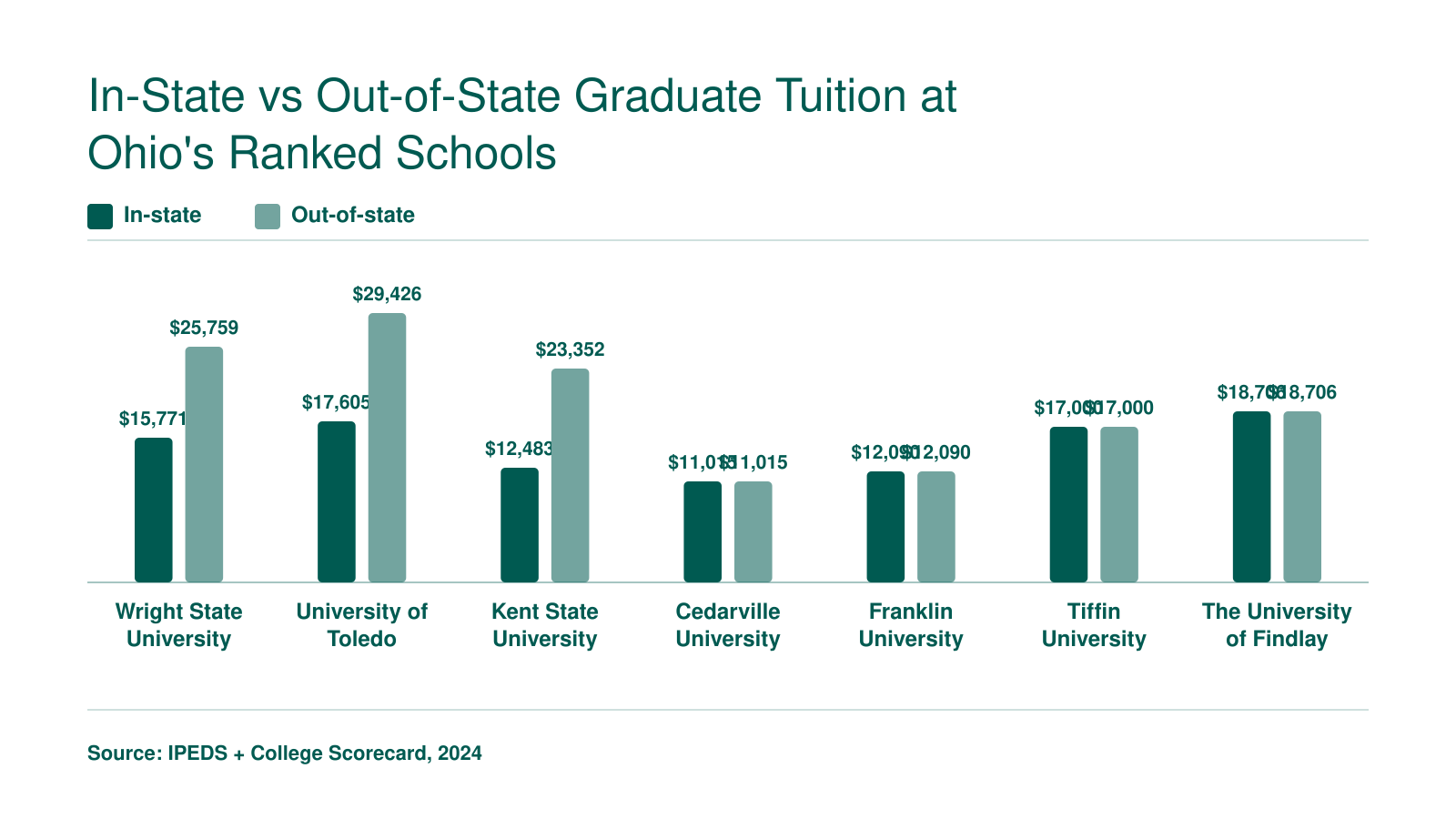
The public schools split by residency. Kent State University lists $12,483 in-state and $23,352 out-of-state. Wright State University lists $15,771 and $25,759. University of Toledo lists $17,605 and $29,426, the widest gap here at roughly $11,800 and the highest out-of-state figure. Cedarville, Franklin, Tiffin University and Findlay charge one rate regardless of residency, so out-of-state students pay no premium there. Verify fees and credit hours on each bursar page, since these figures are program tuition and not a full bill.
Treat institution-wide net price as a rough average, not a program quote. Examples include about $20,787 at Kent State and $24,468 at Cedarville.
Licensure and certification
Ohio has no state license for cybersecurity practitioners. Employers screen for industry credentials such as Security+ and CISSP instead. Franklin notes Certified Ethical Hacker exam prep in its program.
In-State vs Out-of-State Graduate Tuition at Ohio's Ranked Schools
These bars show annual published graduate tuition and fees, not net price, so they reflect the sticker cost before any aid. The University of Toledo has the widest residency gap, at $11,821 between in-state and out-of-state rates. Cedarville University, Franklin University, Tiffin University, and The University of Findlay charge the same figure to every student.
Certifications a Cybersecurity Master's Prepares You for, and Ohio's Job Market
Which certifications does a master's actually help you sit for? Coursework usually maps to four: CompTIA Security+ (entry-level network and risk fundamentals), CISSP (broad security management, though it requires five years of paid experience on top of the exam), CISM (governance and program leadership), and CEH (offensive testing). Franklin University's program names Certified Ethical Hacker preparation outright and carries an ethical hacking course; Cedarville's cybersecurity management concentration, with risk management and enterprise security architecture courses, leans toward the CISM and CISSP end. None of the schools here publishes an exam voucher bundle at the master's level, so budget separately for test fees.
Ohio's demand is concentrated in Columbus, Cleveland, Cincinnati, and Dayton across financial services, insurance, healthcare, defense contracting, retail, and government. JPMorgan Chase runs a Columbus digital security division of roughly 1,000 people, while Dayton work clusters around Wright-Patterson AFB and the Air Force Research Laboratory. State cybersecurity employment grew 312.8 percent from 2010 to 2025, outpacing the national 240.8 percent, though posted openings fell from a 2022 peak of 18,993 to 13,405 in 2025.
In Ohio, the real trade-off is residency against flexibility: a public campus program can reward in-state tuition, while a flexible online master's lets you keep working wherever you live.
Cybersecurity Master's in Ohio: Your Remaining Questions
Can international students on an F-1 visa enroll in an Ohio cybersecurity master's, and does the program need to be on campus?
Is a cybersecurity graduate certificate in Ohio a cheaper stepping stone to a full master's?
Can an F-1 student switch programs or earn a second master's after starting in Ohio?
Compare Cybersecurity programs on the data that matters
Explore more Computers & IT specializations or browse every graduate field.
All Computers & IT programs