Master's in Cybersecurity Programs With No GRE Required
Compare 440+ accredited no-gre Cybersecurity programs at 380+ schools, with graduate earnings, cost, debt, and completion data from IPEDS and the U.S. College Scorecard.

Preparing for the GRE can eat months a working professional would rather spend on coursework. Many cybersecurity master's programs now waive it, drop it, or make it optional, though the wording differs by school.
Cost spreads far wider than admissions rules do. American Public University System charges $470 per credit online, while the University of Denver lists $41,232 to $51,540 in tuition for an in-person program that also skips the GRE.
For most working adults, price and format matter more than the test.
Key Points
- American Public University System charges $470 per credit, near $16,900 total.
- Most 2027 no-GRE cybersecurity master's programs are fully online and asynchronous.
- No GRE does not equal open admission; verify accreditation and NSA CAE-CD.
Top 10 Cybersecurity Master's Programs With No GRE Requirement
Applying to a cybersecurity master's program no longer has to feel like a standardized test gauntlet. The schools below offer no-GRE or test-optional admission across online, hybrid, and campus formats. Each short profile highlights the credential, concentration options, and practical strengths that matter most when comparing programs.
University of Massachusetts-Lowell
#1Lowell, MA · ~$16,000/yr (est.)
Best for: Online learners seeking security-studies context
UMass Lowell blends cybersecurity with security studies, making it a fit for learners who want technical cyber skills alongside policy, intelligence, and criminal justice context. The online master's program is designed to be completed in as little as 18 months, and its cybersecurity concentration includes network security, digital forensics, and intelligence analysis. A second path, a master's in computer science with a cybersecurity option, is available for students seeking a more technical foundation.
- 10-course, 30-credit online program
- Combines criminal justice and IT
- Covers network security, digital forensics, intelligence analysis
- No GRE required
- Can be completed in as little as 18 months
- Tuition of $610 per credit
- Requires bachelor's degree, 3.0 GPA, statement, two recommendations
- National Center of Academic Excellence designation
- 30-credit degree with cybersecurity option
- No GRE required
- On-campus delivery with part-time or full-time study
- Optional master's thesis
- STEM-OPT eligible
- Requires statement of purpose and two recommendation letters
- Bachelor's-to-master's pathway available
West Virginia University
#2Morgantown, WV · ~$11,000/yr (est.)
Best for: Professionals targeting cybersecurity management roles
West Virginia University's business cybersecurity management master's is built for professionals who want to lead security programs rather than only manage technical controls. The online program uses 8-week terms and can be finished in one to two years. No GMAT or GRE is required, and the AACSB-accredited business school pairs security coursework with hands-on projects and CISSP preparation.
- 30 credits across 10 courses
- $1,043 per credit hour
- One to two years with 8-week terms
- No GMAT or GRE required
- Bachelor's degree with minimum 2.75 GPA
- Hands-on projects and CISSP preparation
- Offered by AACSB-accredited John Chambers College of Business
Pace University
#3New York, NY · $30,000 – $35,000/yr (est.)
Best for: STEM-focused online learners choosing concentrations
Pace University's online cybersecurity master's is STEM-designated and structured for working professionals who want to move quickly. The program can be completed in as little as one year full-time or two years part-time, and no GMAT or GRE is required. Students choose between cyber operations and cybersecurity leadership concentrations, with a general track also available, and the curriculum aligns with NSA standards through a National Center of Academic Excellence designation.
- 30 credit hours, 100% online
- No GMAT or GRE required
- Cyber Operations or Cybersecurity Leadership concentration
- General track also available
- STEM-designated; National Center of Academic Excellence
- Finish in 1 year full-time or 2 years part-time
- Prerequisites in statistics, coding, data communications
- 3.0 GPA preferred; holistic admission review
University of North Dakota
#4Grand Forks, ND · ~$14,000/yr (est.)
The University of North Dakota's cybersecurity master's is a fully online, ABET-accredited program with a mandatory cyber security analyst concentration and optional certificate tracks in ethical hacking, computer forensics, and secure networks. No GRE or GMAT is required, and asynchronous courses let working students move at their own pace. The program is designed to be completed in about two years.
- 36 credit hours, fully online
- No GRE or GMAT required
- Mandatory Cyber Security Analyst concentration
- Optional tracks in Ethical Hacking, Computer Forensics, Secure Networks
- ABET-accredited
- National Center of Academic Excellence
- Asynchronous classes; fall, spring, summer starts
- Estimated two-year completion
American Public University System
#5Charles Town, WV · $5,000 – $10,000/yr (est.)
American Public University's cybersecurity studies master's takes a policy and criminal justice perspective on digital crime, covering intrusion prevention, threat detection, incident response, and the legal and ethical questions that shape security. The 36-credit online program is test optional with no entrance exam required, and rolling admissions with 12 start dates a year fit demanding schedules. Graduates typically move into information security management, consulting, or analyst roles.
- 36 credit hours
- No GRE or GMAT required
- $470 per credit
- Rolling admissions; 12 start dates per year
- Asynchronous online classes; 8- to 16-week terms
- NSA/DHS National Center of Academic Excellence in Cyber Defense
- Capstone: research paper or hands-on project
- Transfer up to 15 credits
University of New Haven
#6West Haven, CT · ~$20,000/yr (est.)
The University of New Haven's cybersecurity master's is a STEM-designated, on-campus program with a general concentration that blends required core courses with electives in risk management, incident detection, memory forensics, reverse engineering, and enterprise network administration. GRE scores are optional for graduates of regionally accredited U.S. colleges, though international scholarship applicants may need to submit them. Students without a computing background can add up to 12 prerequisite credits.
- 30 credit hours, STEM-designated
- GRE optional for U.S. regionally accredited graduates
- 6 required credits; 9 cybersecurity electives; 15 program electives
- Covers risk management, incident response, memory forensics, reverse engineering
- Project requirement included in electives
- Up to 12 prerequisite credits for computing gaps
- Upsilon Pi Epsilon honor society chapter
- Thesis or capstone option
University of Baltimore
#7Baltimore, MD · $17,000 – $23,000/yr (est.)
The University of Baltimore's user-centered cybersecurity master's stands out by applying psychological and cognitive principles to secure, usable interfaces, with coursework built around diary studies and usability tests. The 30-credit STEM program requires no entrance exam, offers a fully online option, and covers GDPR and CCPA compliance. Admission requires a 3.0 GPA, two recommendation letters, a resume or CV, and a statement of personal interest.
- 30 credit hours, STEM-designated
- No entrance exam required; test optional
- Fully online option available
- Focus on secure, usable interfaces; diary studies and usability tests
- Covers GDPR and CCPA standards
- 3.0 GPA minimum; two recommendations; resume/CV; statement
- $50 application fee
- Prepares for information security analyst and UX designer roles
University of Colorado Denver/Anschutz Medical Campus
#8Denver, CO · $5,000 – $10,000/yr (est.)
CU Denver's cybersecurity and information assurance master's combines information systems security, ethical hacking, digital forensics, IT governance, cloud security, networking, and Python in a 30-credit curriculum. GMAT and GRE scores are optional, and students can choose fully online asynchronous courses or hybrid evening classes that meet once weekly. The program carries a CAE-CD designated curriculum and includes a Design Science Practicum or internship.
- 30 credit hours
- No entrance exam required; GMAT/GRE optional
- Fully online asynchronous or hybrid evening classes
- Covers ethical hacking, digital forensics, cloud security, Python
- CAE-CD designated curriculum
- 8-week sessions; fall, spring, summer starts
- 3.0 GPA minimum; $50 domestic application fee
- Design Science Practicum or internship option
Davenport University
#9Grand Rapids, MI · ~$20,000/yr (est.)
Davenport University's information assurance-cybersecurity master's blends technology and management in a 31-credit curriculum that covers risk management, legal and ethical issues, and data protection. No GRE or GMAT is required, and the program is available online and on campus in Grand Rapids. It aligns with CISSP certification, offers possible full-tuition DoD scholarships, and can be finished in under two years.
- 31 credit hours
- No GRE or GMAT required
- Online and on-campus delivery
- Full-tuition DoD scholarships may be available
- CAE CDE designated school
- CISSP certification preparation
- Prerequisites in information security, cryptography, data communications, statistics
- Finish in under two years
University of Denver
#10Denver, CO · ~$42,000/yr (est.)
The University of Denver's on-campus cybersecurity master's is a 24-month program requiring 48-60 credits, with no GRE or GMAT required. Foundational courses support students without a computer science background, and the curriculum includes hands-on projects and a capstone. The program is reported to hold NSA accreditation and aligns with industry certifications.
- 48-60 credit hours
- No GRE or GMAT required
- On-campus, 24 months
- Tuition $41,232 - $51,540
- Bachelor's degree with minimum 2.5 GPA
- Foundational courses for non-CS backgrounds
- Capstone and hands-on projects
- NSA accreditation reported
Cost & outcomes by school
Federal data for the highest-earning Cybersecurity programs, independent of the ranking above. Earnings are this field's master's graduates four years after completing, where the Scorecard reports them.
| School | Earnings | Tuition / yr | Debt | Grads/yr | Format |
|---|---|---|---|---|---|
| Champlain College VT | $134,853 | $10,710 | $35,971 | 45 | Online |
| Middle Georgia State University GA | — | $4,534 | — | — | Online |
| University of the Potomac-Washington DC Campus DC | — | $5,850 | — | — | Online |
| University of the Potomac-VA Campus VA | — | $5,850 | — | — | Online |
| Georgia Southern University GA | — | $6,646 | — | — | Online or campus |
| Louisiana State University-Shreveport LA | — | $7,349 | — | — | Campus |
| University of Nevada-Las Vegas NV | — | $7,413 | — | — | Hybrid |
| Longwood University VA | — | $7,758 | — | — | Online |
| University of North Carolina at Charlotte NC | — | $8,037 | — | — | Campus |
Sources: U.S. Department of Education. Tuition and graduates: IPEDS. Earnings and debt: College Scorecard, this field's master's graduates; a dash means no figure is reported.
Cost, debt & payoff
Median earnings of this field's master's graduates (4 yrs after completing) vs. their median federal loan debt · U.S. College Scorecard
Across these programs the median graduate earns about $89,165 and finishes with roughly $41,000 in debt — a ratio that clears a common rule of thumb (keep debt below first-year salary). Tuition and debt vary widely school to school, so check the per-school figures in the table above before you shortlist.
No-GRE Admissions: What Cybersecurity Programs Actually Require
Admissions policies vary, but they cluster into a few clear patterns.
- Three GRE policy typesPrograms generally take one of three approaches: GRE not required, GRE optional, or GRE waivable with qualifying GPA or work experience. Schools like Pace, St. Bonaventure, Tulsa, and Hawai‘i Pacific do not require the GRE. Hilbert accepts optional score submission for extra consideration.
- Baseline application materialsExpect an accredited bachelor’s degree, a current resume, a statement of purpose, and letters of recommendation. Minimum GPA requirements vary; several programs target 3.0, while others prefer 3.0 without requiring it or evaluate applicants below 3.0 case by case.
- Technical prerequisites and bridge coursesNon-technical applicants often need foundation work in programming, networking, or related areas. Pace lists computational statistics, coding, and business data communications; Tulsa may require one or two introductory IT/CS courses; Kennesaw State offers modules in programming principles, computing infrastructure, and data communications. Hawai‘i Pacific requires no prerequisite courses to apply.
- Alternatives: certifications and work experienceSome programs accept IT certifications or relevant technical work experience in place of formal prerequisite coursework. University of Delaware, for instance, considers applicants with non-technical bachelor’s degrees if they have technical work experience or certifications.
Lowest-Cost No-GRE Cybersecurity Master's Options
These are the most affordable no-GRE options in this snapshot. American Public University System lists a flat $470 per-credit online rate across 36 credits, putting estimated total tuition near $16,900 for any residency. University of Illinois Springfield publishes $550 per credit for 30 credits and a $16,500 total. University of Michigan-Dearborn lists a 30-credit program but does not publish a flat per-credit rate. The public programs show separate in-state and out-of-state tuition, so verify the online rate before applying. Net price figures below are institution-wide averages after aid, not a quote for an individual student.
| School | Program | Delivery | Per-credit tuition | Required credits | Net price after aid |
|---|---|---|---|---|---|
| University of Michigan-Dearborn | Cybersecurity and Information Assurance, MS | Hybrid | N/A | 30 | $9,492 |
| American Public University System | Master of Science in Cybersecurity Studies | Online | $470 | 36 | $9,597 |
| University of Illinois Springfield | Master of Science Cybersecurity Management | Online | $550 | 30 | $9,833 |
Related Articles
Online vs. Campus: Live Classes, Self-Paced Courses, and Residencies
Most no-GRE cybersecurity master's programs are designed for working professionals, but "online" does not always mean self-paced, and a few still require in-person commitments. Most of the programs below are fully online master's in cybersecurity with asynchronous coursework as the default. At schools like the University of North Dakota, Pace University, and American Public University System, recorded lectures, virtual labs, and discussion boards let you complete work around 12-hour shifts in a security operations center. Live virtual meetings are not universal, so verify whether attendance is tracked. Duke is an exception: it blends live and recorded classes and requires an on-campus residency.
Hidden In-Person Demands
Fully online rarely means zero obligations beyond the screen. Some programs require proctored exams through a webcam or approved testing center, and several gate graduation behind capstone presentations, practicums, or internships that must be completed at an approved site. Check the program handbook for residency, exam, and capstone rules before you apply.
Typical Timelines
Most programs run 30 to 36 credits and wrap up in about two years full time. Accelerated master's in cybersecurity programs like Pace's 12-month track and AMU's roughly 12-month route exist, while part-time students commonly need two to three years, and sequential curriculums can stretch longer.
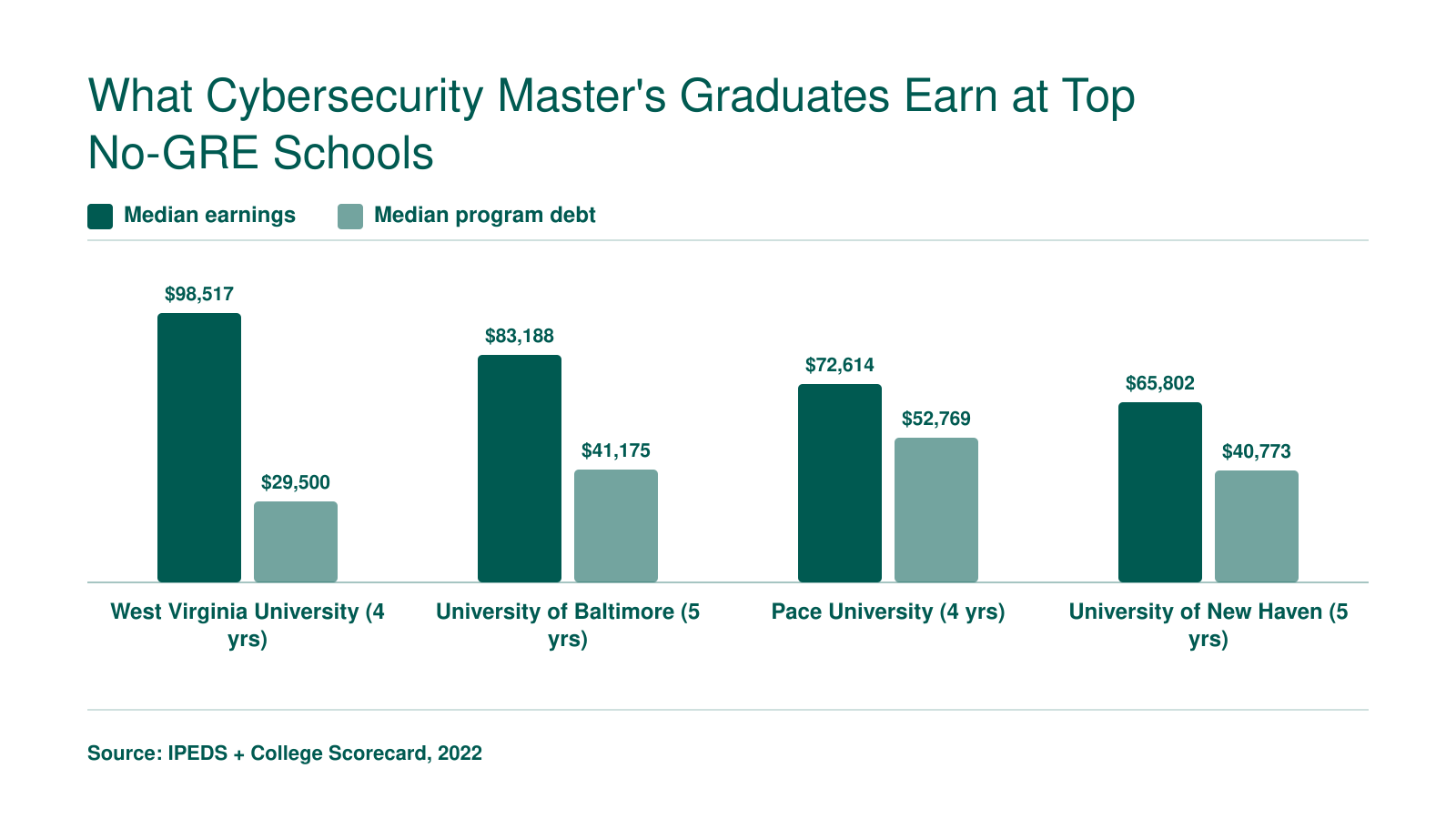
What Cybersecurity Master's Graduates Earn at Top No-GRE Schools
Median earnings come from each program's reported time window, either four or five years after finishing. Median program debt is shown alongside for context.
Concentrations and the Certifications They Prepare You For
A concentration is a set of electives that steers you toward a job path, and in cybersecurity each path tends to line up with a different industry certification. Digital forensics and network defense lead to incident response and analyst roles. Cloud security leads to architecture work. Governance, risk and compliance (GRC) leads to audit and management.
Certification support varies widely. Columbia College maps each course to at least one exam, including Security+, CISM and CISSP1, though its materials don't establish included vouchers. WGU includes (ISC)² CC, CySA+ and PenTest+ at no cost, offers optional CISM and SecurityX vouchers, and lists no CISSP or Security+ voucher for 20262. Maryville's technical emphasis prepares for CEH, CCSP, ECES and Splunk, while its business/leadership emphasis points to Security+, CISA and CySA+3. SANS pairs courses with GIAC exams, such as SEC504 with GCIH4.
If you want to manage, look for GRC and CISM alignment, as at Columbia's Cybersecurity Management track or WGU. If you want hands-on technical work, favor GIAC pairings and lab-heavy tracks like SANS.
The 2024 ISC2 Cybersecurity Workforce Study estimated a global gap of about 4.76 million unfilled cybersecurity positions. Demand that large is one reason many employers weigh skills and credentials heavily, and why some master's programs have dropped the GRE.
Cybersecurity programs by state
No-GRE Cybersecurity Master's FAQs
Do you need the GRE for a cybersecurity master's degree?
Can you get a cybersecurity master's without a technical background?
Is an online no-GRE cybersecurity master's worth it?
When are application deadlines and start dates for the 2026-2027 cycle?
Compare Cybersecurity programs on the data that matters
Explore more Computers & IT specializations or browse every graduate field.
All Computers & IT programs