Best Master's in Cybersecurity Programs in South Carolina
Compare 7 accredited Cybersecurity programs in South Carolina, with graduate earnings, cost, debt, and completion data from IPEDS and the U.S. College Scorecard.
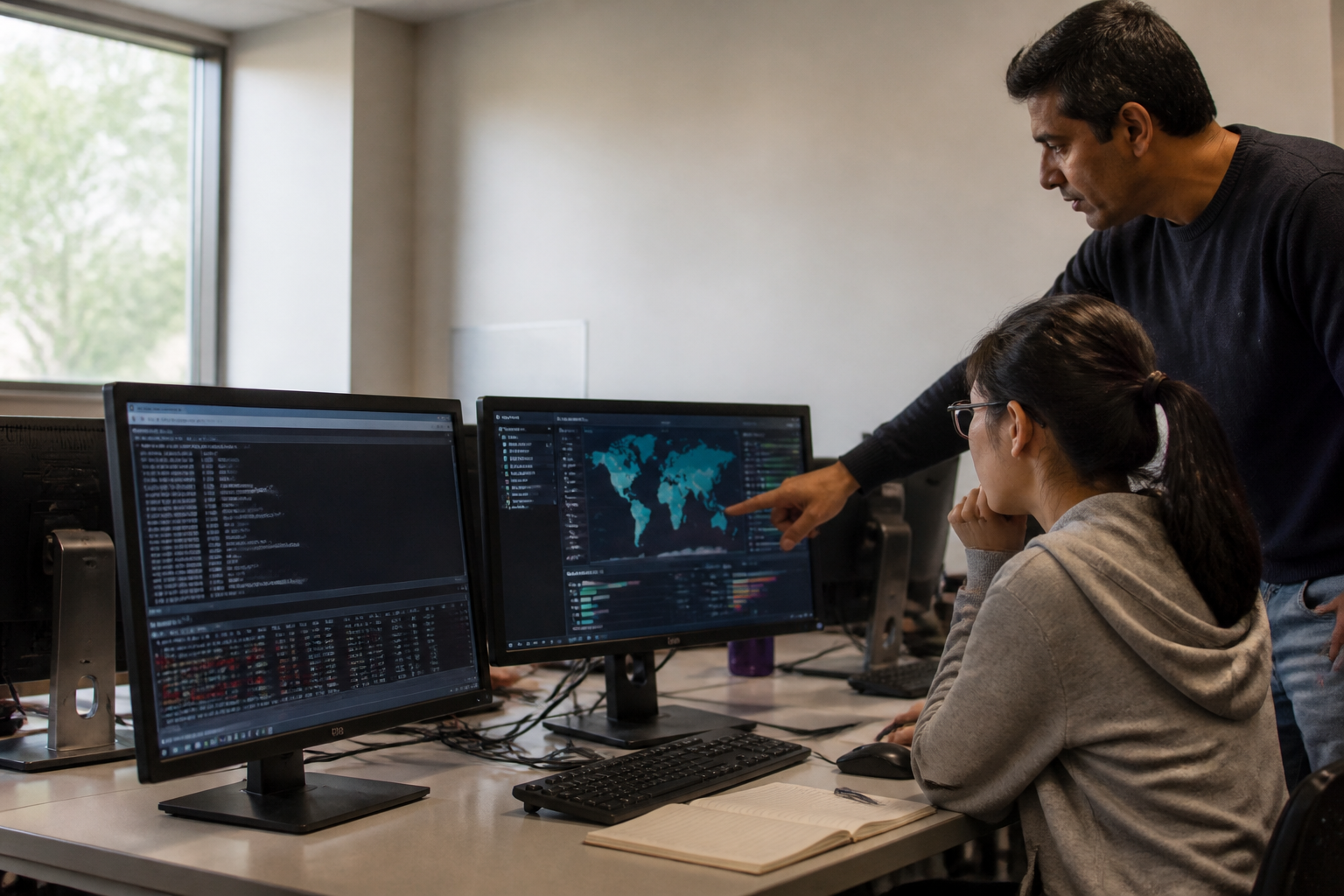
South Carolina's military installations, defense contractors, and federal cyber operations create steady demand for trained security professionals. Programs here run from roughly 30 to 45 credit hours, and formats range from a campus in Conway to fully online.
The ranking puts campus, hybrid, and online master's programs side by side, because format, GRE policy, cost, and technical versus management focus vary more than degree titles suggest, a pattern seen across master's in management information systems in South Carolina.
In defense-sector hiring, hands-on skill and clearance eligibility often count for as much as the diploma.
Key Points
- Claflin University's cybersecurity master's is fully online.
- Anderson University's cyber leadership master's includes Fusion Cyber's virtual range.
- The 2027 rankings weigh graduate earnings, debt, and net price.
Best Master's in Cybersecurity Schools in South Carolina: 2027 Rankings
South Carolina's cybersecurity master's programs span campus, online, and hybrid formats, with options ranging from management-focused degrees to deeply technical security concentrations. The rankings below prioritize verifiable graduate outcomes and affordability, while the program details highlight each school's curriculum and delivery.
Anderson University
#1Anderson, SC · ~$14,000/yr (est.)
Best for: Cybersecurity managers seeking hybrid executive format
Anderson University's Master of Science in Cybersecurity is a 31-credit hybrid built for working professionals, with primarily online coursework and one seated intensive each semester. The STEM-focused, I-17 approved program blends cybersecurity technology, cloud data security, and business courses in finance, ethics, and leadership, and students can enter national Capture the Flag competitions. Anderson University is institutionally accredited by SACSCOC, but the reviewed materials do not confirm an NSA/DHS CAE-CD designation.
- 31 total credit hours
- Hybrid delivery with primarily online coursework
- One seated intensive per semester
- 18-month completion timeline
- Cybersecurity management focus
- Business courses in finance, ethics, and leadership
- National Capture the Flag competitions
Claflin University
#2Orangeburg, SC · ~$11,000/yr (est.)
Best for: Online learners preferring eight-week asynchronous sessions
Claflin University's Master of Science in Cyber Security is a 35-credit fully online program delivered in asynchronous eight-week sessions, with core work in ethical hacking and computer forensics plus a capstone research component. Admission requires a related bachelor's degree, a 3.0 GPA, recommendations, and a statement of purpose, with prerequisite courses available for students without a computer science background. Claflin University is institutionally accredited by SACSCOC, but the reviewed materials do not confirm an NSA/DHS CAE-CD designation.
- 35 total credit hours
- Fully online asynchronous format
- Eight-week session courses
- Core courses in ethical hacking and computer forensics
- Capstone research component
- Minimum 3.0 GPA for admission
- Prerequisite courses for non-CS backgrounds
Coastal Carolina University
#3Conway, SC · $10,000 – $15,000/yr (est.)
Best for: Campus learners with GRE waiver via experience
Coastal Carolina University's Santee Cooper Master of Science in Information Systems Technology with a Concentration in Security is a 33-credit campus program that pairs security coursework with a thesis or project. Applicants may have the GRE or GMAT waived with two years of relevant experience or a 3.3 GPA, and provisional admission is available. Coastal Carolina University is institutionally accredited by SACSCOC, but no NSA/DHS CAE-CD designation is confirmed in the reviewed sources.
- 33 total credit hours
- Campus program
- GRE or GMAT required, with waivers available
- Thesis or project option
- Electives aligned with career goals
- Minimum two letters of recommendation
Columbia International University
#4Columbia, SC · ~$12,000/yr (est.)
Columbia International University's online Master of Arts in Cybersecurity is a program of 30 to 39 credits that blends computer science and criminal justice perspectives, covering cryptography, digital forensics, database management, cybersecurity law, and ethical hacking. Applicants with technical backgrounds typically need a GPA above 3.0, while students from other fields take bridge courses in computing and networks. Columbia International University is institutionally accredited by SACSCOC, but the reviewed materials do not confirm an NSA/DHS CAE-CD designation.
- 30 to 39 credit hours
- Fully online delivery
- Computer science and criminal justice blend
- Bridge courses for non-technical backgrounds
- Covers cryptography and digital forensics
- Covers network penetration testing and ethical hacking
- Minimum 3.0 GPA for technical backgrounds
Strayer University-South Carolina
#5Greenville, SC · ~$15,000/yr (est.)
Strayer University-South Carolina's online Master of Science in Cybersecurity is a 45-credit, ten-course program with 11-week classes and a practical focus on risk assessments, firewall setup, encryption, and access control. Students receive academic coaching and career planning support, and the program is fully online. Strayer University is institutionally accredited by the Middle States Commission on Higher Education, but the reviewed materials do not confirm an NSA/DHS CAE-CD designation.
- 45 total credit hours
- 10 total courses
- Fully online delivery
- 11-week course format
- Risk assessments and firewall setup practice
- Encryption and access control coursework
- Academic coaches and career planning
- Military benefits accepted
Cost & outcomes by school
Federal data for the highest-earning Cybersecurity programs, independent of the ranking above. Earnings are this field's master's graduates four years after completing, where the Scorecard reports them.
| School | Earnings | Tuition / yr | Debt | Grads/yr | Format |
|---|---|---|---|---|---|
| Coastal Carolina University SC | — | $10,764 | — | — | Campus |
| South Carolina State University SC | — | $11,460 | — | — | Online |
| Columbia International University SC | — | $11,640 | — | — | Online |
| University of South Carolina SC | — | $14,134 | — | — | Online |
| Benedict College SC | — | $14,402 | — | — | Hybrid |
| Strayer University-South Carolina SC | — | $15,135 | — | — | Online |
| Anderson University SC | — | $13,759 | — | — | Online |
Sources: U.S. Department of Education. Tuition and graduates: IPEDS. Earnings and debt: College Scorecard, this field's master's graduates; a dash means no figure is reported.
Online and Hybrid Cybersecurity Master's Options in South Carolina
Online study buys flexibility, but some programs still ask you to show up in person. Yes, South Carolina offers online master's in cybersecurity programs, and the formats differ more than the labels suggest.
- Fully online: Claflin University's Master of Science in Cyber Security is 35 credits, delivered asynchronously in 8-week sessions.1 Strayer University-South Carolina offers a fully online 45-credit, 10-course Master of Science in Cybersecurity. Columbia International University's master's degree in cybersecurity is also offered online, with a course of study of 30 to 39 credit hours.
- Hybrid: Anderson University's Master of Science in Cybersecurity Management is 31 credits and mostly online, with one seated intensive each semester. The typical path is five semesters, about 20 months, with Fall, Spring, and Summer starts. Faster timelines of roughly 18 months exist only for students who take approved heavier loads.
- Campus-based: Coastal Carolina University's security concentration is 33 credits and offered on campus, with a thesis or capstone option.
If you work full time, Claflin's asynchronous format and Anderson's three annual start terms are the easiest to fit around a job. Plan travel for Anderson's intensives.
Which South Carolina Cybersecurity Master's Programs Waive the GRE?
Do you need to take the GRE for a South Carolina cybersecurity master's, or can you choose one of the master's in cybersecurity programs with no GRE required?
The answer varies by program, and policies shift as schools update their admissions pages. Some master's programs in South Carolina on this page treat the GRE as optional: applicants may submit scores as supplemental information, but the scores are not required for admission. Other programs do not publish a clear GRE policy online, so applicants should contact the graduate office directly before assuming the test is required or waived.
Most programs place heavier weight on prerequisites than on the GRE. Many expect a bachelor's degree in computer science, information technology, cybersecurity, or a related STEM field. Applicants without that preparation may need to complete bridge courses in programming, networking, or introductory cybersecurity. A minimum GPA, often around 3.0, is common, though some programs review the last 60 credits or use a lower cutoff.1
Always confirm current GRE requirements, waiver criteria, and application deadlines with the specific program before you apply.
Related Articles
Cost, Licensure, and Certification: What to Know Before You Enroll
Cost here means two separate numbers: the published annual graduate tuition, and the total you pay once you multiply a program's credit requirement by its rate. For the most affordable master's in cybersecurity programs, both matter, and they rarely move together.
What tuition looks like
Annual graduate tuition for these schools ranges from about $10,764 in state at Coastal Carolina University to roughly $15,135 at Strayer University-South Carolina. Residency only changes the math at the public option: Coastal Carolina's out-of-state rate climbs to about $21,438, while Claflin University ($10,912), Columbia International University ($11,640), Anderson University ($13,759), and Strayer charge the same whether you live in Charleston or Chicago, which is a real advantage for online students outside South Carolina.
Credit load drives the rest. Anderson's hybrid track requires 31 credits, Coastal Carolina 33, Claflin 35, CIU 30 to 39, and Strayer 45. Published figures typically exclude fees and books, so confirm totals with each bursar.
Certifications, not licenses
South Carolina issues no state license for cybersecurity work. What employers actually screen for is industry credentials. Security+ is a DoD 8140 Intermediate qualification across 19 work roles and appears routinely in Charleston-area postings; CISSP sits at the Advanced level, and CISM covers Information Systems Security Manager roles. Defense employers also apply 8140 timelines: nine months to meet foundational qualification, 12 for residential, plus 20 continuing education hours a year.
Claflin's ethical hacking and forensics core and Anderson's leadership and risk coursework overlap meaningfully with those credential domains, though neither replaces sitting the exam.
Technical vs. Management-Focused Cybersecurity Master's Programs in South Carolina
South Carolina cybersecurity master's programs tend to divide into technical and management-oriented paths. The leadership-oriented option on this page carries the Information Security and Cyber Leadership degree title. Technical tracks focus on security engineering, penetration testing, digital forensics, and secure software; management tracks center on governance, risk, policy, and security administration.
| Dimension | Technical Track | Management / Leadership Track |
|---|---|---|
| Primary emphasis | Hands-on security operations, attack and defense skills, and secure system implementation. | Information assurance, governance, risk, policy, and administrative security leadership. |
| Representative topics | Penetration testing, network security, digital forensics, and secure software development. | Technology planning, information policy, regulation, human systems integration, and team coordination. |
| Capstone or thesis | Applied security project, lab-based capstone, or thesis option depending on the program. | Security leadership capstone or policy-focused project; check each program's published thesis option. |
| Typical careers | Penetration tester, security engineer, digital forensics analyst, secure software developer. | Security manager, cyber risk analyst, information security officer, cyber leadership administrator. |
| Certification alignment | Aligns with CEH, OSCP, Security+, and network security credentials. | Aligns with CISM, CISSP management domains, and risk or audit certifications. |
Hands-on practice can be fully remote. One South Carolina master's in information security and cyber leadership is 100% online, runs 30 credit hours, and gives students access to a virtual cyber range through a partnership with Fusion Cyber, according to the program's own description.
How We Rank the Best Cybersecurity Master's Programs in South Carolina
Where do these rankings come from, and how much weight should you give them? We start with federal College Scorecard data on what graduates of each cybersecurity master's program earn and how much they borrow. We then add graduate tuition from IPEDS, along with each school's net price and graduation rate.
Those numbers have limits. Graduation rates and net price describe the whole institution, not the cybersecurity program alone. The earnings window Scorecard reports can also differ from one program to the next, so compare figures with that in mind.
Tuition, fees, and admissions requirements change often. Before you apply, confirm current costs and application policies directly with each school.
Common Questions About Cybersecurity Master's Programs in South Carolina
How long does a cybersecurity master's take in South Carolina?
Are there cybersecurity master's programs for international students in South Carolina?
Can I work full-time while earning a cybersecurity master's in South Carolina?
Compare Cybersecurity programs on the data that matters
Explore more Computers & IT specializations or browse every graduate field.
All Computers & IT programs