Best Master's in Information Security and Assurance Programs in South Carolina
Compare 3 accredited Information Security & Assurance programs in South Carolina, with graduate earnings, cost, debt, and completion data from IPEDS and the U.S. College Scorecard.

South Carolina's master's options in information security and assurance are few, so the real decision is format, cost, and outcomes. Programs differ sharply: a fully online University of South Carolina degree, a Clemson University computer science master's with a cybersecurity emphasis in Charleston, and Strayer University's online cybersecurity master's.
Price and prerequisites separate them more than curriculum does. Clemson expects a computer science, computer engineering, or electrical engineering bachelor's, while Strayer's published GPA minimum is 2.5. The comparisons ahead draw on federal IPEDS and College Scorecard data, not reputation surveys.
Key Points
- University of South Carolina's 2025-26 resident tuition is $572.25 per credit.
- University of South Carolina's information security master's can be completed fully online.
- NSA CAE designation validates cybersecurity curricula for federal and defense roles.
Ranked: Best Master's in Information Security and Assurance Schools in South Carolina
This year's ranking includes three South Carolina institutions with master's programs in information security and assurance. The list spans fully online, campus, and hybrid options, so students can compare format alongside cost and outcomes.
University of South Carolina
#1Columbia, SC · ~$14,000/yr (est.)
Best for: Online learners targeting cyber leadership
South Carolina's flagship public university pairs technical security coursework with leadership and communication skills for cyber professionals. Its master's in information security and cyber leadership uses a virtual cyber range from Fusion Cyber, and special-topics courses draw on USC cybersecurity leaders. The program accepts fall, spring, and summer applications, with military benefits available for eligible veterans and active-duty students.
- Virtual cyber range through Fusion Cyber partnership
- Blends technical security with leadership and people skills
- Special-topics courses taught by USC cybersecurity leaders
- Fall, spring, and summer admission cycles
- Military benefits may cover most tuition and fees for eligible veterans
Clemson University
#2Clemson, SC · $10,000 – $15,000/yr (est.)
Best for: Professionals needing Charleston campus access
Clemson's cybersecurity emphasis sits within its computer science master's at the Charleston Innovation Campus. The program expects a bachelor's in computer science, computer engineering, or electrical engineering, along with networking and operating systems background. Coursework covers security foundations and distributed denial of service, preparing graduates for network security engineering and security analysis roles.
- Housed at Charleston Innovation Campus in North Charleston
- Cybersecurity emphasis within a computer science master's
- Requires bachelor's in CS, computer engineering, or electrical engineering
- Expects networking and operating systems background
- Covers security and distributed denial of service topics
- Serves full-time students and working engineers and scientists
Strayer University-South Carolina
#3Greenville, SC · ~$15,000/yr (est.)
Best for: Working adults seeking flexible hybrid format
Strayer University's South Carolina location offers an NSA-validated cybersecurity master's in 45 credit hours. The curriculum covers system security, access control, firewalls, encryption, and incident response through real-world cases. Admissions requires a 2.5 GPA, and the university accepts military benefits and employer tuition reimbursement.
- 45 credit hours across 10 courses, each about 11 weeks
- Fully online option plus hybrid campus classes
- NSA-validated cybersecurity curriculum
- Requires 2.5 minimum GPA and accredited bachelor's degree
- Military benefits and employer tuition reimbursement accepted
- Dedicated Cybersecurity Center hub with real-world case studies
- Transfer up to four eligible classes
- $2,540 per course plus $65 technology fee each term
Cost & outcomes by school
Federal data for the highest-earning Information Security & Assurance programs, independent of the ranking above. Earnings are this field's master's graduates four years after completing, where the Scorecard reports them.
| School | Earnings | Tuition / yr | Debt | Grads/yr | Format |
|---|---|---|---|---|---|
| Strayer University-South Carolina SC | $96,961 | $15,135 | $75,331 | 1 | Online |
| Clemson University SC | — | $12,646 | — | — | Campus |
| University of South Carolina SC | — | $14,134 | — | — | Online |
Sources: U.S. Department of Education. Tuition and graduates: IPEDS. Earnings and debt: College Scorecard, this field's master's graduates; a dash means no figure is reported.
Online and Hybrid Master's Options in South Carolina for Working Professionals
For working professionals evaluating master's programs in South Carolina, format comes down to three practical questions: where classes meet, whether you have to log in at a set hour, and how many credits stand between you and the degree.
Fully online
The University of South Carolina's information security and assurance degree, the Master of Science in Information Security and Cyber Leadership, is delivered entirely online through distributed learning and requires 30 credits: 12 hours of core coursework and 18 hours of electives. Strayer University-South Carolina's Master of Science in Cybersecurity is also online, with 45 credit hours across 10 courses in 11-week terms, a winter start, and in-person options tied to the Greenville campus.
Campus-based, built around a job
Clemson University's computer science master's with a cybersecurity emphasis meets at the Zucker Family Graduate Education Center on the Charleston Innovation Campus and is structured for both full-time students and working professionals. Clemson's graduate handbook states plainly that the conventional degree cannot be completed online; it directs online applicants to a separate 30-credit computer science master's offered through Coursera, where Networks, Systems, and Security is a core concentration area.1 That track points toward infrastructure defense and secure systems work.
One caution: these program pages do not spell out whether classes run live or self-paced, so confirm scheduling with admissions before you enroll.
Which South Carolina Master's Programs Waive or Make the GRE Optional?
The table below compares published GRE policies, technical prerequisites, and application deadlines for the South Carolina information security programs in this ranking. Verify current deadlines with each program before applying, since review timelines can shift. For the University of South Carolina programs listed, no technical prerequisites are published, so a prior programming or networking background is not shown as a formal requirement, but applicants should confirm any expected coursework directly.
| School | GRE Policy | Technical Prerequisites | Application Deadlines |
|---|---|---|---|
| University of South Carolina: MS in Information Security and Cyber Leadership | Not required; applicants may submit scores for review | Not published | June 1 (fall); November 1 (spring) |
| University of South Carolina: MS in Computer Science | Not required; recommended for applicants below a 3.4 GPA (160 Quantitative, 145 Verbal expected) | Not published | February 1 (fall); October 1 (spring) |
Related Articles
What a Master's in Information Security Costs in South Carolina
University of South Carolina publishes a 2025-26 graduate rate of $572.25 per credit for South Carolina residents, $692.25 per credit for the online out-of-state cohort, and $1,240 per credit for nonresidents, plus a $17 per-credit technology fee and a one-time $80 matriculation fee, so online out-of-state students do not automatically receive the resident rate; Strayer's published totals are equal in-state and out-of-state, though students should confirm the online rate with the program. The chart below shows published graduate tuition totals at the ranked programs, while Clemson and Strayer South Carolina do not publish per-credit or total-credit figures consistently enough to calculate full cost. The federal net price is an institution-wide average after aid, not a quote for this degree; among programs with a published program-level median debt, Strayer South Carolina reports $75,331 with an estimated 10-year monthly payment of $857.
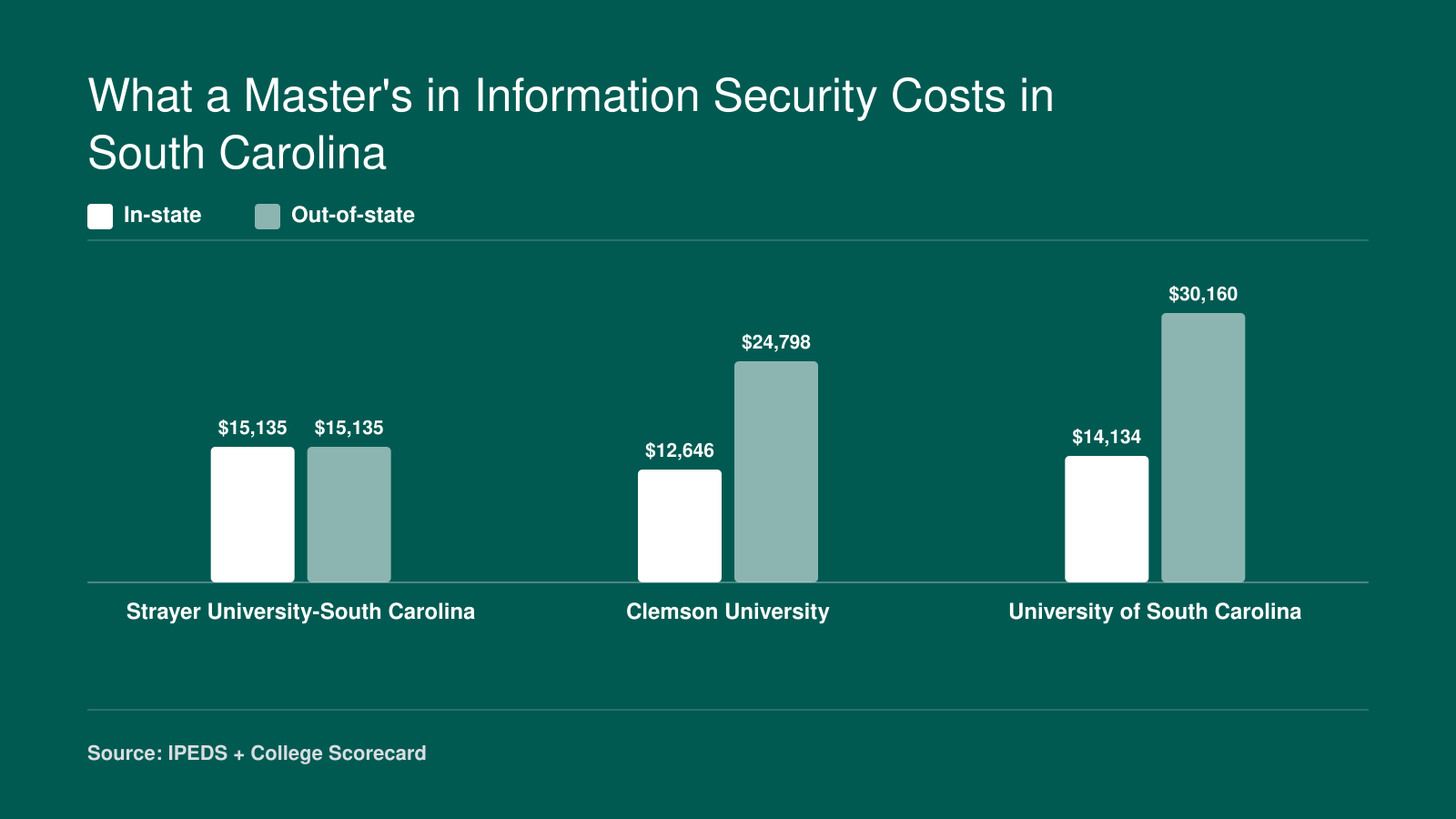
To find current South Carolina numbers, visit CyberSeek.org, filter for the state, and note the data period before citing any totals. Cross-check openings against BLS.gov OEWS and the South Carolina Department of Employment and Workforce, then verify figures through ISC2, ISACA, CompTIA, and program advisors, confirming each source's date and scope.
Certifications, NSA CAE Designations, and Earnings After a South Carolina Cybersecurity Master's
An NSA National Center of Academic Excellence (NSA CAE designation) is a federal review stamp on a school's cybersecurity curriculum. CAE-CD covers cyber defense education, CAE-R covers research capacity, and CAE-CO covers highly technical cyber operations. Federal agencies, defense contractors, and the intelligence community in South Carolina treat these labels as shorthand for a vetted curriculum, and some scholarship and hiring pipelines reference them directly.
Designations at USC and Clemson
Secondary reporting places the University of South Carolina with cyber defense and research designations and Clemson University with a research designation as of 2026. Designation types and renewal dates change, so confirm current status with the department before you enroll. USC's online master's in information security and cyber leadership connects to a virtual cyber range built around NIST and CMMC frameworks, which maps closely to the compliance work contractors actually do. Clemson's cybersecurity emphasis within the computer science master's runs through the Charleston Innovation Campus at the Zucker Family Graduate Education Center, in a format built for both full-time and working students.
Certifications and earnings
Strayer University-South Carolina describes its cybersecurity master's as NSA-validated and runs case-study coursework through a dedicated cybersecurity center. Ask each program directly whether courses map to CISSP, CISM, Security+, or CEH domains and whether exam vouchers are included, since published crosswalks are thin. CISSP still requires five years of paid experience, with one year waived for an approved degree.
Strayer graduates in this field reported median earnings of $87,435 one year after completion and $96,961 four years out, though the reported cohort is small enough to read as a signal rather than a promise.
FAQ: South Carolina Information Security Master's Programs
Prospective students often ask how admissions, CISSP credit, online tuition, and certification tradeoffs work for South Carolina information security master's programs. Here are the practical answers.
Do I need a technical background for a master's in information assurance?
Can an information security master's count toward the CISSP experience requirement?
Can out-of-state students pay in-state rates for South Carolina online cybersecurity master's programs?
Is a master's in information security worth it compared with certifications alone?
Compare Information Security & Assurance programs on the data that matters
Explore more Computers & IT specializations or browse every graduate field.
All Computers & IT programs