Best Online Master's in Information Security and Assurance Programs
Compare 150+ accredited online Information Security & Assurance programs, with graduate earnings, cost, debt, and completion data from IPEDS and the U.S. College Scorecard.

On-campus formats once dominated information assurance training. Today, fully online master's programs deliver the same defense of data integrity, availability, and confidentiality, but the ranked options exclude any hybrid requirement or campus visit. Published tuition runs from $8,700 to $50,975, a spread that reshapes the return on a degree.
The ranking, certification alignment, real net cost, graduate earnings, format, admissions for career changers, and frequently asked questions all condition the choice. The strongest program is rarely the most expensive.
Key Points
- Carnegie Mellon reports median graduate earnings of $156,313 five years out.
- Western Governors University graduates carry $11,526 median debt, $131 monthly.
- Old Dominion offers 8-week asynchronous courses with no scheduled meetings.
Top 10 Fully Online Master's in Information Security and Assurance Programs
These are the 10 fully online master's programs in information security and assurance that stand out for working professionals who need no campus visits or residencies. The order below weighs several federal data points, including what students pay, how many finish, and what they earn afterward. None of these programs requires in-person attendance.
Carnegie Mellon University
#1Pittsburgh, PA · ~$51,000/yr (est.)
Best for: CERT Division practitioner exposure
Carnegie Mellon's fully online Information Security and Assurance track builds cybersecurity leaders through a curriculum covering risk management, cybersecurity, and data privacy. It suits both technical and non-technical professionals and offers direct exposure to practitioners at the university's CERT Division. Students can study part-time with fall, spring, and summer starts and no campus visits.
- Fully online, no campus visits required
- Six to eight semesters, part-time
- Three start dates: fall, spring, summer
- CERT Division practitioner exposure
- Non-technical backgrounds welcome
- Same faculty as on-campus students
- Covers risk management and data privacy
- Three high-demand focus areas
University of South Florida
#2Tampa, FL · ~$10,000/yr (est.)
Best for: Working professionals needing hands-on practicum
University of South Florida's online master's with an information assurance concentration focuses on information security controls, regulatory requirements, risk management, and incident response. The program combines four core courses, five concentration courses, and a required practicum so students gain real industry experience while earning the degree. It is a strong fit for working professionals who want practical skills without commuting to campus.
- Fully online delivery
- 10 total courses
- Three-credit-hour practicum required
- Information risk management focus
- Covers information security controls
- Recommended background in database management
- Focus on regulatory environment
Northeastern University
#3Boston, MA · ~$29,000/yr (est.)
Best for: Optional paid co-op and internships
Northeastern's fully online MS in Cybersecurity blends information technology with law, criminology, the social sciences, and management. Students complete project work, a capstone, and optional paid co-op or internships, with part-time or full-time pacing over about two years. The program carries an NSA/DHS Center of Academic Excellence designation and prepares graduates for roles in tech, government, finance, and defense.
- Fully online option available
- 2-year program with full-time and part-time options
- Rolling admissions, 2 start dates per year
- 3.0 GPA minimum, 2 letters of recommendation
- Capstone required
- NSA/DHS Center of Academic Excellence designation
- Optional paid co-op and internships
- Blends IT with law and criminology
Saint Louis University
#4Saint Louis, MO · ~$26,000/yr (est.)
Saint Louis University's fully online MS in Cybersecurity emphasizes applying information security principles to detect and mitigate vulnerabilities while also covering policy, ethics, and privacy. The 30-credit program uses eight-week terms and a master's research project. You can add a graduate certificate in cloud computing, threat intelligence, or AI for cybersecurity, often without extra credits.
- Fully online option available
- 30 total credit hours
- Eight-week course terms
- 2 start dates per year (fall, spring)
- 3.0 GPA minimum
- Capstone required
- Optional graduate certificates in cloud computing, threat intelligence, or AI
- Ethics, policy, and legal coverage
Western Governors University
#5Salt Lake City, UT · ~$9,000/yr (est.)
Western Governors University's fully online master's in cybersecurity and information assurance uses competency-based learning, so students advance as soon as they demonstrate mastery. The curriculum covers cyberdefense, cloud security, incident response, penetration testing, and governance, and aligns with NICE Framework and CISSP. WGU is NWCCU-accredited and includes industry certifications like CompTIA CySA+ and PenTest+ at no extra cost.
- Fully online, asynchronous classes
- Competency-based, typically under 2 years
- 11 total courses
- 12 start dates per year, rolling admission
- No entrance exam required
- Five industry certifications included (CompTIA CySA+, PenTest+)
- Aligned to NICE Framework and CISSP
- Flat rate per 6-month term
Strayer University-Florida
#6Tampa, FL · ~$15,000/yr (est.)
Strayer University's fully online master's in cybersecurity prepares students to spot threats, investigate digital crimes, and manage breach impact. The 45-credit program runs in 11-week courses with a dedicated Cybersecurity Center, and the curriculum is NSA-validated as a CAE-CD program. Students can transfer up to four classes and receive employer reimbursement support.
- Fully online option available
- 45 total credit hours, 10 courses
- 11-week courses, winter start
- 2.5 GPA minimum
- Employer reimbursement supported
- Transfer up to four classes
- NSA-validated cybersecurity curriculum (CAE-CD)
- Dedicated Cybersecurity Center resources
American Public University System
#7Charles Town, WV · $5,000 – $10,000/yr (est.)
American Public University System's fully online master's in information technology with an information assurance and security concentration covers network security, cryptography, intrusion detection, incident handling, risk assessment, and audit. The 36-credit program adds core courses in MIS, databases, and IT project management for both technical and leadership skills. Courses start monthly in 8- to 16-week sessions.
- Fully online option available
- 36 total credit hours
- Information assurance concentration: 15 semester hours
- 12 start dates per year
- No entrance exam required, 3.0 GPA minimum
- Thesis or capstone option
- 8- to 16-week course sessions
- Accepts CompTIA, CISSP, CCNA certifications for credit
University of South Carolina
#8Columbia, SC · ~$14,000/yr (est.)
University of South Carolina's fully online master's in information security and cyber leadership blends technical information security with social and people skills for managing risk and guiding strategy. The program is designed for working professionals, career changers, and veterans who want to keep their jobs while studying. Graduates move into cybersecurity analyst and security leadership roles across government, healthcare, finance, and tech.
- Fully online option available
- Careers in information security
- Tackles cyber threats and breaches
- Builds technical, social, and people skills
- Serves public and private sectors
University of Arizona
#9Tucson, AZ · ~$15,000/yr (est.)
University of Arizona's fully online master's in management information systems offers a Security and Information Assurance concentration covering public- and private-sector information security, risk management, and systems security. The program can be completed in as little as 16 months and requires 30-33 credits, including a master's project. It is STEM designated, and 92% of students land internships.
- Fully online option available
- 16-month program
- 30-33 total credits, 9 units for concentration
- STEM designated, 36-month work eligibility
- 92% internship placement, internships built in
- Capstone required
- Non-business majors take two extra classes
- U.S. News best public graduate IS program
University of Michigan-Dearborn
#10Dearborn, MI · ~$17,000/yr (est.)
University of Michigan-Dearborn's fully online MS in Cybersecurity and Information Assurance covers network and data security, forensics, cloud computing security, and AI. Students choose one of three concentrations: Network & System Security, Data & Application Security, or Software Security, and finish with coursework, a project, or a thesis. A STEM bachelor's degree is required, but the GRE is not.
- Fully online option available
- 30 total credit hours
- Three concentration options: Network, Data, Software Security
- No entrance exam required, test optional
- Rolling admissions
- 0 letters of recommendation required
- Thesis or capstone option
- STEM bachelor's degree required
Cost & outcomes by school
Federal data for the highest-earning Information Security & Assurance programs, independent of the ranking above. Earnings are this field's master's graduates four years after completing, where the Scorecard reports them.
| School | Earnings | Tuition / yr | Debt | Grads/yr | Format |
|---|---|---|---|---|---|
| Utah Valley University UT | $154,576 | $10,224 | — | 14 | Online |
| Fordham University NY | $150,150 | $26,752 | $29,139 | 31 | Hybrid |
| Western Governors University UT | $144,205 | $9,320 | $11,526 | 1,484 | Online |
| University of Houston TX | $138,873 | $10,051 | $34,749 | 83 | Hybrid |
| Sam Houston State University TX | $136,772 | $8,954 | — | 13 | Online |
| University of Maryland Global Campus MD | $130,314 | $9,882 | $35,875 | 895 | Online |
| Fort Hays State University KS | — | $4,949 | — | — | Online |
| Texas A&M University-Central Texas TX | — | $6,242 | — | — | Hybrid |
| Navajo Technical University NM | — | $6,520 | — | — | Online |
| Sul Ross State University TX | — | $6,661 | — | — | Online |
| Arkansas State University AR | — | $7,322 | — | — | Online |
| Pacific States University CA | — | $7,890 | — | — | Hybrid |
Sources: U.S. Department of Education. Tuition and graduates: IPEDS. Earnings and debt: College Scorecard, this field's master's graduates; a dash means no figure is reported.
Cost, debt & payoff
Median earnings of this field's master's graduates (4 yrs after completing) vs. their median federal loan debt · U.S. College Scorecard
Across these programs the median graduate earns about $96,961 and finishes with roughly $65,853 in debt — a ratio that clears a common rule of thumb (keep debt below first-year salary). Tuition and debt vary widely school to school, so check the per-school figures in the table above before you shortlist.
Information Assurance vs. Cybersecurity, and Which Certifications These Degrees Prepare You For
The field is splitting into two related tracks. Information security and assurance centers on risk, governance, policy, and compliance, confidentiality, integrity, availability, and non-repudiation, while cybersecurity master's programs lean toward technical defense and offense. That distinction shapes which certifications make sense. Among the programs below, WGU's online M.S. in Cybersecurity and Information Assurance aligns its coursework with the CISSP CBK and includes vouchers for CySA+, PenTest+, and ISC2 CC, with optional vouchers for CASP+ and CISM. SANS Technology Institute's MSISE awards GIAC certifications as students progress,1 while Capella says its cybersecurity master's prepares students for CISSP and offers no-cost CompTIA, Cisco, and SAS vouchers to eligible students.2
Certification experience rules vary. CISSP requires five years in at least two domains;3 a qualifying master's can reduce that to four, and the 2026 ISC2 update kept the degree reduction at one year.4 CISM requires experience in three of four domains within ten years,5 but a master's in a related field can waive up to two years, with one substitution allowed.6 Confirm current ISC2/ISACA policy before applying.
Governance-minded students should target CISM or CISSP, while hands-on technical students should look at GIAC and Security+.
What the Most Affordable Online Information Assurance Master's Programs Really Cost
Published tuition alone rarely reflects the full cost of an online master's. The programs below show published in-state and out-of-state tuition plus each institution's approximate net price, which averages aid received. Before comparing, verify per-credit rates and mandatory fees: Georgia Tech's fully online cybersecurity master's lists roughly $12,000 but adds a $212 to $531 online learning fee, and American Military University adds an $85 per-course technology fee and a $350 graduation fee. Books and certification exam fees are typically extra.
| School | Program | Published In-State Tuition | Published Out-of-State Tuition | Approx. Institutional Net Price |
|---|---|---|---|---|
| Utah Valley University | Cybersecurity, M.S. | $10,224 | $22,834 | $6,376 |
| Ferris State University | Information Security and Intelligence (MS) | $9,538 | $9,538 | $8,624 |
| Murray State University | Master of Science in Information Systems with a concentration in Information Security | $10,683 | $10,683 | $9,096 |
Related Articles
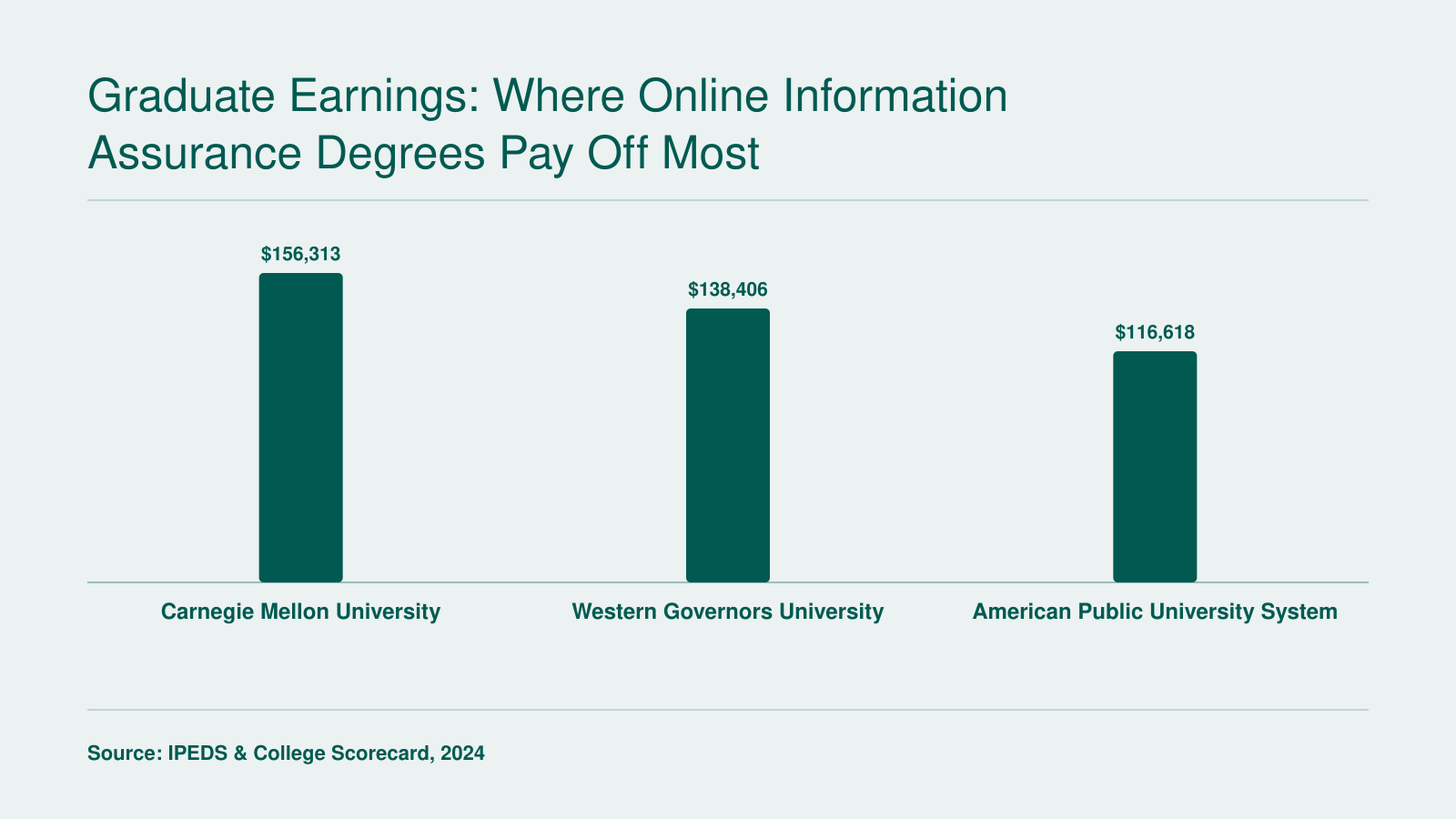
Graduate Earnings: Where Online Information Assurance Degrees Pay Off Most
Five years after finishing, median program earnings reach $156,313 at Carnegie Mellon University, $138,406 at Western Governors University, and $116,618 at American Public University System. The same programs show median debt of $51,970 ($591 monthly), $11,526 ($131 monthly), and $41,147 ($468 monthly), respectively.
Asynchronous Classes, Term Lengths, and Online Student Support
Format matters as much as curriculum for working professionals, and the programs here differ more than their marketing suggests. Old Dominion runs an Accelerated Master's in Information Security and Assurance with 8-week courses and no scheduled meeting times6, so it is asynchronous by design, though instructors may still set deadlines or exam times. Aston offers self-paced study.1 EC-Council University requires weekly live virtual sessions in 10-week terms.2 UC Berkeley's MICS mixes live online classes with self-paced content and expects in-person immersions, so confirm those details before applying.3 Several other schools do not spell out their live-session rules on their program pages.
Term structure varies too. West Florida and American Public University mix 8- and 16-week courses45, while Norwich's online cybersecurity master's program takes one 11-week course at a time over roughly 18 months. Ask each school for the expected weekly hours before you commit.
Support can separate close competitors. Look for virtual labs (EC-Council offers 24/7 access2, Old Dominion6 and Norfolk State list them7), the UWF Cyber Range4, and 24/7 tech support at UMass Lowell.8 Before enrolling, ask admissions about proctored exams and any synchronous capstone presentations.
Admission Requirements and Pathways for Career Changers
- Bachelor's and GPAExpect a bachelor's from a regionally accredited institution. Published minimum GPAs among the referenced programs generally fall between 2.5 and 3.0, with some stating no minimum.
- GRE policyThe programs discussed here generally do not require the GRE; Penn State World Campus does not accept it.
- Technical prerequisitesSeveral programs require foundational coursework in programming, statistics, or IT. Wisconsin requires introductory computer science plus calculus or statistics; Pace requires computational statistics, intro coding, and data communications.
- Career-changer pathwaysRelevant work experience or certifications may strengthen an application at some schools, but prerequisites may still apply. Pace allows prerequisites to be completed after admission.
- Application documentsA résumé, statement of purpose, and recommendation letters are typical. Check each program for specific prompts or counts.
Information Security & Assurance programs by state
Frequently Asked Questions About Online Information Assurance Master's Degrees
Is an online master's in information assurance worth it?
Which is better: information assurance or cybersecurity?
Can you complete an online information assurance master's without a technical background?
Do employers view an online information assurance master's the same as a campus degree?
Compare Information Security & Assurance programs on the data that matters
Explore more Computers & IT specializations or browse every graduate field.
All Computers & IT programs