Best Master's in Information Security and Assurance Programs in Texas
Compare 14 accredited Information Security & Assurance programs in Texas, with graduate earnings, cost, debt, and completion data from IPEDS and the U.S. College Scorecard.

Texas has no shortage of cybersecurity master's programs, but the price of the degree varies far more than the job it leads to. Average net price after aid runs from roughly $1,300 at the lowest-cost public option to about $41,000 at Southern Methodist University.
Some programs hold National Security Agency and Department of Homeland Security designation, others are fully online, and graduate pay does not always track tuition. Employers hiring security analysts weigh demonstrated skills and certifications nearly as heavily as the diploma.
Key Points
- The University of Houston leads graduate earnings at $138,873 four years out, with median debt of $34,749.
- Texas requires no license, so CISSP, Security+, and CISM carry weight alongside your degree.
- NSA/DHS designation matters for CyberCorps Scholarship for Service eligibility, and GRE policies vary by school.
Ranked: Top 10 Master's in Information Security Programs in Texas
These Texas programs are ordered by what graduates earn, what they borrow, and what the degree costs after aid. Each card lists the delivery format and tuition, and the graduation rates cited are institution-wide, not specific to the program. See the methodology section at the end of the page for how we rank.
The University of Texas at Dallas
#1Richardson, TX · ~$15,000/yr (est.)
Best for: Research-minded students who want hands-on labs
UT Dallas offers information assurance as a concentration within its Master of Science in Computer Science, run through its Cyber Security Research and Education Institute. It carries an NSA/DHS Center of Excellence designation, and an NSF Scholarship for Service award supports students in the degree. The university's institution-wide graduation rate is about 76%, and the program leans toward hands-on lab work in malware and binary analysis.
- Information Assurance concentration inside the MS in Computer Science
- Four tracks leading to an MS or PhD
- NSA/DHS Center of Excellence designation
- NSF Scholarship for Service award supports students
- Labs cover malware unpacking, binary code, and kernel internals
- Courses in systems, network, and data security, cryptography, and forensics
- Housed in the Cyber Security Research and Education Institute
Southern Methodist University
#2Dallas, TX · ~$37,000/yr (est.)
Best for: Quantitative grads choosing campus or online study
SMU's MS in Cybersecurity focuses on building systems that are secure by design, with coursework in cryptography, access control, and data and network security. Students can attend in person or online, full time or part time, and research opportunities run through the Deason Institute for Cyber Security. The institution-wide graduation rate is about 84%, and the program reports that all 2024 graduates found jobs within six months. Admission favors applicants with quantitative, math, computer science, or engineering backgrounds.
- 30 credit hours, two years full time or three part time
- In-person and fully online options
- Synchronous and asynchronous formats
- Electives in cryptography, software testing, and data mining
- Research through the Deason Institute for Cyber Security
- 9:1 graduate student-to-faculty ratio
- Prerequisite courses required
University of Houston
#3Houston, TX · $10,000 – $19,000/yr (est.)
Best for: Working professionals needing a hybrid format
The University of Houston delivers its MS in Cybersecurity in a hybrid format built for working professionals, with a project management framework running through the curriculum. It holds the NSA/DHS Center of Academic Excellence designation and works with the Center for Information Security Research and Education. Reported graduate earnings are strong, at roughly $95,300 one year after completion and about $138,900 four years out. The institution-wide graduation rate is about 65%.
- 30 credit hours across 10 courses
- Hybrid delivery for working professionals
- NSA/DHS Center of Academic Excellence designation
- No thesis or capstone required
- Core courses in cryptography, network security, and risk management
- Applied research with the Center for Information Security Research and Education
Sam Houston State University
#4Huntsville, TX · ~$9,000/yr (est.)
Sam Houston State's online MS in Information Assurance and Cybersecurity covers operating system and database security, ethical hacking, business continuity, and digital evidence. Students choose thesis, non-thesis, or professional paths, and multiple application deadlines give several entry points each year. Reported graduate earnings are about $97,900 one year after completion and about $136,800 four years out. The institution-wide graduation rate is about 55%.
- 30 credit hours, fully online
- Thesis, non-thesis, and professional paths
- Thesis path prepares students for PhD study
- Comprehensive exams cover core subjects
- Two letters of recommendation and a resume required
- Computer science prerequisites may apply
Hallmark University
#5San Antonio, TX
Hallmark University in San Antonio runs a 12-month online MS in Cybersecurity aimed at working adults moving into senior security roles. Tuition covers many industry certification exam costs, including CompTIA Security+, and students can test on site. The program includes hands-on Security Operations Center simulations. The institution-wide graduation rate is about 66%.
- 12-month fully online program
- Certification exam costs largely covered by tuition
- On-site certification testing center in San Antonio
- Hands-on Security Operations Center simulations
- Industry partners include Cisco, CompTIA, and Microsoft
- Career services and resume workshops included
Dallas Baptist University
#6Dallas, TX · ~$26,000/yr (est.)
Dallas Baptist University folds an Information Security concentration into its MS in Information Technology and Management, so the degree mixes security with business and leadership training. The program is STEM-designated and offers internships and industry projects. The institution-wide graduation rate is about 57%.
- Information Security concentration, one of six options
- 36 credit hours
- ACBSP accredited business school
- Internships with employers such as JPMorgan Chase, Amazon, and Salesforce
- STEM-designated degree
- Partners with 14 industry organizations
Texas A&M University-Central Texas
#7Killeen, TX · $5,000 – $10,000/yr (est.)
Texas A&M University-Central Texas in Killeen offers an MS in Information Systems with a Cybersecurity concentration, available online, in person, or in a mix of both. The 30-credit degree combines an information systems core with courses in enterprise cybersecurity management, network and systems security, and digital forensics. It is open to applicants without an information systems bachelor's degree, and an advisor guides course planning.
- Cybersecurity is one of three concentration options
- 30 credit hours
- Fully online option available
- Thesis or capstone option
- Open to non-IS bachelor's degrees
- Security courses include digital forensics and enterprise cybersecurity management
Our Lady of the Lake University
#8San Antonio, TX · ~$19,000/yr (est.)
Our Lady of the Lake University in San Antonio offers a fully online MS in Information Systems and Security that splits its 30 hours between information systems and information assurance coursework. It is aimed at working IT professionals heading toward CIO, CTO, or CSO roles. Admission weighs a 3.0 GPA and a GRE or GMAT score, with conditional paths for applicants from other backgrounds. The institution-wide graduation rate is about 46%.
- Information Assurance and Security concentration
- 30 credit hours, fully online
- 3.0 undergraduate GPA minimum
- GRE or GMAT listed in admissions
- Foundation course for applicants from non-technical majors
- Emphasis on internet security architectures
Strayer University-Texas
#9Farmers Branch, TX · ~$15,000/yr (est.)
Strayer University-Texas, based in Farmers Branch, offers an online MS in Information Security and Assurance that ends in a graduate capstone. Coursework spans IT risk management, advanced network security design, web application security, cryptography, and computer forensics planning. Reported earnings are about $87,400 one year after completion, but reported graduate debt is higher than at most schools on this list. The institution-wide graduation rate is about 25%.
- Online delivery
- Graduate capstone taken last or next to last
- Coursework in IT risk management and cryptography
- Covers advanced network security design and web application security
- Computer forensics planning and cybercrime techniques
- Recommended course sequence provided
Houston Christian University
#10Houston, TX · ~$12,000/yr (est.)
Houston Christian University offers a fully online MS in Cybersecurity with an Information Technology track, designed to be finished in about a year. Coursework is asynchronous and covers applied cryptography, penetration testing, and cloud, wireless, and IoT security, ending in a capstone. A low-residency option adds weekend campus sessions. The institution-wide graduation rate is about 49%.
- Information Technology track, one of two concentrations
- 30 credit hours, about one year
- Fully online, asynchronous classes
- Optional low-residency weekend campus intensives
- Applied Learning Practicum internships
- 3.0 GPA minimum, with 18 credits of prerequisite coursework
- Capstone required
Cost & outcomes by school
Federal data for the highest-earning Information Security & Assurance programs, independent of the ranking above. Earnings are this field's master's graduates four years after completing, where the Scorecard reports them.
| School | Earnings | Tuition / yr | Debt | Grads/yr | Format |
|---|---|---|---|---|---|
| University of Houston TX | $138,873 | $10,051 | $34,749 | 83 | Hybrid |
| Sam Houston State University TX | $136,772 | $8,954 | — | 13 | Online |
| Strayer University-Texas TX | $96,961 | $15,135 | $75,331 | 1 | Online |
| Texas A&M University-Central Texas TX | — | $6,242 | — | — | Hybrid |
| Sul Ross State University TX | — | $6,661 | — | — | Online |
| DeVry University-Texas TX | — | $9,832 | — | — | Online |
| Houston Christian University TX | — | $11,870 | — | — | Online |
| Concordia University Texas TX | — | $14,040 | — | — | Online |
| Wayland Baptist University TX | — | $16,580 | — | — | Online |
| The University of Texas at Dallas TX | — | $15,168 | — | 49 | Campus |
| Our Lady of the Lake University TX | — | $19,254 | — | 3 | Online |
| Dallas Baptist University TX | — | $25,862 | — | 2 | Campus |
Sources: U.S. Department of Education. Tuition and graduates: IPEDS. Earnings and debt: College Scorecard, this field's master's graduates; a dash means no figure is reported.
NSA/DHS Center of Academic Excellence Status of Ranked Texas Master's Programs
CAE status matters because federal employers often look for graduates of NSA/DHS-designated schools, and the designation supports hiring pipelines into government cybersecurity roles. It also matters for funding: CyberCorps Scholarship for Service eligibility is tied to attending a designated institution. The table lists the ranked schools with a current designation in the sources we reviewed (the CAE Institution Map and the NSA CAE-designated schools list). Other schools ranked here do not appear in that designation data, so we do not assign them a status.
| School | CAE Designation(s) | Designation Status |
|---|---|---|
| The University of Texas at Dallas | CAE-CD, CAE-R | CAE-CD 2004 to 2027; CAE-R 2008 to 2030 |
| Southern Methodist University | CAE-CD | Current CAE Cyber Defense designation |
| Sam Houston State University | CAE-CD | Current CAE Cyber Defense designation |
| Our Lady of the Lake University | CAE-CD | Current CAE Cyber Defense designation |
Online and Hybrid Master's in Information Security Options in Texas
Campus programs offer labs and local employers, while online information security and assurance programs offer flexibility and, often, a lower price. Here is how Master's Programs in Texas break down.
- Online: Sam Houston State University, Hallmark University, Our Lady of the Lake University, Strayer University-Texas, Houston Christian University.
- Hybrid: University of Houston, Texas A&M University-Central Texas.
- Campus: The University of Texas at Dallas, Southern Methodist University, Dallas Baptist University. SMU also lists a fully online option.
Out-of-state students should note that Houston Christian and Strayer list a single tuition figure for everyone, at $11,870 and $15,135. Texas A&M-Central Texas lists $13,586 for nonresidents.
Trade-offs to weigh
- Hands-on work: UT Dallas advertises malware-unpacking labs, which are hard to replicate remotely, though Hallmark lists SOC simulations online in its cybersecurity master's programs.
- Networking: SMU's twice-yearly career fairs and Dallas Baptist's internship partners favor students who can be on campus.
- Working while enrolled: Houston Christian's asynchronous classes and Houston's working-professional design suit full-time employees.
Related Articles
Which Ranked Texas Master's Programs Waive or Make the GRE Optional?
Skipping the GRE saves time and testing fees, but not every program here makes that easy, and several do not say where they stand. We have not confirmed a current policy for every school, so treat what follows as a starting point, check each admissions page, and compare those policies with broader No-GRE master's programs lists.
Schools with test language on their program pages
- Southern Methodist University: Program details reference the GRE. Confirm whether it is required or waivable, and on what criteria.
- Our Lady of the Lake University: The program lists an entrance exam (GRE or GMAT) and a 3.0 GPA minimum. Conditional admission is described as case-by-case.
Schools where no GRE policy is confirmed
The University of Texas at Dallas, University of Houston, Sam Houston State University, Hallmark University, Dallas Baptist University, Texas A&M University-Central Texas, Strayer University-Texas, and Houston Christian University: we could not verify a GRE policy, so do not assume a waiver.
Prerequisites and deadlines
Sam Houston State, Southern Methodist, Strayer, Houston Christian, and Our Lady of the Lake list prerequisite courses. Our Lady of the Lake also offers a foundation course for non-technical majors. Texas A&M-Central Texas is open to non-IS bachelor's degrees. Houston Christian lists a 3.0 GPA minimum. We have not confirmed fall 2027 deadlines, so verify them directly with each school.
What a Master's in Information Security Costs in Texas and How It Aligns With Certifications
Cost shows up two ways: the published tuition rate a university charges per credit or per year, and net price, which is an institution-wide average of what students actually pay after grants and scholarships. Net price is a useful benchmark, not a quote for your program.
Residency Drives the Gap
At the cheapest public options, Texas A&M University-Central Texas and Sul Ross State University publish graduate tuition near $6,200 and $6,700 for Texas residents against roughly $13,600 and $14,200 for non-residents, a residency gap of about $7,300 to $7,600. Sam Houston State University runs roughly $8,950 in-state versus $16,300 out, and the University of Houston about $10,000 versus $19,200. The widest spread is at The University of Texas at Dallas: roughly $15,200 against $29,500. Most of these degrees require 30 credit hours. Private universities charge one rate regardless of residency; Concordia University Texas publishes $800 per credit.
Certification Alignment
Hallmark University covers certification exam costs in tuition and runs an on-site testing center with Cisco, CompTIA and Microsoft partnerships. Concordia maps coursework to CompTIA Security+ and CySA+. Sul Ross embeds industry-recognized risk certificates. Explicit CISSP, CISM or GIAC mapping is not published by these programs, so ask admissions. Under DoD 8140 workforce rules, certifications carry real weight for Texas defense and federal employers.
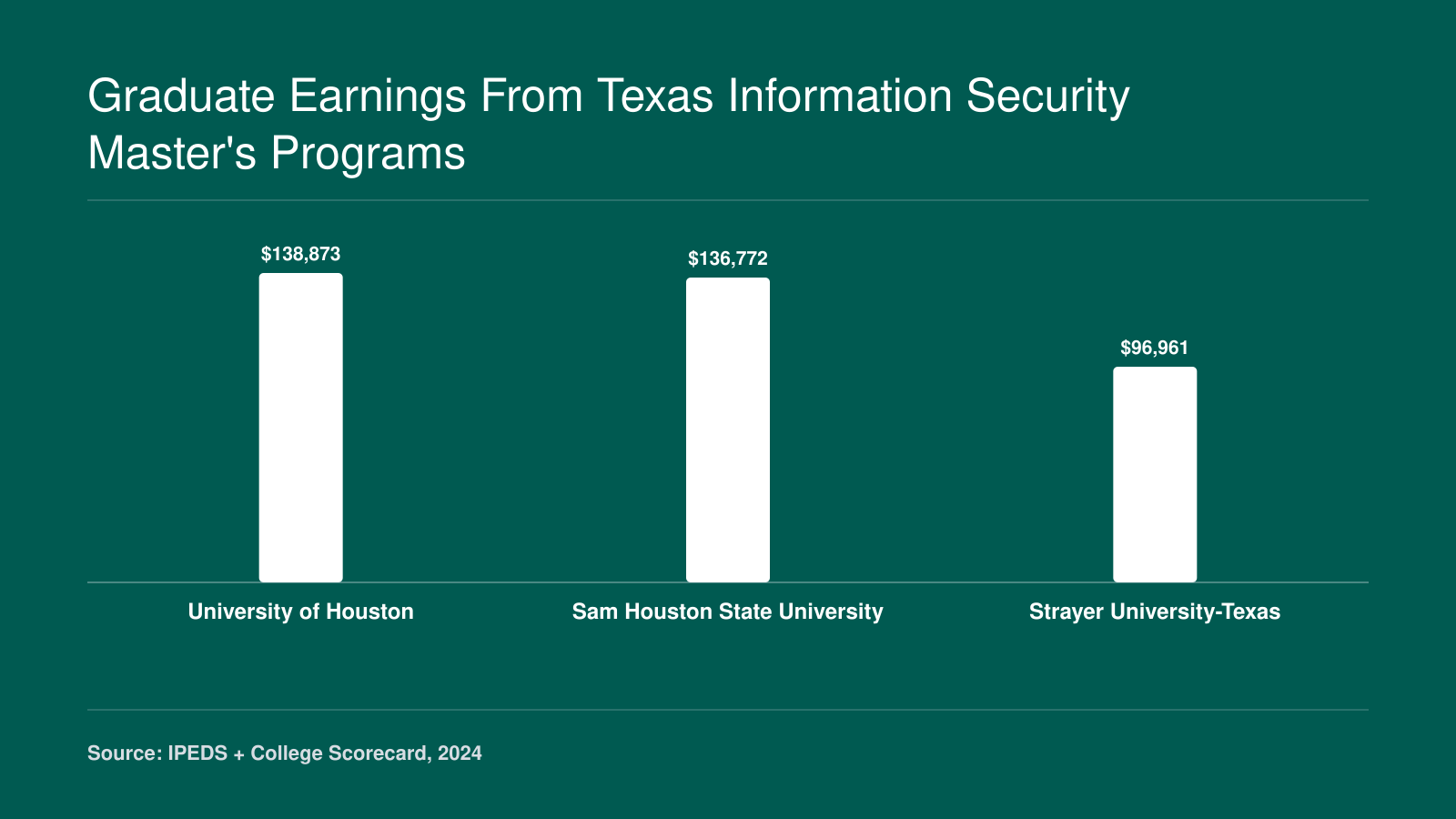
Graduate Earnings From Texas Information Security Master's Programs
Median earnings are shown four years after finishing, at the program level. The University of Houston leads at $138,873, against median program debt of $34,749, which is roughly four dollars earned per dollar borrowed.
How We Rank Texas Master's in Information Security Programs
How do you compare a master's in information security across Texas schools when marketing claims all sound alike? We rely on three outcome measures: median earnings of program graduates after completion, median federal debt at completion, and average net price.
All figures come from IPEDS and College Scorecard. Campus, hybrid, and online programs share one ranking, so you can weigh them directly.
The data has limits. Net price and graduation rates describe the whole institution, not the information security program alone. Some programs also have no published earnings yet, so those schools are judged on the measures that are available. Treat the rankings as a starting point and confirm current costs with each school.
Master's in Information Security FAQs
Do I need a computer science background for a master's in information security?
Is a master's in information security worth it in Texas?
Does a master's degree count toward the CISSP experience requirement?
Compare Information Security & Assurance programs on the data that matters
Explore more Computers & IT specializations or browse every graduate field.
All Computers & IT programs