Best Master's in Information Security and Assurance Programs in Arizona
Compare 4 accredited Information Security & Assurance programs in Arizona, with graduate earnings, cost, debt, and completion data from IPEDS and the U.S. College Scorecard.
In a market this small, the gaps between programs are large. Resident tuition runs from $13,023 at Northern Arizona University to $14,856 at the University of Arizona, whose nonresident rate reaches $34,110.
The three schools also take different routes. The University of Arizona places a security concentration inside its MS in Management Information Systems. NAU offers a Computer Information Technology degree with an Information Security and Assurance focus. ASU's is a 30-credit Master of Computer Science in Cybersecurity. The ranking rests on College Scorecard and IPEDS outcomes, not reputation surveys.
With so few options, a mismatch between a program's focus and your target role is expensive to correct.
Key Points
- The University of Arizona offers its security option as an online MS in Management Information Systems.
- ASU's online MS in Computer Science (Cybersecurity) makes the GRE optional.
- Nonresidents pay $19,254 more in published tuition at the University of Arizona than residents.
Best Master's in Information Security and Assurance Programs in Arizona, Ranked
Only three Arizona schools make our ranked list for information security and assurance at the master's level, so the choice comes down to a few real tradeoffs. The main differences are whether the program leans toward business risk or technical depth, how flexible the delivery is, and how much the degree costs for in-state versus out-of-state students.
University of Arizona
#1Tucson, AZ · ~$15,000/yr (est.)
Best for: Business-minded future security and risk managers
The University of Arizona in Tucson offers a Master of Science in Management Information Systems with a Security and Information Assurance concentration. Its three concentration courses cover information security in public and private sectors, risk management, and systems security, so the focus is on risk and governance rather than deep engineering. Schools offering this program graduate about 68% of students institution-wide. The university also lists a separate online MS in Cyber Operations, which is a different degree from the one ranked here.
- Security and Information Assurance concentration worth nine units
- 30 to 33 credits, as little as 16 months
- Capstone required; prerequisite courses required
- Non-business majors take two extra classes
- STEM designated with 36-month post-graduation work eligibility
- 92% internship placement reported, with internships built in
- Career targets: security analyst, risk manager, IT governance specialist
Northern Arizona University
#2Flagstaff, AZ · ~$13,000/yr (est.)
Best for: Working adults wanting self-paced online study
Northern Arizona University in Flagstaff delivers its Master's in Computer Information Technology with an Information Security & Assurance emphasis through the online campus. The focus is protecting networks, systems, and data, and the competency-based format suits working adults moving into security roles. Schools offering this program graduate about 61% of students institution-wide. NAU publishes less curriculum detail than the two larger programs, so check the catalog for current course requirements.
- Four emphasis options, including Information Security & Assurance
- Other emphases: Data Analytics, Mobile and Web App Development, Project Management
- Offered through NAU's online campus
- Personalized Learning, competency-based format
- Career targets: security analyst, IT security manager, cybersecurity specialist
Arizona State University
#3Scottsdale, AZ · ~$11,000/yr (est.)
Best for: Technical students drawn to cryptography and secure software
Arizona State University's online Master of Computer Science with a cybersecurity concentration is the most technical of the three. The concentration centers on CSE 543 Information Assurance and Security, with options in applied cryptography, software security, and advanced network security, and the program also covers forensics. Its information assurance courseware meets NSTISSI 4011 and CNSSI 4012 standards. ASU runs multiple start sessions each year, with separate application deadlines for each.
- 30 credits, course-based, with a project portfolio and no thesis
- 9-credit concentration: CSE 543 plus two of CSE 539, 545, 548
- 9 core credits in applications, foundations, and systems; 12 elective credits
- Meets NSTISSI 4011 and CNSSI 4012 standards
- Minimum 3.0 GPA; six credit hours of calculus expected
- TOEFL, IELTS, or Duolingo for non-native English speakers
- Fully online option; full-time and part-time pacing
- Not eligible for the STEM-OPT extension
Cost & outcomes by school
Federal data for the highest-earning Information Security & Assurance programs, independent of the ranking above. Earnings are this field's master's graduates four years after completing, where the Scorecard reports them.
| School | Earnings | Tuition / yr | Debt | Grads/yr | Format |
|---|---|---|---|---|---|
| University of Arizona AZ | — | $14,856 | — | — | Online |
| Arizona State University AZ | — | $13,587 | — | 350 | Campus |
| Arizona State University AZ | — | $10,843 | — | 58 | Online |
| Northern Arizona University AZ | — | $13,023 | — | — | Online |
Sources: U.S. Department of Education. Tuition and graduates: IPEDS. Earnings and debt: College Scorecard, this field's master's graduates; a dash means no figure is reported.
Online and Hybrid Information Security Master's Programs in Arizona
Delivery formats split across the schools ranked here. The University of Arizona's information security option is an online Master's in Management Information Systems in Arizona with a Security and Information Assurance concentration. ASU's master's degree in cybersecurity is a computer science concentration that can be completed fully online through ASU Online or on the Tempe campus, with 30 credits across 10 seven-and-a-half-week classes. ASU also lists an online MA in Global Security with a cybersecurity concentration, so students can choose between a technical track and a policy-focused track. NAU's Computer Information Technology degree with an Information Security and Assurance focus is available on campus in Flagstaff or online with flexible scheduling. Several private Arizona universities also market online cybersecurity degrees, but this page's rankings stay with public institutions. Price structures differ: ASU Online is generally per credit and varies by program, with an in-state cap at 11 credit hours, while NAU Online advertises flat program rates without separate out-of-state tuition. Confirm your program's online rate against the campus resident rate before budgeting.
Which Arizona Master's Programs Waive or Make the GRE Optional?
Among the Master's Programs in Arizona we reviewed, Arizona State University's online MS in Computer Science (Cybersecurity) is the one program here with a clearly stated GRE position, a status we track in the Master's in Information Security and Assurance Programs With No GRE Required directory: the test is optional, though ASU does not accept the at-home edition of the GRE General Test.1 Admission leans on a 3.25 GPA in the last 60 hours of a bachelor's or applicable master's degree, plus depth of computer science preparation.2
The University of Arizona's admissions pages list no GRE requirement, optional policy, or waiver, so confirm directly with the program before assuming either way.3 Northern Arizona University also publishes no GRE policy in the pages we reviewed.4
Common prerequisites are a regionally accredited bachelor's degree, a minimum GPA between 3.0 and 3.25, and programming experience. ASU expects a computer science or related degree2 and knowledge of C/C++, Java, Python, and HTML.1 The University of Arizona accepts any major3, but applicants without programming work in the past three years take CYBR 500 or pass the Python Challenge. NAU's catalog sets a 3.0 graduate GPA.4
Related Articles
Master's in Information Security Cost, Aid, and Arizona Certification Requirements
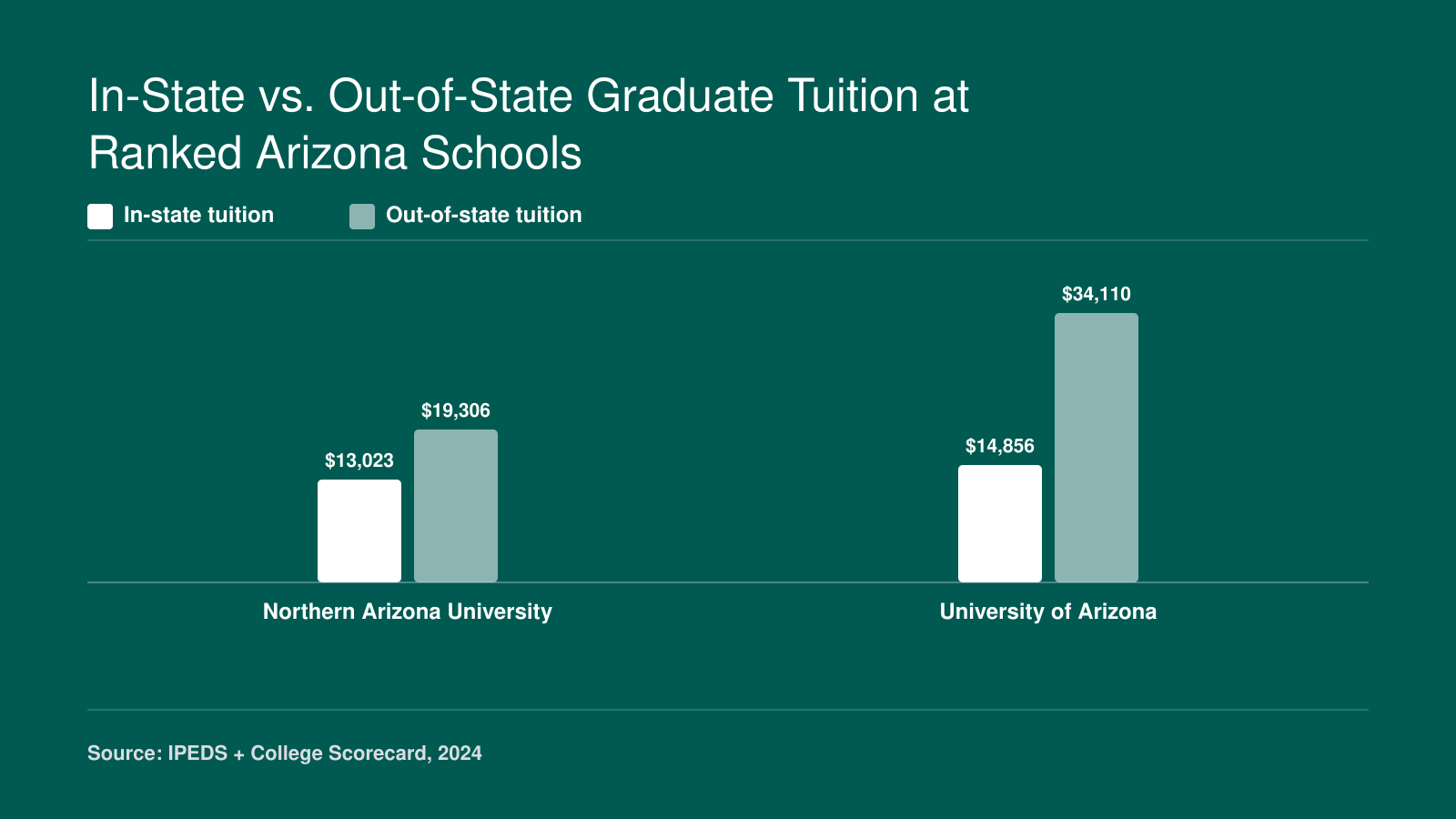
Published per-credit rates tell you more about what you will pay than any averaged tuition figure, which is why our Most Affordable Master's in Information Security and Assurance Programs ranking looks at per-credit costs. Our data lists resident and nonresident tuition of $13,023 and $19,306 at Northern Arizona University, and $14,856 and $34,110 for the University of Arizona's information systems security concentration. The gap shows how much residency can matter. The net price figures ($14,158 for NAU, $16,674 for UA) are institution-wide averages, not a quote for this degree.
Program pages are more concrete. ASU Online's cybersecurity master's costs $500 per credit, $15,000 for 30 credits, with no extra fees or textbooks. UA Online's MS in Cybersecurity lists $1,250 per credit across 33 credits, about $41,250 before fees, and rates are reviewed annually. UA's online Cyber Operations master's runs $750 per credit over 30 credits, plus a $53 program fee. NAU's online per-credit rate was not available, so ask the school directly.
For funding, look at graduate assistantships, employer tuition benefits, and CyberCorps Scholarship for Service, and ask each school whether it participates.
We found no dedicated Arizona state license for information security work. Employers instead look to certifications such as CISSP, CISM, and Security+, and federal or defense roles often require a security clearance.
In-State vs. Out-of-State Graduate Tuition at Ranked Arizona Schools
Residency changes the bill much more at one school than the other. Nonresidents pay $6,283 more in published tuition at Northern Arizona University and $19,254 more at the University of Arizona. Online rates may be priced differently from the figures shown, so confirm the current rate with each program.
NSA/CAE Designations at Arizona Universities and Why They Matter
The National Security Agency, through the National Centers of Academic Excellence in Cybersecurity (NCAE-C) program, recognizes schools whose curricula meet federal cybersecurity standards.1 Among the universities ranked here, Northern Arizona University, Arizona State University, and the University of Arizona all hold the Cyber Defense designation (CAE-CD).2 The University of Arizona goes further, carrying all three current designation types: Cyber Defense, Cyber Research (CAE-R, through 2030), and Cyber Operations (CAE-CO, through 2030).2
Why the Designation Matters
For students comparing these campus programs with the best online master's in information security and assurance programs, CAE status is more than a badge. It opens practical doors:
- Scholarship eligibility: Students at designated schools can compete for CyberCorps Scholarship for Service (SFS) and Department of Defense funding.
- Mapped curriculum: Coursework aligns with federal knowledge-unit standards, so your training matches what government and defense employers expect.
- Employer recognition: Hiring managers across public and private sectors know the designation signals rigorous, standards-based preparation.
Designations are renewed on fixed cycles, so confirm current status on the official NCAE-C designated institutions map before you apply, since periods lapse and lists change.3
Career Outcomes and Earnings for Arizona Information Security Graduates
The central tradeoff is whether cybersecurity master's programs in Arizona pay for themselves quickly enough given Arizona's defense and tech employers.
The University of Arizona's cyber operations program names roles such as cybersecurity analyst, information security analyst, security engineer, cyber policy analyst, and intelligence specialist, with employer pipelines at Accenture, Boeing, Cisco, Deloitte, IBM, and Lockheed Martin. Arizona State University's computer science cybersecurity MS concentrations map to systems security analyst, security engineer, network architect, software engineer, and cybersecurity risk analyst, and its computer forensics, applied cryptography, and secure software courses support forensics investigator roles. Governance and risk work at UA and ASU aligns with GRC analyst and cyber policy positions, while network and systems security tracks feed cloud security engineer roles. Across the programs here, published return-on-investment ratios range from about 2.9 for NAU's online computer information technology with information assurance to 3.2 for ASU's online MCS, with UA's MIS security concentration at 3.1.
How We Rank Arizona Information Security Master's Programs
A ranking is only as good as the numbers behind it. Ours is built from federal data that any reader can check: published graduate tuition, average net price, institution-wide graduation rates, and, where the College Scorecard reports them at the program level, graduate earnings and median debt. Programs that cost less and leave graduates earning more, with less borrowed, place higher.
What we leave out matters just as much. Reputation surveys, peer assessment scores, and paid placements carry no weight here; no school can buy a position.
Two limits are worth naming. Institution-wide figures describe the university, not the security program specifically, so we treat them as context. And federal data reflects the most recent reporting snapshot, which can lag a school's current catalog.
Compare Information Security & Assurance programs on the data that matters
Explore more Computers & IT specializations or browse every graduate field.
All Computers & IT programs