Master's in Information Security and Assurance Programs With No GRE Required
Compare 230+ accredited no-gre Information Security & Assurance programs, with graduate earnings, cost, debt, and completion data from IPEDS and the U.S. College Scorecard.

Do you need the GRE for a master's in information security and assurance? Often not. Several programs here, including Michigan-Dearborn, Colorado Denver, Southern Maine and Franklin, list no entrance exam requirement; Georgia lists the GRE as optional and not required, so policies differ by school.
The degree itself deserves a quick definition. Information assurance centers on the confidentiality, integrity, and availability of information, plus risk and governance. Cybersecurity leans toward technical defense.
That split matters when you read curricula, because a program titled "cybersecurity" may be built on either side of it.
Key Points
- GRE waivers often hinge on a 3.0 GPA or work experience.
- Southern Utah University lists $509 per credit and $16,797 total.
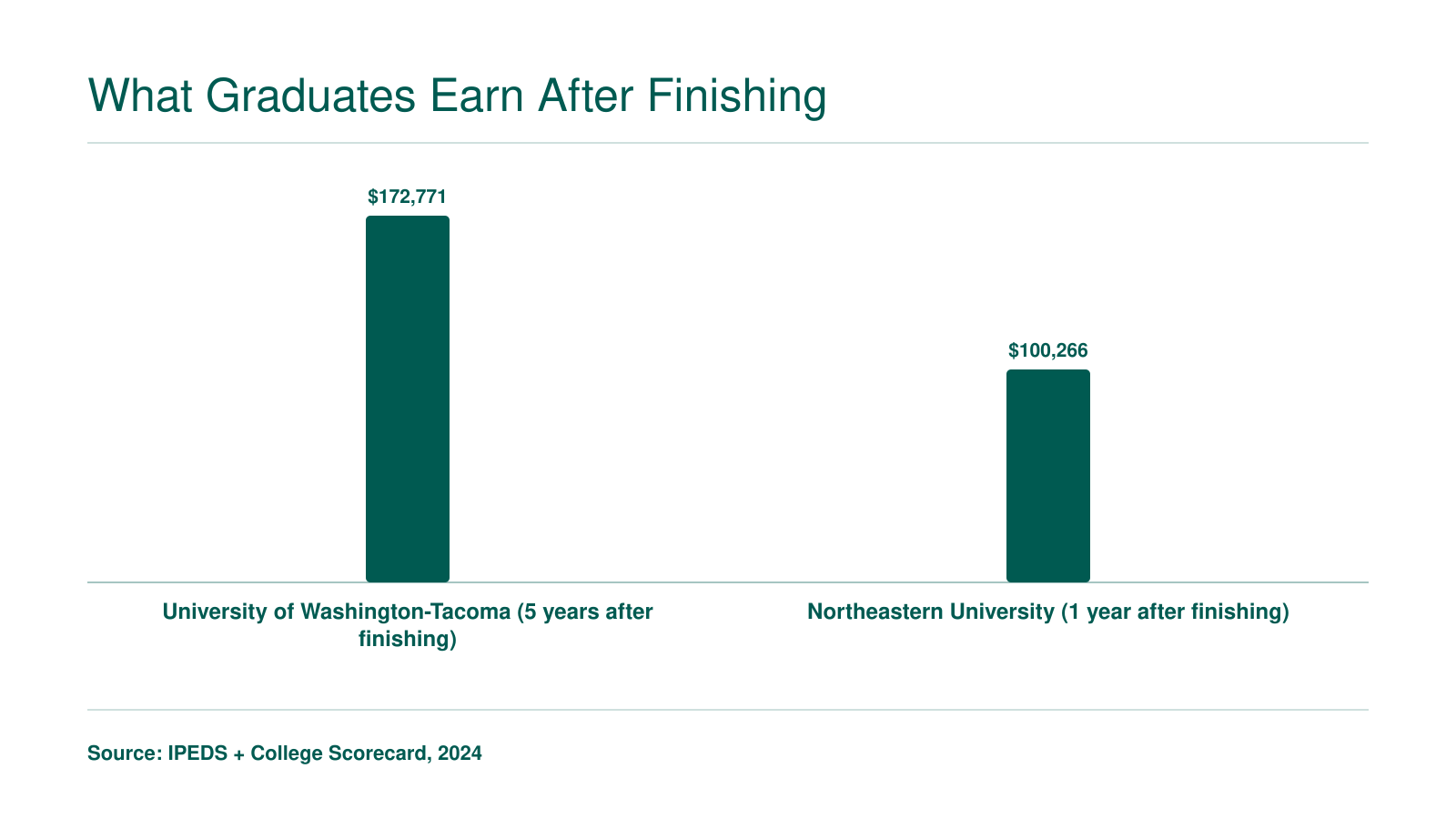
- Five years out, UW Tacoma graduates earned median $172,771.
Top 10 No-GRE Information Security and Assurance Master's Programs
These master's programs appear because their advertised admission paths do not require the GRE, either through test-optional policies or GPA-based waivers. Each entry summarizes the degree, delivery format, and published tuition so you can compare options quickly. A listing here does not replace checking the school's current testing policy for the term you plan to enter.
University of Washington-Tacoma Campus
#1Tacoma, WA · $19,000 – $33,000/yr (est.)
Best for: Working IT and military professionals
UW Tacoma jointly runs a cybersecurity and leadership degree through its engineering and business schools, pairing technical defense work with strategy. Students build hands-on protection skills for networks, data, and web services while completing a capstone with regional industry or government partners. The program serves working IT and military professionals and offers a technical bridge pathway for applicants without the usual computer science background.
- No entrance exam required; test optional
- 40 quarter credits, 12-month full-time or 24-month part-time
- Saturday-only class schedule
- 3.0 GPA minimum and work experience required
- Prepares for CISSP certification
- STEM-designated with 2-year OPT extension for F-1 students
University of Georgia
#2Athens, GA · ~$11,000/yr (est.)
Best for: Aspiring cybersecurity researchers and scholars
UGA's School of Computing delivers a research-oriented cybersecurity and privacy master's with core work in operating systems, networks, and data security. Students can choose a thesis or non-thesis route and complete a bachelor's-to-master's pathway through Double Dawgs. The program sits within the Institute for Cybersecurity and Privacy, which holds a National Center of Academic Excellence in Cybersecurity Research designation.
- GRE scores optional
- 30-32 credit hours, thesis or non-thesis options
- 3.0 GPA minimum
- Three letters of recommendation and statement of purpose
- International applicants need TOEFL or IELTS unless waived
- Core courses in operating systems, networks, and data security
- Double Dawgs bachelor's-to-master's pathway
University of Miami
#3Coral Gables, FL · ~$47,000/yr (est.)
Best for: On-campus engineering graduate students
Miami places cybersecurity inside an electrical and computer engineering master's, which suits applicants who want technical depth in systems, cryptography, and forensics. The 30-credit degree includes a capstone and offers a thesis or non-thesis route. The school no longer requires the GRE for MS applicants, though international applicants still encounter English-proficiency expectations.
- 30 total credit hours
- Thesis or non-thesis path
- Courses in internet security, cryptography, and forensics
- Three-credit capstone project
- No GRE required for MS applicants
- 3.0 GPA recommended and three recommendation letters
- On campus in Coral Gables
University of Michigan-Dearborn
#4Dearborn, MI · ~$17,000/yr (est.)
UM-Dearborn offers a 30-credit cybersecurity and information assurance master's with three technical concentrations and no GRE requirement. The program can be completed fully online, on campus, or in a mix, with late-afternoon and evening classes designed for working students. It emphasizes forensics, cloud security, and AI along with core network and data security.
- 30 total credit hours
- Three concentrations: Network & System Security, Data & Application Security, and Software Security
- Fully online, on campus, or mixed delivery
- Rolling admissions
- No entrance exam required; test optional
- No recommendation letters required
- Evening and late afternoon classes
- Forensics and cloud computing security coursework
University of Massachusetts-Lowell
#5Lowell, MA · ~$16,000/yr (est.)
UMass Lowell's security studies master's takes an interdisciplinary view of cyber threats, combining technical defense with criminology, policy, and intelligence analysis. The cybersecurity concentration covers network security and forensics within a 30-credit degree that admits year-round and can be completed largely online. A graduate certificate pathway lets students stack credits toward the master's.
- 30 total credit hours
- Interdisciplinary program run by School of Criminology and Justice Studies
- Rolling admissions with fall, spring, and summer starts
- Test optional
- Online or hybrid delivery
- Focus on network security, cyber forensics, and policy
- Graduate certificate pathway to MS
- Careers in government, defense, and biotech
University of Colorado Denver/Anschutz Medical Campus
#6Denver, CO · $5,000 – $10,000/yr (est.)
CU Denver's specialized cybersecurity and information assurance master's combines security engineering with risk management and business leadership. Students take mostly 8-week courses, with fully online asynchronous and evening hybrid formats, and complete a design science practicum or internship. The program is STEM certified and holds National Centers of Academic Excellence designation.
- 30 total credit hours
- Fully online asynchronous or evening hybrid options
- GMAT and GRE optional
- Mostly 8-week courses
- Courses in ethical hacking, digital forensics, cloud security, and IT governance
- STEM certified and National Centers of Academic Excellence recognition
- Design Science Practicum or internship
Clayton State University
#7Morrow, GA · $5,000 – $10,000/yr (est.)
Clayton State's Master of Science in Cyber Technology offers an information security concentration that can be completed in three semesters. The program is designed for working professionals and career changers, with three start terms and a GRE waiver tied to a qualifying undergraduate GPA. Students choose an applied project or research track and graduate ready for security administration and analysis roles.
- 30 total credit hours
- As few as three semesters
- GRE waived with undergraduate GPA 2.7 or above
- Fall, spring, and summer starts
- Applied project or research track
- 2.5 GPA minimum for admission
- Careers: security administrator, network security specialist, and data analyst
University of Southern Maine
#8Portland, ME · $10,000 – $27,000/yr (est.)
Southern Maine's online cybersecurity master's emphasizes security operations, risk management, and hands-on labs that simulate attacks in production environments. The 30-credit degree can be completed full time in two years or part time in four, with a thesis or capstone option. The program holds NSA and DHS Center of Academic Excellence designation and supports CISSP and CFCE certification preparation.
- 30 total credit hours
- Fully online
- No entrance exam required; test optional
- Rolling admissions, fall and spring starts
- Thesis or capstone pathway
- NSA/DHS Center of Academic Excellence designation
- Eligible for CISSP and CFCE certification
- Hands-on labs simulating real cyberattacks
Marquette University
#9Milwaukee, WI · ~$25,000/yr (est.)
Marquette's computer and information science master's offers an Information Assurance and Cyber Defense concentration with a required practicum. The 33-credit program is available on campus, fully online, or in blended evening formats for working professionals. Students cover network design, software security, applied cybersecurity, and system administration.
- 33 total credit hours
- On campus or fully online
- No entrance exam required; GRE test optional
- Evening and blended class options
- Hands-on practicum required
- Employer tuition reimbursement supported
- Synchronous and asynchronous online options
- Program founded in 2001
Franklin University
#10Columbus, OH · ~$12,000/yr (est.)
Franklin University's online cybersecurity master's is built for working adults, with flexible 6- and 12-week courses and a locked per-credit tuition rate. The 36-credit program covers cryptography, ethical hacking, network security, and governance, ending in a research paper or client-based capstone. It holds an NSA Center of Academic Excellence designation and aligns with CISSP and CEH certification.
- 36 total credit hours
- Fully online with 6- and 12-week courses
- No entrance exam required; test optional
- 2.5 GPA minimum
- NSA Center of Academic Excellence in Cyber Defense
- Embedded certificates in cyber defense and governance
- Prepares for Certified Ethical Hacker exam
- Credit for prior learning and certifications available
Cost & outcomes by school
Federal data for the highest-earning Information Security & Assurance programs, independent of the ranking above. Earnings are this field's master's graduates four years after completing, where the Scorecard reports them.
| School | Earnings | Tuition / yr | Debt | Grads/yr | Format |
|---|---|---|---|---|---|
| Western Governors University UT | $144,205 | $9,320 | $11,526 | 1,484 | Online |
| Montana State University MT | — | $7,661 | — | — | Campus |
| Liberty University VA | — | $8,730 | — | — | Online |
| University of Colorado Denver/Anschutz Medical Campus CO | — | $9,298 | — | — | Online |
| San Jose State University CA | — | $9,934 | — | — | Online |
| University of Southern Maine ME | — | $9,918 | — | — | Online |
Sources: U.S. Department of Education. Tuition and graduates: IPEDS. Earnings and debt: College Scorecard, this field's master's graduates; a dash means no figure is reported.
Cost, debt & payoff
Median earnings of this field's master's graduates (4 yrs after completing) vs. their median federal loan debt · U.S. College Scorecard
Across these programs the median graduate earns about $96,961 and finishes with roughly $65,853 in debt — a ratio that clears a common rule of thumb (keep debt below first-year salary). Tuition and debt vary widely school to school, so check the per-school figures in the table above before you shortlist.
Do You Need the GRE for a Master's in Information Security? What Programs Ask for Instead
For most programs in this field, the GRE is not a hard requirement: schools waive it based on GPA (often 3.0+) or work experience, and several make the GMAT/GRE optional.
- What you can use insteadA bachelor's degree, minimum GPA, a resume showing IT or security experience, a statement of purpose, and letters of recommendation are common substitutes. Liberty allows applicants without required courses to complete them after admission.
- Technical prerequisitesSome programs expect networking, programming, database, calculus, or statistics coursework; Sam Houston State lists specific prerequisites, while Augusta's technical track prefers a technical degree or strong Python, networking, cybersecurity, or OS background. UT Austin states no course or major requirements.
- Business school GMAT waiversWhere information assurance sits in a business school, the GMAT may be waived too. CU Denver makes GMAT/GRE optional but requires a 3.00 GPA plus either 3+ years of professional work or a completed graduate degree.
- Deadlines and termsDeadlines vary by program: Augusta uses July 15 (fall), May 1 (summer), December 12 (spring 2026); CMU's Round 1 closes December 1, 2026; UT Austin's Fall 2027 cycle opens October 1, 2026.
How Much a No-GRE Information Assurance Master's Costs
Net price below is an institution-wide average after federal, state, and institutional aid, not a fixed graduate quote. Specific per-credit pricing varies: Southern Utah University lists $509 per credit over 30 credits for a $16,797 total with fees included, while American Military University charges $470 per credit for 36 credits plus a $1,020 technology fee and a $350 graduation fee, about $18,290 total.
| School and Program | In-State Tuition | Out-of-State Tuition | Net Price | Total Credits | Estimated Total Program Cost |
|---|---|---|---|---|---|
| Clayton State University: Master of Science in Cyber Technology | $5,180 | $16,532 | $8,365 | 30 | Not reported |
| University of Michigan-Dearborn: Cybersecurity and Information Assurance, MS | $15,640 | $32,896 | $9,492 | 30 | Not reported |
| University of Washington-Tacoma Campus: Master of Cybersecurity and Leadership | $13,168 | $43,404 | $10,163 | 40 | $22,608 |
Related Articles
Online Formats: Live Sessions, Campus Visits, and Pacing
Fully online delivery has become the default for master's in information security and assurance programs, not the accommodation it was a decade ago. Most of the programs ranked here are online master's in information security and assurance programs, several remain campus-based, and Marquette's blended M.S. in Computer and Information Science sits between the two, with synchronous and asynchronous options and evening or blended class formats.
- Asynchronous: University of Colorado Denver's Cybersecurity and Information Assurance M.S. has no set meeting times, though weekly deliverables carry firm deadlines. Its hybrid track differs: at least six in-person meetings each eight-week session.
- Scheduled attendance: University of Washington-Tacoma's Master of Cybersecurity and Leadership runs on a Saturday-only campus schedule and expects prior work experience.
- Term length: Eight-week courses are common at CU Denver; Franklin offers six- or twelve-week terms and a 16-month path.
At 30 to 36 credits, most of these degrees take roughly two and a half to three years at a part-time load of six credits per term. Check the official page before enrolling: programs marketed as online sometimes require fixed-time sessions or a campus intensive.
What Graduates Earn After Finishing
Program-level earnings show the payoff can be substantial. Five years after finishing, graduates of the University of Washington-Tacoma information assurance track earned a median $172,771, with median program debt of $40,174. One year after finishing, Northeastern University graduates earned a median $100,266; that program's debt figure is not reported.
CAE Designation and Certification Alignment
CAE-CD designation lasts five academic years, after which a school must reapply.2 The NSA and CISA sponsor the Centers of Academic Excellence in Cyber Defense program, which is open to regionally accredited U.S. institutions at the associate, bachelor's and graduate levels.1 It is a curriculum review separate from regional accreditation, so a fully accredited school may not hold it. For you, it signals coursework checked against a national standard shared by cybersecurity master's programs with NSA CAE designation.
Which Schools Report CAE Status
Program materials for the University of Georgia, the University of Colorado Denver, the University of Southern Maine and Franklin University mention CAE status, and Franklin specifies Cyber Defense. Treat these as school-reported claims. Designations renew on a cycle and may cover only certain programs, so confirm current status on the official CAE map before applying.1
Course-to-Exam Mapping
UW Tacoma says its program prepares students for CISSP, Southern Maine describes graduates as eligible for it, and Franklin cites Certified Ethical Hacker preparation. None of the materials confirms CISM mapping, Security+ prep or included exam vouchers, so ask admissions directly. Western Governors University, which is not ranked here, shows what explicit mapping looks like in a WGU Cybersecurity Masters: its Cybersecurity Management course aligns with ISACA CISM.3
Degree Versus Experience
CISSP and CISM both require professional work experience. A master's prepares you for the exams but does not replace that requirement, so check each certifying body's rules for how education is credited. Plan on sitting for the exam after you have logged the required years in the field.
Information Security & Assurance programs by state
Frequently Asked Questions
What is the difference between information assurance and cybersecurity?
Are there information assurance master's programs that waive the GMAT too?
Is a master's in information security and assurance worth the investment for salary?
Can I get into a no-GRE information security master's without a computer science degree?
Compare Information Security & Assurance programs on the data that matters
Explore more Computers & IT specializations or browse every graduate field.
All Computers & IT programs