Best Master's in Information Security and Assurance Programs in Utah
Compare 5 accredited Information Security & Assurance programs in Utah at 3 schools, with graduate earnings, cost, debt, and completion data from IPEDS and the U.S. College Scorecard.

In Utah, the campus-or-online decision is mostly settled: the ranked programs from Western Governors University, Southern Utah University, and Utah Valley University are all online. Pace and price differ sharply.
Growth along the Wasatch Front, from Salt Lake City to Orem, keeps pulling in data centers, fintech, and healthcare IT, and each of them needs people who can secure systems. Employers want proof of hands-on skill, not just a degree.
The real tension is between a flat-rate competency model and per-credit tuition at a state university, and an information security and assurance masters tuition comparison shows where the value sits.
Key Points
- Western Governors University reports the highest one-year median at $121,837.
- Every ranked program here is available online with no campus attendance.
- WGU skips the GRE and GMAT; SUU states no GRE is required.
Top-Ranked Master's in Information Security Programs in Utah
Utah's ranked information security master's programs lead with three distinct models: a competency-based online degree, an accelerated online cybersecurity master's with state educator ties, and a part-time program moving fully online. Each offers a different balance of cost, pace, and specialized electives, so the best fit depends on your schedule and career goal.
Western Governors University
#1Salt Lake City, UT · ~$9,000/yr (est.)
Best for: Self-paced learners wanting flat-rate tuition
Western Governors University offers a fully online, competency-based M.S. in Cybersecurity and Information Assurance built for working IT and security professionals. The 11-course program maps to the NICE Framework and CISSP body of knowledge, includes industry certification prep, and charges a flat tuition per six-month term. Graduates typically earn a median salary above $140,000 four years after completing the degree.
- 11 courses and 36 competency units total
- No entrance exam required
- Asynchronous online classes with 12 start dates per year
- Flat tuition of $4,925 per six-month term
- Includes CompTIA CySA+ and PenTest+ certification prep
- Aligned to NICE Framework and CISSP body of knowledge
- Competency-based, progress at your own pace
- Capstone required
Southern Utah University
#2Cedar City, UT · $9,000 – $25,000/yr (est.)
Best for: Utah educators seeking endorsement pathway
Southern Utah University's online Master of Science in Cybersecurity with Information Assurance offers accelerated seven-week sessions and no out-of-state tuition, making it one of the most affordable options in Utah. The 30-credit program includes a common core, emphasis electives, and a capstone, with multiple concentration tracks. A unique agreement with the Utah State Board of Education allows licensed educators to use the degree toward the state's CTE Cybersecurity Professional Endorsement.
- 30 credits: 15 core, 12 emphasis electives, 3 capstone
- 100% online with accelerated seven-week sessions
- No out-of-state tuition
- Can finish in as few as 11 months
- Strategy emphasis focuses on leadership and risk management
- Add more than one emphasis if desired
- Cyber Operations emphasis focuses on system design and protection
- 33 total credit hours for this emphasis
- Training in cyber system design for critical infrastructure
- Multiple start dates with seven-week sessions
- Healthcare Administration emphasis focuses on healthcare sector security
- Common core with different elective options
- Accelerated seven-week sessions
- No entrance exam required
Utah Valley University
#3Orem, UT · $10,000 – $15,000/yr (est.)
Best for: Part-time students wanting online elective tracks
Utah Valley University's M.S. in Cybersecurity is a 30-credit, part-time program designed to be completed in about 24 months. The curriculum includes 21 core credits and 9 elective credits that allow focus areas in forensics, reverse engineering, secure coding, or web and mobile security.
- 30 total credit hours (21 core, 9 elective)
- Part-time format designed to finish in about 24 months
- Elective tracks in forensics, reverse engineering, secure coding, or web/mobile security
- Requires computing-related bachelor's degree with 3.0 GPA
- Two letters of recommendation and admission essay required
- Minimum grade of B- and 3.0 GPA to stay enrolled
- Validated by NSA NCAE-CD through 2030 (full CAE-CD in process)
Cost & outcomes by school
Federal data for the highest-earning Information Security & Assurance programs, independent of the ranking above. Earnings are this field's master's graduates four years after completing, where the Scorecard reports them.
| School | Earnings | Tuition / yr | Debt | Grads/yr | Format |
|---|---|---|---|---|---|
| Utah Valley University UT | $154,576 | $10,224 | — | 14 | Online |
| Western Governors University UT | $144,205 | $9,320 | $11,526 | 1,484 | Online |
| Southern Utah University UT | — | $8,577 | — | 15 | Online |
Sources: U.S. Department of Education. Tuition and graduates: IPEDS. Earnings and debt: College Scorecard, this field's master's graduates; a dash means no figure is reported.
How We Rank Utah's Information Security Master's Programs
Regional accreditation still does the heaviest lifting for financial aid and employer recognition among accredited master's programs in Utah, and Western Governors University holds NWCCU accreditation.1 Our comparisons draw on federal IPEDS and College Scorecard data: graduate tuition, net price, graduation rate, and program-level earnings and debt where they are published. Graduation rate and net price are institution-wide figures; earnings and debt reflect program-level data only when available.
A National Security Agency and Department of Homeland Security CAE designation signals a vetted cybersecurity curriculum, but, for cybersecurity master's programs with NSA CAE designation, the designation can sit at the bachelor's or school level rather than the master's degree. Western Governors' CAE-CD status runs through academic year 2026 and is tied to its B.S. in Cybersecurity and Information Assurance,2 while Utah Valley's M.S. in Cybersecurity holds Program of Study validation through 2030 rather than full CAE-CD designation.3 ABET and AACSB credentials usually attach to undergraduate or business-school programs; Southern Utah's Leavitt School of Business holds AACSB accreditation, but that does not automatically extend to its information security and assurance master's.
Online and Hybrid Master's in Information Security Options in Utah
Every ranked Utah program on this page can be completed as an Online Master's in Information Security and Assurance, and none requires routine campus attendance; the programs differ mainly in pacing.
- WGU: The M.S. Cybersecurity and Information Assurance program is fully online, asynchronous, and competency-based, with no scheduled classes or due dates. Six-month terms start monthly, and full-time is at least 8 competency units per term.1 WGU's stated completion time is 18 months, and WGU reports 63% finish within that window. The one in-person step is the ISC2 Certified in Cybersecurity exam at a live proctored site.
- Southern Utah University: Asynchronous, with seven-week courses and several start dates a year. Advertised timelines of 11 months (Cyber Operations, 30 credits) and 12 months (Strategy, 30 to 33 credits) are minimums, not averages. No formal part-time option is stated.
- Utah Valley University: Online from Fall 2026, with classes livestreamed twice weekly and recordings available. UVU's M.S. Cybersecurity program is built as a two-year, part-time, 30-credit program. Confirm with admissions whether any orientation or capstone step is in person.
If you work full time, treat the fastest advertised timelines as ceilings. Start with one or two courses, then adjust. WGU suits uneven schedules, SUU suits steady short sprints, and UVU suits fixed weekly rhythms.
Which Utah Master's Programs Waive or Skip the GRE
Admissions trends for the information security master's programs below lean clearly toward GRE-optional or no-GRE policies. Western Governors University skips the GRE and GMAT entirely, and Southern Utah University's healthcare administration emphasis states no GRE is required. Utah Valley University's published admission materials do not state a GRE policy, so applicants should confirm with the program.
| School | GRE Policy | Minimum GPA | Prerequisites / Non-Technical Applicants |
|---|---|---|---|
| Western Governors University | GRE and GMAT are not required. | Not stated | Applicants may qualify with any bachelor's degree plus either a relevant and current IT certification or related IT coursework. |
| Southern Utah University | No GRE required for the healthcare administration emphasis; no published policy for the general track. | 3.0 cumulative GPA | Applicants whose degree is not in Information Systems, Information Technology, Computer Science, Cybersecurity, or a related field must complete CSIA 6000 leveling course before the program; it cannot be taken concurrently with another course. |
| Utah Valley University | No published policy. | 3.0 on a 4.0 scale | Applicants with bachelor's degrees in other fields may be considered if they have at least two years of relevant technology or cybersecurity industry experience and have completed undergraduate courses in data communication, programming, and server administration. |
Related Articles
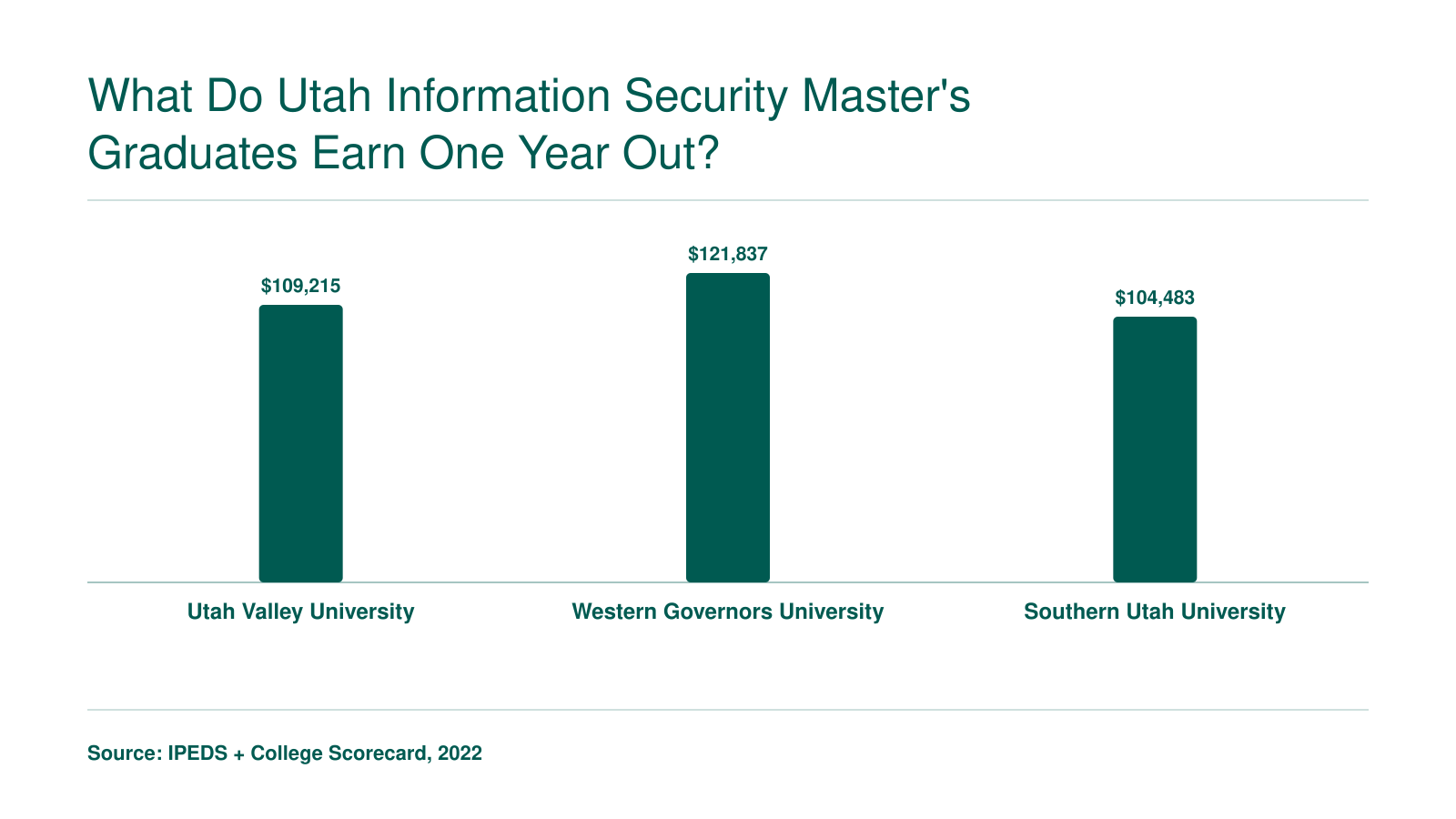
What Do Utah Information Security Master's Graduates Earn One Year Out?
Program-level earnings show how Utah information security master's graduates fare shortly after finishing. Western Governors University reports the highest one-year median here at $121,837, followed by Utah Valley University at $109,215 and Southern Utah University at $104,483. WGU also reports median federal debt of $11,526 and a median monthly payment of $131 among borrowers.
Frequently Asked Questions About Utah Information Security Master's Programs
Which Utah university has the best cybersecurity master's program?
Does Southern Utah University offer a cybersecurity master's online?
Do Utah cybersecurity master's programs include internships or capstone projects?
What career services or employer connections do Utah cybersecurity master's students get?
Compare Information Security & Assurance programs on the data that matters
Explore more Computers & IT specializations or browse every graduate field.
All Computers & IT programs