Best Master's in Information Security and Assurance Programs in California
Compare 9 accredited Information Security & Assurance programs in California, with graduate earnings, cost, debt, and completion data from IPEDS and the U.S. College Scorecard.

California posts more cybersecurity job openings than any state except Virginia, and the hiring splits three ways: Silicon Valley tech firms, defense contractors, and public agencies bound by compliance mandates.
The master's programs feeding them, including Master's in Management Information Systems in California and IT management master's programs California, are not priced alike. Resident graduate tuition at a public campus here runs under $9,000 a year; a private engineering master's in Santa Clara County tops $60,000.
And none of the California programs ranked here currently carries an NSA Center of Academic Excellence designation, a credential some federal employers screen for.
Key Points
- We could not confirm an NSA CAE designation for any program here.
- San Jose State residents pay about $10,080 less in annual graduate tuition.
- California posted 44,344 cybersecurity jobs from May 2024 to April 2025.
Top Information Security and Assurance Master's Programs in California
These eight California programs combine campus, hybrid, and fully online formats, from public universities to private and career-focused institutions. We could not confirm a current NSA/DHS CAE designation (CAE-CD, CAE-R, or CAE-CO) for any of them, so check the NSA's published CAE list before applying if that credential matters to you. Graduation rates shown are institution-wide, not specific to the security program.
Pacific States University
#1Los Angeles, CA · ~$8,000/yr (est.)
Best for: International students pursuing thesis research
Pacific States University in Los Angeles offers an MS in Information Systems with a Cyber Security emphasis. The university describes the curriculum as STEM-based and the degree as eligible for the two-year STEM OPT extension. Classes meet in the evening, online, or in hybrid formats, and the program requires a graduate thesis. The university has announced it will not offer CPT starting September 15, 2026, which matters for international students planning work authorization.
- 56 quarter units with a 3.0 GPA minimum
- Graduate thesis required
- Evening, online, and hybrid formats
- Double concentration adds 24 units
- Eligible for STEM OPT extension
- Enrolls F-1 international students
- Hands-on labs and real-world projects
- No CPT offered starting September 15, 2026
California State University-Dominguez Hills
#2Carson, CA · $9,000 – $19,000/yr (est.)
Best for: Cohort learners drawn to applied research
California State University, Dominguez Hills in Carson runs its MS in Cyber Security as an accelerated 18-month cohort with evening and weekend meetings. The school has a graduation rate of 43%, so the cohort structure and faculty-supervised research project are worth weighing against that. CSUDH students have taken part in the Cyber Halo research program with Space Systems Command and national laboratory partners, a distinctive path into mission-focused security work.
- 18-month cohort program
- Six core and four elective courses
- Faculty-supervised cyber-security research project
- 2.5 GPA minimum and two letters of support
- Late afternoon, evening, and weekend classes
- Fall deadline July 1, spring deadline November 15
- Leveling courses may be required
- TOEFL 80 for international applicants
National University
#3San Diego, CA · ~$16,000/yr (est.)
Best for: Future security policy and compliance managers
National University in San Diego delivers its MS in Cyber Security and Information Assurance fully online. The Information Assurance and Security Policy specialization emphasizes the management side: policy, risk mitigation planning, cryptography, privacy, and disaster recovery. The school has a graduation rate of 43%, and the program suits professionals aiming at government and organizational assurance roles.
- 54 graduate units: eight core plus four specialization courses
- Information Assurance and Security Policy concentration
- Four concentration options in total
- Fully online delivery
- Up to 13.5 graduate transfer units
- Cyber policy project to finish the degree
- Covers IT risk mitigation and enterprise continuity planning
- Focus on government standards and policy
San Francisco Bay University
#4Fremont, CA · ~$9,000/yr (est.)
San Francisco Bay University in Fremont offers an MS in Computer Science with a Cybersecurity concentration, taught in person. Students taking 12 credits a semester can finish in about a year, and coursework spans machine learning, cloud computing, and network security. The program is a computer science degree with a security focus rather than a dedicated assurance degree. Fall starts and scholarships are available.
- 36 credit hours with a required capstone
- Can finish in one year at 12 credits per semester
- In-person on the Fremont campus
- Fall start
- 14 credits of required core coursework
- Scholarships and financial aid available
- Cybersecurity is one of three concentrations
Santa Clara University
#5Santa Clara, CA · ~$32,000/yr (est.)
Santa Clara University offers an MS in Computer Science and Engineering with an information assurance track, taught on campus in Silicon Valley. The school has a graduation rate of 88%, the highest in this group. It is also among the pricier options, so weigh cost carefully. Graduate certificates in networking and information assurance give a lighter alternative to the full degree.
- Information assurance is one of six concentration options
- Campus-based program
- Covers software and hardware design plus theory of computation
- Graduate certificates in information assurance available
- Suited to working professionals updating skills
- Ph.D. offered in the same department
San Jose State University
#6San Jose, CA · ~$10,000/yr (est.)
San José State University offers an online MS in Informatics with a Cybersecurity and Privacy concentration, so it is an information-focused degree rather than a pure security engineering program. The school has a graduation rate of 69%. The program lists no GRE or GMAT requirement, and SJSU takes part in California's statewide cybersecurity workforce initiative with other CSU campuses.
- Fully online option available
- No GRE or GMAT required
- Two concentration options
- Hands-on project portfolio for employers
- Coursework in data management, networking, and human-centered design
- Scholarships available
California Lutheran University
#7Thousand Oaks, CA · ~$22,000/yr (est.)
California Lutheran University in Thousand Oaks pairs technical defense skills with leadership training in its MSIT Cybersecurity track. The school has a graduation rate of 70%. Evening classes and part-time study suit working professionals, and no prior cybersecurity experience is required. Tuition is among the higher figures in this group.
- 36 credit hours across 12 courses
- Complete in 12 to 24 months
- Evening classes at the Thousand Oaks campus
- Four cybersecurity electives, including ethical hacking and digital forensics
- Hands-on penetration testing labs
- Capstone internship or IT project
- No prior cybersecurity experience required
- Part-time study available
DeVry University-California
#8Ontario, CA · ~$10,000/yr (est.)
DeVry University-California offers its Master of Information Technology Management with a Cybersecurity and Information Assurance emphasis through the Keller Graduate School of Management. The program is designed for managers and can be completed in as few as 12 months. The school has a graduation rate of 22%, the lowest here, which is a real consideration. DeVry is accredited by the Higher Learning Commission.
- 39 credit hours across 13 courses
- Finish in as few as 12 months on an accelerated schedule
- Graduate certificate earned along the way
- Technology management capstone
- Courses in network security, data privacy, and incident response
- Prior learning credit may waive up to 9 credit hours
- Accredited by the Higher Learning Commission
Cost & outcomes by school
Federal data for the highest-earning Information Security & Assurance programs, independent of the ranking above. Earnings are this field's master's graduates four years after completing, where the Scorecard reports them.
| School | Earnings | Tuition / yr | Debt | Grads/yr | Format |
|---|---|---|---|---|---|
| National University CA | $118,388 | $16,416 | $40,950 | 75 | Online |
| Pacific States University CA | — | $7,890 | — | — | Hybrid |
| San Francisco Bay University CA | — | $9,010 | — | — | Campus |
| San Jose State University CA | — | $9,934 | — | — | Online |
| DeVry University-California CA | — | $9,832 | — | — | Online |
| California Lutheran University CA | — | $22,046 | — | — | Campus |
| Santa Clara University CA | — | $31,694 | — | — | Campus |
| California State University-Dominguez Hills CA | — | $8,978 | — | 29 | Campus |
| Northcentral University CA | — | $17,998 | — | 9 | Online |
Sources: U.S. Department of Education. Tuition and graduates: IPEDS. Earnings and debt: College Scorecard, this field's master's graduates; a dash means no figure is reported.
How We Ranked California Information Security Master's Programs
This ranking is a California-only comparison of master's programs in information security and assurance, built from public federal data in College Scorecard and IPEDS rather than reputation or advertising. We weighed graduate tuition, net price, institution-wide graduation rate, program-level earnings and debt where they are published, and whether a program is offered on campus, online, or hybrid.
Two of those figures need careful reading. Graduation rates and net price are institution-wide, not program-specific, so read them as signals of a school's overall track record and affordability. For several schools here, program-level earnings and debt are not yet published; we note that gap rather than estimate.
NSA CAE designation and GRE policies were checked against official NSA and university admissions pages, not secondhand summaries.
Online and Hybrid Master's in Information Security Options in California
Fully online and campus-based study suit different students, and the master's programs in California split along that line. National University, San Jose State University and DeVry University-California are listed as online information assurance master's programs. Pacific States University offers evening, online, and hybrid formats. California State University-Dominguez Hills, San Francisco Bay University, Santa Clara University and California Lutheran University are campus programs.
Schedules
Dominguez Hills holds late afternoon, evening and weekend classes. California Lutheran offers part-time study and evening classes for working professionals. San Jose State notes a fully online option, so ask whether a campus route also exists.
What to confirm
National University requires a USB headset with a microphone, a sign of live voice interaction. The published program details do not mention required campus residencies for the online programs, so ask each school directly. On tuition, National University lists one rate for in-state and out-of-state students, while San Jose State publishes separate residency rates, so confirm which applies to online enrollment.
GRE Policies: Which Ranked California Master's Programs Waive the GRE
Can you get into a California information security master's without the GRE? For most of the No-GRE master's programs below, yes, though policies vary by program and campus.
GRE Not Required
San Jose State University admits applicants to its online informatics track with no entrance exam. Among the programs here, this is the clearest no-test route, though you should confirm current terms on the admissions page.
GRE Optional or Waivable
Several programs accept scores but do not require them: UC Berkeley's MICS and UC San Diego's MS Computer Science list the GRE as optional.12 Where a published policy exists, a score can strengthen a borderline file: for example, applicants with a GPA below a stated threshold may submit one to offset a lower average. Others allow waivers for work experience or a prior graduate degree.
GRE Policy Not Published
Some admissions pages here do not state a GRE requirement, waiver, or optional policy at all. Where that is the case, contact the program directly rather than assume.
Expect a minimum GPA (commonly 2.5 to 3.0) and, for technical tracks, prerequisite programming or networking coursework.
Related Articles
Cost and California Certification: What a Master's in Information Security Costs
Public campuses charge California residents far less than nonresidents: at California State University-Dominguez Hills and San Jose State University, the annual graduate tuition gap is about $10,080. National University, DeVry University-California, California Lutheran University and Santa Clara University list one graduate rate for residents and nonresidents. The figures below are annual federal estimates, not total program prices, and a verified per-unit total was not available for every school, so confirm with each bursar. California has no state license for security professionals; employers, including state agencies and defense contractors under DoD 8140, look for certifications such as CISSP, CISM, CISA, and Security+, so budget exam fees separately.
| School | Graduate tuition (in-state, annual) | Graduate tuition (out-of-state, annual) | Institution-wide net price (annual) | Required credits |
|---|---|---|---|---|
| California State University-Dominguez Hills | $8,978 | $19,058 | $8,615 | N/A |
| San Jose State University | $9,934 | $20,014 | $13,760 | N/A |
| National University | $16,416 | $16,416 | $22,878 | 54 |
| California Lutheran University | $22,046 | $22,046 | $30,109 | 36 |
| DeVry University-California | $9,832 | $9,832 | $33,744 | 39 |
| Santa Clara University | $31,694 | $31,694 | $50,062 | N/A |
California had 44,344 cybersecurity job postings between May 2024 and April 2025, according to CyberSeek (NIST, CompTIA and Lightcast). That was second only to Virginia (53,855) and ahead of Texas (42,559). Nationally, CyberSeek reports about 74 qualified workers for every 100 openings in 2025.
Information Assurance vs. Cybersecurity: Choosing the Right Master's Focus
Information assurance is the discipline of keeping data trustworthy. It focuses on risk assessment, governance, compliance, and continuity planning. Cybersecurity leans toward the technical work of defending networks, testing systems, and responding to incidents. Most programs blend both, but the emphasis shapes where you land.
If policy and risk appeal to you, National University's Information Assurance and Security Policy concentration stresses government standards, IT risk mitigation, and disaster recovery planning. DeVry University-California pairs information assurance with risk mitigation planning. That coursework generally lines up with CISA and CISM and with roles like GRC analyst or security auditor. Santa Clara University also lists an information assurance concentration.
Technical learners should look at California Lutheran University, which highlights penetration testing labs and digital forensics, or San Francisco Bay University's cybersecurity track with cloud security coursework. These fit Security+ and roles such as SOC analyst or security engineer. Broad programs spanning both suit CISSP, which also requires years of work experience.
The program listings here do not confirm formal exam prep, so ask admissions how courses map to certifications.
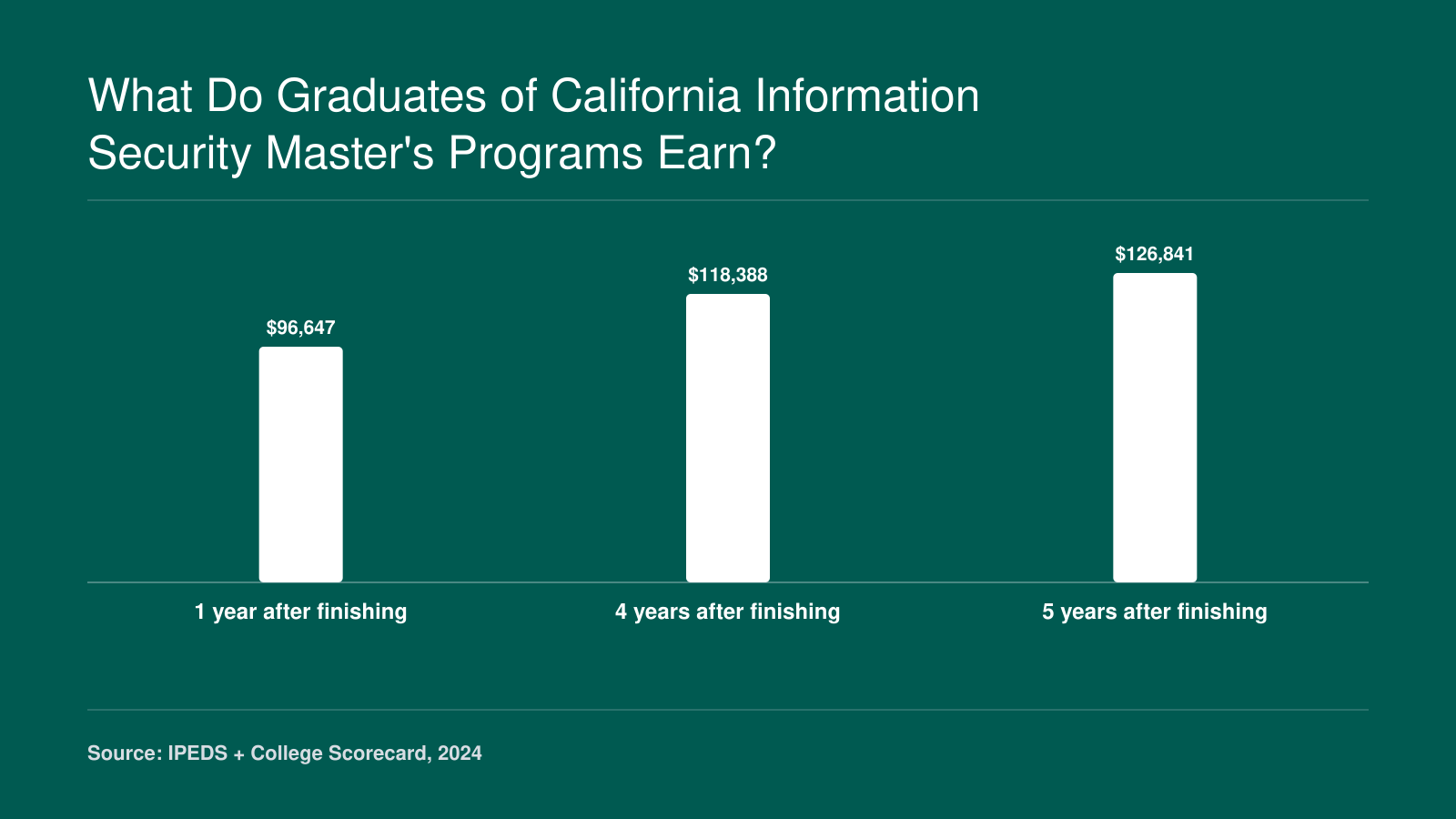
What Do Graduates of California Information Security Master's Programs Earn?
National University is the only school here with program-level earnings published for its information security master's, so it is the only one charted. Other schools are omitted rather than filled in with institution-wide figures. Each bar shows the program's median earnings for graduates who were working, at a different point after finishing.
Frequently Asked Questions About Information Security Master's Programs in California
Which California universities offer NSA CAE-designated master's programs?
How long does a master's in information security take in California?
Can I get in without a computer science background?
Compare Information Security & Assurance programs on the data that matters
Explore more Computers & IT specializations or browse every graduate field.
All Computers & IT programs