Best Master's in Information Security and Assurance Programs in Ohio
Compare 5 accredited Information Security & Assurance programs in Ohio, with graduate earnings, cost, debt, and completion data from IPEDS and the U.S. College Scorecard.

What does a master's in information security and assurance cost in Ohio, and how does it differ from a cybersecurity degree? Ohio hospitals, banks, state agencies and manufacturers need staff who can protect systems and data. Published program tuition at the schools here runs from $9,832 to $17,605.
Information security and assurance centers on protecting data, managing risk, and meeting policy and compliance demands. Cybersecurity leans toward technical defense of networks and systems. Most Ohio programs blend the two, whether the degree title says cybersecurity or Master's in Management Information Systems.
The course list and certification prep usually reveal more about a program than its name.
Key Points
- Tiffin and Franklin offer fully online cybersecurity master's programs with start dates throughout the year.
- GRE rules differ by school, so check each admissions page before applying for 2027.
- Compare per-credit cost, not headline tuition, because DeVry's lowest listed price covers 45 credits.
Ohio's Top-Ranked Master's in Information Security and Assurance Programs
These five Ohio master's programs range from a research-oriented engineering degree to fully online options built for working adults. Each card lists the program's structure, capstone or thesis options, and any concentration. Graduation rates are institution-wide figures for the whole school, not for the program.
University of Toledo
#1Toledo, OH · $18,000 – $29,000/yr (est.)
Best for: Engineering-minded students who want thesis research
The University of Toledo houses its M.S. in Cyber Security in the Department of Electrical Engineering and Computer Science, so the degree leans technical, with hardware security and cryptography electives. The school graduates about 57% of its students, an institution-wide figure. Students can finish with a thesis, a project, or a coursework capstone, and the professional capstone uses the university's Cyber Range. Research and professional tracks let you tilt toward either academic study or applied practice.
- 30 credit hours, on campus, with fall and spring starts
- Two tracks: research and professional
- Capstone choice: thesis, project, or coursework
- Professional capstone uses UToledo's Cyber Range
- Electives include cryptography, hacking and forensic analysis, wireless networks
- 2.8 GPA minimum and three letters of recommendation
- GRE listed; required for research-capstone applicants from non-U.S. institutions
- Combined BS-to-MS option; no fall or spring application deadline
Cleveland State University
#2Cleveland, OH · ~$11,000/yr (est.)
Best for: Career-changers without an IT background
Cleveland State University offers its security coursework inside the Master of Information Systems, housed in the Monte Ahuja College of Business. The security concentration combines core MIS courses with information security, advanced information security, and information systems auditing. The program runs fully online with rolling admissions and requires no prior IT background, which suits career-changers. The school graduates about 51% of its students, an institution-wide figure.
- 31 credit hours; fully online option available
- Security concentration is one of three customizable sub-tracks
- Choose a thesis, non-thesis, or internship track
- Security courses include information systems auditing
- Rolling admissions; preparatory support for non-IT majors
- Can earn a Certificate in Business Analytics
- STEM-designated; scholarships available
Tiffin University
#3Tiffin, OH · ~$17,000/yr (est.)
Best for: Busy professionals wanting fully asynchronous classes
Tiffin University's Master of Science in Cybersecurity is delivered fully online and asynchronously, so there are no set login times. The curriculum covers security operations, threat intelligence, governance, risk and compliance, and it uses frameworks such as NIST and MITRE ATT&CK. A required capstone project ends the degree. The school graduates about 40% of its students, an institution-wide figure. Employees of participating Ohio organizations may qualify for a reported $250-per-credit discount.
- 33 credit hours, 11 courses, $755 per credit
- 12-month pace with 7-week course terms
- Six start dates a year; fully online and asynchronous
- Capstone project required
- Covers cryptography, secure system design, risk assessment, SOC work
- Redesigned for 2025 with AI, quantum, and IoT topics
- Reported $250-per-credit discount for eligible Ohio employer partners
Franklin University
#4Columbus, OH · ~$12,000/yr (est.)
Franklin University's online M.S. in Cybersecurity is the lowest-priced program in this group, at $690 per credit, with a locked tuition rate. Coursework runs from cryptography and ethical hacking to information risk management and security governance. It is test optional and carries an NSA Center of Academic Excellence in Cyber Defense designation. The school graduates about 11% of its students, an institution-wide figure, so compare it with the program details here.
- 36 credit hours; about 16 months with 6- or 12-week courses
- $24,840 total program tuition; locked rate
- No entrance exam; test optional; 2.5 GPA minimum
- Finish with a research paper or a client-based capstone
- NSA Center of Academic Excellence in Cyber Defense
- Embedded certificates in cyber defense and governance
- Transfer up to 16 credits; credit for prior learning
- One program completion reported in federal data
DeVry University-Ohio
#5Columbus, OH · ~$10,000/yr (est.)
DeVry University's Master of Information Systems Management with an Information Security concentration pairs technical security with management skills. It is delivered online. You can earn a Cybersecurity and Information Assurance Graduate Certificate along the way, and you may waive up to five courses. The school graduates about 39% of its students, an institution-wide figure.
- 45 credit hours across 15 courses
- Capstone required
- Finish in as little as 1 year 4 months on an accelerated schedule
- May waive up to five courses
- Earn a cybersecurity graduate certificate along the way
- Topics: IT policy, data privacy, network security, governance
- Includes AI-literacy and project management skills
Cost & outcomes by school
Federal data for the highest-earning Information Security & Assurance programs, independent of the ranking above. Earnings are this field's master's graduates four years after completing, where the Scorecard reports them.
| School | Earnings | Tuition / yr | Debt | Grads/yr | Format |
|---|---|---|---|---|---|
| DeVry University-Ohio OH | — | $9,832 | — | — | Online |
| Cleveland State University OH | — | $11,297 | — | — | Online |
| Tiffin University OH | — | $17,000 | — | — | Online |
| Franklin University OH | — | $12,090 | — | 13 | Online |
| University of Toledo OH | — | $17,605 | — | 3 | Campus |
Sources: U.S. Department of Education. Tuition and graduates: IPEDS. Earnings and debt: College Scorecard, this field's master's graduates; a dash means no figure is reported.
Online and Hybrid Master's in Information Security Options in Ohio
Tiffin University runs its Master of Science in Cybersecurity, an information security and assurance degree, in 7-week terms with six start dates a year, and its asynchronous classes have no set login times. Franklin University's M.S. in Cybersecurity is also fully online, with 6- or 12-week courses and starts in spring, summer and fall. DeVry University-Ohio delivers its Master of Information Systems Management (Information Security) online on an accelerated schedule of about 1 year 4 months.
Cleveland State University lists a fully online option for its Master of Information Systems with an information security concentration. Confirm which format your cohort will follow. The University of Toledo's M.S. in Cyber Security is a campus program with fall and spring starts and hands-on training in its Cyber Range, so plan for in-person attendance there.
None of these online master's programs in Ohio clearly states an on-campus residency requirement. Still, ask about any lab or capstone requirements before you enroll.
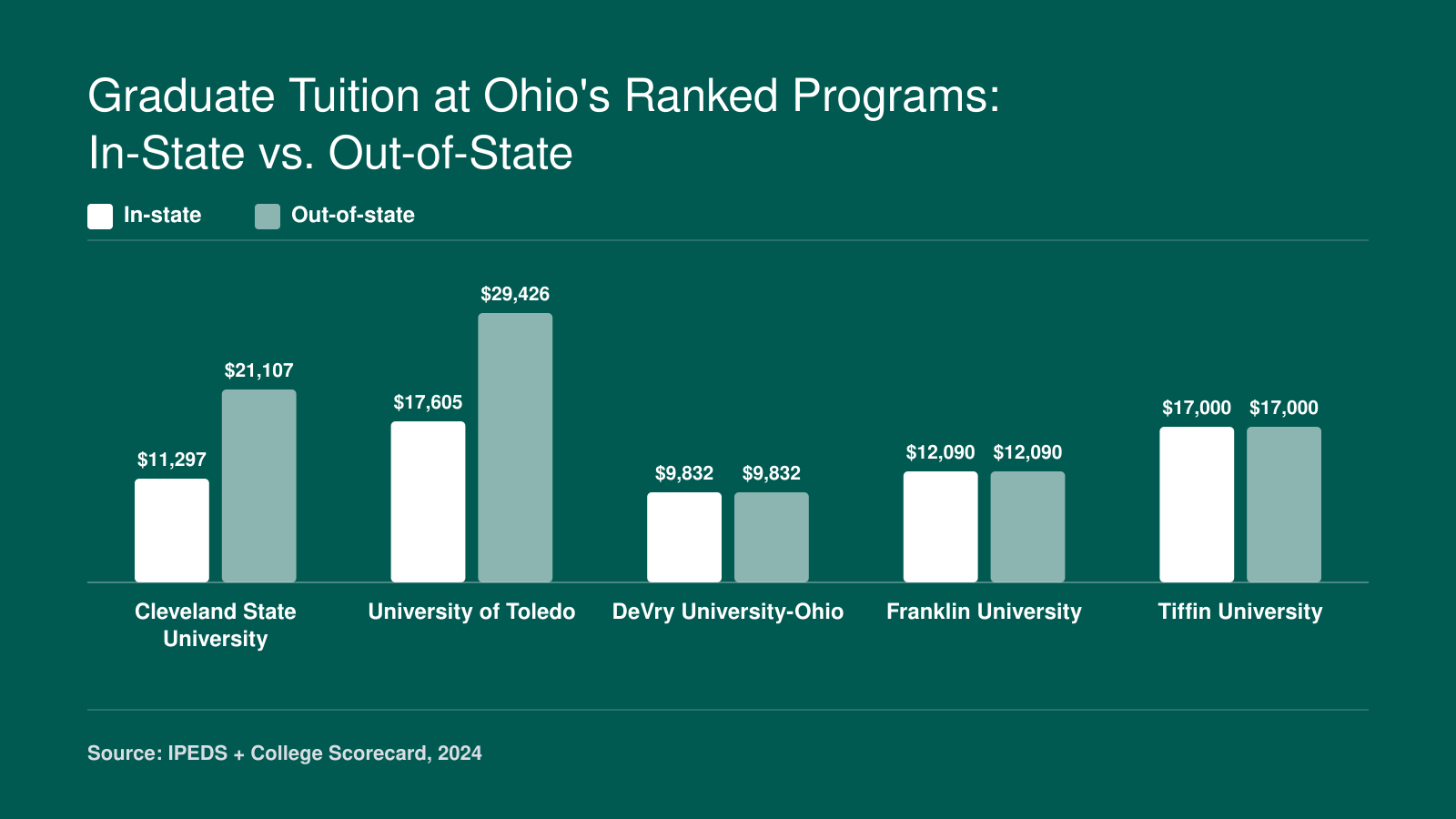
One practical check: ask whether online students pay the in-state rate. Tiffin, Franklin and DeVry charge the same tuition regardless of residency. Cleveland State and Toledo list higher out-of-state rates.
Which Ohio Master's Programs Waive or Make the GRE Optional?
Testing policies vary sharply here, so confirm the current requirement on each program's admissions page before you build an application timeline; for a broader list, see Master's in Information Security and Assurance Programs With No GRE Required.
- University of Toledo: The M.S. in Cyber Security does list an entrance exam, with the GRE named, alongside a 2.8 minimum GPA, prerequisite coursework, at least three recommendation letters (one from an employer or professor), and a statement of purpose answering a cyber security prompt.
- Franklin University: No entrance exam is required, and the M.S. in Cybersecurity is test optional, placing it among No-GRE master's programs. The published GPA floor is 2.5, with prerequisite coursework expected.
- Cleveland State University: The online Master of Information Systems uses rolling admissions and states that no prior IT background is required, with preparatory support for applicants from non-IT majors. Its materials do not publish a GRE requirement for this degree; note that Cleveland State's engineering departments run separate testing rules.1
- Tiffin University and DeVry University-Ohio: Neither program's published materials state a GRE policy, so ask admissions directly rather than assuming a waiver.
For career changers without a computing degree, Franklin and Cleveland State are the most forgiving entry points on paper.
Application Deadlines and Prerequisites to Check Before You Apply
Requirements differ by school, so confirm each item on the program's own admissions page for University of Toledo, Cleveland State University, Tiffin University, Franklin University and DeVry University-Ohio.
- Fall and spring deadlinesLook for priority and final dates for each start term. Some programs set fixed dates and others admit year-round.
- Rolling admissionWhere a school reviews files as they arrive, apply early. Ask admissions for the last practical date before a term starts.
- Prerequisite courseworkCompare your transcript against programming, networking, discrete math and statistics requirements at each school.
- Bridge or foundation coursesApplicants without a computing degree may be asked to finish these first. Ask whether they carry degree credit and add time or tuition.
- English proficiency for international applicantsCheck each school's published TOEFL or IELTS minimums before you pay for testing.
Cybersecurity Master's Tuition in Ohio and the Certifications That Add Value
What the Programs Cost
Compare published tuition figures first, then credit counts when evaluating cybersecurity master's degree cost and financial aid. DeVry University-Ohio shows the lowest listed figure, but its program runs 45 credits, so per-credit cost matters more than the headline for students comparing the Most Affordable Master's in Information Security and Assurance Programs. Cleveland State is the most affordable option with a distinct in-state rate: about $11,297 for residents versus $21,107 for nonresidents, a premium near $9,800. Toledo's gap is wider, roughly $17,605 versus $29,426. Franklin and Tiffin charge one rate regardless of residency.
For totals, Franklin lists $690 per credit across 36 credits, about $24,840. Tiffin lists $755 per credit across 33 credits, roughly $24,900, though rates can change, so confirm with the school. Net price figures are approximate institution-wide averages, not program-specific.
Aid and Credentials
Franklin supports employer reimbursement and military benefits, and it locks your tuition rate. Ask Toledo and Cleveland State about graduate assistantships.
Ohio does not license cybersecurity professionals. Employers look for certifications: CompTIA Security+, CISSP (a qualifying degree can substitute for one year of the experience requirement), and CISM. Franklin awards four credits for a current CISSP and says its program prepares students for the Certified Ethical Hacker exam. The other schools here publish no certification alignment I could confirm.
Graduate Tuition at Ohio's Ranked Programs: In-State vs. Out-of-State
These bars show published graduate tuition and fees for each school's program, not net price after aid. Your actual cost depends on scholarships, employer reimbursement, transfer credit and the credit hours you need. Franklin, DeVry and Tiffin charge the same rate to everyone, while Cleveland State and Toledo charge residents noticeably less. The figures are not total program cost, so check each school's per-credit rate and credit requirement before comparing.
Related Articles
NSA/DHS CAE Designations at Ohio Schools
The National Centers of Academic Excellence in Cybersecurity program is a joint NSA and Department of Homeland Security review that validates a school's cybersecurity curriculum against federal standards. There are three flavors: CAE-CD for cyber defense education, CAE-R for research institutions, and CAE-CO for the more specialized cyber operations track. Designations run in fixed windows rather than lasting forever, so check the validity dates before you treat one as a selling point.
Tiffin University is the designated school among those ranked here, holding CAE-CD with a validity period running from 2020 to 2031. Statewide, the official CAE community map lists 10 Ohio institutions as current, and none of the Ohio entries carry a CAE-CO designation.
Why it matters: CAE status is a gateway to CyberCorps Scholarship for Service funding and signals credibility to federal hiring managers. Separately, confirm any program you consider is accredited by the Higher Learning Commission.
Career Outcomes and ROI for Ohio Information Security Master's Graduates
The ROI question comes down to whether a master's costing $25,000 or more pays off quickly through entry-level wages or only over a longer climb into senior security roles. Federal data does not yet report median earnings or debt for graduates of these specific Ohio programs. The clearest yardstick is the state labor market: information security analysts in Ohio typically start around $65,117 a year, and senior roles exceed $145,261. Those are 2024 occupational figures, not salaries for any one program's graduates.
Against that range, tuition is the variable you control. Franklin University lists $24,840 in total program tuition at a locked rate, and Tiffin University charges $755 per credit across 33 credits. Tiffin also advertises a 97% job placement rate for its program. Before you weigh that figure, ask admissions which graduating class and time window it covers.
Your next step is to shortlist two or three programs by format and GRE policy, whether that means the Best Online Master's in Information Security and Assurance Programs or the Accelerated Master's in Information Security and Assurance Programs. Then set each one's total cost against that entry-level wage to see how quickly the degree could pay for itself.
Compare Information Security & Assurance programs on the data that matters
Explore more Computers & IT specializations or browse every graduate field.
All Computers & IT programs