Best Master's in Information Security and Assurance Programs in New York
Compare 12 accredited Information Security & Assurance programs in New York, with graduate earnings, cost, debt, and completion data from IPEDS and the U.S. College Scorecard.

Which master's in information security pays off in New York? New York's finance, healthcare, and government employers compete for security analysts, but programs vary sharply in cost, format, and NSA designation.
Median graduate debt at Columbia University in the City of New York is $82,682, while Fordham University graduates report $150,150 in median earnings four years out. The ranking below compares campus, online, and hybrid programs by graduate earnings, net price, and employer-recognized credentials. In this market, credential and debt load matter more than school prestige.
Key Points
- St. John's University-New York and Excelsior University offer fully online master's programs.
- Rochester Institute of Technology, St. John's, and Excelsior each advertise NSA/DHS Center of Academic Excellence designations.
- Four years out, Fordham graduates report $150,150 and Excelsior graduates report $135,961.
Top 10 Master's in Information Security and Assurance Programs in New York
This list covers campus, hybrid, and online master's programs across New York State, from Manhattan to Buffalo. Graduation rates cited on this page describe the institution as a whole, not completion in the specific program. Where program-level earnings or outcomes are not yet published, we say so rather than fill the gap.
Columbia University in the City of New York
#1New York, NY · ~$58,000/yr (est.)
Best for: Researchers wanting a CS security pathway
Columbia offers its security focus as a Computer Security pathway inside the MS in Computer Science, so you earn a general CS degree with a security specialization. The 30-point curriculum includes advanced technical coursework, faculty pathway advisors, and active research labs. It sits in New York City and offers a dual MS with Journalism. Federal data shows strong early earnings and employment for the school's computer and information sciences master's graduates, though that figure covers the broader field rather than the security pathway alone.
- Computer Security is one of 10 pathways in the MS in Computer Science
- 30 points of coursework, mostly at the 4000 level or above
- At least 6 points of advanced 6000-level technical courses
- Up to 3 points may come from outside computer science
- Faculty pathway advisors guide course selection
- Research opportunities through labs and groups
- Dual MS option with Journalism
- Campus-based in New York City
Binghamton University
#2Vestal, NY · $10,000 – $15,000/yr (est.)
Best for: Data-minded IT students targeting security operations
Binghamton's Cybersecurity concentration sits within its MS in Information Systems and leans toward the application and data side of security. Students build skills in networking, databases, scripting, and software testing, with an applied data science track available. Internships are common on campus, in New York City, and out of state. The campus is in Vestal, and it is one of the lower-tuition public options on this list for New York residents.
- Cybersecurity is one of 3 concentration options
- Covers networking, databases, and systems integration
- Scripting and software testing for large applications
- Focus on data mining and analytics alongside security
- Internships in NYC and out of state
- Career coaching through Watson Career and Alumni Connections
- Financial aid and scholarships available
- Campus-based in Vestal
University at Buffalo
#3Buffalo, NY · $10,000 – $15,000/yr (est.)
Best for: Future security managers and IT auditors
The University at Buffalo houses its security focus in the MS in Management Information Systems, blending technical skills with risk and management training. Coursework spans digital forensics, cloud security, cybersecurity analytics, IT risk management, and IS auditing. Graduates aim at roles such as information security manager, cyber-risk analyst, and IT auditor. It is a campus program in Buffalo, and course availability varies by semester.
- Focus area within the MS in Management Information Systems
- One of 6 concentration options
- Coursework in digital forensics and cloud computing security
- Covers IT risk management and IS auditing
- Vulnerability assessment and incident response training
- Prepares for security management and cyber-risk roles
- Course availability varies by semester
- Campus-based in Buffalo
Fordham University
#4Bronx, NY · ~$27,000/yr (est.)
Fordham's 30-credit MS in Cybersecurity runs about 12 months and is built for working professionals, with evening, weekend, online, and hybrid classes at its Lincoln Center campus in Manhattan. Students choose electives in cyber operations, AI in cybersecurity, or management, policy, and intelligence. Federal data shows solid early earnings and employment for graduates. The school lists rolling admissions with January and August 2027 starts.
- 30 credits across 10 courses, about 12 months
- Hybrid on-campus and online format
- Evening and weekend classes
- Elective clusters: cyber operations, AI, and policy and intelligence
- Capstone project or two-part thesis, internship optional
- Bridging courses for programming, statistics, and discrete math
- All undergraduate majors welcome
- Rolling admissions with January and August 2027 starts
CUNY City College
#5New York, NY · ~$11,000/yr (est.)
CUNY City College's Cybersecurity MS is housed in the Grove School of Engineering in Harlem. It was seed funded by the New York City Economic Development Corporation and shaped with private sector and government partners, who regularly help update the content. It has the lowest net price on this list, which makes it a strong value pick. Program-level earnings are not yet published.
- Housed in the Grove School of Engineering
- Seed funded by the NYC Economic Development Corporation
- Built with private sector and government partners
- Covers network design and architecture
- Applied use of cybersecurity tools and current technologies
- Classroom learning paired with internships
- Campus-based in New York City
Rochester Institute of Technology
#6Rochester, NY · ~$60,000/yr (est.)
RIT's 30-credit MS in Cybersecurity moves from enterprise security, cryptography, and system security into electives such as malware forensics, IoT security, and offensive security engineering. The program holds an NSA and DHS Center of Academic Excellence designation. Students finish with a thesis or capstone, and many add an optional paid co-op. The campus is in Rochester, and program-level earnings are not yet published.
- 30 credit hours with a 3.0 GPA minimum
- NSA and DHS Center of Academic Excellence designation
- Core courses in enterprise security, cryptography, and system security
- Electives include malware forensics and offensive security engineering
- Thesis or capstone option
- Optional paid co-op experience
- RITSEC club competes in national cyber defense competitions
- Campus-based in Rochester
St. John's University-New York
#7Queens, NY · ~$36,000/yr (est.)
St. John's offers a 30-credit MS in Cyber and Information Security that can be completed fully online or on the Queens campus. The program is NSA and DHS designated and offers three specializations: Cyber Security, Data and Analytics, or IT Enterprise. Students finish with a capstone or a six-credit thesis and can use the Sanford Family Cyber Lab. Full-time and part-time paths make it flexible for working students.
- 30 credits, as little as one year
- Fully online option or Queens campus
- 3 specializations: Cyber Security, Data and Analytics, IT Enterprise
- NSA and DHS designated program
- Capstone project or six-credit thesis
- Hands-on work in the Sanford Family Cyber Lab
- Full-time and part-time options
- Financial aid and scholarships available
Pace University
#8New York, NY · $30,000 – $35,000/yr (est.)
Pace's MS in Information Systems includes a Security and Information Assurance track at its New York City campus, bridging business and IT. The degree runs 30 to 36 credits, takes about 24 months, and offers three starts a year. Tuition is $1,730 per credit, with merit scholarships and graduate assistantships to offset cost. It is STEM designated and accepts military benefits.
- 9-credit specialization within a 30 to 36 credit degree
- About 24 months, full-time or part-time
- Fall, spring, and summer start dates
- Capstone required
- Cybersecurity and forensics labs
- $1,730 per credit tuition
- Merit scholarships up to $6,400 and graduate assistantships
- STEM designated, military benefits accepted
Excelsior University
#9Albany, NY
Excelsior University, based in Albany, delivers an online MS in Cybersecurity with an Information Assurance concentration. Courses are asynchronous and start every eight weeks, which suits working adults, and up to 15 credits can transfer in. The school is a designated Center of Academic Excellence in Cyber Defense. Federal data shows solid early earnings and employment for its graduates, and tuition and net price are not reported in the data we use.
- 30 credits, fully online option available
- Asynchronous courses starting every 8 weeks
- Transfer up to 15 credits
- Covers cyber defense mitigation and digital forensics
- Core classes in security policy and compliance
- Center of Academic Excellence in Cyber Defense
- Hybrid option with lab sessions in St. Petersburg, Florida
- Access to the National Cybersecurity Institute
Rensselaer Polytechnic Institute
#10Troy, NY · ~$64,000/yr (est.)
Rensselaer's Information Security concentration is part of its MS in Information Technology in Troy, which pairs management and technology courses with advanced security work. Most students finish in three semesters, and options include a professional or research track and a salaried summer co-op. Cohorts are small, and applicants need prior computer science, data structures, and algorithms coursework. Entrance exam scores are required for Troy applicants.
- One of 12 concentration options
- Three semesters, 10 total courses
- Professional and research track options
- Capstone required
- Salaried summer internship or co-op
- Option to add a second concentration
- Prior coursework in CS, data structures, and algorithms expected
- Entrance exam required for Troy applicants
Cost & outcomes by school
Federal data for the highest-earning Information Security & Assurance programs, independent of the ranking above. Earnings are this field's master's graduates four years after completing, where the Scorecard reports them.
| School | Earnings | Tuition / yr | Debt | Grads/yr | Format |
|---|---|---|---|---|---|
| Fordham University NY | $150,150 | $26,752 | $29,139 | 31 | Hybrid |
| Excelsior University NY | $135,961 | — | $27,333 | — | Online |
| DeVry College of New York NY | — | $9,832 | — | — | Online |
| Binghamton University NY | — | $13,950 | — | — | Campus |
| University at Buffalo NY | — | $14,530 | — | — | Campus |
| St. Joseph's University-New York NY | — | $23,278 | — | — | Campus |
| CUNY City College NY | — | $11,402 | — | 18 | Campus |
| Pace University NY | — | $30,770 | — | 80 | Campus |
| St. John's University-New York NY | — | $36,227 | — | 11 | Online |
| Rensselaer Polytechnic Institute NY | — | $64,054 | — | — | Campus |
| Rochester Institute of Technology NY | — | $60,052 | — | 41 | Campus |
| Columbia University in the City of New York NY | — | $57,973 | $82,682 | 89 | Campus |
Sources: U.S. Department of Education. Tuition and graduates: IPEDS. Earnings and debt: College Scorecard, this field's master's graduates; a dash means no figure is reported.
Online and Hybrid Master's Options Among New York's Ranked Programs
Two of the programs here are fully online master's programs in New York: St. John's University-New York's Cyber and Information Security M.S., which can be finished in as little as a year across 30 credits, and Excelsior University's M.S. in Cybersecurity, built on asynchronous courses that start every eight weeks and accept up to 15 transfer credits. Fordham University's Cybersecurity M.S. is the hybrid option, mixing on-campus and online coursework with evening and weekend classes over 12 months.
The rest are campus-based: Columbia University, CUNY City College, Pace University, Binghamton University, University at Buffalo, Rochester Institute of Technology, and Rensselaer Polytechnic Institute.
Matching format to your situation
Working analysts already employed in the city tend to do better with Fordham's evening schedule or asynchronous online cybersecurity master's programs. Career changers usually get more from campus programs, where lab access, co-ops, and on-site recruiting do real work: RIT offers an optional paid co-op, and Pace runs faculty-led tech labs.
Geography matters too. Binghamton (Vestal), Buffalo, RIT (Rochester), RPI (Troy), and Excelsior (Albany) sit well outside the NYC metro. See the cost section for how online tuition compares.
Which Ranked New York Master's Programs Waive or Make the GRE Optional
Testing policies vary across the cybersecurity master's programs with no GRE requirement covered here, so it helps to group them by how much weight they place on the GRE.
GRE Not Required
Binghamton University's Watson College is among the No-GRE master's programs in this guide, making the GRE optional for master's applicants entering in spring and fall 2026, though scores are recommended for anyone pursuing a graduate assistantship.1 Policies can differ by individual program, and no separate GMAT policy is established.
GRE Optional or Waivable
St. John's University-New York lists an entrance exam among its requirements, so applicants should confirm whether a current waiver applies to their track. Rensselaer Polytechnic Institute's information security master's lists both the GRE and GMAT as accepted entrance exams, giving applicants a choice of test.
Policy Not Published
Several ranked schools, including Columbia University, University at Buffalo, Fordham University, CUNY City College, Rochester Institute of Technology, Pace University, Excelsior University, St. Joseph's University-New York, and DeVry College of New York, do not publish a clear GRE or GMAT policy on the program pages reviewed. Rather than guess, treat these as unconfirmed and ask admissions directly.
Test requirements change from one entry term to the next, so verify the policy for the exact term you plan to start.
Master's Admissions Checklist for New York Information Security Programs
Requirements differ by school, so confirm each on the official program page before you apply.
- Bachelor's degree and GPAA completed bachelor's degree is the baseline. Minimum GPA expectations vary, so check each program page.
- Prerequisite courseworkApplicants from non-technical backgrounds may need programming, networking, or discrete math before starting core courses.
- Resume, statement, and recommendationsExpect a current resume and a statement of purpose. Recommendation requirements differ by school. Some programs also look for professional experience.
- English proficiencyInternational applicants generally need to submit approved test scores.
- DeadlinesPace University: fall Aug 1 (domestic) or Jun 1 (international); spring Dec 1 or Oct 1; summer May 1 or Mar 1. CUNY City College: June 12 for fall 2026. Closing dates for later cycles were not yet published.
- Credits and part-time pacePace lists 30 credits and 24 months, full- or part-time, with no separate part-time timeline. Fordham University requires 30 credits over 10 courses and publishes no part-time duration. At CUNY City College, full-time study can finish in three semesters.
Related Articles
NSA Designations and Accreditation for New York Master's Programs
Rochester Institute of Technology, St. John's University-New York, and Excelsior University each advertises an NSA/DHS National Center of Academic Excellence designation. Excelsior names the Cyber Defense (CAE-CD) category. RIT and St. John's do not state a category or valid-through date in their program descriptions, so confirm current status on the official CAE roster before you rely on it. No current designation could be confirmed for the other ranked schools, though that is not proof none exists.
CAE status matters for two reasons. It signals to federal agencies and contractors that a curriculum meets national standards, and it is the usual route to the CyberCorps Scholarship for Service, which pays tuition and a stipend in exchange for government work after graduation.
Curriculum focus matters too. University at Buffalo's information security, resiliency and risk focus and Pace University's security and information assurance track lean toward governance, risk and compliance, the managerial emphasis found in many top MIS master's programs in New York. RIT and CUNY City College stress hands-on defense of networked systems, closer to a technical cybersecurity degree and distinct from the leadership orientation of many Master's in IT Management in New York programs.
New York institutions are typically accredited by the Middle States Commission on Higher Education. Verify each school's status directly. St. John's also reports ABET accreditation for its program and cites a #8 ranking among top cybersecurity colleges.
Certification and Licensure in New York
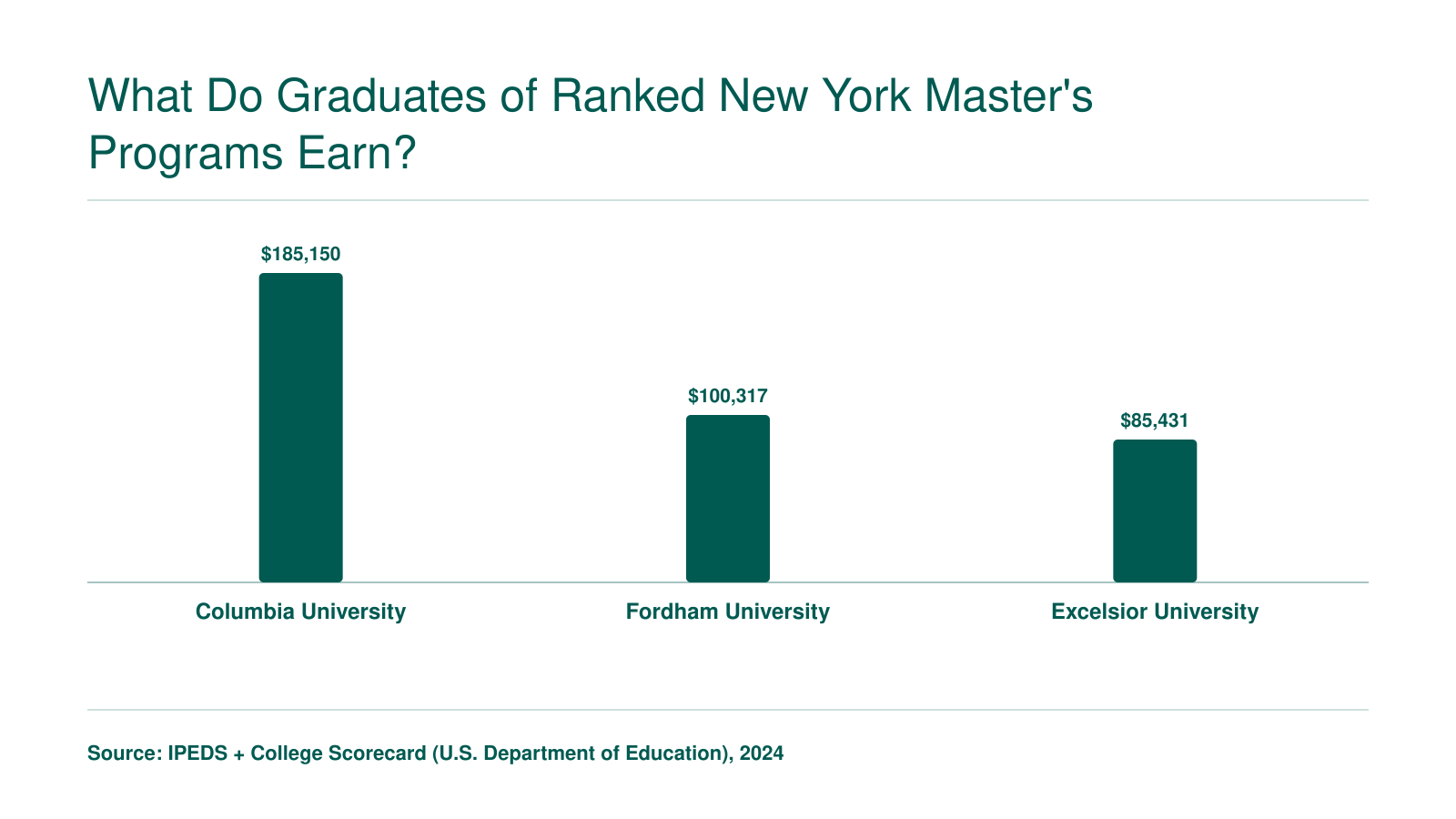
What Do Graduates of Ranked New York Master's Programs Earn?
The bars show median program-level earnings one year after graduates finish. Four years out, Fordham University graduates report $150,150 and Excelsior University graduates report $135,961. Median program debt is $82,682 at Columbia University in the City of New York, $29,139 at Fordham University, and $27,333 at Excelsior University. These are medians for each school's listed program, not institution-wide figures, and programs without a published program-level figure are not charted.
Compare Information Security & Assurance programs on the data that matters
Explore more Computers & IT specializations or browse every graduate field.
All Computers & IT programs