Best Master's in Information Security and Assurance Programs in Wisconsin
Compare 8 accredited Information Security & Assurance programs in Wisconsin, with graduate earnings, cost, debt, and completion data from IPEDS and the U.S. College Scorecard.

A master's in information security and assurance trains you to protect systems and data through technical controls, risk management, and policy. Wisconsin's programs share that aim but differ sharply in format, admissions, and price, including master's in information security and assurance programs with no GRE required.
Delivery spans fully online, hybrid, and campus options. Annual in-state tuition and fees run from $8,270 at UW-Parkside to $51,170 at Marquette.
Security employers weigh certifications and hands-on skills heavily, so price alone rarely signals quality.
Key Points
- Most Wisconsin programs here skip the GRE, including UW-La Crosse, UW-Platteville, UW-Green Bay, and UW-Parkside.
- UW-Green Bay's collaborative online cybersecurity master's charges $850 per credit, or $26,350 over 31 credits.
- Fully online options span six UW campuses, while Marquette's program runs hybrid.
Ranked Wisconsin Master's in Information Security and Assurance Programs
These Wisconsin master's programs are listed in rank order, balancing cost, graduate outcomes, and whether you can study on campus, online, or in a hybrid format. Graduation rates shown are institution-wide figures, not rates for the security program itself, and net price is an approximate institution-wide average. Most programs here are labeled cybersecurity, so check each curriculum to see how much is information assurance and how much is general security.
University of Wisconsin-La Crosse
#1La Crosse, WI · $10,000 – $15,000/yr (est.)
Best for: Students choosing between systems and forensics tracks
UW-La Crosse offers a 31-credit online Master of Science in Cybersecurity with a technical core in network security, cyber crime, and ethics. Students choose one 12-credit track, secure systems design or digital forensics and security management, then finish with a pre-capstone and capstone. Applicants need a bachelor's degree, a 3.00 undergraduate GPA, and prior programming plus calculus or statistics coursework. The program is part of the UW System cybersecurity collaborative, and published research indicates the GRE is not required.
- 31 total credits with a capstone
- Two 12-credit tracks: secure systems design or digital forensics
- Prerequisite: programming plus calculus or statistics, C or better
- 3.0 GPA minimum for admission
- Must finish within seven years
- Delivered online
University of Wisconsin-Platteville
#2Platteville, WI · $10,000 – $20,000/yr (est.)
Best for: Full-time employees needing asynchronous coursework
UW-Platteville's fully online, asynchronous M.S. in Cybersecurity is designed around people working full time. The 31-credit curriculum covers network security, cryptography, risk management, and cyber crime, and it is aligned with CAE-CD requirements. Applicants submit a personal statement of up to 1,000 words, and published research indicates no GRE or GMAT scores are required.
- 31 credits, fully online and asynchronous
- Two emphases: Secure Systems Design or Digital Forensics & Security Management
- Curriculum aligned with CAE-CD requirements
- Project-based capstone
- Up to 12 credits can be taken as a special student
- Personal statement of up to 1,000 words
University of Wisconsin-Whitewater
#3Whitewater, WI · $10,000 – $15,000/yr (est.)
Best for: Career changers wanting frequent start terms
UW-Whitewater runs a 30-credit online Master of Science in Cybersecurity taught by faculty from IT and computer science, with an AACSB-accredited business school behind it. Students choose between Cyber Resilience and Security Engineering emphases. The curriculum aligns with the National Centers of Academic Excellence framework, and tuition is the same for in-state and out-of-state students.
- 30 credits: 15 core plus 15 emphasis
- Emphases: Cyber Resilience or Security Engineering
- Starts spring, summer, or fall
- Asynchronous online delivery
- Tuition starts at $722 per credit for 2026-27
- CAE-aligned curriculum
University of Wisconsin-Green Bay
#4Green Bay, WI · ~$10,000/yr (est.)
UW-Green Bay delivers the online M.S. in Cybersecurity through the UW Online Collaboratives, drawing on faculty from across Wisconsin and pairing students with success coaches. The Secure System Design track focuses on analyzing networks and applications and engineering defenses. It accepts students from any major, though prerequisite courses are required, and tuition is a locked flat rate for residents and non-residents alike.
- Flat $850 per credit, in-state and out-of-state
- Locked tuition rate
- Two concentration options; this one is technical defense
- Open to any undergraduate major, with prerequisites
- Military benefits accepted
- Success coaches provided
University of Wisconsin-Madison
#5Madison, WI · ~$12,000/yr (est.)
UW-Madison's MS in Information is the only campus-based program on this list, and its Human Factors in Cybersecurity concentration pairs technical defense with psychology, usability, data privacy, and ethics. A required internship adds hands-on experience. It has the highest institution-wide graduation rate here, though out-of-state tuition is steep. No entrance exam is required.
- Human Factors in Cybersecurity concentration
- 30 credits, about three semesters full time
- Part-time option spread over three to four years
- Required internship
- No entrance exam required
- Fall start only
- 3.0 GPA and two letters of recommendation
Marquette University
#6Milwaukee, WI · ~$25,000/yr (est.)
Marquette is the private option on the list, with an Information Assurance and Cyber Defense concentration inside its M.S. in Computer and Information Science. A required practicum gives students hands-on defense experience. It can be taken on campus or fully online, with evening, blended, synchronous, and asynchronous options. The GRE is optional, and tuition is a single rate for all students.
- 33 credits, thesis or capstone option
- Required hands-on practicum
- Campus, hybrid, or fully online delivery
- Evening and blended class options
- GRE optional
- Employer tuition reimbursement supported
- Program founded in 2001
University of Wisconsin-Superior
#7Superior, WI · $10,000 – $19,000/yr (est.)
UW-Superior offers a fully online cybersecurity master's with four tracks: Digital Forensics, Cyber Response, Governance & Leadership, and Security Architecture. That is the widest choice of specializations among the Wisconsin programs ranked here. Prior work and life experience can be turned into graduate credit, and published research indicates GRE and GMAT scores are not required.
- Four tracks: Digital Forensics, Cyber Response, Governance & Leadership, Security Architecture
- Fully online
- Prior learning credit accepted
- Part of the UW cybersecurity collaborative
- Flat per-credit tuition for residents and non-residents
University of Wisconsin-Parkside
#8Kenosha, WI · ~$10,000/yr (est.)
UW-Parkside's online M.S. in Cybersecurity lets students specialize in Digital Forensics, learning to investigate breaches and recover digital evidence. It is fully online and aimed at working adults moving toward roles such as information security analyst, network architect, or systems administrator. It belongs to the same UW collaborative as several other programs here, and published research indicates no GRE or GMAT is required.
- Digital Forensics concentration
- Fully online format
- Foundation in governance, security architecture, and cyber response
- Career paths: security analyst, network architect, systems administrator
- Part of the UW cybersecurity collaborative
Cost & outcomes by school
Federal data for the highest-earning Information Security & Assurance programs, independent of the ranking above. Earnings are this field's master's graduates four years after completing, where the Scorecard reports them.
| School | Earnings | Tuition / yr | Debt | Grads/yr | Format |
|---|---|---|---|---|---|
| University of Wisconsin-Superior WI | — | $9,658 | — | — | Online |
| University of Wisconsin-Madison WI | — | $12,325 | — | — | Campus |
| Marquette University WI | — | $24,680 | — | — | Hybrid |
| University of Wisconsin-Whitewater WI | — | $10,543 | — | 24 | Online |
| University of Wisconsin-Green Bay WI | — | $10,244 | — | 5 | Online |
| University of Wisconsin-Parkside WI | — | $10,184 | — | 2 | Online |
| University of Wisconsin-Platteville WI | — | $10,049 | — | — | Online |
| University of Wisconsin-La Crosse WI | — | $10,832 | — | 2 | Online |
Sources: U.S. Department of Education. Tuition and graduates: IPEDS. Earnings and debt: College Scorecard, this field's master's graduates; a dash means no figure is reported.
Online and Hybrid Information Security Master's Options in Wisconsin
Working professionals can complete most of the online master's in information security and assurance programs on this page fully online. The fully online group includes UW-La Crosse, UW-Platteville, UW-Whitewater, UW-Green Bay, UW-Superior, and UW-Parkside. Marquette's program is hybrid, while UW-Madison's campus Information master's with the Human Factors in Cybersecurity concentration is campus-based. The UW Extended Campus collaborative cybersecurity master's is the shared online model: multiple University of Wisconsin campuses deliver one fully online, asynchronous 31-credit curriculum, with no set login times. UW-Platteville also states its online classes are asynchronous. Partner campuses cite part-time completion around two to three and a half years.1 UW-La Crosse describes the degree as a two-year commitment with fall, spring, and summer starts, and UW-Whitewater's 30-credit online MS is asynchronous with no campus requirement. UW-Green Bay's online option lets students work on their own schedule as well. Marquette's hybrid option includes synchronous and asynchronous online courses. For students who want lab access, research assistantships, or local employer networking, UW-Madison's campus program tends to fit best.
Which Wisconsin Master's Programs Waive or Skip the GRE
Most ranked Wisconsin cybersecurity master's programs are master's programs with no GRE required. UW-La Crosse, UW-Platteville, UW-Green Bay and UW-Parkside all admit without the GRE or GMAT, as does the UW Extended Campus collaborative Master of Science in Cybersecurity that several of these campuses deliver jointly.1 UW-Madison's information master's lists no entrance exam. Marquette's computer and information science master's is test optional.
UW-Whitewater's published admissions material points applicants to general graduate admission criteria without stating a program-specific GRE policy or minimum GPA, so confirm directly with the department.2 UW-Superior likewise does not publish a stated policy on the pages reviewed.
GPA and course prerequisites
A 3.0 undergraduate GPA is the common bar for these information security and assurance master's programs at UW-La Crosse, UW-Platteville, UW-Green Bay and the collaborative program.1 UW-Platteville applies that 3.0 to the program specifically, above its general graduate standard.3 UW-Parkside states no minimum.
Expect prerequisite coursework rather than a test: introduction to computer science with real programming, plus calculus or statistics. UW-Whitewater's requirements shift by emphasis, with intermediate programming reserved for security engineering, and prerequisite courses are available to applicants missing the basics.2 UW-Green Bay may admit promising applicants provisionally while they finish those foundations.
Related Articles
What a Master's in Information Security Costs in Wisconsin, and Whether You Need a License
Wisconsin's cybersecurity master's pricing has moved toward flat online rates that ignore where you live. The collaborative online MS in Cybersecurity, offered through UW-Green Bay, charges $850 per credit. At 31 credits that totals $26,350, with no program fees; the Universities of Wisconsin list $688 in segregated fees for 2026-27 (textbooks are extra).2 UW-Whitewater lists $722 per credit for 2026-27, or $21,660 across 30 credits. That is a starting rate, so check for added fees.
The annual in-state and out-of-state tuition figures in the Master's Programs in Wisconsin ranking data run roughly $9,700 to $10,500 versus $18,800 to $20,800. For these online programs, the flat rate makes that gap irrelevant. Net price is an approximate institution-wide average after aid, not a program quote.
Licensing and credentials
Wisconsin issues no state license for information security professionals.3 Employers instead look to certifications such as CISSP, CISM, or Security+.
You may still meet other requirements:
- Defense work: Contractors often require a baseline certification under DoD 8140/8570, plus an employer-sponsored security clearance.
- State government: Individual job postings set their own requirements.
- Insurance: Wisconsin-domiciled insurance licensees file an annual information-security compliance certification by March 1.3 That is a company obligation, not a professional license.
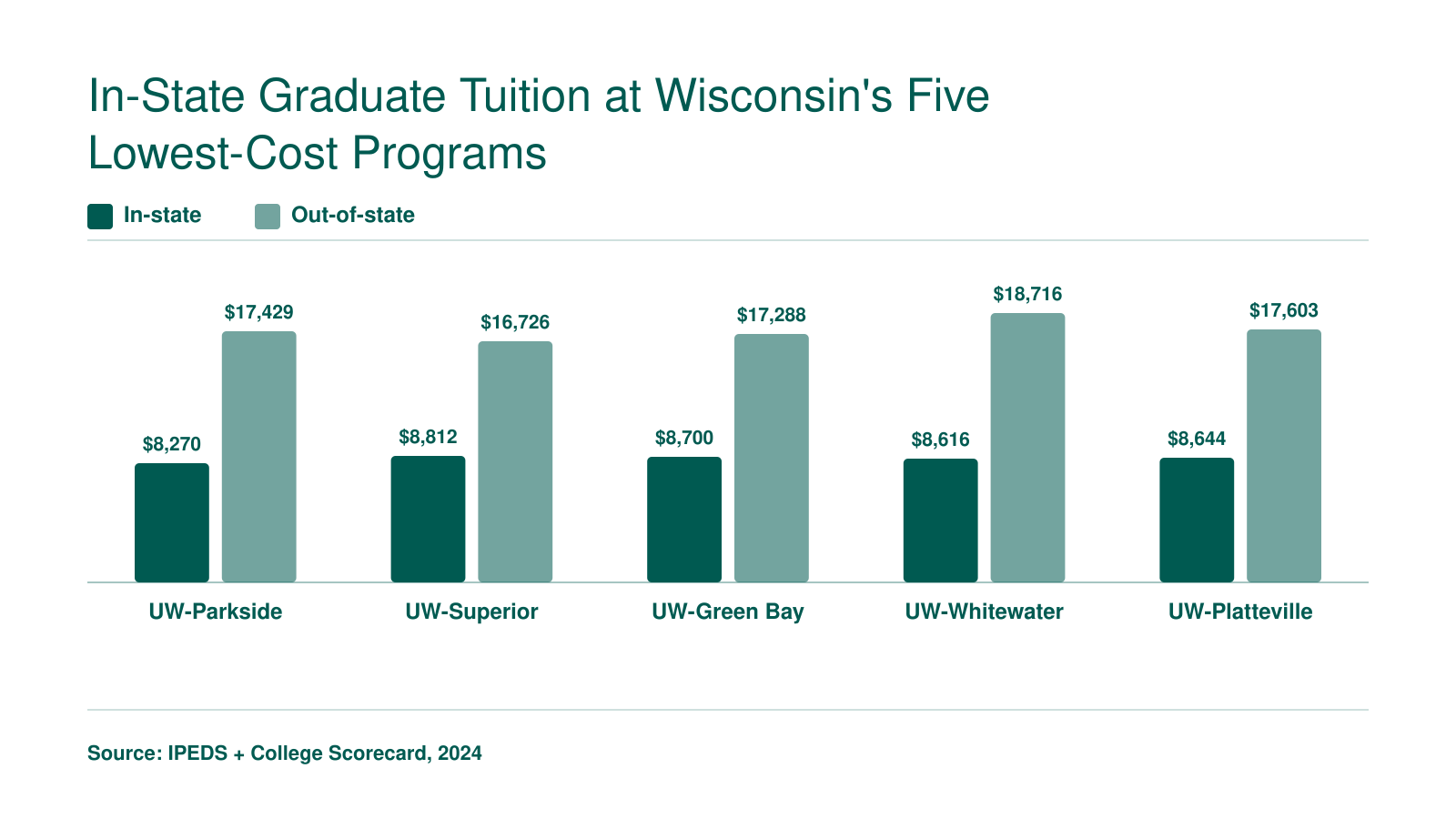
In-State Graduate Tuition at Wisconsin's Five Lowest-Cost Programs
Public Wisconsin master's programs in information security are priced well below many private options, and the in-state and out-of-state gap is modest at several schools. UW-Parkside has the lowest in-state figure here, followed closely by UW-Superior, UW-Green Bay, UW-Whitewater, and UW-Platteville.
CISSP, CISM, and Security+: Matching a Wisconsin Master's to Your Certification Goals
A governance track and a technical track point at different certifications, and that distinction should drive your choice more than the degree name does.
UW-Green Bay and UW-Platteville both describe cybersecurity master's curricula built in alignment with CAE-CD requirements and with the domains behind CISM, CISSP, CEH, and CompTIA Security+.1 Alignment is not the same as official exam prep, and neither school's published material establishes that the master's itself currently holds an NSA/DHS CAE-CD designation or that the degree secures any certification eligibility waiver. Treat the overlap as a study head start, not a shortcut.
Matching track to credential
- Assurance, governance, and risk: Green Bay's Governance & Leadership and Cyber Response concentrations, plus coursework in compliance, risk management, strategic planning, and legal and ethical issues, line up with CISM-style managerial work.
- Technical and architecture: Security Architecture, Digital Forensics, and Secure Systems Design concentrations sit closer to hands-on Security+ and CEH territory.
Quick rule: a career changer chasing Security+ should take the lowest-cost online technical track available among the Most Affordable Master's in Information Security and Assurance Programs; a mid-career manager targeting CISM should pay for the governance concentration and skip the forensics electives.
Compare Information Security & Assurance programs on the data that matters
Explore more Computers & IT specializations or browse every graduate field.
All Computers & IT programs