Best Master's in Information Security and Assurance Programs in Maryland
Compare 8 accredited Information Security & Assurance programs in Maryland, with graduate earnings, cost, debt, and completion data from IPEDS and the U.S. College Scorecard.

Maryland sits beside Fort Meade, home to the NSA and U.S. Cyber Command, so local employers hire security graduates in steady numbers, many for roles that require clearance and DoD-approved certifications.
The programs here mix campus, online, and hybrid formats. Tuition and outcomes vary widely: among the most affordable master's in information security and assurance programs, UMGC and UMES cost far less than Johns Hopkins, which publishes the strongest earnings figures.
A CAE designation or a famous name matters less than whether the specific degree fits the job you want.
Key Points
- Maryland has no state cybersecurity license, so Security+ and CISSP baselines drive federal hiring.
- Johns Hopkins MSSI does not require the GRE, easing the application.
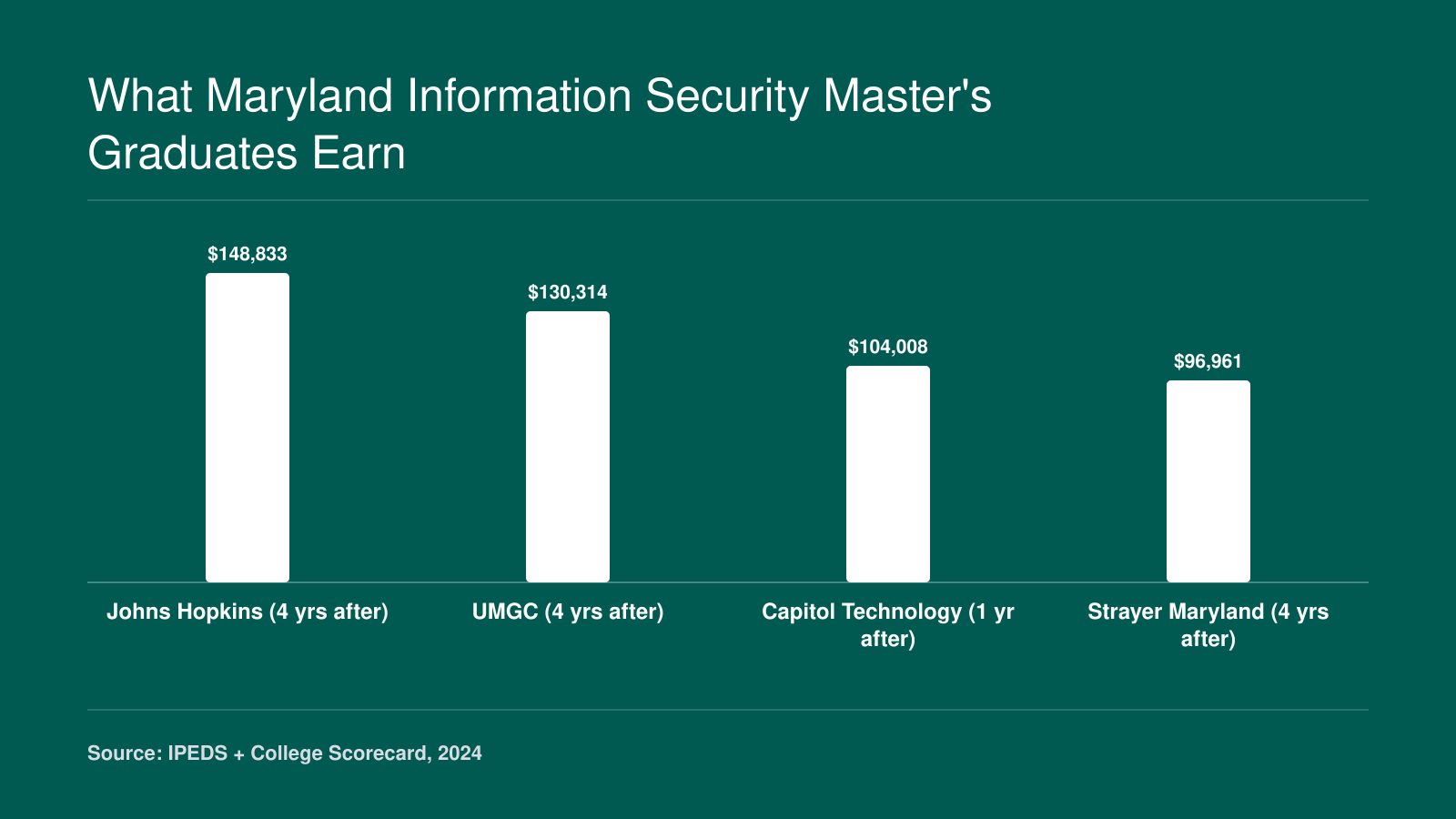
- Compare earnings only within the same measurement window, since Capitol is measured one year out.
Best Master's in Information Security and Assurance Programs in Maryland, Ranked
These Maryland programs cover campus, online, and hybrid formats, so you can compare them side by side. Graduation rates are institution-wide, not specific to the security program, so treat them as context rather than a program outcome. Deadlines below come from each school's admissions pages. Several sites list future terms, so confirm dates before you apply.
Johns Hopkins University
#1Baltimore, MD · ~$65,000/yr (est.)
Best for: Full-time students seeking research immersion
Johns Hopkins runs its Master of Science in Security Informatics as a full-time, on-campus program at the Homewood campus in Baltimore. It takes three semesters and includes a lab open around the clock, course assistant roles, and a newer dual-master's option with the M.S.E. in Computer Science. Admission starts in spring or fall. The retrieved pages list November 15 for Spring 2027 and March 15 for Fall 2027, and they do not list GRE scores or an application fee as requirements.
- Three-semester, full-time program on the Homewood campus
- Security informatics coursework, research, and professional development
- Lab open 24 hours a day with individual and team workspaces
- Course assistant roles pay $9 to $15 per hour
- Head TA positions pay $3,000 per course
- Dual-master's option with the M.S.E. in Computer Science, case-by-case admission
- Spring and fall starts; GRE not required
University of Maryland-Baltimore County
#2Baltimore, MD · $15,000 – $20,000/yr (est.)
Best for: Working professionals wanting hybrid flexibility
UMBC's Master of Science in Cybersecurity is a 30-credit program in Computer Science and Electrical Engineering, with an Information Assurance concentration. It is offered at the Catonsville campus and at Shady Grove in Rockville, and since fall 2025 the required courses are available online and on campus. Starts are fall and spring, and the GRE is not required. The program page lists a fall domestic deadline of August 15 and a spring domestic deadline of December 1. The professional-programs page gives a fall final deadline of August 1, so confirm the date with admissions.
- 30 credit hours, about three years part-time
- Information Assurance concentration
- NSA/DHS Center of Academic Excellence program
- Fully online option; hybrid and online course formats
- Campuses in Catonsville and Rockville (Shady Grove)
- Fall and spring starts; GRE not required
- Ten miles from Fort Meade
Capitol Technology University
#3Laurel, MD · ~$12,000/yr (est.)
Best for: Online learners targeting CISSP-aligned coursework
Capitol Technology University in Laurel delivers its Master of Science in Information Assurance fully online. The 36-credit curriculum covers all ten CISSP domains and carries the NSA/DHS Center of Academic Excellence designation. Evening lectures are recorded, there is no residency requirement, and up to nine graduate credits can transfer in. We did not find a published deadline or start schedule in our research, so check Capitol's admissions page for current terms.
- 36 credit hours, fully online
- Covers all ten CISSP domains
- NSA/DHS Center of Academic Excellence designation
- Synchronous and asynchronous options; lectures recorded
- No residency requirement
- Up to nine graduate credits may transfer
University of Maryland Global Campus
#4Adelphi, MD · ~$10,000/yr (est.)
UMGC offers an online MS in Information Technology with an Information Assurance specialization, built for working adults. Coursework covers firewalls, VPNs, wireless security, cryptanalysis, and risk assessment, and it prepares students for CISSP and Security+. The program carries the NSA/DHS designation and the Professional Science Master's label. Our research did not confirm a published deadline, so check UMGC admissions for current start terms.
- Fully online Information Assurance specialization
- Prepares for CISSP and Security+ certifications
- NSA/DHS cybersecurity designation
- Professional Science Master's degree
- Covers firewalls, VPNs, wireless security, and cryptanalysis
- Noncredit prep courses available
University of Maryland Eastern Shore
#5Princess Anne, MD · ~$8,000/yr (est.)
University of Maryland Eastern Shore, in Princess Anne, offers an online Master of Science in Applied Cybersecurity Engineering. The 36-credit degree includes 21 credits of technical electives such as cryptography, intrusion detection, and critical infrastructure protection, and ends in a capstone seminar. Applicants generally need a technology-related bachelor's degree and three letters of recommendation. Our research did not confirm a published deadline, so check UMES admissions.
- 36 credit hours, fully online
- 21 credits of technical electives
- Capstone seminar required
- Technology-related bachelor's degree expected
- Minimum of three letters of recommendation
- 18 credits at the 600 level or above
University of Maryland-College Park
#6College Park, MD · ~$18,000/yr (est.)
The University of Maryland, College Park offers cybersecurity through a Cybersecurity and Risk Management track inside the Master of Information Management, not a separately titled cybersecurity degree. The two-year campus program blends technical and managerial skills and ends in an industry capstone. The retrieved admissions page lists Fall 2027 only, with a priority deadline of January 29, 2027 and a final deadline of July 9, 2027.
- Two-year campus program
- Courses in cyberdefense and ethical hacking
- Information risk management and human-centered cybersecurity
- Information governance coursework
- Industry capstone required
- Fall entry; page lists Fall 2027 dates
Strayer University-Maryland
#7Baltimore, MD · ~$15,000/yr (est.)
Strayer University's Maryland campus offers the online Master of Science in Cybersecurity, formerly titled Information Security and Assurance. It requires 45 quarter credits and a capstone, follows NICE/NIST guidance, and has an NSA CAE-CD designation. Courses embed IT certification training and micro-credentials. Our research did not confirm a published deadline, so check Strayer's admissions page for start dates.
- 45 quarter credits, fully online
- Capstone required
- NICE/NIST-guided curriculum
- NSA Center of Academic Excellence in Cyber Defense designation
- Micro-credentials and embedded certification training
- Formerly named Information Security and Assurance
Bowie State University
#8Bowie, MD · ~$11,000/yr (est.)
Bowie State University offers an on-campus Master of Science in Information Systems & Sciences with an Information Assurance concentration. The curriculum follows CNSS 4011 standards and covers security architecture, auditing, and risk management. It supports BRAC-affected personnel and holds an NSA/DHS Center of Academic Excellence designation. Our research did not confirm a published deadline, so check Bowie State's graduate admissions page.
- On-campus Information Assurance concentration
- Curriculum driven by CNSS 4011 standards
- NSA/DHS National Center of Academic Excellence
- Courses on designing, auditing, and securing systems
- Developed with Maryland Higher Education Commission grant support
- Supports BRAC-affected personnel
Cost & outcomes by school
Federal data for the highest-earning Information Security & Assurance programs, independent of the ranking above. Earnings are this field's master's graduates four years after completing, where the Scorecard reports them.
| School | Earnings | Tuition / yr | Debt | Grads/yr | Format |
|---|---|---|---|---|---|
| Johns Hopkins University MD | $148,833 | $64,730 | — | 85 | Campus |
| University of Maryland Global Campus MD | $130,314 | $9,882 | $35,875 | 895 | Online |
| Strayer University-Maryland MD | $96,961 | $15,135 | $75,331 | 3 | Online |
| Bowie State University MD | — | $10,854 | — | — | Campus |
| University of Maryland-Baltimore County MD | — | $16,524 | — | — | Campus |
| University of Maryland-College Park MD | — | $18,276 | — | — | Campus |
| University of Maryland Eastern Shore MD | — | $8,010 | — | 4 | Online |
| Capitol Technology University MD | — | $12,060 | — | 25 | Online |
Sources: U.S. Department of Education. Tuition and graduates: IPEDS. Earnings and debt: College Scorecard, this field's master's graduates; a dash means no figure is reported.
Online and Hybrid Master's in Information Security Options in Maryland
The real choice here is whether you need to set foot on a campus at all, or whether you want the option. Delivery format varies more than the course lists do, so it pays to confirm how each Master's in Information Security and Assurance program actually runs before you compare.
Fully online options
UMGC runs its M.S. in Cybersecurity Technology fully online, with select hybrid courses also available. Its M.S. in Cybersecurity Management and Policy follows the same pattern for students enrolling in 2026-2027, with UMGC listing Adelphi as its Maryland base. Published materials do not establish a required campus residency or fixed live-session schedule for these programs.
Hybrid and campus options
UMBC's M.S. in Cybersecurity is a hybrid master's degree in cybersecurity, taught at its Catonsville campus and the Shady Grove site in Rockville, as well as online. Beginning Fall 2025, required courses became available in both formats, so domestic students can finish fully online. Applicants pick a campus on the application. International students needing visa status face an in-person attendance condition that online coursework cannot replace.
Which Maryland Master's Programs Waive or Make the GRE Optional
Which cybersecurity master's programs in Maryland let you skip the GRE? Several of the schools here have already dropped or softened the requirement, and they appear on the Master's in Information Security and Assurance Programs With No GRE Required list.
No-GRE and optional-test policies
- Johns Hopkins MSSI: The GRE is not required. Completion runs through at least ten approved graduate courses plus a capstone. - UMBC MS Cybersecurity: No GRE required. Applicants should hold a bachelor's in computer science, information systems, mathematics, or a related field, with a minimum 3.0 GPA. One or more years of IT work is preferred, and a 3.0 GPA applies.
Technical prerequisites
The MEng Cybersecurity expects a STEM bachelor's, a 3.0 GPA, and a programming course such as ENEE150, CMSC132, or CMSC216. The MIM track lists no prerequisite coursework.
Confirm the policy for your exact entry term, since requirements shift between application cycles.
Master's in Information Security Cost in Maryland and Certification Requirements
Maryland has no state license for cybersecurity work, so federal and defense roles follow DoD 8140/8570 certification baselines such as Security+ and CISSP. NSA/DHS CAE designations at schools like UMGC, UMBC, Capitol, and Bowie State signal program quality, but none of the published materials map courses to those certifications or to CISSP experience credit, so ask each admissions office directly. Net price is an institution-wide average after aid, not a master's-specific figure, and per-credit rates come from each school's published schedule, so they may not match program-level tuition from federal data.
| School and program | In-state tuition | Out-of-state tuition | Net price (institution-wide) | Published per-credit rate | Credits | Estimated total |
|---|---|---|---|---|---|---|
| University of Maryland Eastern Shore, M.S. Applied Cybersecurity Engineering | $8,010 | $13,428 | $13,338 | N/A | 36 | N/A |
| University of Maryland-College Park, Master of Information Management (Cybersecurity and Risk Management) | $18,276 | $38,207 | $15,678 | N/A | N/A | N/A |
| University of Maryland-Baltimore County, Online M.S. Information Systems, Information Security | $16,524 | $26,100 | $16,467 | $962 | 30 to 34 | $28,860 to $32,708 |
| Johns Hopkins University, M.S. Security Informatics | $64,730 | $64,730 | $18,809 | $1,697 (online) | 30 (online) | N/A |
| Bowie State University, M.S. Information Systems and Sciences (Information Assurance) | $10,854 | $15,768 | $19,298 | N/A | N/A | N/A |
| University of Maryland Global Campus, M.S. Cybersecurity Technology | N/A | N/A | N/A | $694 | 30 | $20,820 |
| Capitol Technology University, M.S. Cybersecurity | N/A | N/A | N/A | $665 plus $55 IT fee | 36 | $23,940 (tuition only) |
Related Articles
NSA/DHS CAE Designations at Maryland Cybersecurity Schools
A CAE badge can strengthen a résumé, but it describes the institution, not necessarily the online master's in information security and assurance program you are considering. Here is how the designations break down:
- Bowie State University: CAE-CD (Cyber Defense)1
- Capitol Technology University: CAE-CD1
- University of Maryland Global Campus: CAE-CD, valid through academic year 2027
- University of Maryland-Baltimore County: CAE-CD and CAE-R (Research)2
- Johns Hopkins University: CAE-R2
- University of Maryland-College Park: CAE-R2
University of Maryland Eastern Shore and Strayer University-Maryland do not appear in the designation information we reviewed.2 None of the schools here is listed as CAE-CO (Cyber Operations).2
The designation matters because NSA, DoD, and many contractors treat it as a baseline signal of curriculum quality. CyberCorps Scholarship for Service funding is also tied to attending a designated institution.1
The schools ranked here are regionally accredited through Middle States (MSCHE). Before applying, check the current NSA's Centers of Academic Excellence list and ask the admissions office whether your specific track falls under the designation.
What Maryland Information Security Master's Graduates Earn
Each bar shows median earnings for the program's own graduates, and the window differs by school. Johns Hopkins, UMGC and Strayer are measured four years after completion, while Capitol Technology is measured one year after, so its bar is not directly comparable. University of Maryland-College Park reports no program-level figure and is left out. Median debt is published for only two programs: UMGC graduates borrow $35,875 (about $408 a month over 10 years) and Strayer graduates $75,331 (about $857 a month). UMGC lists Booz Allen Hamilton, Cisco, NSA and Northrop Grumman as partners, and Johns Hopkins points to its proximity to NSA and the Pentagon. Neither source describes a formal master's hiring pipeline.
Compare Information Security & Assurance programs on the data that matters
Explore more Computers & IT specializations or browse every graduate field.
All Computers & IT programs