Best Online Master's in Cybersecurity Programs
Compare 320+ accredited online Cybersecurity programs, with graduate earnings, cost, debt, and completion data from IPEDS and the U.S. College Scorecard.

The word "online" now stretches to cover everything from fully asynchronous coursework to programs that still expect proctored residencies, and that distinction matters most to anyone holding down a full-time security job. Every program ranked here is delivered 100% online with no required campus visits; hybrid degrees were left out.
Cost is the other variable that rarely matches reputation, and that comparison holds just as firmly for an Online MBA in Cybersecurity. Published graduate tuition across the ranked schools runs from roughly $10,843 at Arizona State to $45,574 for out-of-state students at Penn State. Credit requirements (most sit at 30 to 33), live-session demands, and median graduate earnings vary just as widely, and hiring managers rarely distinguish between the two ends of that price range.
Key Points
- Every ranked cybersecurity master's here is delivered fully online in 2027.
- Emporia State's 33-credit online cybersecurity degree totals about $11,979 all-in.
- UMGC graduates earn a median $111,361 versus $21,000 federal debt.
Top 10 Fully Online Master's in Cybersecurity Programs for 2027
Every program below can be finished without setting foot on campus, and each earned its spot on a blend of cost, completion, and graduate outcomes. Hybrid and in-person options are excluded, so this list focuses on degrees delivered fully online.
Arizona State University
#1Scottsdale, AZ · ~$11,000/yr (est.)
Best for: Budget-conscious online learners
Arizona State University's online Master of Computer Science includes a cybersecurity concentration that can be completed through 10 seven-and-a-half-week courses. The program totals 30 credits and is priced at $15,000, with no textbook costs. Admission requires a 3.00 GPA in the last 60 undergraduate credits and prior coursework in programming, calculus, and discrete math.
- 30 total credit hours
- 10 courses, each lasting 7.5 weeks
- $15,000 total program cost
- No textbooks required
- Minimum 3.00 GPA in last 60 credits
- Prerequisites: programming, calculus, discrete math
- Core areas: applications, foundations, systems
- Professional certification option available
Saint Louis University
#2Saint Louis, MO · ~$26,000/yr (est.)
Best for: Working adults needing flexible pacing
Saint Louis University offers a 33-credit Master of Science in Cybersecurity through its School for Professional Studies. Online students pay $810 per credit, roughly $26,730 for the degree, in eight-week terms. The curriculum pairs technical courses in cloud security and digital investigations with a required master's research project.
- 33-credit master's program
- $810 per credit for online students
- 100% online format available
- Eight-week flexible terms
- Fall or spring start terms
- 3.0 GPA preferred for admission
- Master's research project required
- Courses: cloud security, digital investigations, networking
University of Massachusetts-Lowell
#3Lowell, MA · ~$16,000/yr (est.)
Best for: Career changers crossing into cybersecurity
UMass Lowell pairs a 10-course Security Studies master's with a cybersecurity concentration that can be completed entirely online in as little as 18 months. Tuition is $610 per credit, keeping total cost under $20,000, and no GRE is required. The curriculum spans network security, digital forensics, and intelligence analysis, blending criminal justice and IT perspectives.
- 10-course, 30-credit online program
- No GRE required
- Complete in 18 months
- Tuition is $610 per credit
- Total cost under $20,000
- Minimum 3.0 GPA required
- Two letters of recommendation
- Blends criminal justice and IT
- Optional master's thesis
- STEM-OPT eligible
- Core course in algorithms
- Bachelor's-to-master's pathway
- $50 application fee
- Transcripts required to apply
James Madison University
#4Harrisonburg, VA · ~$13,000/yr (est.)
James Madison University's online Master of Science in Computer Science features a cybersecurity concentration in a fully asynchronous format. Students can study part time or full time, with full-time completion typically taking 2.5 years. Graduates earn a National Security Agency certificate in Cyber Defense.
- 100% online delivery
- Asynchronous format
- Part-time or full-time options
- Full-time duration 2.5 years
- NSA Cyber Defense certificate
- Designed for working professionals
- Focus on secure computing systems
West Virginia University
#5Morgantown, WV · ~$11,000/yr (est.)
West Virginia University's online Master of Science in Business Cybersecurity Management combines technical labs with live corporate projects. The 30-credit program is $1,043 per credit and can be finished in one to two years through eight-week terms. No GMAT or GRE is required, and the curriculum prepares students for CISSP certification.
- 30 credits over 10 courses
- $1,043 per credit hour
- One to two years duration
- 8-week terms
- No GMAT or GRE required
- Minimum 2.75 GPA
- Prepares for CISSP certification
- Hands-on technical labs and live corporate projects
Northern Arizona University
#6Flagstaff, AZ · ~$13,000/yr (est.)
Northern Arizona University's Master of Science in Cybersecurity emphasizes hands-on work through capstone projects, internships, and industry mentors. Students complete more than 200 hours of practical experience in small classes. The program prepares graduates for roles across government, private industry, and research.
- Hands-on capstone projects
- Internship opportunities
- Industry mentors available
- 200+ hours practical experience
- Small class sizes
- Ethical considerations emphasized
- Career prep: government, private industry, research
Pennsylvania State University
#7University Park, PA · ~$26,000/yr (est.)
Penn State World Campus delivers fully online master's study in cybersecurity analytics and operations through two degree tracks. Both build from core courses in software security, network management, and cybersecurity analytics, with electives and a culminating experience. The 33-credit programs can be completed in one to four years.
- 33 credits total
- $1,037 per credit for 11 or fewer credits
- 100% online format
- Core courses in security
- Electives available
- Culminating experience required
- Up to 9 transfer credits
- Program length 1-4 years
- 18 credits of core courses
- 12 credits of electives
- Capstone project or course
- Core courses include software security, network security, analytics
- Three references required
- Competency in statistics expected
- Competency in information technology expected
- Blends technology and management
University of Arizona
#8Tucson, AZ · ~$15,000/yr (est.)
The University of Arizona's online Master of Science in Cybersecurity is a 33-credit interdisciplinary degree with Information Systems and Physical Systems tracks. The Information Systems track uses accelerated seven-week courses, while the Physical Systems track follows a 16-week format. Students can earn an Enterprise Security Certificate and train to assess, prevent, and manage security risks.
- 33 credits required
- $1,250 per credit
- Accelerated 7-week courses
- Six admission dates yearly
- Hands-on interactive classes
- Enterprise Security Certificate option
- Physical Systems track 21 units
- 16-week format
- Common core courses with other track
- Joint program with engineering and business colleges
- Hands-on technical mastery focus
University of Detroit Mercy
#9Detroit, MI · ~$23,000/yr (est.)
University of Detroit Mercy offers a 30-credit Master of Science in Information Assurance with a cybersecurity major, available fully online. The program combines eight core courses with electives such as ethical hacking and automotive cybersecurity management. Detroit Mercy holds recognition as an NSA and Department of Homeland Security Center for Academic Excellence in Cyber Defense.
- 30 total credit hours
- Eight core courses and two electives
- $1,011 per credit
- 18-month program
- NSA/DHS Center for Academic Excellence
- Electives: ethical hacking, forensics, automotive cybersecurity
- Online students pay reduced tuition
- Fall, winter, summer course rotation
University of Rhode Island
#10Kingston, RI · ~$18,000/yr (est.)
The University of Rhode Island's Professional Science Master's in Cyber Security is designed for working professionals and offers part-time online study. The program includes technical courses, workplace skills, and a graduate internship, and it can lead to industry certifications such as A+ and Security+. A bridge program supports applicants from non-technical backgrounds.
- $1,377 per credit
- Online degree format
- Part-time enrollment available
- Non-technical background bridge program
- Industry certifications: A+ and Security+
- Graduate internship included
- Center of Academic Excellence designation
- Accelerated bachelor's to master's option
Cost & outcomes by school
Federal data for the highest-earning Cybersecurity programs, independent of the ranking above. Earnings are this field's master's graduates four years after completing, where the Scorecard reports them.
| School | Earnings | Tuition / yr | Debt | Grads/yr | Format |
|---|---|---|---|---|---|
| Excelsior University NY | $144,427 | — | — | 60 | Online |
| University of San Diego CA | $137,533 | $31,240 | $48,077 | 39 | Hybrid |
| Champlain College VT | $134,853 | $10,710 | $35,971 | 45 | Online |
| University of Maryland Global Campus MD | $106,787 | $9,882 | $39,520 | 109 | Online |
| Kennesaw State University GA | — | $6,702 | — | 185 | Online |
| Nichols College MA | — | $1,200 | — | — | Online |
| Turtle Mountain College ND | — | $3,938 | — | — | Online |
| Columbia Southern University AL | — | $3,936 | — | — | Online |
| Middle Georgia State University GA | — | $4,534 | — | — | Online |
| Fort Hays State University KS | — | $4,949 | — | — | Online |
| University of West Georgia GA | — | $6,046 | — | — | Hybrid |
| University of the Potomac-Washington DC Campus DC | — | $5,850 | — | — | Online |
Sources: U.S. Department of Education. Tuition and graduates: IPEDS. Earnings and debt: College Scorecard, this field's master's graduates; a dash means no figure is reported.
Cost, debt & payoff
Median earnings of this field's master's graduates (4 yrs after completing) vs. their median federal loan debt · U.S. College Scorecard
Across these programs the median graduate earns about $89,165 and finishes with roughly $41,000 in debt — a ratio that clears a common rule of thumb (keep debt below first-year salary). Tuition and debt vary widely school to school, so check the per-school figures in the table above before you shortlist.
Inside Our Scoring: Why 100% Online Delivery and Outcomes Outweigh Prestige
Brand recognition and the outcomes that actually shape a graduate's career can point toward very different master's degree in cybersecurity programs. The scoring favors the numbers that matter in affordable cybersecurity master's programs, not the logo on a diploma.
Eligibility starts with format
Only programs that can be completed fully online qualify. That means working professionals never have to interrupt a job for a mandatory on-campus residency, and every program below fits an already busy schedule. A hybrid program with a single required in-person weekend is not the same as a fully remote degree.
What moves the score
We combine affordability signals (graduate tuition and net price), the school's overall graduation rate, and, where published, College Scorecard program-level earnings and federal borrowing. Programs that report stronger earnings with lower typical borrowing perform better. The underlying data comes from IPEDS and the U.S. Department of Education's College Scorecard. Reputation surveys and brand surveys play no role in how programs are ordered.
Where the data has limits
Net price and graduation rate are institution-wide averages, not program-specific guarantees. Some programs have no published earnings because their cohorts are too small to report, and federal debt is shown only when enough graduates exist to publish a figure. We would rather say that plainly than invent a number that looks tidy.
Cheapest Online Master's in Cybersecurity: Total Program Cost Compared
To estimate total program cost, multiply per-credit tuition by required credits and add mandatory fees. For example, Emporia State University charges $363 per credit for 33 credits, about $11,979 all-in with the same rate for out-of-state students, while American Military University's flat $470 per credit over 36 credits plus a $1,020 technology fee and a $350 graduation fee totals roughly $18,290. Old Dominion University's Fall 2026 out-of-state rate of $662 per credit over 30 credits comes to about $19,860. Sticker prices often omit certification exam vouchers, lab or proctoring fees, and graduation fees.
| School | In-State Graduate Tuition | Out-of-State Graduate Tuition | Net Price | Online Rate Policy |
|---|---|---|---|---|
| Turtle Mountain College | $2,794 | $2,794 | $3,428 | Flat rate (same in-state and out-of-state) |
| Marshall University | $9,510 | $20,342 | $7,502 | Out-of-state rate applies |
| Fairmont State University | $8,708 | $18,924 | $9,032 | Out-of-state rate applies |
Cutting Your Bill: Employer Tuition Benefits, GI Bill, and Graduate Aid
The sticker price of an online cybersecurity master's degree is rarely the price you actually pay, but the discounts that matter most require you to ask for them before you enroll, not after your first bill arrives.
Start with your employer
Under Section 127 of the tax code, an employer can provide up to $5,250 per employee each calendar year in educational assistance without it counting as taxable income.1 That exclusion covers tuition, fees, books, supplies, and equipment, and it can also be applied toward qualified education loan payments within the same annual cap.2 Tech firms and defense contractors frequently fund security credentials for staff, but the federal rule sets only a ceiling: employers are free to cap benefits lower, limit which programs qualify, require you to stay employed for a set period, or reimburse only after you pass the course. Read the policy document, not the recruiting brochure.
Military and service-linked funding
Veterans and service members may be able to apply Post-9/11 GI Bill benefits to an eligible online graduate program, with Yellow Ribbon potentially covering costs above the annual tuition cap when both the school and your benefit tier qualify. Confirm VA approval for your specific degree and enrollment status rather than assuming it transfers. The University of Pittsburgh's online unit, for instance, accepts Post-9/11 and Montgomery GI Bill benefits, VR&E, and Tuition Assistance for its accredited online cybersecurity master's programs.3
The CyberCorps Scholarship for Service is the strongest service-linked option: it supports master's and doctoral study for up to three years, pays a graduate stipend of $37,000 a year, and requires U.S. citizenship or permanent residency, full-time enrollment, and government cybersecurity service equal to the scholarship period.4 Participating campuses add their own rules, with Binghamton requiring a 3.3 graduate GPA5 and the University of Rhode Island setting a 3.0 floor and a FAFSA on file.6
One question to ask first
Before you apply, email admissions and ask whether your employer is a corporate partner with a negotiated per-credit rate, and whether tuition is locked for the duration of your program. Both answers can change your total cost more than any scholarship essay will.
Related Articles
Highest First-Year Earnings Among Ranked Programs
Graduate Pay vs. Federal Debt at Leading Online Programs
The widest earnings-debt gap belongs to UMGC, where median earnings of $111,361 sit against $21,000 in median federal debt. Earnings reflect the longest available College Scorecard window for each program: five years for UMGC, Utica, and Marshall, and four years for West Virginia University, La Salle, and Pace. Where a 10-year repayment estimate is published, monthly payments run $336-$600, a modest share of these salaries.
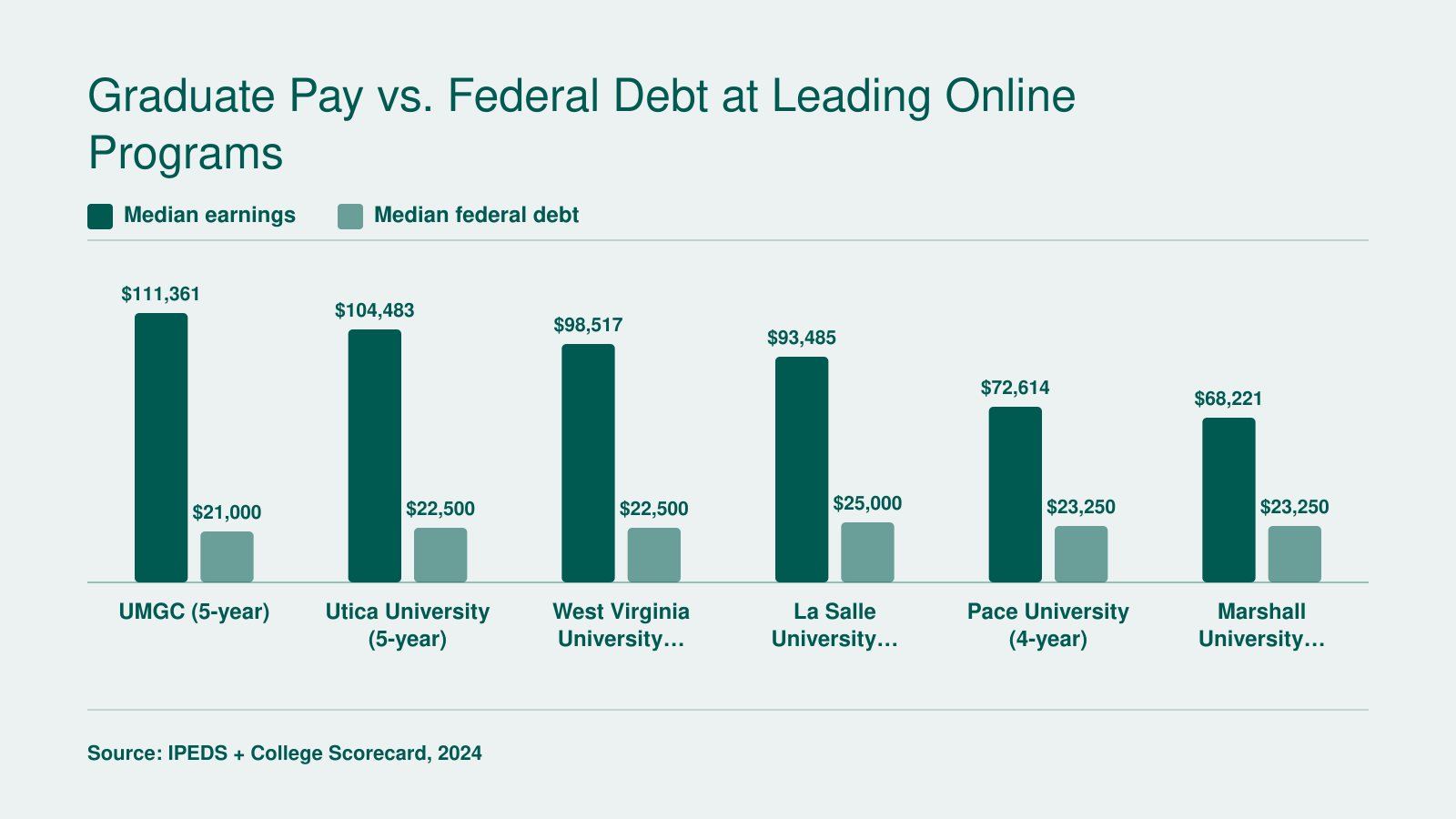
What you pay in total and what graduates actually earn tell you more about a cybersecurity master's than the name on the diploma.
Admission Requirements: GRE Policies, GPA, and Prerequisites for Non-CS Applicants
- Bachelor's degree and GPAA bachelor's degree from an accredited institution is standard, often with a 3.0 GPA as a frequent benchmark. Hawai'i Pacific may admit below-3.0 applicants on probation, and Drexel lists 3.0 as preferred.
- GRE policyMany programs waive the GRE. Pace, Wisconsin, San Diego, and Drexel do not require it; San Diego may accept GRE, GMAT, MAT, or LSAT when GPA is below 3.0.
- Technical prerequisitesCommon prerequisites include programming, networking, operating systems, and quantitative work. Pace requires three prerequisite courses; Wisconsin requires intro computer science plus calculus or statistics. Bridge options include CS 601 and CS 646 at University of Nevada, Reno and CYBR 505 at San Diego.
- Work experience and application materialsOhio State recommends one year of experience, but it is not universally required. Submit a resume, statement of purpose, and recommendation letters; Delaware accepts nontechnical degrees with technical work or certifications.
- Start datesRolling admission or multiple yearly start dates are common, letting applicants align prerequisites and funding.
Cybersecurity programs by state
Your Online Cybersecurity Master's Questions, Answered
These answers address the questions prospective students ask most often about cost, time, accreditation, and career value. The figures below draw from the program data and earnings comparisons elsewhere on this page. Always confirm current tuition and admission policies directly with each school.
Is a master's in cybersecurity worth it if you earn it online?
What is the total cost of an online cybersecurity master's degree?
Which online master's in cybersecurity has the lowest total cost?
How many months does an online cybersecurity master's take to finish?
What accreditations should I look for in a cybersecurity master's program?
Do I need a computer science background for a cybersecurity master's?
Can I keep working full time while completing an online cybersecurity master's?
Will employers treat an online cybersecurity master's the same as an on-campus degree?
Compare Cybersecurity programs on the data that matters
Explore more Computers & IT specializations or browse every graduate field.
All Computers & IT programs