Best Online MBA in Cybersecurity Programs
Compare 70+ accredited online MBA in Cybersecurity programs, with graduate earnings, cost, debt, and completion data from IPEDS and the U.S. College Scorecard.

Since late 2023, public companies have had to disclose material cyber incidents to the SEC within four business days and describe how their boards oversee cyber risk. That rule pulled security into the boardroom, where many technical leaders lack fluency.
An online cybersecurity MBA program targets that gap. Published tuition across the best online MBA programs ranked here runs from $6,702 in-state at Kennesaw State to $31,824 at Thomas College. Every one can be completed 100% online, with no hybrid or residency requirements.
That price spread does not track brand name.
Key Points
- University of San Diego reports $137,533 median earnings four years after completion.
- AACSB accreditation favors research schools; IACBE and ACBSP emphasize teaching.
- Cybersecurity MBA prioritizes governance, risk, and compliance over technical depth.
Top 10 Fully Online MBA in Cybersecurity Programs Ranked
These are the best 100% online MBA in cybersecurity programs in the USA, each fully online with no campus visits required. The programs below cover a range of concentrations from information security and assurance to cybersecurity data analytics, priced for working professionals. Use the cards to compare cost, format, and career focus across the ranked list.
Kennesaw State University
#1Kennesaw, GA · ~$7,000/yr (est.)
Best for: Georgia-based analysts seeking accelerated evening MBA
Kennesaw State University pairs a part-time, accelerated Evening MBA with a focused Information Security and Assurance concentration. The program can be completed in as little as 18 months, with 15 hours of core business study and 21 hours of specialized courses covering security technology, governance, risk management, disaster recovery, and legal issues. It is designed for working professionals who need a flexible schedule while building security leadership expertise.
- Evening MBA program
- Part-time accelerated format
- Completed in as little as 18 months
- 15 hours of core business classes
- 21 hours of concentration courses
- Covers security technology, governance, and risk management
- Includes disaster recovery planning and legal/ethical issues
- Designed for working professionals in data protection
University of San Diego
#2San Diego, CA · ~$31,000/yr (est.)
Best for: Military and law enforcement professionals advancing cyber leadership
The University of San Diego offers a fully online Master of Science in Cyber Security Operations and Leadership designed for working professionals. The 20-month program requires 30 units at $995 per unit, and admissions do not require GRE or GMAT scores. Students complete seven-week courses one at a time, with two courses per semester, and the program is designated a National Center of Academic Excellence in Cybersecurity. Program-level median earnings one year after finishing were $97,944, rising to $137,533 four years after finishing.
- 100% online program
- 20-month program length
- 30 total units required
- $995 cost per unit
- No GRE or GMAT required
- Seven-week course duration
- Two courses per semester
- Spring, summer, and fall start dates
West Virginia University
#3Morgantown, WV · ~$11,000/yr (est.)
Best for: Business professionals wanting certification-aligned hands-on labs
West Virginia University offers a Master of Science in Business Cybersecurity Management through its John Chambers College of Business and Economics. The online program requires 10 courses totaling 30 credits, with 8-week terms and a cost of $1,043 per credit hour. Admission requires a bachelor's degree with a minimum 2.75 GPA, official transcripts, and a resume; no GMAT or GRE is needed. One year after finishing, program-level median earnings were $74,438, rising to $98,517 four years out.
- John Chambers College of Business and Economics
- 10 courses totaling 30 credits
- $1,043 per credit hour
- One to two years with 8-week terms
- No GMAT or GRE required
- Bachelor's degree with minimum 2.75 GPA
- Official transcripts and resume required
- Prepares for CISSP certification
Cedarville University
#4Cedarville, OH · ~$11,000/yr (est.)
Cedarville University offers an online MBA in Cybersecurity Management rooted in a biblical worldview. The program combines core business courses with four specialized cybersecurity classes focused on law, risk management, and enterprise security architecture. It features seven-week terms, part-time or full-time options, and completion in one or two years, with six start dates annually.
- Seven-week terms
- Part-time and full-time options
- One- and two-year completion paths
- Cohort-based learning with dedicated adviser
- Six start dates annually
- Applications accepted year-round
- Four specialized cybersecurity courses
- ACBSP accredited
Capitol Technology University
#5Laurel, MD · ~$12,000/yr (est.)
Capitol Technology University delivers an online MBA in Cybersecurity that blends business management with hands-on cyber defense. The program covers data-driven leadership, risk analysis, security strategy, and communication with stakeholders, culminating in a capstone research project with a faculty mentor. The university is a National Center of Excellence in Cyber Defense and operates a Center for Cybersecurity Research and Analysis.
- $665 per credit
- Fully online program
- Capstone project required
- Military benefits accepted
- National Center of Excellence in Cyber Defense
- Center for Cybersecurity Research and Analysis
- Prepares for CISO roles
- 3.0 GPA minimum
Boise State University
#6Boise, ID · $10,000 – $15,000/yr (est.)
Boise State University offers an Online MBA with Cyber Emphasis, a 49-credit program focused on risk management, strategic decision-making, and organizational governance rather than technical execution. The 100% online format features seven-week courses with six start dates per year, and admission requires a bachelor's degree with a 3.0 GPA, two years of management experience, and no GMAT or GRE. The program can be completed in as few as 12 months full-time or two years part-time.
- 49 total credit hours
- 100% online format
- Seven-week classes
- Six start dates per year
- Full-time or part-time options
- No GMAT or GRE required
- 3.0 minimum GPA required
- Two years management experience required
Bay Path University
#7Longmeadow, MA · ~$15,000/yr (est.)
Bay Path University's MBA with Cybersecurity Concentration integrates strategic leadership with cybersecurity expertise for working professionals. The program covers emerging cyber threats, information assurance, and strategic crisis management, preparing graduates to protect organizational assets and drive business solutions.
- 30-credit MBA with cybersecurity focus
- Courses address emerging cyber threat landscapes
- Integrates business leadership with technology management
- Strategic crisis management curriculum
- Designed for working professionals
Western Kentucky University
#8Bowling Green, KY · $12,000 – $18,000/yr (est.)
Western Kentucky University offers an MBA with a Cybersecurity Data Analytics stackable concentration. The 12-credit graduate certificate focuses on data analytics, cybersecurity defense, and risk management, with flexible timeline options from one to five years. Applicants need a statistics background and spreadsheet proficiency.
- 12-credit graduate certificate
- Stackable MBA concentration
- Flexible 1-5 year completion
- Focuses on cybersecurity data analytics
- Risk management perspective
- Requires statistics background
- Requires spreadsheet proficiency
- Online options available
University of Colorado Colorado Springs
#9Colorado Springs, CO · $16,000 – $27,000/yr (est.)
The University of Colorado Colorado Springs offers an MBA Cybersecurity Management Track through its College of Business. The program can be completed fully online or on campus and is designed for both business and non-business graduates. The curriculum includes 36 credit hours, with 24 core credits and 12 specialized credits covering cybersecurity technologies, enterprise information security, and governance, typically completed in 2.5 years.
- 36 credit hours required
- 24 core credit hours
- 12 specialized credit hours
- Fully online program
- 8-week model for online courses
- Courses cover cybersecurity technologies and governance
- Designed for working professionals
- Foundation courses may be required or waived
Thomas College
#10Waterville, ME · ~$32,000/yr (est.)
Thomas College offers a 33-credit MBA with a concentration in Cybersecurity, delivered 100% online. The program blends core business courses with specialized cyber topics including risk analysis, cyber law, ethics, and global security issues, while aligning security operations with revenue goals. Graduates pursue roles such as Chief Information Security Officer, IT risk director, or compliance manager.
- 33 total credit hours
- Fully online program
- Aligns security with business revenue goals
- Covers ethics, privacy, law, and global considerations
- Maintains MBA core for business foundation
- Prepares for CISO role
- Faculty include cybersecurity experts
- Theory and practice of cybersecurity
Cost & outcomes by school
Federal data for the highest-earning Cybersecurity programs, independent of the ranking above. Earnings are this field's master's graduates four years after completing, where the Scorecard reports them.
| School | Earnings | Tuition / yr | Debt | Grads/yr | Format |
|---|---|---|---|---|---|
| Champlain College VT | $134,853 | $10,710 | $35,971 | 45 | Online |
| Grand Canyon University AZ | — | $10,015 | — | 75 | Online |
| Nichols College MA | — | $1,200 | — | — | Online |
| Fayetteville State University NC | — | $6,791 | — | — | Online |
| The University of Texas at Tyler TX | — | $8,480 | — | — | Online |
| Lamar University TX | — | $8,642 | — | — | Online |
| Southern Utah University UT | — | $8,577 | — | — | Online |
| American Public University System WV | — | $8,700 | — | — | Online |
| Weber State University UT | — | $9,066 | — | — | Hybrid |
| University of West Florida FL | — | $9,062 | — | — | Online |
| DeVry University-California CA | — | $9,832 | — | — | Online |
| DeVry University-Florida FL | — | $9,832 | — | — | Online |
Sources: U.S. Department of Education. Tuition and graduates: IPEDS. Earnings and debt: College Scorecard, this field's master's graduates; a dash means no figure is reported.
AACSB, IACBE, or ACBSP? Business Accreditation Across the Ranked Programs
Accreditation forces a practical tradeoff: the most selective business credential can matter for certain employers, but it is not the only signal of teaching quality. AACSB is the most selective business accreditor, favoring research-oriented schools. IACBE and ACBSP emphasize teaching, applied learning, and student outcomes. Regional accreditation, such as the Higher Learning Commission, is the baseline every legitimate school should hold.
Among the online MBA in cybersecurity programs below, the AACSB group includes University of Illinois Springfield, Lamar University, and Emporia State University. Bellevue University holds IACBE accreditation, and Pfeiffer University holds ACBSP. Several other schools carry regional accreditation without a clear business-specific designation, so confirm before applying.
When AACSB matters
If you are targeting Fortune 500 employers, tuition reimbursement policies, or a future doctoral program, AACSB accreditation is often the safer bet, even among the most affordable MBA cybersecurity programs. If your priority is a teaching-focused MBA that maps directly to security leadership roles, an IACBE or ACBSP program can still be a strong fit.
Cyber-specific trust signal
NSA and DHS also designate National Centers of Academic Excellence in Cyber Defense, a separate credential from business accreditation. University of Illinois Springfield holds CAE-CD status through 2027. North Carolina Central University's concentration carries the designation. Always verify whether a CAE-CD award applies to the MBA itself, not just to other programs on campus.
Online MBA Cybersecurity Cost: The Three Lowest-Priced Fully Online Options
The table below shows the three fully online cybersecurity MBA options with the lowest published net price in this ranking. Net price is an institution-wide average after grants and scholarships, not a personal quote, so your actual cost may differ. Check the school's current per-credit rate and any technology, online-learning, or graduation fees, and ask about employer tuition assistance or military rates.
| School | Program | Concentration | In-State Tuition | Out-of-State Tuition | Average Net Price After Aid |
|---|---|---|---|---|---|
| Murray State University | Master of Business Administration | Cybersecurity | 10683 | 10683 | 9096 |
| University of South Florida | MBA | Cybersecurity | 10428 | 21126 | 9812 |
| University of Illinois Springfield | Master of Business Administration with Cybersecurity Management Certificate | Cybersecurity Management | 11938 | 19515 | 9833 |
Related Articles
What Security Leaders Earn Nationally
Security leadership pays a significant step above analyst roles.
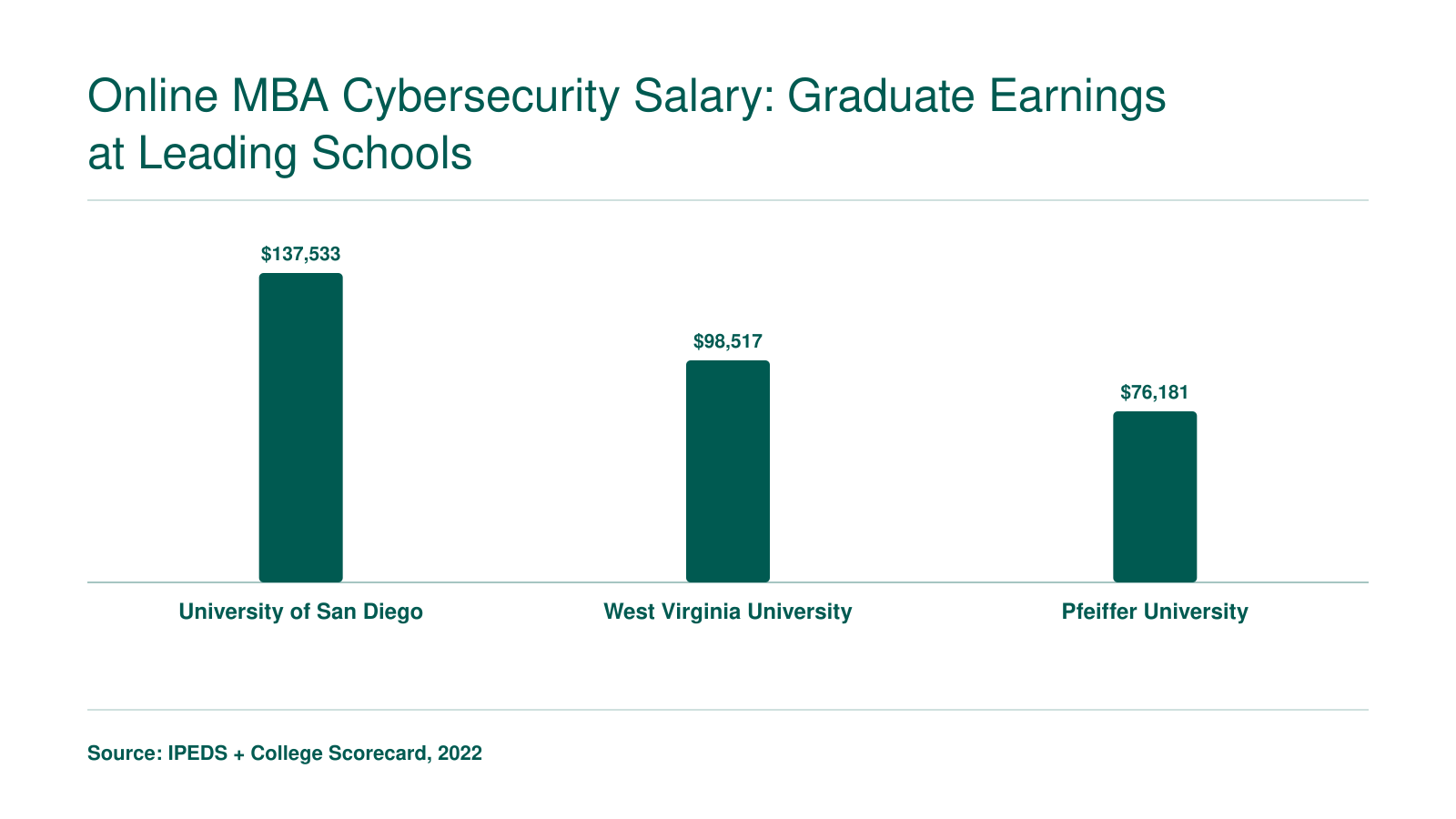
Online MBA Cybersecurity Salary: Graduate Earnings at Leading Schools
Among programs with federal earnings data, the University of San Diego reports the highest median earnings four years after completion at $137,533, followed by West Virginia University at $98,517 and Pfeiffer University at $76,181. University of San Diego graduates with debt data carried median debt of $48,077 with a $547 monthly payment over ten years, while West Virginia University borrowers held $29,500 with a $336 payment; Pfeiffer does not publish program-level debt or monthly payment in these data. Compared with the national management wage discussed above, these figures suggest a cybersecurity MBA can pay off for graduates moving into security leadership roles.
Cybersecurity Management MBA or MS in Cybersecurity: Which Fits Your Goals?
The main split is leadership versus technical depth. A cybersecurity MBA is built for professionals moving into security governance, risk, compliance, and executive decision-making; an MS in cybersecurity tends to go deeper into hands-on systems, networking, and code. Most cybersecurity MBAs do not require a technical background, but many MS programs expect at least some IT or engineering foundation.
| Dimension | Cybersecurity Management MBA | MS in Cybersecurity |
|---|---|---|
| Primary focus | Governance, risk, compliance, security leadership, and business strategy | Hands-on technical depth in networks, systems, programming, and security operations |
| Typical student | Working security professionals or managers moving toward leadership, compliance, and executive roles | Aspiring or current technical practitioners who want to build, test, and defend systems |
| Technical prerequisites | Most programs do not require a technical background; admissions usually focus on a bachelor's degree, resume, GPA, or work experience | Often expects computer science, information technology, or engineering coursework, though some programs accept students without a technical background |
| Certification alignment | Saint Mary's prepares students for CySA+, Security+, Network+, other CompTIA certifications, CISSP, and CISM. UNCW aligns coursework with Security+, CEH, and CISSP. McKendree maps NIST knowledge requirements to several professional certifications. | Eastern Illinois's MS prepares students for CISSP and CompTIA Security+. WGU's cybersecurity degree path includes Security+ and CySA+ preparation and exam vouchers in tuition, but it is not an MBA program. |
| Target roles | Cybersecurity manager, risk or compliance lead, CISO-track leader, security consultant | Security analyst, penetration tester, security engineer, security architect, or incident responder |
Admissions and Online Format Details to Verify Before You Apply
- Undergraduate recordVerify a bachelor's from a regionally accredited school. Several programs here publish a 3.0 minimum GPA; Emporia State may admit 2.65–2.99 with other success factors, and Eastern Washington considers 2.5 with three years of work.
- Work experienceExperience rules vary: Emporia State requires three-plus years managing technology resources, FIU asks for four-plus years of professional work, and UNCW expects two years; others may review a résumé without a published minimum.
- GMAT/GRE policyTest policies split. UT Tyler requires the GMAT or a waiver based on last-60 GPA above 3.25, a prior master's, or three-plus years of U.S. managerial experience; St. Thomas, Johnson & Wales, and Champlain are test-free.
- Delivery formatVerify delivery details: ask whether courses are asynchronous or have scheduled live sessions, and whether exams are proctored, program pages often do not state this.
- Transfer credit and certificationsTransfer and certification credit vary. Mount Union allows up to 9 semester hours of accredited, aligned transfer work graded B or better; Johnson & Wales decides foundation-course waivers after transcript review. Treat CISSP-style credit as a school-by-school question.
Cybersecurity programs by state
Compare Cybersecurity programs on the data that matters
Explore more MBA specializations or browse every graduate field.
All MBA programs