Best MBA in Cybersecurity Programs
Compare 80+ accredited MBA in Cybersecurity programs at 70+ schools, with graduate earnings, cost, debt, and completion data from IPEDS and the U.S. College Scorecard.

The best MBA in cybersecurity is rarely the one with the loudest marketing, because most schools never publish graduate earnings or debt. Even program size varies widely: Boise State's online MBA with a cyber emphasis runs 49 credits and $36,840 before scholarships, while Weber State's offering is a 12-credit certificate.
The programs span online, campus, and hybrid formats. Some carry an MS or certificate title rather than a true MBA, which changes both price and how employers read the credential.
A security concentration is cheap for a school to launch. The coursework and certifications behind it are what hiring managers weigh.
Key Points
- Murray State charges $10,683 online tuition regardless of residency, unlike every other lower-cost school charted.
- Program-level graduate earnings are not yet published for these schools, so net price and debt carry more weight.
- Admissions terms and format rules vary by school, so confirm GMAT waivers and live-session hours before applying for 2027.
10 Cybersecurity MBA Schools for 2027
The top three in this list earn their places by combining a cybersecurity concentration with clear delivery structure. Florida International University pairs risk management with a STEM-designated MBA, the University of San Diego offers a fully online leadership-focused degree, and James Madison University builds an information security concentration into a hybrid MBA. Each gives a different path to the same goal: a business credential that speaks to security leadership.
Florida International University
#1Miami, FL · ~$11,000/yr (est.)
Best for: Risk management-focused online learners
Florida International University's MBA in Cybersecurity Risk Management is a 16-month online program built around Monday and Wednesday synchronous sessions and two optional in-person residencies. The curriculum combines 21 hours of MBA core work with 24 hours of cybersecurity risk management coursework, and the STEM-designated degree qualifies for ISACA certification waivers. Small cohorts of up to 20 students and an advisory board of South Florida chief information security officers keep the focus on applied management.
- 16-month online program with Monday and Wednesday sessions
- 21 hours MBA core plus 24 hours cybersecurity specialization
- Two optional in-person residencies
- ISACA certification waivers available
- STEM-designated MBA
- Cohort size up to 20 students
University of San Diego
#2San Diego, CA · ~$31,000/yr (est.)
Best for: Career changers skipping standardized exams
The University of San Diego offers a 100 percent online Master of Science in Cyber Security Operations and Leadership, which prioritizes leadership, law, policy, and incident response over purely technical execution. The 20-month program requires 30 units at $995 per unit and does not ask for GRE or GMAT scores. Four years after completion, graduates reported a median of $137,533.
- 100 percent online, 20-month program
- 30 units at $995 per unit, $29,850 total tuition
- No GRE or GMAT required
- Seven-week courses, two per semester
- WASC accredited and National Center of Academic Excellence
- Focus on cybersecurity leadership, law, policy, and incident response
James Madison University
#3Harrisonburg, VA · ~$13,000/yr (est.)
Best for: Hybrid learners near Northern Virginia
James Madison University's MBA with an information security concentration is a 42-credit hybrid program aimed at working professionals. Most coursework is online with synchronous and asynchronous elements, and the cohort meets occasionally in McLean, Virginia. The curriculum pairs 15 hours of core business classes with specialized security courses in network management, computer forensics, and security ethics.
- 42 credit hours, primarily online with synchronous and asynchronous elements
- Occasional in-person sessions in McLean, Virginia
- One course every eight weeks, cohort based
- Information Security courses: network management, computer forensics, ethics
- Strategic management capstone requires B or better
- Core business foundation plus specialized security courses
California State University-San Bernardino
#4San Bernardino, CA · ~$10,000/yr (est.)
California State University San Bernardino offers a campus-based MBA with a cybersecurity concentration that can be completed in 36 to 42 units. Admission requires a bachelor's degree with a 3.0 GPA or higher, and applicants can use work experience in place of GMAT or GRE scores. The program prepares students for business leadership roles with a security focus.
- 36 to 42 unit campus-based program
- Requires bachelor's degree with 3.0 GPA or higher
- GMAT or GRE scores or work experience may substitute
- Personal statement, resume, and recommendation letter required
- Prepares for leadership roles with cybersecurity focus
Cedarville University
#5Cedarville, OH · ~$11,000/yr (est.)
Cedarville University's online MBA in Cybersecurity Management is built for working professionals and delivered in seven-week terms with part-time or full-time options. Students complete core business courses plus four specialized cybersecurity classes covering law, risk management, and enterprise security architecture. The program carries ACBSP accreditation and a biblical worldview foundation.
- Online MBA with seven-week terms
- Part-time and full-time options, one or two years
- Four specialized cybersecurity courses
- Core business plus cybersecurity law, risk, architecture
- Cohort-based with dedicated program adviser
- ACBSP accreditation
- Six start dates annually, year-round applications
West Virginia University
#6Morgantown, WV · ~$11,000/yr (est.)
West Virginia University's online M.S. in Business Cybersecurity Management combines a business school foundation with hands-on security projects for corporate partners. The 30-credit program uses 8-week terms, requires no GMAT or GRE, and can be finished in one to two years. Four years after completion, graduates reported a median of $98,517.
- Online program, 30 credits, 10 courses
- $1,043 per credit hour
- One to two years, 8-week terms
- No GMAT or GRE required, minimum GPA 2.75
- Hands-on projects with corporations
- Prepares for CISSP and covers 11 industry certifications
- AACSB accredited John Chambers College of Business
Kennesaw State University
#7Kennesaw, GA · ~$7,000/yr (est.)
Kennesaw State University's Evening MBA with an information security and assurance concentration is an accelerated part-time option that can be completed in about 18 months. Students take 15 hours of core business courses and 21 hours of concentration work covering security governance, risk management, and disaster recovery. The program targets professionals who need to protect organizational data across business functions.
- Evening MBA, part-time accelerated, 18 months
- 15 hours core and 21 hours concentration courses
- Covers security technology, governance, risk, disaster recovery
- Designed for professionals protecting organizational data
Boise State University
#8Boise, ID · $10,000 – $15,000/yr (est.)
Boise State University's online MBA with a cyber emphasis is a 49-credit program that focuses on risk management and organizational governance rather than technical execution. Admission requires a 3.0 GPA and two years of management experience, but no GMAT or GRE. The program delivers seven-week courses with multiple start dates per year.
- 49 credits, 100 percent online, seven-week courses
- No GMAT or GRE required; 3.0 GPA and two years management experience
- Six start dates per year
- 12 credits cyber emphasis plus 37 required credits
- $36,840 tuition without scholarship, $33,165 with scholarship
- Capstone required
Weber State University
#9Ogden, UT · ~$9,000/yr (est.)
Weber State University offers an MBA certificate in cybersecurity that can be completed in as few as two semesters or taken as a stand-alone credential. The 12-credit graduate program requires no technical background and covers cybersecurity fundamentals, security policies, and penetration testing. It fits within the MBA or can be used to add a focused security credential.
- 12 credit hours, complete in two semesters
- Can be part of MBA or stand-alone certificate
- No technical background required
- Focus on fundamentals, policy, penetration testing
- Hands-on applied projects
- Up to seven years to complete
Western Kentucky University
#10Bowling Green, KY · $12,000 – $18,000/yr (est.)
Western Kentucky University's MBA offers a stackable cybersecurity data analytics concentration designed for tech-savvy business leaders. The 12-credit graduate certificate emphasizes data analytics, cyber defense, and risk management, with flexible completion from one to five years. Applicants should have a statistics background and spreadsheet proficiency.
- 12-credit graduate certificate, stackable concentration
- Flexible completion timeline from one to five years
- Requires statistics background and spreadsheet proficiency
- Focus on data analytics, cyber defense, risk management
Cost & outcomes by school
Federal data for the highest-earning Cybersecurity programs, independent of the ranking above. Earnings are this field's master's graduates four years after completing, where the Scorecard reports them.
| School | Earnings | Tuition / yr | Debt | Grads/yr | Format |
|---|---|---|---|---|---|
| Champlain College VT | $134,853 | $10,710 | $35,971 | 45 | Online |
| Grand Canyon University AZ | — | $10,015 | — | 75 | Online |
| Nichols College MA | — | $1,200 | — | — | Online |
| University of West Georgia GA | — | $6,046 | — | — | Campus |
| Fayetteville State University NC | — | $6,791 | — | — | Online |
| University of Nevada-Las Vegas NV | — | $7,413 | — | — | Campus |
| The University of Texas at Tyler TX | — | $8,480 | — | — | Online |
| Lamar University TX | — | $8,642 | — | — | Online |
| Southern Utah University UT | — | $8,577 | — | — | Online |
| American Public University System WV | — | $8,700 | — | — | Online |
| Weber State University UT | — | $9,066 | — | — | Hybrid |
| University of West Florida FL | — | $9,062 | — | — | Online |
Sources: U.S. Department of Education. Tuition and graduates: IPEDS. Earnings and debt: College Scorecard, this field's master's graduates; a dash means no figure is reported.
Why Earnings and Debt Outweigh Reputation in Our Rankings
Cybersecurity hiring stayed hot through 2026 even as other corners of tech cooled, and that demand has pushed more of the best MBA schools to bolt a security concentration onto an existing MBA. The marketing moves faster than the outcomes data, which means a glossy brochure can describe a program whose graduates haven't actually been tracked yet. A school's brochure tells you what it hopes you'll become; federal outcome data tells you what its graduates actually did.
The Numbers We Weigh
We build these rankings from inputs you can verify rather than from brand buzz:
- Graduate tuition: the published per-credit or program sticker price before aid.
- Average net price: what students actually pay after grants and scholarships.
- Graduation rate: the institution-wide completion figure.
- Earnings and debt: program-level figures from College Scorecard where the federal government has published them.
What These Figures Can and Can't Tell You
Be clear-eyed about the limits. Graduation rates are reported for the whole institution, not the cybersecurity track specifically, so they signal institutional reliability more than program quality. Net price averages across students rather than quoting a personal cost; your actual cost depends on your aid package. And where earnings data isn't yet published for a program, we say so plainly instead of guessing.
Prestige-based lists fail the people this degree serves most: career-switchers and working IT professionals who need a payback timeline, not a logo. A top-20 name that leaves you with six-figure debt is a worse bet than an affordable MBA program whose graduates earn well and borrow little. We rank for that math.
Cybersecurity MBA Cost: Tuition, Fees, and the Charges Schools Bury
The sticker price you see first is rarely the price you pay. Published tuition and what lands on your billing statement can drift thousands of dollars apart, and the gap depends heavily on where you live and how a school structures its fees.
What In-State and Out-of-State Really Cost
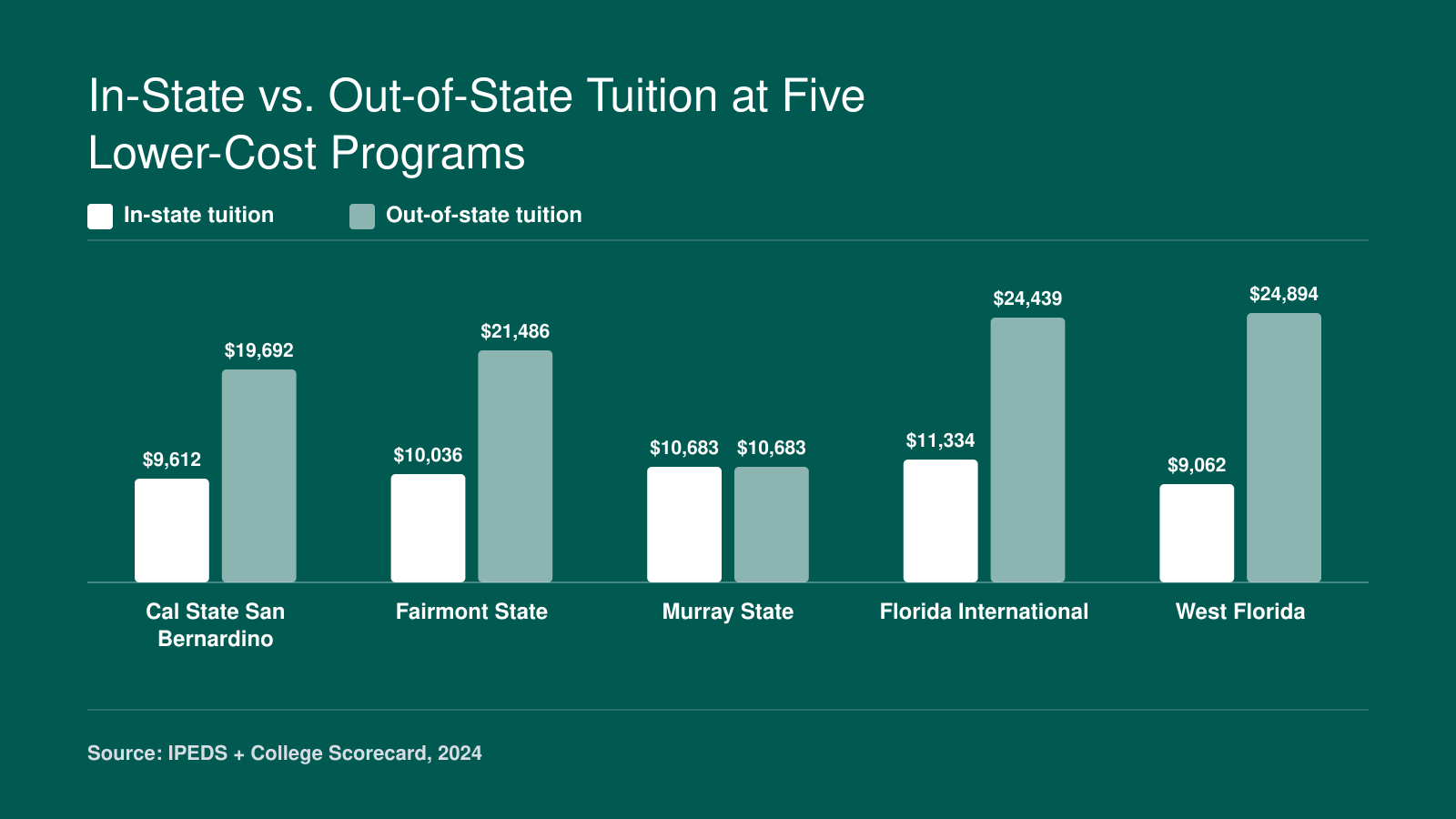
Among the lower-cost programs ranked here, in-state tuition runs from roughly $7,400 to about $12,300, while out-of-state figures climb from around $16,700 to over $25,500. At public universities, that residency gap can double your bill. Online programs often blunt it: Murray State University, for example, charges the same $10,683 whether you live in Kentucky or not, because many Online MBA programs use flat-rate pricing that erases the out-of-state penalty entirely.
Sticker tuition also overstates most students' actual cost. After aid, the approximate average net price across these programs tends to settle lower than the headline rate, so run your own numbers before ruling a program out on cost alone.
The Charges That Don't Show Up in the Tuition Line
Fees travel separately, and they add up:
- Technology and distance-learning fees: George Mason's Costello Online MBA adds a $35 per credit distance-learning fee ($1,680 over 48 credits); American Public University charges $85 per course in technology fees.
- Software and course fees: Saint Peter's bills a $105 per trimester software package; Southern Oregon attaches a $65 course fee plus an $85 graduation fee.
- Residency travel: FIU's optional in-person residencies mean airfare, lodging, and meals on top of tuition.
- Foundation courses: If your bachelor's wasn't in business, prerequisite coursework can add credits (and cost) before the MBA proper begins.
Before committing, ask admissions for a total program cost that bundles every fee, not just the per-credit rate. And check whether your employer offers tuition assistance; many do, and it can cover a meaningful slice of the bill.
In-State vs. Out-of-State Tuition at Five Lower-Cost Programs
Murray State University charges $10,683 whatever your residency, so its online MBA is the one place here where moving or staying put makes no difference. Every other school in the chart charges out-of-state students more. The premium runs from about $10,100 at California State University-San Bernardino to roughly $15,800 at the University of West Florida. Fairmont State's online program and Florida International's live-online format still carry a residency premium, so an online label alone does not guarantee a flat rate. These are published graduate tuition-and-fee figures before any aid, so your actual cost will differ.
Related Articles
Asynchronous, Live-Online, or Hyflex: Matching the Format to Your Schedule
Most online cybersecurity MBA programs we reviewed run on short seven- or eight-week terms, and the main difference is whether you log in on your own time or at set hours. Fully asynchronous formats give you the most control, but they trade away some of the cohort connection that live sessions create. If you are choosing an online MBA in cybersecurity partly for the professional network, ask how each school builds peer contact, because asynchronous students often have to create it themselves.
| Format | How classes meet | Campus visits | Typical pacing | Best suited to |
|---|---|---|---|---|
| Fully asynchronous | No fixed login times. University of New Haven (Cyber Risk Management) and Shenandoah University (Cybersecurity Management) describe their programs as online and asynchronous. Mount Union's cybersecurity concentration includes three to four asynchronous courses. | None at New Haven or Shenandoah, which are fully online. | Seven-week terms at New Haven and Mount Union (two classes per term); eight-week courses at Shenandoah. New Haven lists 18 to 24 months. | Busy professionals who need to log in when their schedules allow. |
| Asynchronous with optional live elements | Immaculata University calls its program fully asynchronous, though courses may include both live and asynchronous components. | None. Delivered 100% online. | Accelerated seven-week sessions, one course at a time, with courses in any order. | Students who want flexible, career-friendly pacing and occasional live interaction. |
| Live-online (scheduled sessions) | Set meeting times each week. Our research did not document a named example, so confirm session times with the school. | Varies by program. Ask whether any residency is required. | Varies. Morningside University lists eight-week online courses over 1 to 3 years, but its meeting format is not specified. | Students who want real-time discussion and a stronger cohort, and can keep fixed evenings free. |
| HyFlex | Students choose in person or remote for each session. Our research did not document a named example. | Campus access is needed if you want the in-person option. | Varies by school. Verify term length and part-time load. | Students near campus who want to switch between modes as work demands change. |
What You Need to Apply: GMAT, GPA, and Experience Thresholds
Admissions standards for cybersecurity MBAs vary widely, and many are conditional. Treat the figures below as starting points and confirm current terms with each school's admissions office.
- Bachelor's degreePrograms such as Emporia State, Bushnell, and Notre Dame de Namur list a bachelor's degree as the baseline. Confirm the accreditation of your degree-granting institution directly with each school, since the sources reviewed here do not spell it out uniformly.
- GMAT/GREWaivers are common. UNC Wilmington does not require the GMAT, Eastern Washington waives it for qualified applicants, John Brown and the University of Dallas ask for no entrance exam, and St. Thomas lists no GMAT requirement. Where a school's page does not address testing, ask before assuming either way.
- Minimum GPAPublished minimums run from roughly 2.5 to 3.0. Emporia State, UNC Wilmington, Eastern Washington, and FIU cite 3.0, John Brown 2.75, Johnson & Wales 2.85, and Notre Dame de Namur 2.5. St. Thomas lists 2.33, but its sources are ambiguous. Several schools weigh a lower GPA against work experience or other indicators of success.
- Work experienceRequirements differ. UNC Wilmington asks for two years of full-time post-bachelor's experience, Eastern Washington may consider three years in place of a stronger GPA, and FIU requires four. For most others, no minimum is established. Prior IT or security experience was not stated as mandatory in the sources reviewed.
- Prerequisites and materialsJohn Brown requires finance, accounting, statistics, and economics for its 36-credit MBA. Notre Dame de Namur asks for one course each in accounting, economics, statistics, and math. Expect a resume, essays, and recommendations as well. UNC Wilmington may waive recommendation letters for applicants with five or more years of progressive managerial or military experience, or a GPA of 3.2 or higher.
Prestige is marketing. Outcomes are math. We compared programs on real graduate earnings, net price, and debt, and the bigger name is not always the better value.
Cybersecurity programs by state
Quick Answers Before You Apply
These are the questions prospective students ask most often before committing to a cybersecurity MBA. The answers focus on cost, accreditation, and certification, the three areas where a wrong assumption is most expensive.
Does a cybersecurity MBA pay off for mid-career IT professionals?
Which accreditations should an MBA cybersecurity program have?
Can a master's degree count toward the CISSP experience requirement?
Compare Cybersecurity programs on the data that matters
Explore more MBA specializations or browse every graduate field.
All MBA programs