Accelerated MBA in Cybersecurity Programs
Compare 80+ accredited fastest MBA in Cybersecurity programs at 70+ schools, with graduate earnings, cost, debt, and completion data from IPEDS and the U.S. College Scorecard.

A one-year MBA with a cybersecurity specialization at Champlain College costs $595 per credit across 11 courses; a four-year accelerated bachelor's-to-MBA at Saint Francis University gets you there differently. Both answer the same demand: boards want security leaders who can translate threat intelligence into risk decisions, not just read a packet capture.
Online, campus, and hybrid formats are all represented, and several are master's in cybersecurity programs rather than MBAs. The real tension is timeline against cost: "as few as 12 months" assumes year-round enrollment, and the advertised per-credit rate rarely reflects the all-in bill.
Key Points
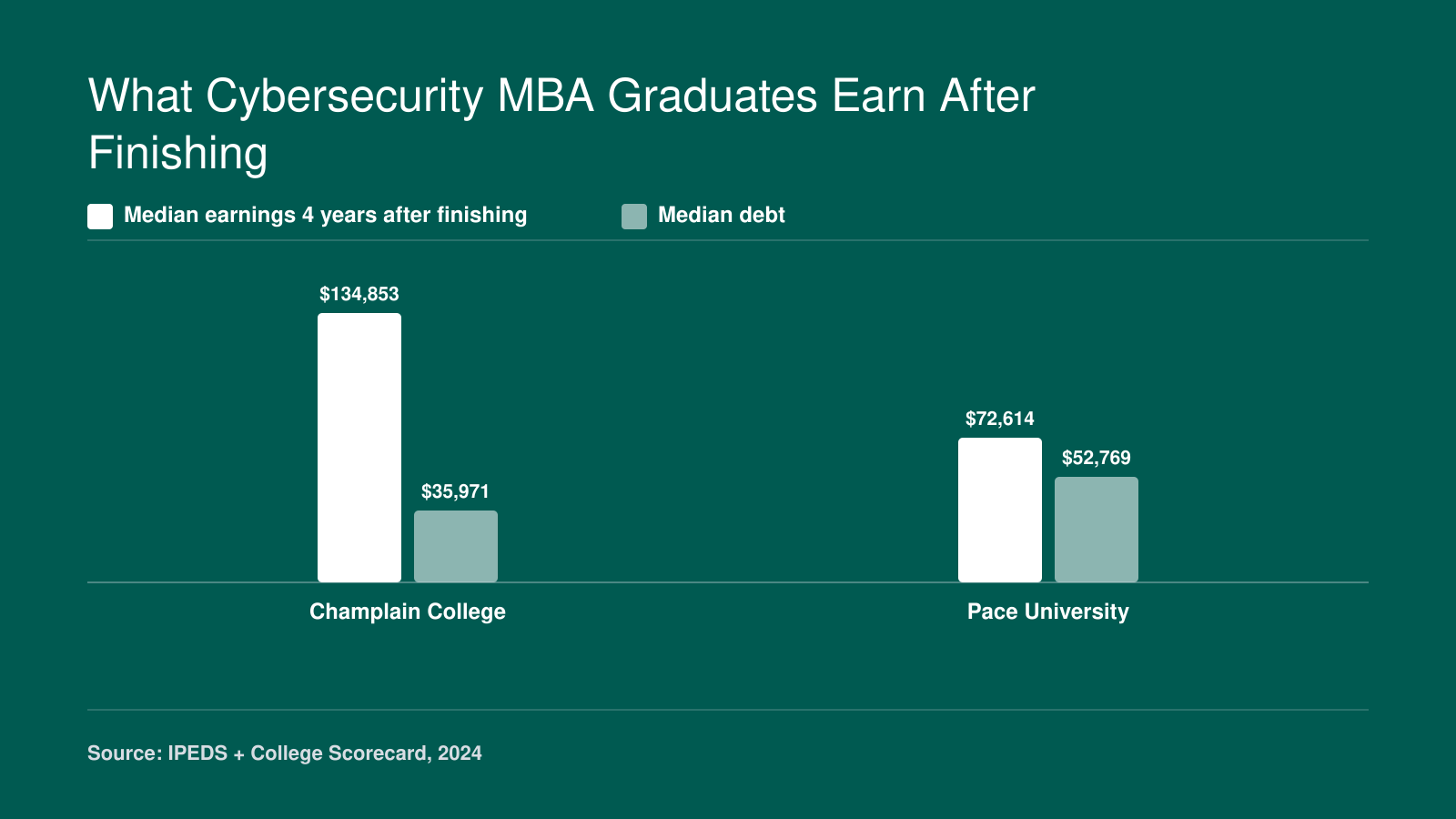
- Champlain graduates report median earnings of $134,853 four years after finishing.
- Saint Peter's, Kennesaw State, and Wilmington lead this ranking on net price.
- Emporia State folds nine cybersecurity credits into its 33-credit MBA.
Top Accelerated MBA in Cybersecurity Programs, Ranked by Speed to Degree
The ranking below leads with the fastest credible routes to a cybersecurity-focused graduate management degree, then weighs each option against federal earnings, debt, and net price data. Where a school offers an MS rather than an MBA, we flag that so you can compare like degrees honestly.
Champlain College
#1Burlington, VT · ~$11,000/yr (est.)
Best for: Online learners needing no-GMAT admission
Champlain College Online offers an MBA with a Cybersecurity Specialization that can be finished in one year with two courses per term. The fully online program costs $595 per credit and requires no GMAT or GRE. Its curriculum pairs core business courses with cybersecurity work in risk assessment, threat intelligence, and governance strategy.
- Fully online, 11 courses, $595 per credit
- One year completion with two courses per term
- No GMAT or GRE required
- Recommended minimum 2.5 GPA
- Covers risk assessment, threat intelligence, governance
- 18-20 hours per week time commitment
- Transfer credit options available
Anna Maria College
#2Paxton, MA · ~$11,000/yr (est.)
Best for: Experienced professionals using work experience waivers
Anna Maria College's MBA with a Cybersecurity concentration blends strategy with hands-on security work, including ethical hacking and risk frameworks. Courses run in 8-week terms online, on campus, or hybrid, and the 36-credit degree includes a capstone consulting project with a nonprofit or startup. Qualified professionals may waive up to two courses and alumni receive a tuition discount.
- 36 credits, $599 per credit, one-year completion
- Online, campus, or hybrid delivery
- 8-week courses with fall, spring, summer starts
- Capstone consulting project with nonprofit or startup
- Up to two courses waived for work experience
- 20 percent tuition discount for alumni
- Concentration launched in 2026 with Rize Education partnership
Mount Mary University
#3Milwaukee, WI · ~$16,000/yr (est.)
Best for: Working adults needing asynchronous flexibility
Mount Mary University's online MBA with a cybersecurity specialization is built for working adults who need asynchronous 7-week courses and about one year to finish. The 30-credit program includes a 21-credit core and nine credits focused on network architecture, risk management, and executive defense. Graduates commonly move into security manager, risk analyst, and IT governance roles.
- 30 total credits, $650 per credit
- Fully online and asynchronous, 7-week terms
- One-year completion with six start dates per year
- 21-credit core plus 9-credit cybersecurity specialization
- Focus on governance, risk analysis, and executive defense
- Minimum 2.8 GPA for admission
- Application fee waived for alumni
Adrian College
#4Adrian, MI · $20,000 – $25,000/yr (est.)
Adrian College's online MBA with a Cybersecurity Management track can be completed in as little as one year with 30-36 credits. The program integrates Harvard Business School online case studies and reports a 90 percent job placement rate for graduates. Admission requires a 3.0 undergraduate GPA, a statement of purpose, and one recommendation.
- 30-36 credits, finish in as little as one year
- Fully online with Harvard Business School online integration
- Nine concentration options including Cybersecurity Management
- Reported 90 percent job placement rate
- Requires 3.0 undergraduate GPA and one recommendation
- Statement of purpose and letter of recommendation required
Kennesaw State University
#5Kennesaw, GA · ~$7,000/yr (est.)
Kennesaw State University offers an Evening MBA with an Information Security and Assurance concentration that full-time students can finish in about 18 months. The curriculum includes 15 core credit hours and 21 concentration hours covering governance, risk management, disaster recovery, and legal and ethical issues. The program is designed for working professionals seeking to lead data protection efforts.
- Part-time accelerated format, complete in 18 months
- 15 core credit hours plus 21 concentration hours
- Covers governance, risk, disaster recovery, legal and ethical issues
- Evening schedule designed for working professionals
- Online delivery option available
Southeastern University
#6Lakeland, FL · ~$11,000/yr (est.)
Southeastern University's MBA in Cybersecurity is a 36-credit program with 24 core MBA hours and 12 cybersecurity concentration hours. Courses run in 8-week online formats, with some face-to-face options in Lakeland, Florida. The program offers part-time, full-time, and accelerated schedules and includes the Google Cybersecurity Professional Certificate.
- 36 total credits: 24 core MBA, 12 cybersecurity concentration
- Online 8-week courses with some face-to-face in Lakeland
- Part-time, full-time, and accelerated options
- Incorporates Google Cybersecurity Professional Certificate
- Admission requires 3.0 GPA, writing assignment, two recommendations
- Three semesters per year with December break
University of Arizona
#7Tucson, AZ · ~$15,000/yr (est.)
University of Arizona offers an accelerated online Master of Science in Cybersecurity, not an MBA, for students who want technical depth. The 33-credit program costs $1,250 per credit and offers two tracks: a 7-week Information Systems format and a 16-week Physical Systems format. It is jointly administered by the College of Engineering and Eller College of Management.
- 33 credits, $1,250 per credit
- Two tracks: Information Systems (7-week) and Physical Systems (16-week)
- Fully online with six admission dates per year
- Jointly administered by Engineering and Eller College of Management
- Interdisciplinary curriculum with common core
Pace University
#8New York, NY · $30,000 – $35,000/yr (est.)
Pace University's online Master of Science in Cybersecurity is a STEM-designated alternative to an MBA with 30 credits and one-year full-time completion. The program is 100% online with virtual labs, project-based learning, and three concentrations: Cyber Operations, Cybersecurity Leadership, or a general track. No GMAT or GRE is required, and the program holds a National Center of Academic Excellence designation.
- 30 credit hours, one year full-time
- No GMAT or GRE required
- 100% online with virtual labs and project-based learning
- STEM-designated and National Center of Academic Excellence
- Three prerequisite courses required
- Preferred 3.0 GPA for admission
- Cyber Operations concentration
- Includes network security and ethical hacking courses
- Cybersecurity Leadership concentration
- Focus on information security management and cyber leadership
Saint Francis University
#9Loretto, PA · ~$22,000/yr (est.)
Saint Francis University offers an undergraduate Cybersecurity Administration degree with an Accelerated MBA component, allowing students to earn nine graduate credits toward an MBA during their BS. The 128-credit program includes hands-on labs, industry certification prep, and tracks like Blockchain Applications and Penetration Testing. Admission requires specific GPA progression standards.
- 128 credits, four-year full-time program
- Accelerated MBA option: 9 graduate credits during undergrad
- Hands-on labs and industry certification preparation
- No GMAT required for MBA
- Tracks include Blockchain, Penetration Testing, System Administration, Digital Forensics
- Threat Assessment concentration
- Focus on real-world threat scenarios and NICE framework
Saint Peter's University
#10Jersey City, NJ · ~$16,000/yr (est.)
Saint Peter's University's Master of Science in Cyber Security is a 30-credit campus-based program that takes about 1.5 years full-time. Classes meet in person on weekday evenings in Jersey City, and students use the university's Cyber Security Center. The curriculum emphasizes defending and recovering information systems, with research options in blockchain and cryptocurrency.
- 30 credits, about 1.5 years full-time
- In-person evening classes on Jersey City campus
- State-of-the-art Cyber Security Center access
- Research opportunities in blockchain and cryptocurrency
- Accelerated BS/BA to MS option available
Cost & outcomes by school
Federal data for the highest-earning Cybersecurity programs, independent of the ranking above. Earnings are this field's master's graduates four years after completing, where the Scorecard reports them.
| School | Earnings | Tuition / yr | Debt | Grads/yr | Format |
|---|---|---|---|---|---|
| Lamar University TX | — | $8,642 | — | — | Online |
| DeVry University-California CA | — | $9,832 | — | — | Online |
| DeVry University-Florida FL | — | $9,832 | — | — | Online |
| DeVry University-Georgia GA | — | $9,832 | — | — | Online |
| DeVry University-Illinois IL | — | $9,832 | — | — | Online |
| DeVry University-Texas TX | — | $9,832 | — | — | Online |
| Anna Maria College MA | — | $10,782 | — | — | Hybrid |
| Eastern Washington University WA | — | $14,106 | — | — | Online |
Sources: U.S. Department of Education. Tuition and graduates: IPEDS. Earnings and debt: College Scorecard, this field's master's graduates; a dash means no figure is reported.
Can You Actually Finish in 12 Months? Credit Loads, Prerequisites, and Weekly Workload
Most schools market a one-year MBA, but few spell out what the accelerated timeline actually assumes. In practice, "as few as 12 months" usually depends on year-round enrollment with no term off, a clean undergraduate business background, and sometimes transfer credit. Published MBA in Cybersecurity programs run roughly 30 to 44 credits, delivered in compressed terms of about six to eight weeks.
Where the timeline is spelled out
Champlain College is unusually specific: 33 credits, 7-week terms, six terms a year, two courses per term, starting in the fall. Take one course per term instead and the same degree stretches across eleven terms. Emporia State lists a 33-credit asynchronous Online MBA in Cybersecurity at 12 months, and Shenandoah advertises 33 credits in 8-week terms over a year. Murray State is franker than most, quoting 12 to 18 months for its 30-credit program.
Prerequisites and transfer caps
Foundation coursework is the usual culprit behind a longer calendar. Mount Union's 36- to 39-credit program includes four foundation courses for applicants without a business background, which must be completed in the first year, and caps transfer credit at nine graduate credits earned with a B or better. Murray State requires accounting and economics prerequisites, though they are self-paced and may run alongside core courses.
Hours per week
Champlain estimates 18 to 20 hours weekly at the two-course pace. Treat that as the realistic floor for any accelerated load, and budget accordingly if you work full time.
What You'll Actually Pay: Lowest-Cost Options and Hidden Fees
The lowest net-price programs in this ranking are Saint Peter's University, Kennesaw State University, and Wilmington University. Net price is an institution-wide average after grant and scholarship aid, so it is a planning figure, not a personal quote. Published fee schedules differ widely: some low-cost online MBA programs bundle all fees into per-credit tuition, while others add a per-session charge or application and late fees, and course materials can run up to $150 per course where open resources are not used. Median graduate debt among these schools runs from $20,000 to $23,833.
| School | Graduate tuition (in-state / out-of-state) | Net price after aid | Median graduate debt |
|---|---|---|---|
| Saint Peter's University | $42,552 | $12,199 | $20,500 |
| Kennesaw State University | $5,808 in-state / $17,736 out-of-state | $15,048 | $23,833 |
| Wilmington University | $12,630 | $15,644 | $20,000 |
Technical Depth vs. Management Focus: Capstones, Certifications, and Hands-on Work
Emporia State's cybersecurity concentration is 9 credits, roughly three courses, inside a 33-credit MBA.1 Mount Union requires four cyber courses plus a capstone.2 That is typical: most cybersecurity MBA programs carry a handful of security courses, and many lean toward governance, risk, and compliance, the MBA in Cybersecurity Risk Management side, rather than technical labs.
Where the technical work sits
St. Mary's University of Minnesota has the most technical option here. Its Cybersecurity Technology MBA lists penetration testing, cloud security, and cryptography as required courses.3 St. Thomas covers cryptography, operating system protection, and application and network security within its 12 credits of specialization.4 Emporia State sits at the management end, built around governance, audits, GDPR and HIPAA compliance, and aligning security policy with business strategy.
Cambridge's penetration testing program is technical and has a capstone, but its credential is a Postgraduate Certificate.5 Check whether it is comparable to a conventional MBA before counting it as one.
Capstones and certifications
Mount Union and EC-Council require capstones. EC-Council's comes late, within 6 semester credits of graduation, with a 3.0 GPA.6 For employer-sponsored projects or internships, ask each admissions office directly.
Emporia State is the one program here that says its coursework helps prepare students for CISM, CRISC, and CISA.1 For career switchers, that alignment shortens the path to a credential employers screen for. Ask the others about CISSP or CompTIA mapping.
Related Articles
What Cybersecurity MBA Graduates Earn After Finishing
Champlain College graduates report median earnings of $134,853 four years after finishing, against $35,971 in median debt. Pace University graduates report $72,614 against $52,769, leaving a much narrower earnings-to-debt gap.
A program that advertises twelve months and a low sticker price is describing its best case, not your actual timeline or your actual bill.
Cybersecurity programs by state
Accelerated Cybersecurity MBA Questions, Answered
Can you really finish an accelerated MBA in cybersecurity in 12 months?
How much does an accelerated cybersecurity MBA cost?
Is an MBA in cybersecurity worth it?
What jobs can you get with an MBA in cybersecurity?
Do accelerated cybersecurity MBA programs require the GMAT?
Does AACSB accreditation matter for a cybersecurity MBA?
Can you hold a full-time job during a one-year cybersecurity MBA?
How does an MBA in cybersecurity risk management differ from an MS in cybersecurity?
Compare Cybersecurity programs on the data that matters
Explore more MBA specializations or browse every graduate field.
All MBA programs