Best Master's in Cybersecurity Programs in New York
Compare 31 accredited Cybersecurity programs in New York at 23 schools, with graduate earnings, cost, debt, and completion data from IPEDS and the U.S. College Scorecard.

Published tuition for a cybersecurity master's in New York runs from roughly $11,500 to more than $48,000, and the cheaper end does not mean weaker outcomes. Finance, healthcare, and government keep hiring, yet New York's graduate prices rank among the country's highest.
Rankings here rest on graduate earnings, debt, and net price, not prestige, with format, GRE, cost, and licensure details alongside.
Employers weigh certifications and hands-on skills, so a famous name rarely settles it.
Key Points
- CUNY John Jay's $3,203 net price is the lowest among the schools here.
- Excelsior University graduates report $144,427 median earnings four years after finishing.
- New York requires no state license, so tuition and certification prep drive your real costs.
Ranked: The 10 Best Master's in Cybersecurity Schools in New York
The order below favors programs where graduate outcomes and cost line up, so a famous name does not automatically win a spot. Several of the strongest values are public or lower-priced private schools, and a few programs are too new to have published earnings. Where a detail could not be confirmed, we leave it out rather than guess.
University at Albany
#1Albany, NY · ~$14,000/yr (est.)
Best for: Applicants choosing among specialized concentrations
The University at Albany pairs a public-university price with a 36-credit degree built with its business and cybersecurity faculty. Students pick from five concentrations and can add an internship or thesis. The school graduates about 61% of its students overall.
- 36-credit program with internship or thesis option
- Five specialized cybersecurity concentrations available
- Hybrid delivery
- Collaborative program between the business and cybersecurity schools
- Internship or thesis option for practical experience
- Hybrid delivery
- Intensive one-year pace with an internship option
- Collaboration between the business and homeland security colleges
- Hybrid delivery
Syracuse University
#2Syracuse, NY · $45,000 – $50,000/yr (est.)
Best for: Working professionals studying fully online
Syracuse offers a fully online 30-credit Master of Science in Cybersecurity. The school reports a National Center of Academic Excellence designation in information assurance research dating to 2009. It graduates about 84% of its students, the highest institution-wide rate on this list.
- 30 credits: 12 core, 12 technical electives, 6 flexible
- Fully online option available
- 3.0 GPA minimum; STEM bachelor's with strong math
- Up to 9 transfer credits accepted
- Final exams in core courses require a B- average
- TOEFL required for international applicants
Hofstra University
#3Hempstead, NY · $30,000 – $35,000/yr (est.)
Best for: Career builders wanting paid co-op experience
Hofstra offers a Master of Science in Cybersecurity jointly through its engineering and business schools. Its Cybersecurity Innovation and Research Center works with industry, government, and education partners. The school graduates about 69% of its students.
- Hands-on research in state-of-the-art labs
- Co-op options with the business and engineering schools
- Admission decisions typically within three business days
- Campus-based
- Offered with the Zarb School of Business and the DeMatteis School
- MBA and DeMatteis co-op options available
- Industry, government, and education partnerships
- Campus-based
Pace University
#4New York, NY · $30,000 – $35,000/yr (est.)
Pace runs its master's in Manhattan and online, with a Center of Academic Excellence in Cyber Defense Education designation reported in program materials. The 30-credit degree is STEM-designated and can be finished in as little as one year full-time. The school graduates about 60% of its students.
- 100% online, with an on-campus option also available
- 30 credits; one year full-time or part-time
- No GMAT or GRE required
- Concentrations in Cyber Operations or Cybersecurity Leadership, or a general track
- STEM-designated; prerequisites in statistics, coding, and data communications
- Fall, spring, and summer starts
CUNY John Jay College of Criminal Justice
#5New York, NY · ~$12,000/yr (est.)
John Jay College offers a campus-based Master of Science in Digital Forensics and Cybersecurity at a very low public price. Evening classes suit working practitioners, and internships are a central element. The school graduates about 56% of its students.
- Evening classes, Monday through Thursday
- Full-time and part-time options
- No entrance exam required
- 3.0 GPA and two letters of recommendation
- CSIBridge certificate for applicants missing prerequisites
- Up to six equivalency credits for practitioners
St. Joseph's University-New York
#6Brooklyn, NY · ~$23,000/yr (est.)
St. Joseph's University-New York offers a Brooklyn-based master's centered on computer crime and electronic evidence. It is a lower-priced private option with a simple application. The school graduates about 69% of its students.
- Brooklyn campus
- Focus on computer crime and electronic evidence principles
- Two recommendation letters and official transcripts required
- $25 application fee, waived for alumni
Utica University
#7Utica, NY · $25,000 – $30,000/yr (est.)
Utica's 30-credit master's carries a Center of Academic Excellence in Cyber Defense designation. The curriculum is built toward CompTIA certifications. The school graduates about 56% of its students.
- 30 credits, about two years
- STEM-designated
- Prepares for Cloud+, CYSA+, and PenTest+ certifications
- CompTIA academic partner
- Courses in threat hunting, incident response, and malware
- Offensive security operations course
- Capstone project required
- Prepares for Cloud+, CYSA+, and PenTest+ certifications
Canisius University
#8Buffalo, NY · ~$17,000/yr (est.)
Canisius offers an on-campus Buffalo master's open to students from any undergraduate background, with bridge courses for non-computer-science majors. It has a dedicated cybersecurity lab and belongs to the U.S. Cyber Command Academic Engagement Network. The school graduates about 66% of its students.
- 30 to 39 credits; one to 2.5 years
- Listed tuition of $965 per credit hour
- Bridge courses for non-computer-science majors
- Partnerships with CompTIA and EC-Council for certification prep
- Internships with local businesses
- STEM-designated for international students
Excelsior University
#9Albany, NY
Excelsior is an online option built for transfer credit and flexibility. Students choose a general or information assurance concentration, with a capstone to finish. Published graduation figures for the school are not available.
- 30 credits; up to 15 may transfer in
- 21-credit core plus a 9-credit concentration
- General and Information Assurance concentrations
- Capstone project required
- Minimum grade of B in every course
- Fully online
Empire State University
#10Saratoga Springs, NY · ~$12,000/yr (est.)
Empire State University offers a fully online master's at a public-university price, and describes it as a new program. Its 30-credit path suits STEM and IT professionals, while a 33-credit path adds an IT essentials course for newcomers. The school graduates about 41% of its students, so check support services closely.
- Fully online, 30 or 33 credits
- 20 to 27 months to complete
- Listed tuition of $471 per credit
- Fall and spring enrollment; spring 2027 deadline is December 4
- Programming and networking knowledge expected
Cost & outcomes by school
Federal data for the highest-earning Cybersecurity programs, independent of the ranking above. Earnings are this field's master's graduates four years after completing, where the Scorecard reports them.
| School | Earnings | Tuition / yr | Debt | Grads/yr | Format |
|---|---|---|---|---|---|
| Excelsior University NY | $144,427 | — | — | 60 | Online |
| Utica University NY | $108,561 | $26,750 | $37,746 | 21 | Online |
| CUNY John Jay College of Criminal Justice NY | $93,984 | $11,532 | — | 31 | Campus |
| Syracuse University NY | $76,631 | $48,132 | — | 31 | Online |
| Hofstra University NY | $73,028 | $31,120 | — | 23 | Campus |
| Pace University NY | $72,614 | $30,770 | $52,769 | 24 | Online |
| SUNY Polytechnic Institute NY | — | $12,865 | — | — | Online or campus |
| Binghamton University NY | — | $13,950 | — | — | Campus |
| Touro University NY | — | $14,979 | — | — | Hybrid |
| Houghton University NY | — | $15,896 | — | — | Online |
| Niagara University NY | — | $15,606 | — | — | Online |
| St. Francis College NY | — | $16,350 | — | — | Campus |
Sources: U.S. Department of Education. Tuition and graduates: IPEDS. Earnings and debt: College Scorecard, this field's master's graduates; a dash means no figure is reported.
Cost, debt & payoff
Median earnings of this field's master's graduates (4 yrs after completing) vs. their median federal loan debt · U.S. College Scorecard
Across these programs the median graduate earns about $74,830 and finishes with roughly $52,769 in debt — a ratio that clears a common rule of thumb (keep debt below first-year salary). Tuition and debt vary widely school to school, so check the per-school figures in the table above before you shortlist.
How We Rank New York Cybersecurity Master's Programs
What actually decides the order of this list of Master's Programs in New York? Every school here earned its spot on what graduates take home and what they owe, not on name recognition.
We start with federal program-level earnings for graduates of the master's degree in cybersecurity and related computing fields, pair that with the median federal debt those graduates carry, layer in the published net price after grant aid, and account for whether the degree runs on campus, online, or in a hybrid format.
Keep two caveats in mind: net price averages across the whole institution, and graduation rates describe the whole school rather than the cybersecurity cohort, so read both as directional, not exact. Some master's programs also have no published earnings figures yet. A card without one is still a complete entry, judged on the measures that do exist.
Online and Hybrid Master's in Cybersecurity Options at Ranked New York Schools
Working professionals choose best online cybersecurity master's programs for flexibility, but the details that decide whether a format fits your schedule are the ones schools publish least often.
Pace University is the clearest case here. Its master's in cybersecurity is listed as 100% online, with virtual labs and projects, faculty with industry experience, career services, and micro-internships, and it is also offered on campus. Syracuse University offers a fully online option, and Empire State University delivers its program fully online with flexible scheduling. Utica University and Excelsior University also list online formats. The University at Albany lists its digital forensics and cybersecurity master's as hybrid.
The published program pages do not settle the rest. For Syracuse, Empire State, Utica, Excelsior, and Albany, there is no confirmation of asynchronous versus synchronous meetings, required residencies or lab weeks, or whether online students get the same faculty, cyber ranges, and career services as campus students. Pace's pages do not state a class-meeting format or residency requirement either. Ask admissions directly before you commit.
Tip: if your work hours are unpredictable, lean toward fully online; choose Albany's hybrid only if regular in-person time is realistic.
Related Articles
Which Ranked New York Master's Programs Waive or Skip the GRE
Some New York No-GRE master's programs skip the test entirely, while others leave it optional or conditional. Here is how the schools we could verify sort out.
No GRE required
CUNY John Jay College of Criminal Justice requires no entrance exam for its digital forensics and cybersecurity master's, asking instead for a 3.0 GPA and prerequisite coursework. Pace University also states no GMAT or GRE is required for its online cybersecurity master's, with a 3.0 GPA preferred and prerequisite courses expected.
Exam required or conditional
Syracuse University lists an entrance exam among its requirements, alongside a STEM bachelor's with strong math and a 3.0 minimum GPA.
Policy not published
For Hofstra University, University at Albany, St. Joseph's University-New York, Utica University, Canisius University, Excelsior University, and Empire State University, current GRE policies are not published on official admissions pages. Check each school's graduate admissions page directly before applying.
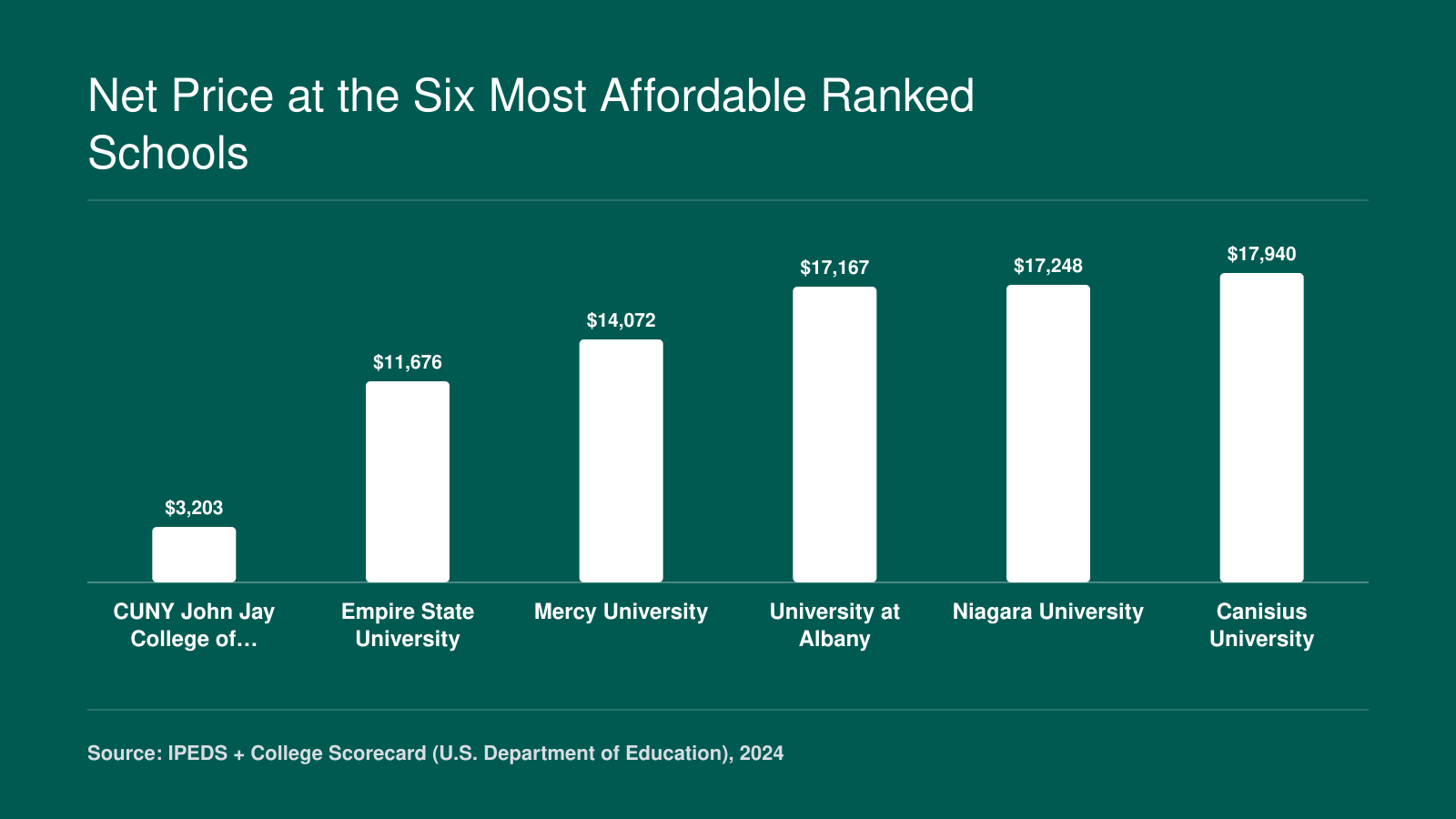
Net Price at the Six Most Affordable Ranked Schools
Net price is an institution-wide average after grants and scholarships, not a quote for every student, and graduate aid varies by program. The public-private gap is real but not uniform: CUNY John Jay College of Criminal Justice ($3,203) and Empire State University ($11,676) sit well below the private schools here. University at Albany, also public, comes in near Niagara University and Canisius University.
Cybersecurity Master's NYC Tuition and New York Licensure: What You'll Pay and What the State Requires
New York does not require a state license to work in cybersecurity, according to the New York Department of Financial Services Cybersecurity Resource Center, so your real expense is tuition, and the sticker price rarely matches it. Institution-wide published tuition is an annual figure that can mislead for graduate study. Multiplying the per-credit rate by the program's credit total gives a more honest number.
Touro lists about $875 per credit for a 33-credit program, roughly $28,875 before fees. Canisius advertises $965 per credit hour across 30 to 39 credits, or about $28,950 to $37,635. Mercy's rate is near $1,108 per credit, so its 30-credit degree lands around $33,240. Hofstra's rate is near $1,760 per credit, which pushes it well above those totals. Fees are extra, and these rates should be confirmed with each bursar.
Public options are cheaper. CUNY John Jay, Empire State University, and University at Albany all publish lower in-state sticker prices than the private schools here, though out-of-state rates climb sharply.
On regulation, 23 NYCRR Part 500 applies to covered financial entities, not individual workers. It requires a qualified CISO, who may be an employee, affiliate, or third-party provider, and it names no specific credential.1
To cut costs, ask your employer about tuition benefits and consider part-time enrollment, which lets you keep earning.
Top First-Year Earnings Among Ranked New York Programs
The highest first-year earnings among the programs here belong to Utica University's Master of Science in Cybersecurity.
Cybersecurity Master's Programs in New York: Salary Outcomes, Debt, and Certification Prep
Four years after finishing, Excelsior University graduates report median earnings of $144,427, the highest program-level figure among the schools here. Utica University follows at $108,561 at four years, and CUNY John Jay College of Criminal Justice at $93,984. One year out, Utica sits at $85,450 and John Jay at $70,714. Several other schools publish no program-level earnings yet, so they are left out rather than estimated.
Debt data is thinner. Utica's median borrower owes $37,746, which works out to roughly $429 a month on a standard 10-year repayment plan. No comparable debt figure is published for the other top earners.
Certification prep
Canisius University offers CYB 506, a 1.5-credit course that prepares students for Security+ or CEH. Touro University cites CEH and CySA+ preparation. Niagara University says its M.S. in Cyber Defense prepares students for the CISSP exam, and Utica University lists certification preparation and a CompTIA academic partnership.
These credentials matter because employers in finance and government, where Niagara says its alumni work, often use them as a quick screen for baseline skills, alongside the degree.
Cybersecurity Master's in New York: Your Questions Answered
How much does a cybersecurity master's in New York cost?
Which New York schools offer online cybersecurity master's programs?
Can I get a cybersecurity master's in New York without a technical background?
Is a master's in cybersecurity worth it in New York?
Do New York cybersecurity master's programs require the GRE?
How long does it take to finish a cybersecurity master's in New York part-time vs full-time?
Do cybersecurity master's programs in New York accept students with a non-computer-science bachelor's degree, and do they offer bridge courses?
Compare Cybersecurity programs on the data that matters
Explore more Computers & IT specializations or browse every graduate field.
All Computers & IT programs