Best Master's in Cybersecurity Programs in Michigan
Compare 17 accredited Cybersecurity programs in Michigan at 10 schools, with graduate earnings, cost, debt, and completion data from IPEDS and the U.S. College Scorecard.

Michigan's automotive, healthcare, and defense employers all run on connected systems, and connected systems need people who can secure them. Several of the schools here hold NSA/CISA Centers of Academic Excellence designations, with programs built around digital forensics, ethical hacking, and risk management.
The rankings compare campus, hybrid, and fully online programs on tuition, graduate outcomes, and delivery format, the same factors used to identify the Most Affordable Master's in Cybersecurity Programs. In-state tuition and fees run from roughly $14,700 at UM-Flint to $32,946 at Detroit Mercy, a spread that reshapes the value calculation well before a single course begins.
Key Points
- Federally reported tuition runs from about $14,700 in-state at UM-Flint to $32,946 at Detroit Mercy.
- Most schools here skip the GRE, but a few publish no policy at all.
- Graduation rates cover whole institutions, so compare programs on net price and format, not prestige.
Best Master's in Cybersecurity Schools in Michigan
Each school below lists its city, delivery format, and graduate tuition for in-state and out-of-state students. Graduation rates describe the whole institution, not completion of the cybersecurity program, and net price is an approximate average after aid, not a quote. Where a program offers concentrations, we call them out so you can spot specialized tracks.
University of Detroit Mercy
#1Detroit, MI · ~$23,000/yr (est.)
Best for: Working professionals studying fully online
University of Detroit Mercy delivers its Master of Science in Information Assurance with a cybersecurity major fully online at $1,011 per credit hour, with listed graduate tuition of $32,946 for in-state and out-of-state students alike. The school graduates about 67% of its students, and its approximate average net price after aid is around $15,232. It has held NSA and DHS Center of Academic Excellence in Cyber Defense recognition since 2004, and electives reach into ethical hacking, system forensics, and automotive cybersecurity management.
- 30 credit hours: eight core courses plus two electives
- Fully online at $1,011 per credit hour
- Stated minimum of 18 months, with a one-academic-year option
- Core covers cyberlaw, cyber defense operations, risk management, and information audit
- Electives include ethical hacking, system forensics, and software assurance
- NSA/DHS Center of Academic Excellence in Cyber Defense
- Admission requires the graduate application and official transcripts
Oakland University
#2Rochester Hills, MI · ~$22,000/yr (est.)
Best for: Students weighing research or professional tracks
Oakland University in Rochester Hills offers its Master of Science in Cyber Security on campus, with late afternoon and evening courses built for working students. Listed graduate tuition is $15,262 in state and $23,188 out of state. The school graduates about 58% of its students, and its approximate average net price after aid is near $9,120. A research track with a thesis and a coursework-only professional track let you choose between academic and applied paths, and a CyberCorps scholarship pathway can support qualifying Oakland seniors.
- 32 credits, offered in late afternoon and evening sessions
- Bachelor's in a related field and a 3.0 GPA for admission
- Two recommendation letters required
- Full-time students take 8 to 12 credits; part-time scheduling available
- Curriculum covers information, network, and software security plus policy and legal aspects
- Housed in the Department of Computer Science and Engineering
- Thesis-based track with up to 8 thesis credits
- 12 credits of foundation courses and a 4-credit core course
- GRE may be required for some applicants
- Depth courses in specialized topics
- Coursework-only track with no thesis
- GRE waiver possible
- Admission terms in fall, winter, and summer
- Depth courses and a required plan of study
Davenport University
#3Grand Rapids, MI · ~$20,000/yr (est.)
Best for: Career changers without a technical background
Davenport University in Grand Rapids delivers its 31-credit Master of Science in Information Assurance with a cybersecurity focus online and on campus, and the program lists no GRE or GMAT requirement. Listed graduate tuition is $24,466 for in-state and out-of-state students, the school graduates about 57% of its students, and its approximate average net price after aid is around $17,707. Admission is open to applicants from any undergraduate background, with prerequisite courses and credit for prior experience, and full-tuition DoD scholarships may be available.
- 31 credits: nine core courses plus two industry-specific electives
- Online and on-campus delivery in Grand Rapids
- No GRE or GMAT required
- Thesis capstone required
- Prerequisites in information security, cryptography, data communications, and statistics
- Curriculum aligned with the NICE framework and CISSP preparation
- Full-tuition DoD scholarships may be available
- Credit for work experience and certificates can reduce cost
University of Michigan-Dearborn
#4Dearborn, MI · ~$17,000/yr (est.)
University of Michigan-Dearborn offers a 30-credit Master of Science in Cybersecurity and Information Assurance in on-campus, online, or hybrid formats, with evening courses for working professionals. Listed graduate tuition is $15,640 in state and $32,896 out of state. The school graduates about 58% of its students, and its approximate average net price after aid is near $9,492. Three concentrations (Network and System Security, Data and Application Security, and Software Security) make it one of the more specialized options in the state.
- 30 credits with coursework, project, or thesis options
- Concentrations: Network & System Security, Data & Application Security, Software Security
- On-campus, online, or hybrid delivery with evening scheduling
- STEM bachelor's degree with a B average required
- Prerequisites in programming, statistics, and calculus
- Courses include wireless network security, cloud security, and intelligent vehicle systems
- No GRE requirement listed
Western Michigan University
#5Kalamazoo, MI · $20,000 – $25,000/yr (est.)
Western Michigan University in Kalamazoo offers a 30-credit hybrid Master of Science in Cybersecurity with online and in-person options, typically completed in about two years. Listed graduate tuition is $15,252 in state and $19,034 out of state, which keeps the out-of-state premium modest. The school graduates about 58% of its students, and its approximate average net price after aid is around $15,273. No GRE is required, and the curriculum prepares students for Network+ and Security+.
- 30 credit hours, about two years to finish
- Hybrid format with asynchronous and synchronous courses
- No GRE required
- Three recommendation letters, personal statement, resume, and transcripts
- Prepares for Network+ and Security+ certifications
- Up to 6 transfer credits, subject to approval
- International students OPT eligible
- Computer Science concentration within the same 30-credit degree
- Coursework drawn from business and engineering colleges
- Fall or spring enrollment
- Assistantships may be available
- Technical background recommended
University of Michigan-Flint
#6Flint, MI · $14,000 – $21,000/yr (est.)
University of Michigan-Flint offers a 32-credit Master of Science in Cybersecurity in hybrid online and on-campus formats, typically completed in 16 to 20 months. Listed graduate tuition is $14,704 in state and $28,320 out of state, though a non-resident tuition scholarship is available. The school graduates about 40% of its students, and its approximate average net price after aid is near $7,007. Students choose from four concentrations, and non-computer-science applicants can complete prerequisite certificates.
- 32 credits, 16 to 20 months on average
- Hybrid online and on-campus delivery
- Bachelor's degree with a 3.0 GPA required
- Statement of purpose, two letters, and a $55 application fee
- Rolling admission
- Joint BS/MS program available
- Application and Software Security focus within the 32-credit degree
- Fast Track options available
- Scholarships and assistantships available
- Cyber-Physical Systems Security focus within the 32-credit degree
- Pathways for applicants from non-CS backgrounds
- Non-credit certificate options
- CIT tuition scholarship available
Walsh College
#7Troy, MI · ~$17,000/yr (est.)
Walsh College in Troy built its Master of Science in Information Technology with a cybersecurity concentration for working IT professionals. It can be taken fully online, in live virtual sessions, or on campus, and it can finish in as little as one year. Coursework spans governance, risk and compliance, threat intelligence, digital forensics, cryptography, and cyber-physical systems. Federal data show median earnings of about $72,081 for students ten years after entry, measured institution-wide.
- About 33 credits, finishing in as little as one year
- Online, live virtual Zoom, or on-campus in Troy
- Capstone or three one-credit practicums
- Advanced standing available for IT certifications
- Foundation courses may be waived
- Fast Track to doctoral courses
- Five-year completion window
Ferris State University
#8Big Rapids, MI · ~$10,000/yr (est.)
Ferris State University in Big Rapids offers its Master of Science in Information Security and Intelligence online or on campus, at a listed graduate tuition of $14,778 for in-state and out-of-state students. The school graduates about 47% of its students, and its approximate average net price after aid is around $8,624, among the lowest on this list. The program carries NSA Center of Academic Excellence designation, offers stackable certificates, and lists the GMAT or GRE as optional.
- Online or on-campus delivery
- NSA Center of Academic Excellence designation
- 3.0 GPA, resume, statement of purpose, and three references required
- GMAT or GRE listed as optional
- Stackable certificates available
- Focus on digital forensics and incident response
- Capstone project included
Cost & outcomes by school
Federal data for the highest-earning Cybersecurity programs, independent of the ranking above. Earnings are this field's master's graduates four years after completing, where the Scorecard reports them.
| School | Earnings | Tuition / yr | Debt | Grads/yr | Format |
|---|---|---|---|---|---|
| Ferris State University MI | — | $9,538 | — | — | Online |
| University of Michigan-Flint MI | — | $14,473 | — | — | Hybrid |
| Central Michigan University MI | — | $17,187 | — | — | Online |
| University of Michigan-Dearborn MI | — | $17,126 | — | — | Hybrid |
| Walsh College MI | — | $17,157 | — | — | Online |
| Davenport University MI | — | $20,098 | — | — | Hybrid |
| Western Michigan University MI | — | $20,103 | — | — | Hybrid |
| Oakland University MI | — | $21,960 | — | — | Campus |
| Michigan Technological University MI | — | $25,916 | — | — | Online or campus |
| University of Detroit Mercy MI | — | $22,544 | — | 5 | Online |
Sources: U.S. Department of Education. Tuition and graduates: IPEDS. Earnings and debt: College Scorecard, this field's master's graduates; a dash means no figure is reported.
Online and Hybrid Master's in Cybersecurity Programs in Michigan
Online study trades live contact for flexibility, a tradeoff covered in the Best Online Master's in Cybersecurity Programs ranking. Asynchronous courses bend around a job, while synchronous sessions fix your schedule but keep you closer to faculty and classmates.
Fully Online, Hybrid, or Campus
Walsh College and University of Detroit Mercy are online master's programs in Michigan that offer fully online paths. Walsh lets students mix online, live virtual, or campus courses with synchronous and asynchronous options, and it requires a free online orientation. Detroit Mercy runs a Fall, Winter and Summer rotation, and its online students pay reduced tuition. Ferris State offers its program online or on campus, including HyFlex sections, and at least some online courses meet live. Western Michigan's hybrid format combines asynchronous online and synchronous courses. Davenport, UM-Dearborn and UM-Flint also blend online and on-campus delivery, while Oakland's program is campus-based. Ferris State lists the same program tuition for Michigan residents and nonresidents, a real advantage for out-of-state students.
Tips for Working Professionals
Few schools publish clear rules on campus visits or proctored exams, so ask admissions before enrolling. Oakland schedules late afternoon and evening courses with part-time study, and UM-Dearborn also offers evening classes. One or two courses per term is a realistic pace alongside full-time work. Ferris State and Davenport both advertise lab access, so confirm whether remote students get the same hands-on environments.
Michigan Cybersecurity Master's Programs That Waive or Make the GRE Optional
Do Michigan cybersecurity master's programs require the GRE? For most schools here, no, many are Master's in Cybersecurity Programs With No GRE Required, though a few publish nothing on the subject.
GRE policies by school
- UM-Dearborn: GRE not required.
- Western Michigan University: No graduate test required.
- Davenport University: No GRE or GMAT required.
- Ferris State University: GRE or GMAT optional.
- Oakland University: GRE may be required for some applicants, so confirm with the department.
- UM-Flint, Detroit Mercy, Walsh College: No GRE policy appeared in the admissions material we reviewed. Ask the admissions office rather than assume.
Prerequisites for career changers
UM-Dearborn's information assurance master's programs ask for a STEM bachelor's degree, a 3.0 GPA, and prior coursework in probability and statistics, programming (CIS 200 or equivalent), and Calculus II. UM-Flint also requires a 3.0 and a bachelor of science. Applicants missing algorithms, programming, or data structures can close the gap through non-credit certificates or a Fast Track route, and may start while finishing it. Oakland requires a 3.0 and foundation courses. Davenport lists prerequisites but gives credit for prior experience. Western Michigan recommends a technical background. Walsh says foundation courses may be waived and offers advanced standing for IT certifications. Ferris State requires a 3.0 but allows provisional admission.
Deadlines
UM-Flint admits on a rolling basis with monthly reviews. Western Michigan's deadline falls one week before the semester begins, for fall or spring entry. Oakland's deadlines vary by semester. UM-Dearborn's catalog page gives no general deadline. Check each program page for current dates before you plan your application.
Related Articles
What a Master's in Cybersecurity Costs in Michigan
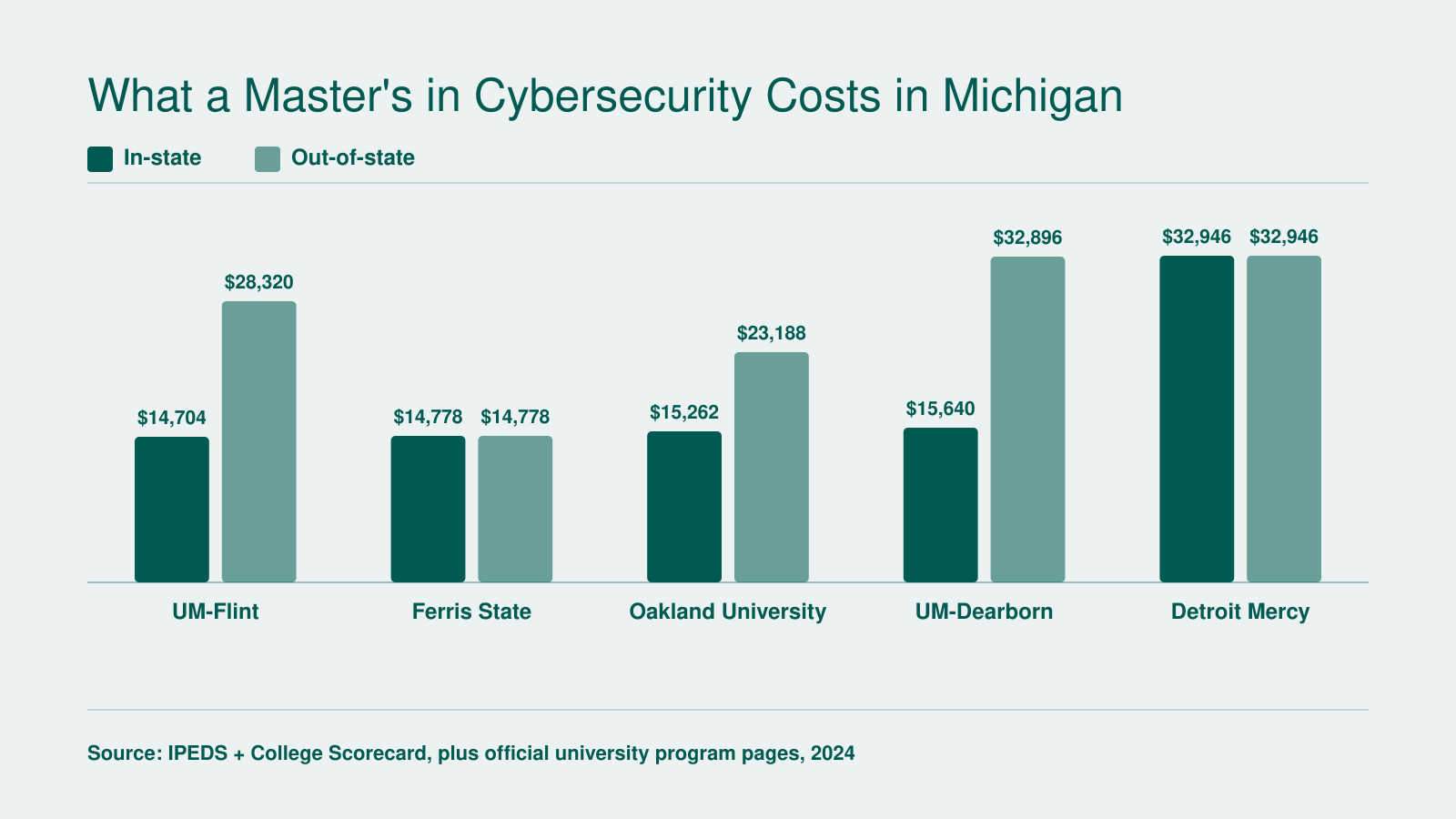
Federally reported annual tuition and fees run from about $14,700 in-state at UM-Flint to $32,946 at Detroit Mercy, a private school that charges everyone the same. Ferris State also reports identical in-state and out-of-state figures, so out-of-state students pay no premium there. Detroit Mercy lists $1,011 per credit for a 30-credit program (about $30,330 before fees), and UM-Flint and Oakland require 32 credits versus 30 at UM-Dearborn, so multiply each school's current per-credit rate by those totals. We could not confirm per-credit rates for the other schools. These figures may reflect institution-wide rather than program-specific rates, and net price after aid is an institution-wide average that is only approximate, so confirm with each bursar.
Nationally, CyberSeek counted 514,359 cybersecurity job openings from May 2024 through April 2025, with a 74% supply/demand ratio. For Michigan's current numbers, check CyberSeek.org and note the access date, then cross-check with BLS wage statistics, O*NET, ISC2, ISACA, CompTIA, and school career offices or local workforce boards.
NSA Designated Cybersecurity Master's Programs in Michigan
A federal designation can strengthen information security and assurance programs in Michigan, but it should not outweigh program fit and cost. The NSA and CISA jointly sponsor the National Centers of Academic Excellence in Cybersecurity, which recognize institutions in Cyber Defense (CAE-CD), Research (CAE-R), and Cyber Operations (CAE-CO). Schools earn a designation for a set period by showing their curriculum meets federal standards.
Three schools in this ranking currently hold a CAE designation:
- Oakland University: CAE-CD (2018 to 2029) and CAE-R (2025 to 2030).1
- University of Detroit Mercy: CAE-CD (2004 to 2027).1
- University of Michigan-Flint: CAE-CD (2026 to 2031).1
None of the schools here is listed with CAE-CO, and the others are not shown with a designation in the official data.1
Why it matters
Designated schools map coursework to federal standards, and attending one is generally a condition for CyberCorps Scholarship for Service and DoD cyber scholarship eligibility.2 Federal employers also recognize the designation.
Designations expire and renew, so check the current CAE list and ask the admissions office whether your specific program is covered.1 Detroit Mercy's period ends in 2027, which makes a quick confirmation especially worthwhile.
Compare Cybersecurity programs on the data that matters
Explore more Computers & IT specializations or browse every graduate field.
All Computers & IT programs