Best Master's in Cybersecurity Programs in Kansas
Compare 4 accredited Cybersecurity programs in Kansas, with graduate earnings, cost, debt, and completion data from IPEDS and the U.S. College Scorecard.

Kansas employers in defense, agricultural technology, healthcare, and finance are hiring security professionals who can move into senior or specialized roles, and an accelerated master's in cybersecurity is usually the fastest credential for that jump. Only a small number of Kansas universities offer a cybersecurity master's, so the ranked list is deliberately short.
The tension is cost and delivery. Fort Hays State's online MPS lists about $5,900 in-state tuition, while Friends University's hybrid MS runs about $34,000 before aid. That spread forces a choice between public online flexibility and private depth.
Key Points
- Kansas State, Fort Hays State, and Friends University hold HLC accreditation.
- In 2027, Kansas State and Fort Hays State offer online cybersecurity formats.
- Kansas information security analysts earned $100,620 median wage in May 2025.
Ranked: Best Master's in Cybersecurity Schools in Kansas
This ranking weighs what many Kansas students care about first: what graduates earn ten years out and whether students actually finish. We also factored published tuition, delivery format fit, and program focus. Each school below includes the specifics that matter most for a cybersecurity master's in Kansas.
Kansas State University
#1Manhattan, KS · $12,000 – $26,000/yr (est.)
Best for: Working professionals needing online cybersecurity specialization
Kansas State University pairs a rigorous computer science master's with a cybersecurity focus, taught online by on-campus faculty. The 30-credit program spans programming, operating systems and high-assurance software engineering, with electives shaped around network defense, secure design and cyber-physical systems. K-State says the program feeds roles such as security engineer, analyst and architect in health care, finance, energy and defense, or doctoral study.
- 30 credit hours total
- Fully online, taught by on-campus professors
- GRE required; three recommendation letters minimum
- Cybersecurity focus: network defense, secure design, cyber-physical systems
- Four concentration options available
- Prepares for security engineer, analyst, architect or doctoral study
Fort Hays State University
#2Hays, KS · ~$5,000/yr (est.)
Best for: Certification-focused learners seeking affordable cyber training
Fort Hays State offers a Master of Professional Studies in Cybersecurity with both online and on-campus courses, built around a 30-credit structure of core, major, elective and capstone work. Admission asks for a bachelor's transcript with a 3.0 GPA in the last 60 hours, two recommendation letters, a personal statement and a resume, with prerequisite coursework possible. The program carries National Center of Academic Excellence in Cyber Defense recognition and prepares students for certifications such as CISSP and CompTIA Security+.
- 30 credit hours: 9 core, 12 major, 6 electives, 3 capstone
- Available on campus and online
- 3.0 GPA required in last 60 hours of bachelor's
- Certification prep for CISSP, CompTIA Security+, PenTest+, CEH and more
- National Center of Academic Excellence in Cyber Defense designation
- Rolling admissions with priority deadlines
Friends University
#3Wichita, KS · ~$12,000/yr (est.)
Best for: Technical specialists needing flexible eight-week pacing
Friends University's 40-credit Master of Science in Cyber Security runs in eight-week terms and can be completed online or in hybrid format. Curriculum covers network security, digital forensics, policy development, secure cloud computing and mobile technology security, ending in a capstone. Admissions require two recommendation letters, an interview, and prerequisites in computer programming and statistics.
- 40 credit hours total
- Eight-week course terms
- Hybrid or online format
- Requires two letters of recommendation and program interview
- Prerequisites: computer programming and statistics
- Capstone project included
- Core topics: secure cloud computing and mobile technology security
Cost & outcomes by school
Federal data for the highest-earning Cybersecurity programs, independent of the ranking above. Earnings are this field's master's graduates four years after completing, where the Scorecard reports them.
| School | Earnings | Tuition / yr | Debt | Grads/yr | Format |
|---|---|---|---|---|---|
| Fort Hays State University KS | — | $4,949 | — | — | Online |
| Friends University KS | — | $11,988 | — | — | Hybrid |
| Kansas State University KS | — | $12,089 | — | — | Online |
| Emporia State University KS | — | $8,843 | — | 4 | Online |
Sources: U.S. Department of Education. Tuition and graduates: IPEDS. Earnings and debt: College Scorecard, this field's master's graduates; a dash means no figure is reported.
Online and Hybrid Cybersecurity Master's Options in Kansas
For the Best Master's in Cybersecurity Programs in Kansas, the format split is straightforward. Kansas State's M.S. in Computer Science, with its cybersecurity core area, is listed as online,1 while Fort Hays State's Master of Professional Studies in Cybersecurity is offered both online and on campus. Friends University runs its Master of Science in Cyber Security in a hybrid or online format, built on eight-week terms.
The public program pages for Master's Programs in Kansas do not spell out every delivery detail, so verify these before you enroll:
- Class timing: Confirm whether coursework is asynchronous (work on your own schedule) or synchronous (set meeting times). Don't assume "online" means self-paced.
- Campus visits and exams: Ask each program about any required residencies and how exams are proctored.
- Pacing and start terms: Check whether part-time enrollment is allowed and how many start dates run each year. Friends University's short terms suit working professionals.
- Out-of-state rates: Online tuition can differ by residency. Kansas State's online programs charge the same rate to residents and nonresidents; for Fort Hays, confirm which rate online students actually pay.
Related Articles
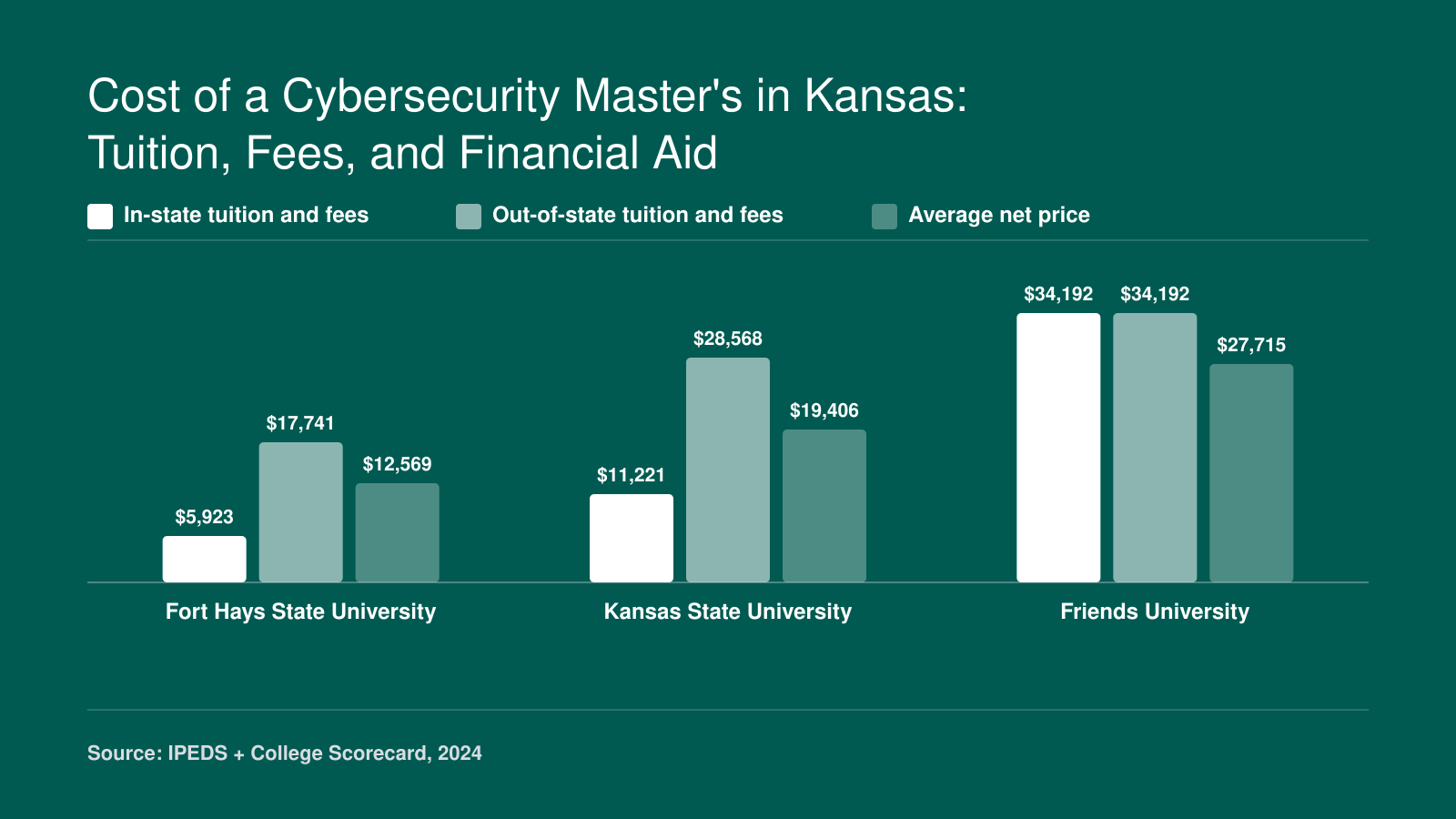
Cost of a Cybersecurity Master's in Kansas: Tuition, Fees, and Financial Aid
In-state and out-of-state tuition can differ sharply at public universities, while net price shows the institution-wide average after grants and scholarships, not an exact quote for this program. Kansas State University participates in the CyberCorps Scholarship for Service, which can provide up to $37,000 in annual stipend support along with tuition and fees, though applications are currently paused. Kansas has no state license for cybersecurity professionals, so budget for industry certifications such as CompTIA Security+ or CISSP, which many employers and DoD contracts expect.
Accreditation and CAE Designations for Kansas Cybersecurity Master's Programs
Kansas State University, Fort Hays State University, and Friends University are all accredited by the Higher Learning Commission, the regional accreditor for Kansas institutions. That matters because regional accreditation underpins eligibility for federal student aid, credit transfer, and employer recognition of the degree.
Fort Hays State is reported to hold an NSA/DHS Center of Academic Excellence designation. The available information does not say whether it is CAE-CD, CAE-CO, or CAE-R, or when it comes up for renewal. We found no established CAE designation for Kansas State or Friends. Designations run for defined terms, so confirm current status on the official CAE Community Map.
For students, CAE status signals a curriculum mapped to federal cybersecurity standards. It can also open eligibility for programs such as CyberCorps SFS, though that depends on the institution's participation.
Kansas State's ABET accreditation covers its undergraduate cybersecurity bachelor's degree. We found no ABET accreditation for a Kansas cybersecurity master's program.
Career Outcomes and Salaries for Kansas Cybersecurity Master's Graduates
Cybersecurity pays well in Kansas, and the statewide numbers back that up. Information security analysts in the state earned a median wage of $100,620 in May 2025, with the top quarter clearing $130,020 and the top tenth reaching $155,490.1 Pay varies by metro: the Kansas City, MO-KS, area reported a higher median of $104,010 across 1,810 analysts (that count spans both states), while Wichita came in at $91,670 across 370 analysts.1
Program-level earnings and debt
Program-specific earnings for the Kansas cybersecurity master's programs on this list, including the Best Online Master's in Cybersecurity Programs, are not currently published in the outcomes data, so we point you to the statewide figures above for a realistic salary benchmark rather than estimate. On the cost side, median graduate debt is published: roughly $21,250 at Kansas State, $21,000 at Fort Hays State, and $25,000 at Friends University. Weighed against a six-figure Kansas median wage, those debt loads are modest and point to a strong return for graduates who land analyst roles.
Who hires in Kansas
Kansas employers span several sectors: federal and defense work near Fort Leavenworth and McConnell Air Force Base, healthcare, finance, and Wichita's aviation industry all need security talent.
How to Choose the Right Kansas Cybersecurity Master's Program
Cybersecurity master's degrees are increasingly built as concentrations inside broader computing degrees rather than standalone programs, so the course list matters more than the title. Kansas State University is the clearest example: its cybersecurity option sits within the M.S. in Computer Science and lists security courses such as CIS 751 and CIS 655.1 That engineering-heavy, research-oriented structure suits secure systems and network defense. Kansas State's documented materials do not describe a dedicated digital forensics and incident response track, so if that is your goal, ask Fort Hays State University and Friends University for their course lists before assuming a fit.1
Thesis, report, or coursework
Kansas State offers thesis, report, and non-thesis routes, at roughly 30 to 33 credits depending on the path.1 The thesis (6 credits) suits students heading toward a PhD or research role. The report or coursework routes fit professionals who want to be job-ready sooner.
Hands-on resources
Kansas State's cybersecurity center holds an NSA/DHS Center of Academic Excellence designation in Cyber Defense Research.1 The official materials do not confirm a named cyber range or lab, so ask every school about labs and competition teams.
Next step: shortlist by format and the Most Affordable Master's in Cybersecurity Programs, then confirm No GRE Required and CAE status with each admissions office.
Compare Cybersecurity programs on the data that matters
Explore more Computers & IT specializations or browse every graduate field.
All Computers & IT programs