Best Master's in Cybersecurity Programs in Florida
Compare 21 accredited Cybersecurity programs in Florida at 20 schools, with graduate earnings, cost, debt, and completion data from IPEDS and the U.S. College Scorecard.

Cybersecurity hiring increasingly rewards demonstrable, hands-on skill, which makes what a master's costs matter as much as whose name is on it. In Florida, that spread is wide: the University of South Florida's in-state master's program totals $28,620, while Florida Institute of Technology's online IT-cybersecurity master's lists sticker tuition of $24,328.59.
Formats split as sharply, between campus labs and fully online, asynchronous coursework. The real tradeoff is price against access to equipment, faculty, and the regional employer networks that still drive security hiring in Tampa, Orlando, and the Space Coast.
Key Points
- Florida requires no state license for cybersecurity work.
- Florida Institute of Technology's online cybersecurity master's requires no GRE.
- Net price is an institution-wide average, so confirm your own cost.
Ranked: Best Master's in Cybersecurity Programs in Florida
These ten Florida programs mix campus and online formats, from large public research universities to career-focused private and online schools. Graduation rates cited below describe each institution as a whole, not the cybersecurity program, and program-level earnings are published for very few of them.
Florida State University
#1Tallahassee, FL · ~$11,000/yr (est.)
Best for: Computer science grads wanting research depth
Florida State University is a large public research university in Tallahassee, and the school's graduation rate is about 86%. Its cybersecurity option is a major inside the Master of Science in Computer Science, so students take graduate computer science coursework alongside core security classes and earn a Cyber Security Major Certificate. It fits students with a computer science background who want a research-oriented, on-campus degree at a public-university price.
- 30 semester hours of graduate computer science courses
- Campus-based delivery in Tallahassee
- Core courses in computer security, cryptography and network security
- Offensive computer security and software reverse engineering courses
- Includes a Cyber Security Major Certificate
- Undergraduate prerequisites required before admission
- Direct application to the program, no separate general CS application
Florida Institute of Technology
#2Melbourne, FL · ~$24,000/yr (est.)
Best for: Career changers from nontechnical backgrounds
Florida Institute of Technology is a private university in Melbourne, and the school's graduation rate is about 64%. The Master of Science in Cybersecurity is taught on campus, centers on cyber defense skills, and admits students from technical and nontechnical backgrounds. It suits career changers who want a dedicated cybersecurity degree with a thesis or capstone-style finish and can pay private-school tuition.
- Classroom delivery at the Melbourne main campus
- Open to technical and nontechnical backgrounds
- Workforce-centric focus on cyber defense competencies
- Six elective credits at the 5000 level or higher
- Thesis can replace the six elective credits
- Final program exam or thesis required
- Requires a resume, recommendation letters and a statement of objectives
University of South Florida
#3Tampa, FL · ~$10,000/yr (est.)
Best for: Working adults studying fully online
The University of South Florida is a public research university in Tampa, and the school's graduation rate is about 77%. Its Master of Science in Cybersecurity Intelligence and Information Security can be completed entirely online and pairs technical security training with cyber intelligence analysis. It fits working adults who want a STEM-based, flexible program from a public university.
- 33-credit applied graduate program
- Can be completed entirely online
- STEM-based curriculum
- Courses on threat identification, cryptography and network security
- Cyber intelligence training alongside technical content
- School of Information scholarships available
Embry-Riddle Aeronautical University-Daytona Beach
#4Daytona Beach, FL · ~$23,000/yr (est.)
Embry-Riddle's Daytona Beach campus is a private, technically focused university, and the school's graduation rate is about 67%. Its Master of Science in Computer Science with a Cybersecurity concentration is built around hands-on work in an on-campus Cybersecurity Engineering Laboratory. It fits students who want an in-person, engineering-style program and accept private tuition, with military benefits accepted.
- 30 credit hours with thesis or graduate research project option
- In-person classes at the Daytona Beach campus
- Cybersecurity Engineering Laboratory (CybEL) hands-on work
- Covers system exploitation, penetration testing and applied cryptography
- Advisory board keeps curriculum aligned with industry
- Military benefits accepted
- Transfer credits may be accepted
- School cites an average income of $112,000 for graduates
Edward Waters University
#5Jacksonville, FL · ~$22,000/yr (est.)
Edward Waters University is a small private institution in Jacksonville, and the school's graduation rate is about 28%, the lowest on this list. Its 36-credit online Master of Science in Cybersecurity blends secure programming, applied security and compliance, and finishes with a capstone. It fits working adults seeking a lower-cost online option, who should weigh the school's graduation rate when comparing support and completion.
- 36 credit hours, delivered online
- Capstone required
- Core courses in secure application programming and network management
- Information security compliance coursework
- Electives include malware reverse engineering
- Hands-on labs and interdisciplinary coursework
- Aimed at management, government and nonprofit security roles
Strayer University-Florida
#6Tampa, FL · ~$15,000/yr (est.)
Strayer University's Florida campus in Tampa offers a fully online master's with hybrid campus options at select locations. The program is validated by the National Security Agency, and the school's graduation rate is reported at 100%, though that figure should be verified before relying on it. It fits working professionals who want a structured, course-by-course online format with military benefits accepted.
- 45 credit hours across 10 courses
- 11-week course terms
- Fully online option available
- Validated by the National Security Agency
- Minimum 2.5 GPA for admission
- Transfer up to four eligible classes
- Military benefits accepted
- One-on-one academic coaches
Nova Southeastern University
#7Fort Lauderdale, FL · ~$25,000/yr (est.)
Nova Southeastern University is a private university in Fort Lauderdale, and the school's graduation rate is about 63%. The listed cybersecurity master's is a Dual Admission path that combines a bachelor's and a Master of Science in Cybersecurity Management in five years, with emphasis on risk management and policy. It fits current high school or transfer students who want to plan an accelerated bachelor's-to-master's route, not experienced professionals seeking a standalone master's.
- Dual Admission: bachelor's and master's in five years
- Campus-based program in Fort Lauderdale
- Focus on risk management and cybersecurity policy
- Requires a 3.0 GPA for high school or transfer entry
- Must maintain a 3.0 undergraduate GPA
- Graduate application required after the bachelor's degree
- Experiential learning and case study analyses
St. Thomas University
#8Miami Gardens, FL · ~$12,000/yr (est.)
St. Thomas University in Miami Gardens is a private university, and the school's graduation rate is about 48%. Cybersecurity is offered as a Cyber Security Management specialization within an online MBA, so it leans toward business leadership more than technical depth. It fits professionals who want a management-oriented degree with the same tuition in-state and out-of-state, at $625 per credit hour and $19,500 total.
- 30 credit hours, 10 courses, as few as 12 months
- Online delivery with accelerated 7-week courses
- $625 per credit hour, $19,500 total tuition
- Same tuition for in-state and out-of-state students
- No GMAT required, 2.33 minimum GPA
- Six start dates per year
- 18 core credits plus 12 specialization credits
- Courses include cybersecurity law and enterprise information security
DeVry University-Florida
#9Orlando, FL · ~$10,000/yr (est.)
DeVry University's Florida campus in Orlando delivers its Keller Graduate School program online, and the school's graduation rate is about 33%. The Master of Information Technology Management with a Cybersecurity and Information Assurance concentration is an IT management degree with security coursework, and it awards a graduate certificate along the way. It fits working IT staff who want an accelerated, fully online route into security management.
- 39 credit hours, 13 courses, about 12 months
- Fully online option available
- Capstone project required
- Automatically earn a graduate certificate in the specialization
- Hands-on work with firewalls and vulnerability scanners
- Disaster recovery planning coursework
- Credit for prior work experience
- Military benefits and employer reimbursement supported
Herzing University-Orlando
#10Winter Park, FL · ~$9,000/yr (est.)
Herzing University's Orlando area campus in Winter Park offers a fully online, self-paced master's, and the school's graduation rate is about 37%. The Master of Science in Cybersecurity accepts a bachelor's degree in any field and covers digital forensics, penetration testing and cloud security. It fits career changers who want rolling admissions and certification preparation, with exam fee reimbursement for up to three certifications.
- 37 credit hours, most students finish in about a year
- $630 per credit
- Asynchronous online classes, full-time and part-time options
- Rolling admissions
- Capstone required, internship optional
- Covers digital forensics, penetration testing and cloud security
- Prepares for Cisco and CompTIA certifications
- Reimburses exam fees for up to three certifications
- Transfer up to 12 approved credits
Cost & outcomes by school
Federal data for the highest-earning Cybersecurity programs, independent of the ranking above. Earnings are this field's master's graduates four years after completing, where the Scorecard reports them.
| School | Earnings | Tuition / yr | Debt | Grads/yr | Format |
|---|---|---|---|---|---|
| Embry-Riddle Aeronautical University-Daytona Beach FL | $145,240 | $22,870 | — | 3 | Campus |
| Florida Atlantic University FL | — | $6,693 | — | — | Campus |
| University of West Florida FL | — | $9,062 | — | — | Online or campus |
| Herzing University-Orlando FL | — | $9,370 | — | — | Online |
| DeVry University-Florida FL | — | $9,832 | — | — | Online |
| Florida Agricultural and Mechanical University FL | — | $9,876 | — | — | Campus |
| University of North Florida FL | — | $10,364 | — | — | Campus |
| University of South Florida FL | — | $10,428 | — | — | Online |
| Southeastern University FL | — | $10,659 | — | — | Online or campus |
| St. Thomas University FL | — | $12,440 | — | — | Online |
| University of Florida FL | — | $12,737 | — | — | Campus |
| The University of Tampa FL | — | $13,240 | — | — | Campus |
Sources: U.S. Department of Education. Tuition and graduates: IPEDS. Earnings and debt: College Scorecard, this field's master's graduates; a dash means no figure is reported.
Online and Hybrid Cybersecurity Master's Options in Florida
Campus-only and fully online formats both exist among master's programs in Florida, and the split is clear. Florida State University and Embry-Riddle Aeronautical University-Daytona Beach are campus-based. Florida Institute of Technology and Nova Southeastern University offer both online and campus options, though the online details published for Florida Tech cover its related online M.S. in Information Technology-Cybersecurity, not the ranked program. USF, Edward Waters, Strayer, St. Thomas, DeVry, and Herzing deliver online.
Format and residency
USF's master's degree in cybersecurity program states there are no on-campus classes, but it does not label courses asynchronous or synchronous. Herzing is the one school here that clearly describes its classes as asynchronous. For most of the others, confirm live-session expectations and any residency requirement with admissions, since they are not clearly published.
Pacing for working professionals
USF runs 8-week courses and lists two years to finish, possibly one depending on availability. Florida Tech's online IT-Cybersecurity degree has multiple starts, 8-week terms, and a part-time rate, with completion in as few as 15 months. St. Thomas (MBA in Cybersecurity) and Herzing advertise as few as 12 months, and Herzing offers part-time enrollment. DeVry lists a 12-month program. Treat these timelines as best-case figures.
GRE and Admission Requirements: Which Florida Master's Programs Are Test-Optional
Among Florida's cybersecurity master's programs, the answer to whether you must submit Graduate Record Examination scores varies by school, with No-GRE master's programs available at some institutions.
- No GRE: Florida Institute of Technology's online MS in IT in Cybersecurity requires neither the GRE nor the GMAT.1
- Waivable: USF's information assurance and cybersecurity management master's lists the GRE as required, but applicants with an accredited degree and a 3.0 GPA or higher can request a waiver.
- Required: Florida Tech's on-campus Department of Computer Sciences and Cybersecurity wants GRE General scores. It sets no overall minimum, but it requires a 50th percentile score in Quantitative.2
- Not clearly published: The research did not establish a GRE policy for Florida State, Embry-Riddle, Edward Waters, Strayer, Nova Southeastern, St. Thomas, DeVry, or Herzing. St. Thomas says only that its MBA track needs no GMAT. Confirm with each admissions office.
Prerequisites and deadlines
Most technical programs prefer a bachelor's in computer science, computer engineering, IT, or management information systems. USF also favors database, systems analysis, and accounting information systems coursework. A 3.0 GPA is common, though Strayer lists 2.5 and St. Thomas 2.33.
Fall 2027 deadlines are not yet confirmed. Florida Tech's department lists February 1 for fall, and USF lists July 15 for fall without a year. Verify both before applying.
Related Articles
Cost, Financial Aid, and Certification Value for Florida Cybersecurity Master's Degrees
The schools below run from lowest to highest institution-level net price, drawn from federal IPEDS and College Scorecard data. Net price is an institution-wide average after grant aid, not a quote for this master's program, so your own cost will differ. The tuition and fees column shows federal listings, and the per-credit column shows rates schools publish directly. Rates come from different years and billing bases, so confirm current figures with each bursar before budgeting.
| School and program | Listed tuition and fees, in-state / out-of-state | Institution-level net price | Published per-credit rate and estimated program cost | Certification alignment and exam vouchers |
|---|---|---|---|---|
| University of South Florida, M.S. in Cybersecurity Intelligence and Information Security | $10,428 / $21,126 | $9,812 | 2026 rates of $954 in-state and $1,977 out-of-state per credit. Credit count differs by source (30 or 33), so a 30-credit estimate is about $28,620 in-state and $59,310 out-of-state. | Not stated in sources reviewed |
| Florida State University, M.S. in Computer Science (Cybersecurity major) | $10,553 / $26,707 | $11,297 | Per-credit rate not confirmed here. The degree requires 30 semester hours. | Includes an academic Cyber Security Major Certificate. Industry exam alignment and vouchers not stated. |
| Edward Waters University, M.S. in Cybersecurity | $22,440 (same rate listed for both) | $13,649 | Per-credit rate not confirmed here. The program is 36 credit hours. | Not stated in sources reviewed |
| Strayer University-Florida, M.S. in Cybersecurity | $15,135 (same rate listed for both) | $16,064 | Per-credit rate not confirmed here. The program is 45 credit hours. | Described as validated by the National Security Agency. Exam alignment and vouchers not stated. |
| Herzing University-Orlando, M.S. in Cybersecurity | $9,370 (same rate listed for both) | $19,850 | $630 per credit. At 37 credits, about $23,310 before any fees. | Prepares for Cisco and CompTIA certifications. Reimburses up to three certification exam fees. |
| St. Thomas University, MBA in Cyber Security Management | $12,440 (same rate listed for both) | $26,312 | $625 per credit. Listed total tuition is $19,500 for 30 credits, the same in-state and out-of-state. | Not stated in sources reviewed |
| DeVry University-Florida, M.I.T.M. in Cybersecurity and Information Assurance | $9,832 (same rate listed for both) | $29,477 | Per-credit rate not confirmed here. The program is 39 credits. | Awards a graduate certificate and a digital badge. Specific exam alignment and vouchers not stated. |
| Nova Southeastern University, M.S. in Cybersecurity Management | $24,830 (same rate listed for both) | $30,371 | Per-credit rate not confirmed here. | Not stated in sources reviewed |
| Florida Institute of Technology, M.S. in Cybersecurity (campus) and online M.S. in IT-Cybersecurity | $24,320 (same rate listed for both) | $35,639 | Online M.S. in IT-Cybersecurity: $737.23 per credit, about $24,329 total. The campus program's per-credit rate is not confirmed here. | Not stated in sources reviewed |
| Embry-Riddle Aeronautical University-Daytona Beach, M.S. in Computer Science (Cybersecurity) | $22,870 (same rate listed for both) | $41,272 | Per-credit rate not confirmed here. The program is 30 credit hours. | Not stated in sources reviewed |
Florida Cybersecurity Credentials: Licensure vs. Certification
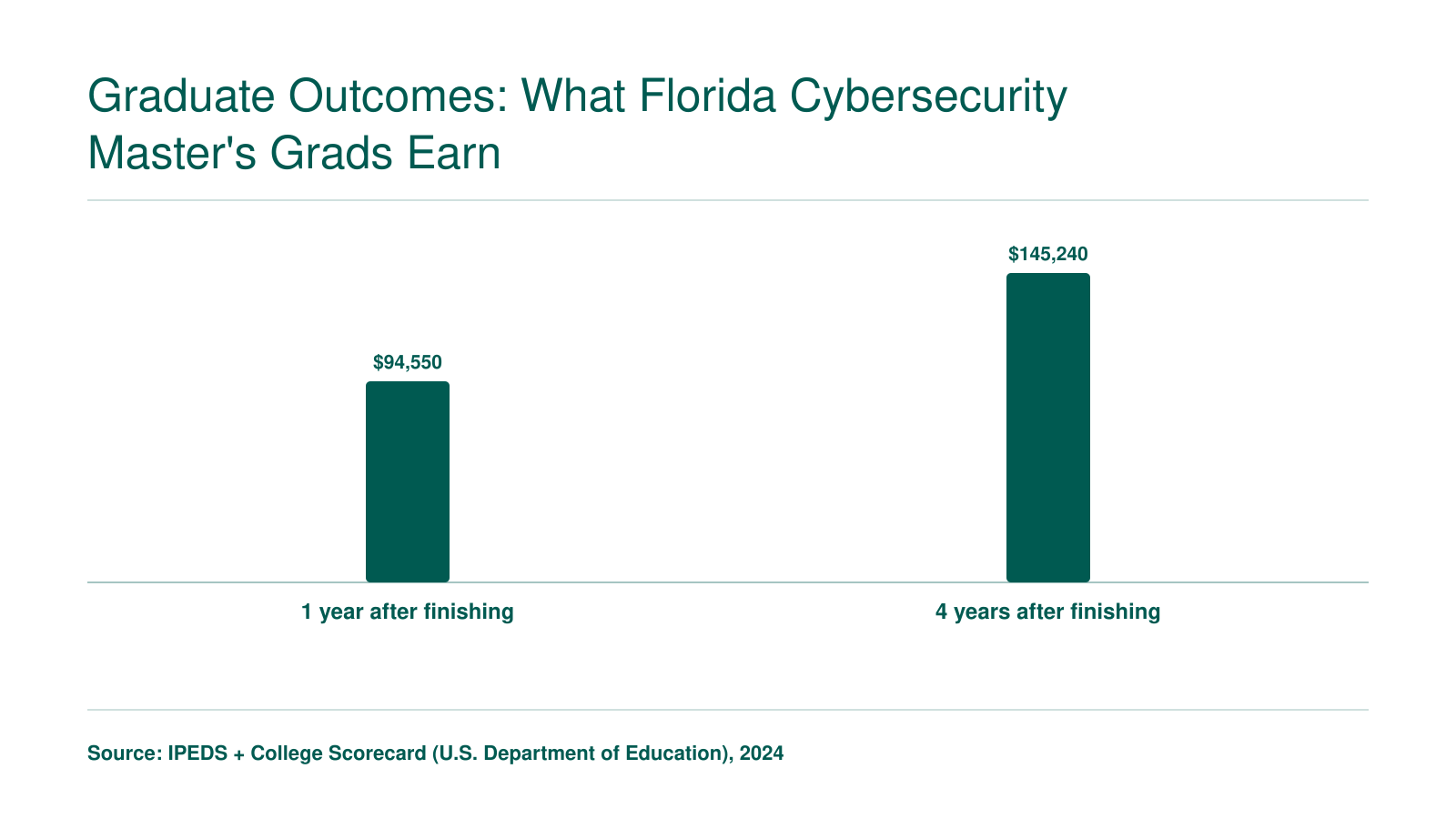
Graduate Outcomes: What Florida Cybersecurity Master's Grads Earn
Program-level earnings come from federal College Scorecard data and are reported only where enough graduates exist to publish a figure. Embry-Riddle Aeronautical University-Daytona Beach reports median earnings for its cybersecurity master's graduates at two points after finishing. Treat them as a signal rather than a guarantee, since they reflect a very small group of graduates.
How to Choose the Right Florida Cybersecurity Master's Program
Technical depth vs. management breadth: that is the first fork. A penetration-testing or SOC analyst path rewards hands-on offensive and defensive tooling, while a security manager role leans on policy, risk, and leadership, as in Master's in IT Management in Florida programs.
Designation and STEM status
The NSA/DHS National Centers of Academic Excellence (CAE) designations signal curricula aligned with federal cyber defense or research standards. Among the schools in this list, FIU carries CAE-CD recognition.1 Nova Southeastern has held CAE-CD recognition since 2005.2 NSU's M.S. in Cyber Defense is also explicitly STEM-designated.2 For international students, a STEM-designated program may support a 24-month OPT extension if its exact CIP code appears on the DHS STEM list, so confirm that detail with the program directly. CAE-Cyber Operations is a separate category and is not clearly established for any program on this page.
Concentration-to-career fit
Technical concentrations, such as Florida Tech's cybersecurity master's or Embry-Riddle's computer science cybersecurity option, align with penetration testing and SOC analyst roles common in Master's in Information Security and Assurance programs. Management and policy tracks, including NSU's cybersecurity management and St. Thomas's MBA specialization, fit security manager or governance roles. Several online and hybrid options in this list, such as USF's fully online master's, give you location flexibility without leaving the Florida rankings set.
Final tiebreaker
When cost and delivery format are otherwise comparable, weigh designation and STEM status more heavily if you need federal hiring advantages or a longer OPT window.
Compare Cybersecurity programs on the data that matters
Explore more Computers & IT specializations or browse every graduate field.
All Computers & IT programs