Accelerated Master's in Data Analytics Programs
Compare 360+ accredited fastest Data Analytics programs, with graduate earnings, cost, debt, and completion data from IPEDS and the U.S. College Scorecard.

A year out of the workforce can cost more than tuition: data scientists earned a median $120,230 in May 2025. That arithmetic is what makes an analytics master's finished in twelve months or less worth the compressed workload.
"Accelerated" covers several formats: 12-month full-time cohorts, 4+1 tracks open only to current undergraduates, and 7- or 8-week online terms built for people still working. Sticker prices for the same 30 credits run from under $13,000 to more than $42,000.
Key Points
- Northwest Missouri State's online data analytics degree totals $12,960 including fees.
- University of Miami lists $42,750 for 30 credits, fees not included.
- Data scientists earned median pay of $120,230 in May 2025.
The 10 Fastest Accelerated Master's in Data Analytics Programs
Order here is set by the calendar: the fewer months between your first class and your diploma, the higher the program sits. We surface programs that compress the master's into a single year or less, then note which formats require full-time study or summer terms. Each entry lists delivery mode and institutional accreditation so you can weigh speed against practical constraints.
Georgia Institute of Technology
#1Atlanta, GA · ~$16,000/yr (est.)
Best for: Quantitative-minded professionals pursuing a one-year analytics degree
Georgia Tech's Master of Science in Analytics is a one-year, interdisciplinary program that draws on statistics, operations research, computing, and business. The campus track is intensive and full-time, ideal for recent graduates or professionals ready to step out of work for a year, while an online option lets working learners keep their jobs. Either path leads to the same Georgia Tech degree.
- One-year full-time campus program
- Fully online option available for working professionals
- Blends statistics, operations research, computing, and business
- Same Georgia Tech degree online or on campus
Fairfield University
#2Fairfield, CT · ~$21,000/yr (est.)
Best for: Balancing-work adults wanting course-by-course flexibility
Fairfield's STEM-designated Master of Science in Artificial Intelligence and Business Analytics can be finished in as few as one year full-time, or stretched over two years part-time. Students choose each course in asynchronous online or in-person format, giving unusual flexibility for a fast-track degree. Electives allow specializations in areas like healthcare, marketing analytics, or quantitative finance.
- 30 total credit hours
- Full-time one-year or part-time two-year tracks
- Choose asynchronous online or in-person for each course
- STEM-designated master's program
- Seven concentration options, including healthcare and marketing analytics
- Capstone required
Hult International Business School
#3Cambridge, MA · ~$56,000/yr (est.)
Best for: Global students seeking a one-year management analytics track
Hult's Analytics Specialization Track is a concentration within the one-year Master's in Management, with study options in Boston, London, or Dubai. The curriculum includes data analysis, business intelligence, and AI strategy, plus a capstone and a Hult Certificate in Applied AI. It may qualify as a STEM specialization for eligible U.S.-campus students.
- One-year Master's in Management with Analytics concentration
- Study at Hult Boston, London, or Dubai
- Includes Hult Certificate in Applied AI
- May qualify as STEM specialization for eligible US-campus students
- Cover data analysis, business intelligence, and AI strategy
- Capstone project required
Saint Mary's University of Minnesota
#4Winona, MN · ~$12,000/yr (est.)
Saint Mary's University of Minnesota offers a fully online Master of Science in Business Intelligence and Data Analytics that some students complete in as little as one year, though most take about two. The 33-credit program covers business intelligence, AI, Python, and big-data analytics, with optional graduate certificates in areas like healthcare analytics or finance. It is designed for working professionals, with asynchronous online classes and rolling admissions.
- 33 total credit hours
- Fully online and asynchronous format
- Some students finish in as little as one year; most take two
- No entrance exam and test optional
- Rolling admissions with fall, spring, and summer starts
- Optional certificates in business analytics, healthcare analytics, AI, or finance
- Up to six transfer credits accepted
Tufts University
#5Medford, MA · ~$51,000/yr (est.)
Tufts' MS in Data Analytics is a 10-course, interdisciplinary program that most full-time students complete in two years, but an accelerated one-year path is possible. The curriculum blends statistics, programming, and communication, ending with a capstone internship. Tufts undergraduates can also pursue a fifth-year option.
- 10 total courses
- Accelerated one-year path available, though most finish in two years
- Capstone internship in a professional setting
- Fifth-year master's option for Tufts undergraduates
- Electives in machine learning, big data, econometrics, and biostatistics
Tulane University of Louisiana
#6New Orleans, LA · ~$69,000/yr (est.)
Tulane's Master of Science in Data Modeling & Analytics for Health trains students to turn complex health data into insights for medicine and population health. The 31-credit program covers statistical computing with R, SAS, and STATA, plus supervised and unsupervised learning, and is new enough to include an accelerated path for Tulane undergraduates. It suits students targeting healthcare, pharma, or health policy roles.
- 31 total credit hours
- Accelerated path for Tulane undergraduates
- Covers statistical computing with R, SAS, and STATA
- Thesis required as culminating project
- No formal math prerequisite required
University of Massachusetts-Amherst
#7Amherst, MA · $15,000 – $20,000/yr (est.)
UMass Amherst's Master of Science in Data Analytics and Computational Social Science is a STEM-designated, 34-credit program available on campus or fully online asynchronously. It includes a 4+1 accelerated option for UMass undergraduates, and the curriculum spans machine learning, text analysis, and GIS. Career support includes trips to Boston and New York.
- 34 total credit hours and 12 total courses
- STEM-designated program
- Available on campus or fully online asynchronous
- 4+1 accelerated option for UMass undergraduates
- Curriculum includes machine learning, text analysis, and GIS
- Career trips to Boston and New York
Montclair State University
#8Montclair, NJ · ~$16,000/yr (est.)
Montclair State's STEM-designated M.S. in Business Analytics and Artificial Intelligence offers fully online cohorts in as few as 21 months, or hybrid full-time study in 16-24 months. Montclair undergraduates can use a 4+1 pathway to finish in about 12 months. The 30-31 credit program covers Python, Tableau, Power BI, and machine learning.
- 30-31 total credit hours
- Fully online cohort in as few as 21 months
- Hybrid full-time option in 16-24 months
- 4+1 pathway for Montclair undergrads in about 12 months
- Trains in Python, Tableau, Power BI, and Excel
- Basic Statistics Foundation Module required before classes
University of Rhode Island
#9Kingston, RI · ~$18,000/yr (est.)
The University of Rhode Island's online M.S. in Health Outcomes and Data Analytics uses 7-week accelerated courses to fit the schedules of working pharmacists and healthcare administrators. The program combines epidemiology, statistics, and ethics, and is built on two graduate certificates. It prepares graduates for health services management, data science, and operations research analyst roles.
- Fully online format
- 7-week accelerated course format
- Built on two graduate certificates
- Combines epidemiology, computer science, statistics, and ethics
- Ideal for pharmacists and healthcare administrators
Drake University
#10Des Moines, IA · $10,000 – $15,000/yr (est.)
Drake University's online Master of Science in Business Analytics is a 30-credit program designed to be completed part-time in two years, with six start dates annually. It includes an accelerated option for Drake undergraduates and covers R, Python, SQL, Tableau, and Power BI. The program is aimed at those who want to keep working while adding analytics skills.
- 30 total credit hours
- Completed part-time in two years
- Six start dates per year
- No GRE or GMAT required
- Domestic applicants pay no application fee
- Accelerated MSBA option for Drake undergraduates
- Coursework covers R, Python, SQL, Tableau, and Power BI
Cost & outcomes by school
Federal data for the highest-earning Data Analytics programs, independent of the ranking above. Earnings are this field's master's graduates four years after completing, where the Scorecard reports them.
| School | Earnings | Tuition / yr | Debt | Grads/yr | Format |
|---|---|---|---|---|---|
| University of North Texas TX | — | $9,091 | — | 356 | Campus |
| University of North Texas at Dallas TX | — | $6,379 | — | — | Online |
| University of West Alabama AL | — | $6,868 | — | — | Online |
| Appalachian State University NC | — | $8,570 | — | — | Campus |
| Westminster College PA | — | $9,000 | — | — | Hybrid |
Sources: U.S. Department of Education. Tuition and graduates: IPEDS. Earnings and debt: College Scorecard, this field's master's graduates; a dash means no figure is reported.
What Accelerated Data Analytics Master's Programs Actually Cost
Northwest Missouri State's online master's in data analytics totals $12,960 for 30 credits with all fees included. The University of Miami lists $42,750 for 30 credits, fees not included. Most list prices fall between those two. Eastern University is lower still at $9,900 for a 10-month, 30-credit program, though it is not a perfect comparison because each school counts different charges.
Per-Credit Price Beats Sticker Price
Compare the rate and the credit count together. Eastern charges $330 per credit and Northwest Missouri State $432. SNHU's $659 over 36 credits comes to $23,724, and CSU Global's $675 over 36 credits comes to $24,300. Acceleration does not lower the rate. It shortens the stretch of living costs and lost wages you carry.
Costs Outside Tuition
Ask for an itemized list before you enroll. Possible extras include:
- Technology fees
- Graduation fees
- Software or bootcamp-style prerequisite modules
- Books, which Oklahoma excludes, plus its $350 nonrefundable admission deposit
Paying for It
Check employer tuition assistance first, since many companies reimburse analytics coursework. Federal loan eligibility generally starts at half-time enrollment, so confirm your credit load with the financial aid office.
Related Articles
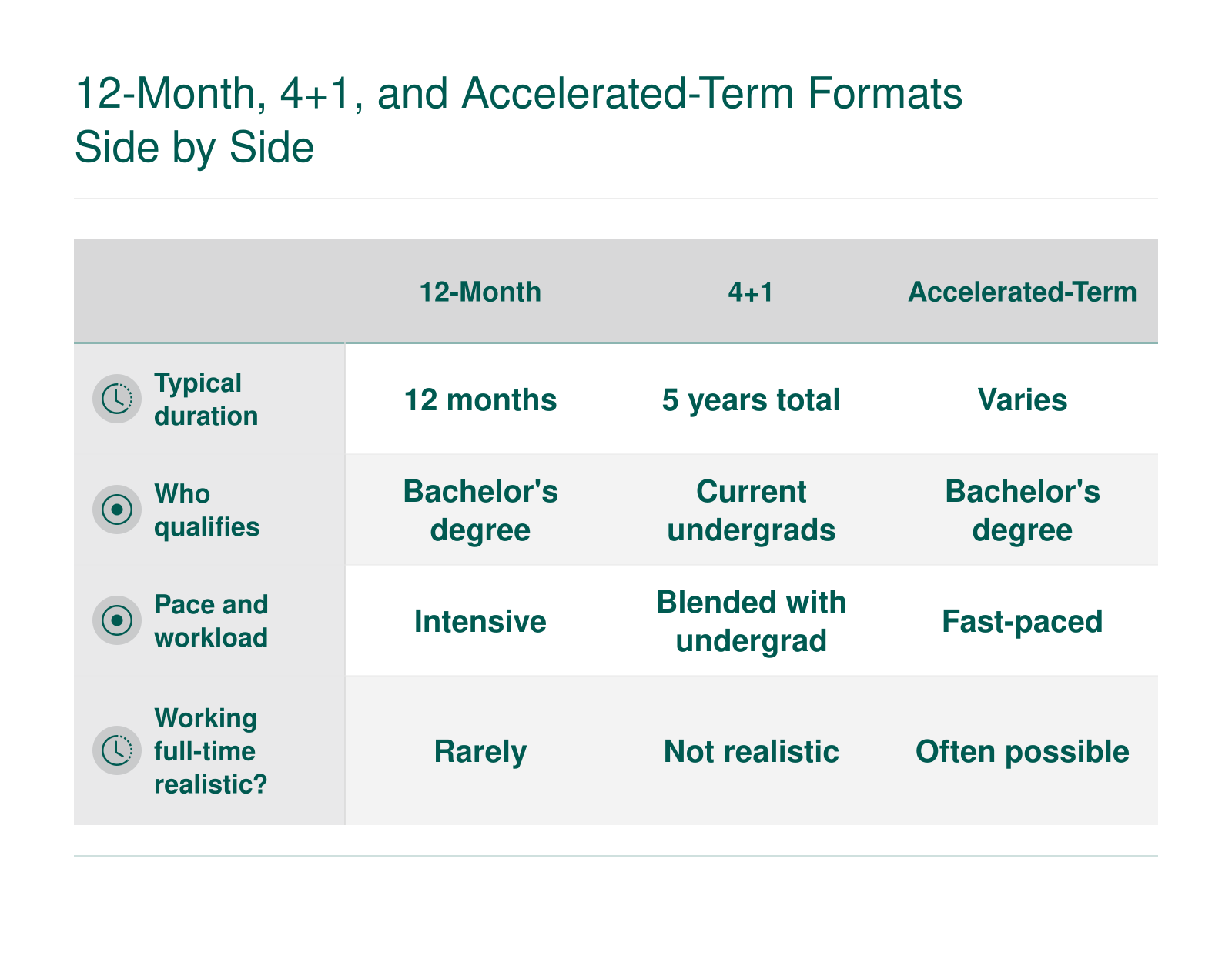
12-Month, 4+1, and Accelerated-Term Formats Side by Side
The fastest data analytics master's degrees fit different life stages. A 12-month program suits someone who can study full-time, while a 4+1 track is only for current undergraduates at the same school. Accelerated-term formats let working professionals compress coursework into shorter sessions.
Accreditation Checks Before You Enroll in a Fast-Track Program
The seven recognized regional accreditors (ACCJC, HLC, MSCHE, NECHE, NWCCU, SACSCOC, and WSCUC) cover the whole institution across associate through doctoral levels, and institutional accreditation from one of them is the non-negotiable baseline for any accelerated program.1 A compressed timeline changes nothing here: a 12-month degree from an unaccredited school still fails the test that matters for transfer credit, graduate admission, and federal aid.
Verify in Under Two Minutes
Search the school's exact legal name in the Department of Education's DAPIP database, then cross-check the same institution and current status in the CHEA directory, which lists more than 8,200 accredited institutions. Confirm the name, accreditor, status, dates, and any adverse actions. Note that DAPIP data is not audited, so a listing alone is not an absolute guarantee, and the Department oversees accreditors rather than accrediting schools itself.2
Business School Signals and Red Flags
Analytics programs housed in business schools, including MBA in Business Analytics programs and the University of Cincinnati's Lindner College of Business, may also hold AACSB accreditation.3 That adds a quality signal but is not required and does not replace institutional accreditation.4
Red flags: unusually short programs from unaccredited schools, accreditors not recognized by ED or CHEA, and "state-approved" status presented as accreditation. State approval is not equivalent.5
Data Scientist Pay at a Glance
Data scientists earned a median annual wage of $120,230 in May 2025, the most recent BLS figure.
Career Payoff: Job Titles and Earnings After an Accelerated Degree
An accelerated master's in data analytics can return you to a full salary a year sooner than a conventional two-year degree, shifting the ROI calculation toward the shorter program even when tuition is comparable.
Graduates commonly move into roles such as data analyst, business intelligence analyst, operations research analyst, management analyst, and analytics manager. National BLS medians for two of those occupations are $88,940 for operations research analysts and $101,860 for management analysts. Program-level outcomes vary. MIT Sloan's 2025 Master of Business Analytics Employment Report reported an average base salary of $139,496 plus a $22,940 average signing bonus. Maryland Smith's Business Analytics & AI Employment Report, Class of 2025 posted 94.7% employment within six months and a median base salary of $85,000, while Wisconsin's Master's in Business Analytics Career Outcomes page reported 89% employment within six months and a $75,629 average starting salary. Not all programs publish outcome data, so look for schools that report employment and salary figures rather than relying on generalizations.
Matching a Fast-Track Program to Your Schedule and Goals
The line between data analytics and data science keeps blurring, which makes the label on a degree a weaker guide than the curriculum behind it. Use four checks to narrow your choice.
- Format: Pick a 12-month full-time program if you can pause work. Choose 8-week online terms if you must keep your job. Consider a 4+1 track if you are still an undergraduate.
- Curriculum fit: Analytics programs lean toward SQL, business intelligence, and decision-making, an applied focus shared by accelerated MBA in business analytics programs. Data science programs lean toward machine learning and heavier Python.
- Real cost: Compare total tuition against the time you will realistically need, not the advertised minimum. A part-time pace that stretches past 12 months changes the math.
- Credentials and portfolio: Confirm accreditation, then look for capstone or industry projects that give you finished work to show employers.
If two programs tie on format and cost, let the capstone decide. Hiring managers tend to ask what you built, not what you studied.
Data Analytics programs by state
Quick Answers on Timelines, Workload, and Eligibility
How long does an accelerated master's in data analytics take?
How much does an accelerated data analytics master's program cost?
Can I work full-time while earning an accelerated data analytics master's?
What is the difference between a master's in data analytics and data science?
Are accelerated data analytics master's programs accredited?
What are the admission requirements for accelerated data analytics master's programs?
Is a 4+1 data analytics program faster than a standalone 1-year master's?
Compare Data Analytics programs on the data that matters
Explore more Computers & IT specializations or browse every graduate field.
All Computers & IT programs