Best Master of Legal Studies (MLS) Programs in Indiana
Compare 3 accredited Legal Studies programs in Indiana, with graduate earnings, cost, debt, and completion data from IPEDS and the U.S. College Scorecard.

Employers in HR, healthcare compliance, and government now expect non-lawyers to read contracts, privacy rules, and enforcement guidance with confidence.
Indiana's MLS options are concentrated at Indiana University Bloomington, Indiana University-Indianapolis, and Purdue Global, so format, cost, and concentration fit matter more than the school's name. An MLS will not qualify you to sit for the Indiana bar, but for many jobs it replaces a three-year JD with a shorter credential in legal fluency.
Key Points
- Indiana University Bloomington's campus-based MLS from the Maurer School of Law ranks first.
- IU Maurer's 30-credit MLS costs $750 per credit for residents and $1,393 for nonresidents.
- An MLS builds legal literacy but won't qualify you for the Indiana bar exam.
Best Master's in Legal Studies Schools in Indiana: 2027 Rankings
Indiana University Bloomington takes the top spot: a campus-based Master of Legal Studies from the Maurer School of Law, at an institution with an 80% graduation rate. Two other Indiana options offer more flexibility, a hybrid program in Indianapolis and a fully online degree from Purdue Global. Graduation rates below describe each school as a whole, not MLS completion.
Indiana University-Bloomington
#1Bloomington, IN · $12,000 – $33,000/yr (est.)
Best for: Campus learners wanting a flagship law school
Indiana University Bloomington offers its Master of Legal Studies on campus through the Maurer School of Law, for professionals in compliance, human resources, and business who want legal knowledge without a JD. The school has a graduation rate of 80%, and the degree requires 30 credits in 2026-2027. Maurer lists 2025-26 tuition at $750 per credit for Indiana residents and $1,393 for nonresidents, about $22,500 for the full 30 credits at the resident rate. The university is accredited by the Higher Learning Commission.
- Campus-based program in Bloomington, Indiana
- Offered by the Maurer School of Law
- 30 credit hours required (2026-2027)
- Resident tuition $750 per credit; nonresident $1,393 (2025-26)
- Content applies to compliance, HR, and business roles
- Designed for professionals, not a path to the bar
Indiana University-Indianapolis
#2Indianapolis, IN · $11,000 – $29,000/yr (est.)
Best for: Working professionals needing hybrid flexibility
Indiana University Indianapolis runs its hybrid Master of Legal Studies through the McKinney School of Law, which describes it as the first non-lawyer master's in Indiana. Students choose from over 150 courses in business, health, intellectual property, and environmental law, with dual degree options in Education Law and Philanthropy. The school has a graduation rate of 54%. McKinney's part-time program is ABA-approved, and the university falls under Indiana University's Higher Learning Commission accreditation. The degree was formerly the Master of Jurisprudence, renamed MLS in 2026.
- Hybrid format in Indianapolis, Indiana
- Offered by the IU McKinney School of Law
- Choose from more than 150 courses
- Dual degree options in Education Law and Philanthropy
- Designed for non-lawyers
- Renamed from Master of Jurisprudence in 2026
- Customizable study around career goals
Purdue University Global
#3West Lafayette, IN · $10,000 – $15,000/yr (est.)
Best for: Online students considering a later EJD
Purdue Global, based in West Lafayette, offers a 100% online Master of Science in Legal Studies, the most flexible option on this list. The program has nine courses (45 quarter credits), multiple start dates, and part-time pacing, at $420 per credit. The school has a graduation rate of 50%. Purdue Global publishes a 10% Indiana-resident tuition reduction for its law school, so confirm with admissions whether it applies to this degree. Credits can also count toward an Executive Juris Doctor.
- 100% online with multiple start dates
- 9 courses, 45 quarter credits
- Average completion time of about 1 year
- $420 per credit
- Full-time and part-time options
- Military benefits and employer reimbursement supported
- Credits can apply toward an Executive Juris Doctor
- Applicants need an accredited bachelor's degree
Cost & outcomes by school
Federal data for the highest-earning Legal Studies programs, independent of the ranking above. Earnings are this field's master's graduates four years after completing, where the Scorecard reports them.
| School | Earnings | Tuition / yr | Debt | Grads/yr | Format |
|---|---|---|---|---|---|
| Purdue University Global IN | — | $10,211 | — | — | Online |
| Indiana University-Indianapolis IN | — | $11,180 | — | — | Hybrid |
| Indiana University-Bloomington IN | — | $11,756 | — | — | Campus |
Sources: U.S. Department of Education. Tuition and graduates: IPEDS. Earnings and debt: College Scorecard, this field's master's graduates; a dash means no figure is reported.
Online and Hybrid Master's in Legal Studies Options in Indiana
Indiana University-Bloomington asks you to be on campus for its Master of Legal Studies (MLS), while Indiana University-Indianapolis lets you build a schedule from in-person, online, and hybrid classes.1 Neither school's official pages describe a degree that can be finished entirely online.
Bloomington: in person
The Maurer School of Law's Master of Legal Studies is in person: 30 credits, one year, full time. You take the same courses as JD students, and most meet between 8 a.m. and 5 p.m., with some later. The 1-credit intro course is online, but that doesn't make the degree hybrid. The pages reviewed don't establish a part-time track or regular weekend classes.
Indianapolis: the flexible option
The McKinney School of Law's M.L.S. (formerly the Master of Jurisprudence)2 mixes formats if your schedule allows.1 Full-time students can finish in 12 months by taking the 4-credit online Legal Process course in summer (it usually starts in late May) and 13 credit hours per semester. Part-time students have up to four years, and most finish in two to three. Day and evening classes are offered. An evening course of 2 credits usually meets once a week, and 3 or 4 credits usually means twice.
The reviewed pages don't tie any concentration to a particular format, so ask admissions which courses run online in a given term.
If you need fully online
Indiana residents who need a fully online option can check the Best Online Master of Legal Studies Programs list, and Purdue Global offers a fully online Master of Science in Legal Studies. Compare per-credit tuition for online students, mandatory fees, and whether a resident discount applies, since pricing can differ from Indiana's in-person rates.
Which Indiana MLS Programs Waive or Make the GRE Optional?
Testing rules are uneven across Indiana, so confirm each school's current admissions page before you apply.
- IU Bloomington (Maurer): no GRE or LSATNeither exam is required. No general minimum GPA is published. Preference goes to IU Bloomington graduates with a 3.5 GPA in their program.
- IU Indianapolis (McKinney): no published policy confirmedWe could not confirm a GRE/LSAT policy, application deadline, or start term for the Master of Legal Studies, which replaced the Master of Jurisprudence name in Spring 2026. The 2.3 GPA in the handbook applies to completing the degree (30 credits), not to admission.
- Purdue Global: verify directlyWe have not confirmed its testing policy or application requirements, so check its admissions page.
- Core materials at MaurerSubmit the IU Graduate Centralized Application, a 2–3 page statement of purpose, a resume or CV, and two recommendations (faculty preferred, employer accepted). Official transcripts are due only if you are admitted.
- Deadlines and start termMaurer admits for fall, with rolling review. The application page lists July 1 (May 15 for international applicants), but the FAQ cites June 1 for fall 2027, so apply early and confirm.
- English proficiencyInternational applicants should expect to document English ability, typically with TOEFL or IELTS scores. We did not confirm the minimums, so check each school's page.
Related Articles
Master's in Legal Studies Tuition, Cost, and Indiana Licensure
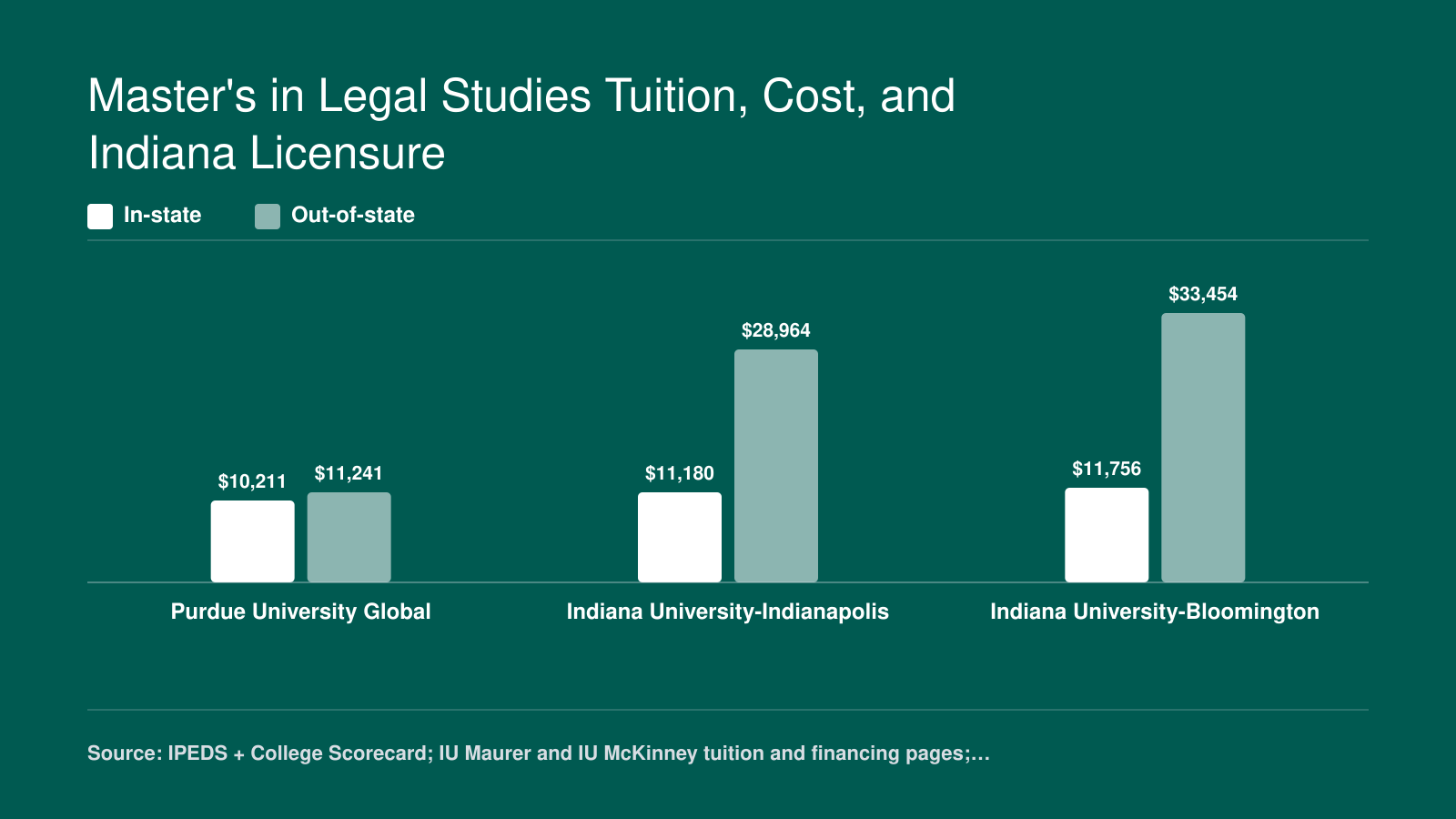
The chart shows federally reported in-state and out-of-state graduate tuition for each school, but your real cost depends on per-credit pricing and fees. IU Maurer's 30-credit MLS is $750 per credit for residents and $1,393 for nonresidents ($22,500 and $41,790 in tuition). With a $1,522 mandatory fee and about $1,320 for books, 2026-27 estimates reach $25,342 for residents and $44,632 for nonresidents. IU McKinney's 30-credit MLS is $1,070 resident and $1,697 nonresident per credit ($32,100 and $50,910), plus $1,614 in fees and $1,250 for books, with an Indiana partner rate of $1,605 per credit ($48,150). Purdue Global lists $420 per credit over 45 credit hours, about $18,900 before any fees, and notes employer reimbursement, military benefits, and financial aid. McKinney offers MLS scholarships based on need or outstanding credentials, plus $2,000 for state employees, while the available Maurer sources document no MLS-specific scholarship. Confirm federal loan eligibility with each financial aid office, and treat net price as a rough institution-wide average, not an MLS figure. An MLS does not lead to an Indiana law license or bar eligibility, which Indiana Supreme Court Rule 12 governs. Rule 30 covers certification of lawyer specialists, and no state-recognized certification for non-lawyer legal professionals is confirmed.
MLS Concentrations and Career Paths in Indiana
Maurer offers a fixed curriculum with no named concentrations, while McKinney lets you build a focus from seven options. The better fit depends on whether you want structure or a defined specialty.
IU Maurer in Bloomington
The 30-credit M.L.S. is ordinarily finished in one academic year, placing it among accelerated master of legal studies programs. Required courses cover introductions to U.S. law, Contracts for Non-JD Students, and American Constitutional Law for Non-JD Students. You then choose one survey course from a listed set and fill the remaining non-capstone credits with electives. Your specialty comes from the electives you select.
IU McKinney in Indianapolis
McKinney's 30-credit M.L.S. (the Master of Jurisprudence before the Spring 2026 change) requires Legal Process for M.L.S. Students (4 credits) and one first-year J.D. course in the fall. Beyond that, students may take almost all law-school courses, seated alongside J.D. students. The concentrations map to Indiana careers roughly like this:
- Corporate and Commercial Law: business and contract-heavy roles; 7 to 8 core credits.
- Health Law: compliance work in Indianapolis health systems, roles that often align with a Master's in Healthcare Administration in Indiana.
- Human Resources: HR and employment-law roles at manufacturers.
- Environmental Law: regulatory work, including state agencies.
- Law Enforcement, School Administration, Social Work: added legal fluency for people already in those fields, including those pursuing an Advanced Standing MSW in Indiana.
McKinney's published requirements are detailed only for Corporate and Environmental, so confirm the rest with the school. Its Intellectual Property graduate certificate is described for J.D. students, not M.L.S. students.
Master of Legal Studies FAQs for Indiana Students
Completion timelines, time limits, and transfer credit rules are the details most likely to change, and the official program pages for IU Maurer and IU McKinney do not spell them all out. Use these questions as a verification guide, and confirm each answer in writing with the school.
How do I confirm part-time timelines, time limits, and transfer credit at IU Maurer and IU McKinney?
What should I ask each school before I enroll?
Where do I verify career and wage outcomes, as opposed to program policies?
Compare Legal Studies programs on the data that matters
Explore more Criminal Justice & Law specializations or browse every graduate field.
All Criminal Justice & Law programs