Best Master of Legal Studies (MLS) Programs in Ohio
Compare 5 accredited Legal Studies programs in Ohio, with graduate earnings, cost, debt, and completion data from IPEDS and the U.S. College Scorecard.

What does a compliance officer, HR manager, or hospital administrator actually get from a Master of Legal Studies? Legal fluency in contracts, regulation, and risk, usually in 30 credits or fewer, without the three years of a JD.
It is not a law degree, and it does not lead to the Ohio bar. Programs such as Cincinnati's online MLS and Akron's Master of Studies in Law say so outright.
The real decision is whether a non-bar credential justifies its tuition in your current field.
Key Points
- Cincinnati's online MLS is 30 credits at $746 per credit for Ohio residents.
- An MLS does not qualify you to sit for the Ohio bar exam.
- Ohio State's Master in the Study of Law requires no GRE, GMAT, or LSAT.
Ohio's Top Master's in Legal Studies Programs, Ranked
Graduation rates shown here are each school's institution-wide figures, not rates for the legal studies program itself. The American Bar Association approves JD programs and does not accredit MLS or other non-JD degrees. An ABA-approved law school may offer one, but that is not approval of the degree. Confirm the university's regional accreditation, such as the Higher Learning Commission, directly with each school.
Case Western Reserve University
#1Cleveland, OH · ~$54,000/yr (est.)
Best for: Foreign-trained attorneys targeting a U.S. bar exam
Case Western Reserve University in Cleveland offers an LLM in U.S. & Global Legal Studies through its School of Law. It is a 24-credit degree built for internationally educated students, so it is a different product from an MLS for non-lawyers. Its institution-wide graduation rate is about 87 percent, the highest on this list, but tuition is also by far the highest. The ABA approves the law school's JD, not this degree, and the school's regional accreditation should be confirmed with the university.
- Campus program in Cleveland, 24 total credits
- 8 required first-semester credits and 16 elective credits
- Required courses include U.S. Contract Law and U.S. Legal Research and Writing
- Optional 10-credit concentration, with 7 concentration options listed
- Example concentrations: Compliance and Risk Management, Health Law, Intellectual Property
- Prepares for a U.S. bar exam, with bar support through the School of Law
- Electives drawn from both JD and LLM classes
University of Cincinnati
#2Cincinnati, OH · ~$15,000/yr (est.)
Best for: Working compliance professionals studying asynchronously
The University of Cincinnati's online Master of Legal Studies is aimed at professionals in regulated industries, business owners, and others who work alongside lawyers. It is fully asynchronous with no campus visits, and the College of Law works with employers to build pathways and capstones tied to students' fields. Institution-wide graduation rate is about 75 percent, and the university is accredited by the Higher Learning Commission. The university states its programs are approved by the Ohio Department of Higher Education, and the ABA does not accredit the MLS itself.
- Online and asynchronous, no campus visits required
- 30 credits across 10 courses in five semesters
- Two seven-week classes per term, three start dates per year
- No GRE, LSAT or GMAT required
- 2.8 minimum GPA and one letter of recommendation
- Capstone project applied to the student's own field
- Certificates in healthcare regulation, IT and cyber law, sports law, business compliance
- Not a path to practicing law
Ohio University
#3Athens, OH · ~$10,000/yr (est.)
Best for: Aspiring researchers headed toward JD or PhD study
Ohio University in Athens offers an MA in Law, Justice & Culture, a research-oriented law and society degree rather than a practice-focused MLS. Students choose a full-time Athens track or a part-time online track, and the program is described as the first of its kind in Ohio. Institution-wide graduation rate is about 65 percent. The university has been accredited by the Higher Learning Commission since 1913, and the degree is not ABA-accredited.
- 32 credits, with thesis, research essay or research capstone options
- Full-time students finish in two 16-credit semesters in Athens
- Separate online track runs four to six part-time semesters
- Fall, spring and summer start dates
- Two academic letters of recommendation and a 1,000-word statement of purpose
- Faculty from nine academic fields
- Graduates enter policy centers, advocacy groups, private companies, and JD or PhD programs
Cleveland State University
#4Cleveland, OH · ~$11,000/yr (est.)
Cleveland State University's Master of Legal Studies runs through the College of Law, where students take classes alongside JD candidates. It focuses on compliance, human resources, health care regulation and management roles, with full-time and part-time study and rolling admissions. Institution-wide graduation rate is about 51 percent. Tuition is $660.65 per credit for Ohio residents, and the school states that ABA rules bar applying MLS credit toward the JD.
- Hybrid format through the College of Law in Cleveland
- Classes taken alongside JD students
- Full-time and part-time study with rolling admissions
- $660.65 per credit for Ohio residents
- Applicants with a GPA below 3.0 must submit LSAT, GRE or GMAT scores
- No bar exam required, and MLS credit cannot be applied toward the JD
University of Akron
#5Akron, OH · $10,000 – $15,000/yr (est.)
The University of Akron offers an online Master of Studies in Law built for compliance, contracts, regulatory and policy professionals. The 30-credit degree is fully asynchronous and can be finished in one academic year full-time or at a part-time pace. Institution-wide graduation rate is about 52 percent. No LSAT or GRE is required, and the degree does not qualify graduates for the bar.
- Online and asynchronous, 30 credits
- Business Law and Technology Law concentrations
- Complete in as little as one year full-time, or study part-time
- Fall start, one start date per year
- No LSAT or GRE required
- Capstone project integrates coursework
- Not a bar-qualifying degree
Cost & outcomes by school
Federal data for the highest-earning Legal Studies programs, independent of the ranking above. Earnings are this field's master's graduates four years after completing, where the Scorecard reports them.
| School | Earnings | Tuition / yr | Debt | Grads/yr | Format |
|---|---|---|---|---|---|
| Ohio University OH | — | $9,720 | — | — | Hybrid |
| University of Akron OH | — | $10,125 | — | — | Online |
| Cleveland State University OH | — | $11,297 | — | — | Hybrid |
| University of Cincinnati OH | — | $14,902 | — | — | Online |
| Case Western Reserve University OH | — | $53,980 | — | — | Campus |
Sources: U.S. Department of Education. Tuition and graduates: IPEDS. Earnings and debt: College Scorecard, this field's master's graduates; a dash means no figure is reported.
Online and Hybrid Master's in Legal Studies Options in Ohio
The University of Cincinnati runs its Master of Legal Studies fully online and asynchronous, built as five terms of seven-week courses with no campus visits required. There are no live class meetings to schedule around, which makes it the most straightforward fit for someone holding a full-time job in another city. Cincinnati pairs the degree with focused options in healthcare administration regulation, IT and cyber law, sports law, and business compliance, so compliance officers, HR managers, and IT security staff can align coursework with the work they already do.
Cleveland State University offers an entirely online Master of Legal Studies in Cybersecurity and Data Privacy, and most of its legal studies students enroll part-time, with full-time study also available. If you are weighing the general track rather than the cybersecurity option, ask the admissions office directly how courses are delivered, since the format is not spelled out publicly.
Before you commit, confirm in writing that online students pay the same per-credit rate as campus students and have access to the same specializations. Those terms are not always identical across master's programs in Ohio.
Which Ohio MLS Programs Waive the GRE or LSAT?
Admissions testing is the first filter many working professionals worry about, especially for online Master of Legal Studies programs. Here is where each program stands:
- Ohio State University (Master in the Study of Law): Not required. Like many No-GRE master's programs, it requires no GRE, GMAT, or LSAT; international applicants still submit English proficiency scores.
- Cleveland State University (Master of Legal Studies): Conditional. Applicants with a final undergraduate GPA under 3.0 must submit an LSAT, GRE, or GMAT score. A stronger GPA clears you without a test.
- Case Western Reserve University, University of Cincinnati, University of Akron, Ohio University: No published policy. These schools do not state a GRE or LSAT requirement for their legal studies admissions, so contact the program directly before you assume anything.
The shared baseline is straightforward: a bachelor's degree and official transcripts from every institution you attended. Ohio State sets a 3.0 minimum GPA for your last degree earned. Cleveland State is the clear outlier, tying its test requirement directly to your GPA rather than waiving or requiring exams across the board.
Related Articles
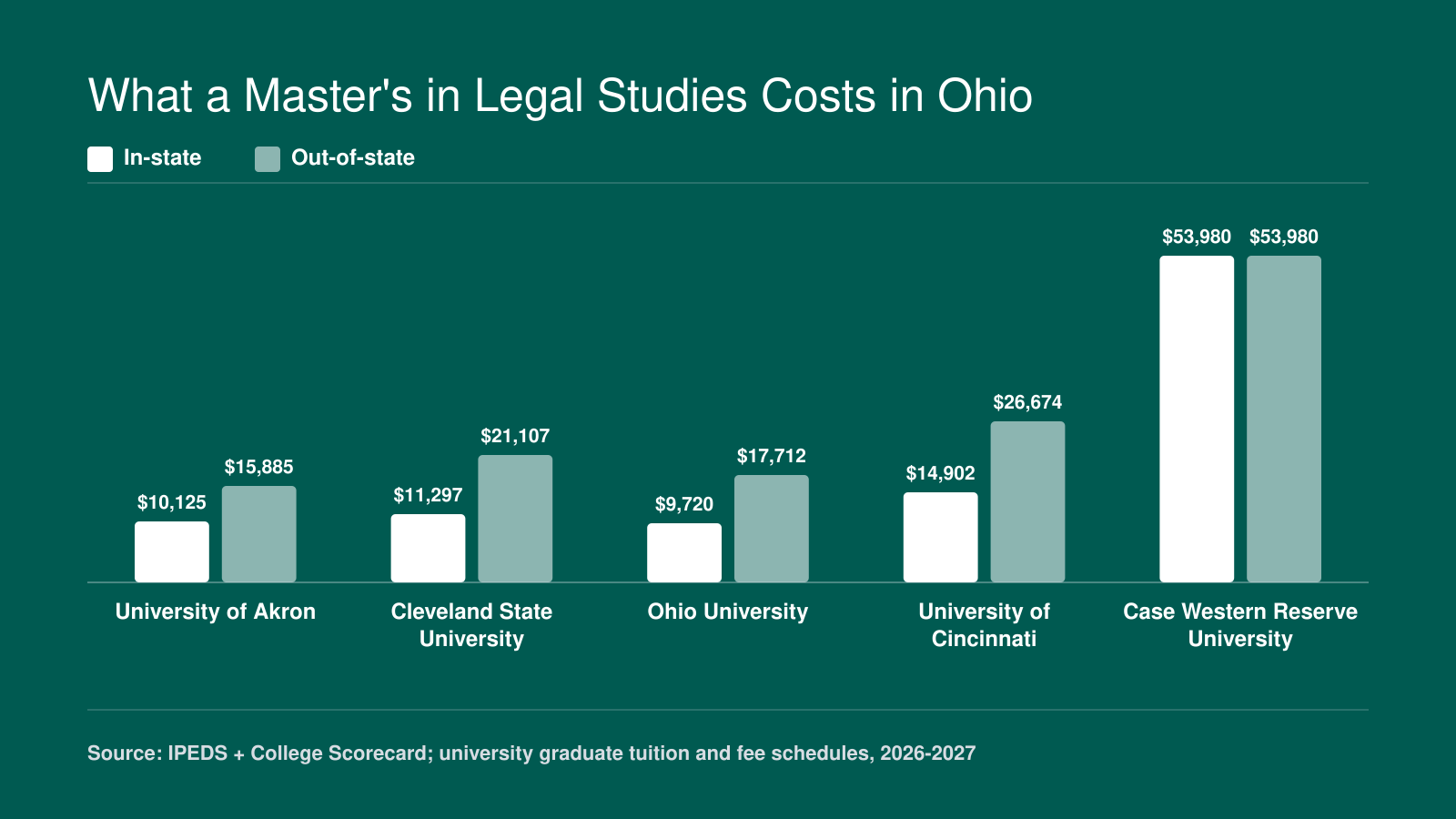
What a Master's in Legal Studies Costs in Ohio
Bars show each school's published annual graduate tuition, in-state versus out-of-state, for the institution as a whole rather than the MLS alone. Cincinnati's online MLS is 30 credits at $746 per credit for Ohio residents, about $22,380 in tuition, though a $960 online graduate rate also appears and sources do not say which applies. Cleveland State lists $655.90 per credit for residents and $656.90 for nonresidents online, plus a $25 per-credit eLearning fee, about $20,427 for 30 credits. That near-flat online rate removes the out-of-state premium. Average net price after aid is an institution-wide figure, not a quote for the MLS.
Can You Practice Law in Ohio With an MLS? Licensure and Certification Limits
The short answer: no
Bar admission in Ohio runs through the Supreme Court of Ohio, and its rules route eligibility through a law degree from a school recognized by the U.S. Department of Education (as of 2026). A Master of Legal Studies is not a substitute. MLS graduates cannot sit for the Ohio bar, represent clients, or give legal advice, and anyone planning around that should verify current requirements directly with the Court's admissions office before enrolling.
What the degree does authorize
An MLS is built for professionals who work alongside lawyers rather than as one: drafting and reviewing contracts inside a company, running a compliance or privacy program, handling regulatory filings, managing HR investigations, and supporting attorneys on discovery and policy work.
Credentials worth pairing with the degree
- OSBA Certified Paralegal: Routes include a bachelor's degree plus at least 20 semester hours of paralegal studies and one year (2,000 hours) of paralegal work, a 124-hour bachelor's in paralegal studies with the same experience, a 60-hour associate's with five years (10,000 hours), or a high school diploma with seven years (14,000 hours). Applicants submit a CLE transcript and three professional references, two from Ohio attorneys in good standing, then pass a written exam covering two substantive areas.
- SCCE's CCEP: Eligibility is commonly reported as roughly two years of compliance and ethics work or about 30 relevant continuing education hours, with a student-equivalent route available. Membership is not required.
MLS versus JD
An MLS typically takes one to two years, a timeline that Accelerated Master of Legal Studies Programs can compress, and costs a fraction of a three-year JD, a cost gap reflected in the Most Affordable Master of Legal Studies Programs. Only the JD opens the bar exam and the right to practice.
Careers and Salaries for Ohio Master's in Legal Studies Graduates
An MLS pays off through jobs that need legal fluency, not through a law license, so the wage picture depends on the role you target.
The latest Ohio statewide wage release from the Bureau of Labor Statistics is May 2023, and it does not give clean statewide medians for these occupations.1 What can be stated reliably:
- Compliance officer: $67,980 median in the Eastern Ohio nonmetropolitan area (May 2023), a regional figure that will run differently in Columbus or Cleveland.2
- HR manager: $149,280 national median (May 2025).3
- Paralegal or contract support: $62,890 national median (May 2025).4
- Information security or privacy analyst: no Ohio median is established in the sources used here, so check current state data before you plan around a number; compare master's in information security and assurance programs in Ohio if you are weighing this path.1
Program-level Scorecard earnings are not reported for the schools here, so no graduate pay figure is offered for any of them.
Matching Programs to Careers
The University of Akron's program is built for compliance and regulatory professionals. The University of Cincinnati's concentrations in healthcare regulation, IT and cyber law, sports law, and business compliance suit HR, contracts, or privacy work. Ohio University's Law, Justice & Culture track leans toward policy, advocacy, and JD or PhD preparation.
On return: in-state program tuition at the public schools here runs roughly $9,720 to $14,902, against wages in the $60,000s for entry-level compliance and paralegal roles.
Frequently Asked Questions About Ohio MLS Programs
Can I become a lawyer with a Master of Legal Studies in Ohio?
What is the difference between an MLS and a JD?
How long does it take to finish an MLS part-time in Ohio?
Can MLS credits count toward a JD later?
Compare Legal Studies programs on the data that matters
Explore more Criminal Justice & Law specializations or browse every graduate field.
All Criminal Justice & Law programs