Best Master of Legal Studies (MLS) Programs in Pennsylvania
Compare 4 accredited Legal Studies programs in Pennsylvania, with graduate earnings, cost, debt, and completion data from IPEDS and the U.S. College Scorecard.

What can a Master of Legal Studies actually do for an HR director or hospital compliance officer? It builds working fluency in contract, employment, and regulatory law for professionals who sit beside attorneys without becoming one. It is not a JD, and it will not qualify anyone to sit for the Pennsylvania bar.
Program tuition across the state's options runs from roughly $24,650 at Penn State to $39,261 at Drexel. That spread is wide enough that the compliance or privacy track you are buying matters more than the name on the diploma.
Key Points
- Drexel's online MLS requires 45 quarter credits, equal to 30 semester credits.
- An MLS never qualifies you to sit for the bar or practice law.
- Information security analysts earn a national median of $103,590, a role Drexel links to its cybersecurity concentration.
The Best Master's in Legal Studies Programs in Pennsylvania
Pennsylvania's Master of Legal Studies options range from fully online compliance degrees to a hybrid program built around energy and privacy law. None of them lead to a law license, so the useful comparison is cost against the career track each one supports. Cost figures below are published tuition and fees, and net price is an approximate institution-wide average, not a program-specific number.
Drexel University
#1Philadelphia, PA · ~$39,000/yr (est.)
Best for: Self-paced online learners with busy schedules
Drexel's Kline School of Law offers a fully online, asynchronous MLS with no campus visits, aimed at professionals in compliance, risk, and regulation. Published tuition and fees are about $62,412 for both residents and non-residents, and the approximate institution-wide average net price is $38,509. The school's graduation rate is 78%. Program-level earnings are not shown.
- Online, asynchronous, with no on-campus requirement
- 45 quarter credits, full-time or part-time
- Nine concentrations, including Criminal Law, NCAA Compliance, and Entrepreneurship
- Flexible option to design a general MLS
- Curriculum covers cybersecurity, financial regulation, and health care compliance
University of Pittsburgh-Pittsburgh
#2Pittsburgh, PA · ~$28,000/yr (est.)
Best for: HR and health care compliance professionals
Pitt Law's online Master of Studies in Law is built for working professionals and does not require the LSAT or prior law experience. Published tuition and fees are about $21,926 in state and $41,430 out of state, with an approximate institution-wide average net price of $30,434. The school's graduation rate is 85%. Five specializations include Corporate Compliance, Health Care Compliance, and Human Resources Law.
- Online and asynchronous, 30 credits, finishable in two years
- 15 core credits in the American legal system, then a 15 credit specialization
- Five specializations, including Sports, Entertainment, and Arts Law
- No entrance exam required
- Fall and spring starts, with 3 to 8 week course terms
- Up to 15 online Pitt Law certificate credits can transfer in
- HR Law specialization prepares students for SHRM certification programs
Widener University
#3Chester, PA · ~$28,000/yr (est.)
Best for: Employees seeking employer tuition partnerships
Widener's Delaware Law School runs a 100% online MLS that can be completed in as little as one year, with fall, spring, and summer starts. Published tuition and fees are about $55,730, and the approximate institution-wide average net price is $25,759. The school's graduation rate is 68%. Students who qualify can sit for compliance and fraud examiner credential exams.
- Fully online, part-time available, as little as one year
- No GMAT, GRE, or LSAT required; a bachelor's degree is
- Optional Regulatory Analysis & Compliance concentration
- Dual MLS/MBA option
- Prepares for the CCEP and Certified Fraud Examiner credentials
- Fifteen-week fall and spring terms, eight-week summer term
Pennsylvania State University
#4University Park, PA · ~$25,000/yr (est.)
Penn State Law's MLS is a hybrid program for professionals who want legal expertise without becoming lawyers. Published tuition and fees are about $15,356, the lowest in this group, and the approximate institution-wide average net price is $19,550. The school's graduation rate is 34%. Prospective students should weigh that against the lower cost and the flexible format.
- Hybrid format blending on-campus and remote courses
- Full-time in 12 months, part-time in two years
- Concentrations in energy law or information security and privacy
- Customizable specialization path
- Rolling admissions with fall, spring, and summer starts
- Application submitted through the LSAC website
Cost & outcomes by school
Federal data for the highest-earning Legal Studies programs, independent of the ranking above. Earnings are this field's master's graduates four years after completing, where the Scorecard reports them.
| School | Earnings | Tuition / yr | Debt | Grads/yr | Format |
|---|---|---|---|---|---|
| Pennsylvania State University PA | — | $26,034 | — | — | Hybrid |
| University of Pittsburgh-Pittsburgh PA | — | $27,580 | — | — | Online |
| Widener University PA | — | $28,004 | — | — | Online |
| Drexel University PA | — | $39,261 | — | — | Online |
Sources: U.S. Department of Education. Tuition and graduates: IPEDS. Earnings and debt: College Scorecard, this field's master's graduates; a dash means no figure is reported.
Online and Hybrid Master's in Legal Studies Options in Pennsylvania
Drexel's Master of Legal Studies requires 45 quarter credits, equal to 30 semester credits, and it is fully online and asynchronous with no on-campus requirement. Its listed average duration is two years, and a 3-credit capstone is required.
Penn State graduate programs include the hybrid option, and it is the one where online students most often miss a detail. It is a flexible 30-credit degree, but the final Capstone Simulation requires 3 to 4 full days of in-person work at Carlisle or University Park. Budget travel and time off for that. The sources reviewed do not establish a current completion time for the 30-credit format, so confirm it with admissions.
Pitt and Widener both offer fully online routes. Pitt's program is asynchronous, cohort-based, and 30 credits over about two years, with two start dates a year. Widener advertises as little as one year, part-time study, and three start dates. Credit totals and any residency or capstone rules were not confirmed for Widener, so ask before applying.
On price, Drexel lists a single tuition figure of $39,261 for in-state and out-of-state students. Pitt lists different in-state and out-of-state figures, so ask which one applies to online enrollment.
Related Articles
Which Pennsylvania MLS Programs Waive the GRE or LSAT?
Test policies vary by school, so check each admissions page before you apply.
- Drexel University: no test required (GRE, LSAT, GMAT or MCAT optional)Requires a bachelor's degree from a regionally accredited institution and a 3.0 GPA, with individual review below that. Also requires transcripts, two recommendations, a résumé, and a graded paper or short problem-of-practice response.
- University of Pittsburgh-Pittsburgh: no entrance exam requiredProgram materials list no entrance exam. The sources reviewed do not publish a GPA minimum or full document list, so confirm those with the admissions office.
- Widener University: no entrance exam required (test optional)A bachelor's degree is required. A GPA minimum and document list are not published in the sources reviewed.
- Pennsylvania State University: test policy not publishedThe admissions page reviewed describes rolling admissions with fall, spring and summer starts. It states no GRE or LSAT policy, so ask the school directly.
- The general patternMost MLS programs do not require the LSAT. Unlike JD admissions, they weigh your degree, GPA, experience and writing.
Master's in Legal Studies Cost and Pennsylvania Certification Pathways
Price gaps among Pennsylvania MLS programs are wide, and the headline university tuition rarely tells you what the degree costs.
Estimating Total Degree Cost
The formula is per-credit rate times required credits, plus mandatory fees. Pitt lists 30 credit hours and Drexel lists 45. Check whether Drexel's credits are quarter credits, since quarter and semester credits are not interchangeable. Confirm fees and per-credit rates on each bursar page; they are not reliably published in one place.
On program-level tuition, Penn State is the cheapest option here at $24,650, followed by Widener at $28,004 and Pitt at $33,195. Drexel is highest at $39,261. Institution-level figures can mislead. Penn State's is $15,356, well below its program cost, while Drexel's is $62,412, well above its program cost.
Licensure and Credentials
Pennsylvania bar applicants need an LL.B. or J.D., plus the bar exam, the MPRE and a character review. An MLS does not qualify you to practice law. Limited alternative routes exist, but they run through separate rules and specific law school coursework, not through this degree.
MLS graduates usually pursue professional credentials instead. Widener's listing points to CCEP and Certified Fraud Examiner preparation, and Pitt's notes SHRM certification eligibility. Widener's listing also states ABA accreditation for its law school.
Concentrations and Career Outcomes for Pennsylvania MLS Graduates
Information security analysts earn a national median of $103,590, and that is one of the roles Drexel links to its Cybersecurity & Information Privacy Compliance concentration. These figures are national occupation wages, not outcomes for any one program's graduates.
Concentrations and Typical Roles
- Drexel, Cybersecurity & Information Privacy Compliance: information security analyst, compliance officer ($71,100 national median).
- Drexel, Financial Regulatory Compliance: compliance manager ($116,350), financial analyst ($83,660).
- Drexel, Health Care Compliance: medical and health services manager ($104,280).
- Drexel, Human Resources Compliance: human resources manager ($121,220).
- Widener, Corporate and Business Law: compliance officer, risk manager, fraud examiner, audit manager.1
Pitt's program points to SHRM certification eligibility for HR-minded students. Drexel itself cautions that no single salary or title fits the degree, since it applies across many fields.
Is an MLS Worth It?
Program tuition runs from $24,650 at Penn State to $39,261 at Drexel, with Widener at $28,004 and Pitt at $33,195 in-state. The payoff depends on the role. Compliance officer pay sits well below manager-level pay, so the degree earns its cost fastest when it moves you into a managerial track you could not reach otherwise.
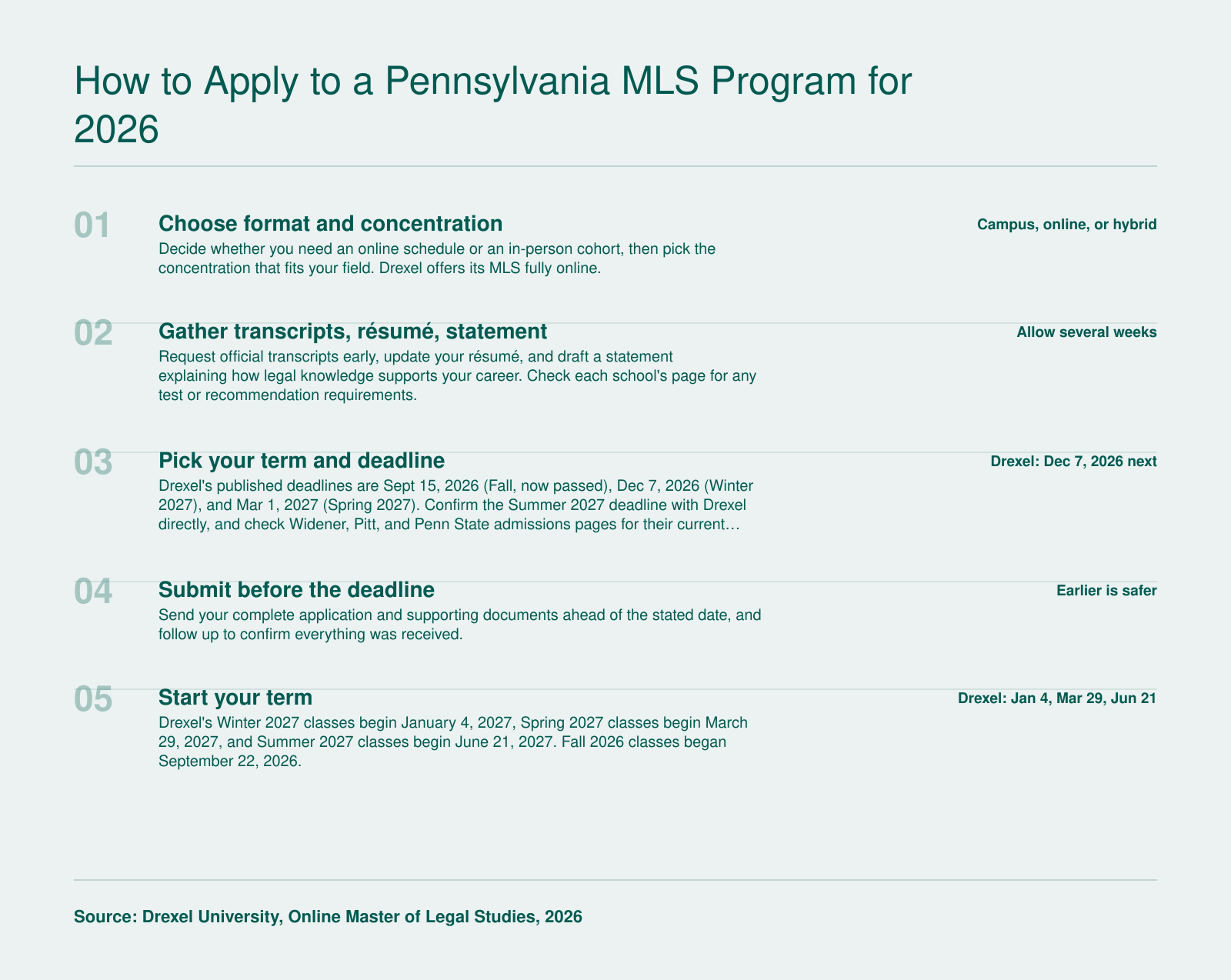
How to Apply to a Pennsylvania MLS Program for 2027
Most master's in legal studies applications follow the same four stages, but deadlines differ by school and term. Drexel's online MLS publishes dates for several terms, so they are shown below. Where a rolling-admission online program is open, apply early to secure the start term you want.
Master of Legal Studies FAQs
Can you become a lawyer with a master of legal studies?
Do you need the LSAT for a master of legal studies?
How long does a master of legal studies take online?
What is the cheapest online master of legal studies program in Pennsylvania?
Compare Legal Studies programs on the data that matters
Explore more Criminal Justice & Law specializations or browse every graduate field.
All Criminal Justice & Law programs