Best Master's in Communication Management Programs
Compare 30+ accredited Communication Management programs at 24 schools, with graduate earnings, cost, debt, and completion data from IPEDS and the U.S. College Scorecard.

Which communication management master's actually pays off once you weigh tuition against what graduates earn? The spread is wide. The same degree title runs from about $9,500 a year at the University of Dubuque to roughly $72,000 at USC, and name recognition rarely tracks net price.
That gap is the real tension. A program's reputation tells you how it markets itself; tuition, net price, graduation rates, and federal earnings and debt data tell you what it costs and returns. Some well-known programs charge several times what a solid regional option does for similar outcomes, so a tuition comparison across programs matters.
For working professionals, format and total cost tend to matter more than prestige, and the figures below make those tradeoffs visible.
Key Points
- Net price is an institution-wide average, so it can differ from your program's real cost.
- A 2026 Journal of Public Relations Education study found just 11 graduate programs with ACEJMC accreditation or PRSA's CEPR.
- The PRSA Foundation's Mission North Fellowship is worth $32,000, and many students never apply.
The 6 Best Master's in Communication Management Programs for 2027
This list mixes fully online, campus-based, and dual-format options, so working professionals and recent graduates can compare programs on the same footing. The schools below stand out for their communication concentrations, technical skill-building, and evidence of graduate employment.
University of Southern California
#1Los Angeles, CA · ~$72,000/yr (est.)
Best for: Mid-career professionals targeting brand leadership
USC Annenberg's Master of Communication Management blends research, content strategy, business acumen, and AI innovation. Students can choose on-campus or online delivery with concentrations in strategic and organizational communication and media, entertainment, and creator industries. The program reports a 100% employment rate within 12 months and draws employers such as Disney, Microsoft, and SpaceX. This is a strong fit for mid-career professionals who want brand leadership or platform strategy and can invest in a Los Angeles-based network.
- 100% job placement rate within 12 months
- Customizable 25-course curriculum
- On-campus format with 300 diverse students
- Post-master's certificates available
- Fully online delivery designed for mid-career professionals
- Concentration in strategic and organizational communication
- AI tools integrated into the curriculum
- Faculty are brand leaders and strategists
- Fully online delivery
- Concentration in media, entertainment, and creator industries
- Employer network includes Disney, Microsoft, and SpaceX
- Rapid deployment of AI in coursework
Temple University
#2Philadelphia, PA · $23,000 – $30,000/yr (est.)
Best for: Budget-focused online learners needing flexible concentrations
Temple University offers a fully online Master of Science in Communication Management that can be completed in as little as one year full time or up to four years part time. The 31-credit program includes audience analysis, organizational communication, and crisis management, with concentrations in public relations, strategic communication and cross-cultural leadership, and conflict management and dispute resolution. It is designed for entry- and mid-level professionals, and international students can attend from their home countries.
- 31 total credit hours
- Complete in one year full time or four years part time
- Core areas include audience analysis and crisis management
- Final capstone project required
- $1,264 per credit in-state tuition
- Concentration in conflict management and dispute resolution
- Fully online webinar and teleseminar courses
- International students can attend from home countries
- Concentration in public relations
- Online format with webinar and teleseminar courses
- Financial aid and scholarships available
- Designed for entry- and mid-level professionals
- Concentration in strategic communication and cross-cultural leadership
- Curriculum includes cross-cultural leadership
- Online delivery with student clubs for networking
- Accredited by Middle States Commission
University of Denver
#3Denver, CO · ~$42,000/yr (est.)
Best for: Communicators adopting AI and marketing strategy
The University of Denver's online Master of Arts in Communication Management emphasizes hands-on projects, data storytelling, and current technology, including AI. Students choose from concentrations in learning and development, marketing communication, organizational communication, and AI strategy and application. The 48-credit program is built for working professionals who want a practical portfolio capstone and an advisory board of industry experts guiding the curriculum.
- Online program with portfolio capstone
- 48 total credit hours
- Learning and development concentration
- Adult learning theories and instructional design
- Online format with integrated marketing campaigns
- Digital campaign management focus
- Hands-on projects and case studies
- Data-driven storytelling emphasis
- Online degree focused on strategic messaging
- Ethics and data storytelling focus
- Advisory board of industry experts
- Real-world case studies
- Online curriculum with AI governance
- AI ethics and governance coursework
- Develop AI-powered communication campaigns
- Latest AI technologies integrated
Mercer University
#4Macon, GA · ~$15,000/yr (est.)
Mercer University offers a fully online Master of Science in Technical Communication Management focused on the managerial side of the field, including project management, usability, and content strategy. Since 1997, over 200 students have graduated, and practice-oriented projects let learners apply course content directly to their workplaces. This program suits technical writers and communication specialists moving into management in engineering, financial services, government, software, or user experience.
- 100% online delivery
- Complete in as little as two years
- Curriculum covers project management, usability, and content strategy
- Over 200 graduates since 1997
University of Alabama at Birmingham
#5Birmingham, AL · ~$9,000/yr (est.)
The University of Alabama at Birmingham provides a campus-based Master of Arts in Communication Management with a 36-credit curriculum covering corporate communication, public relations, and strategic messaging. Students complete a qualifying exam and choose between a thesis or research project, and internships are available after 24 graduate credits. This program fits students who want close faculty mentorship and an on-ground learning environment.
- 36 total credit hours
- Thesis or research project option
- Comprehensive qualifying exam required
- Internships available after 24 graduate credits
University of Dubuque
#6Dubuque, IA · ~$10,000/yr (est.)
The University of Dubuque's Master in Management in Communication Management combines business and communication coursework, including managerial communication, integrated marketing communication, public relations, and crisis management. The 30-credit program can be completed in one year through an accelerated plan and culminates in a capstone field experience. It is a fit for working professionals and career changers who want a business-focused communication management degree in a campus setting.
- 30 total credit hours
- Accelerated one-year plan available
- Capstone field experience seminar
- Integrated Marketing Communication course included
Cost & outcomes by school
Federal data for the highest-earning Communication Management programs, independent of the ranking above. Earnings are this field's master's graduates four years after completing, where the Scorecard reports them.
| School | Earnings | Tuition / yr | Debt | Grads/yr | Format |
|---|---|---|---|---|---|
| George Washington University DC | $101,932 | $36,414 | $51,254 | 68 | Campus |
| University of Southern California CA | $89,760 | $71,515 | $82,426 | 160 | Campus |
| Syracuse University NY | $87,500 | $48,132 | $71,289 | 122 | Hybrid |
| Trinity Washington University DC | $86,961 | $15,660 | — | 4 | Online |
| Florida State University FL | $77,547 | $10,553 | $31,020 | 62 | Online |
| University of Alabama at Birmingham AL | — | $8,640 | — | — | Campus |
| University of Dubuque IA | — | $9,530 | — | — | Campus |
| Florida International University FL | — | $11,334 | — | — | Online |
| Oral Roberts University OK | — | $13,628 | — | — | Online or campus |
| Mid-America Christian University OK | — | $15,930 | — | — | Online or campus |
| The University of Alabama AL | — | $11,980 | — | 38 | Online |
| Columbus State University GA | — | $8,268 | — | 7 | Online |
Sources: U.S. Department of Education. Tuition and graduates: IPEDS. Earnings and debt: College Scorecard, this field's master's graduates; a dash means no figure is reported.
Cost, debt & payoff
Median earnings of this field's master's graduates (4 yrs after completing) vs. their median federal loan debt · U.S. College Scorecard
Across these programs the median graduate earns about $89,760 and finishes with roughly $82,426 in debt — a ratio that clears a common rule of thumb (keep debt below first-year salary). Tuition and debt vary widely school to school, so check the per-school figures in the table above before you shortlist.
What Earned a Spot on This List: Outcomes Over Reputation
A famous school name and a smart financial decision are not always the same thing, and the figures that separate them rarely appear in a brochure. Marketing tells you what a master's in communication program promises. Federal data shows what it delivers.
What We Looked At
- Tuition: Published graduate tuition, both in-state and out-of-state, so public-university residents can see their real advantage.
- Net price: The average amount students pay after grants and scholarships, often far below the sticker price at private schools.
- Graduation rate: How many students at the institution finish what they start.
- Earnings and debt: Program-level graduate pay and borrowing, wherever College Scorecard publishes them. For many communication management programs, these figures are not yet available.
How to Read the Numbers
Both figures measure the whole institution, not the communication management program itself. Net price is also an approximate average, so your actual cost will depend on your aid package, residency, and enrollment status. Use it to compare schools, not as a quote.
Format Is a Filter, Not a Factor
Each program is labeled online, campus-based, or both, so working professionals can quickly narrow the field to options, including an online master's in communication, that fit around a full-time job. That label is there for convenience only. Being fully online or fully on campus did not move any school up or down the list.
Communication Management Master's Programs Tuition and Net Price, Side by Side
Published tuition and average net price below come from federal IPEDS and College Scorecard data. Average net price is an institution-wide average after grant and scholarship aid, not a personal price quote. Mercer, Dubuque, USC, and Denver list one graduate tuition rate for in-state and out-of-state students, and among the more affordable options, Temple pairs a $28,198 average net price with a 75% graduation rate while Mercer pairs $23,847 with a 70% graduation rate.
| School | In-State Graduate Tuition | Out-of-State Graduate Tuition | Average Net Price | Delivery Format | Graduation Rate |
|---|---|---|---|---|---|
| University of Alabama at Birmingham | $9,098 | $22,562 | $18,749 | Campus | 64% |
| University of Dubuque | $42,095 | $42,095 | $23,386 | Campus | 40% |
| Mercer University | $42,312 | $42,312 | $23,847 | Online | 70% |
| Temple University | $23,011 | $38,958 | $28,198 | Online | 75% |
| University of Southern California | $72,097 | $72,097 | $32,740 | Campus | 92% |
| University of Denver | $61,398 | $61,398 | $36,131 | Online | 76% |
The PRSA Foundation administers a Mission North Fellowship worth $32,000, one of the larger awards available through its fellowship program for students pursuing public relations and communications careers. Many communication grad students never look beyond their school's own aid office, missing industry-sponsored funding like this.
Concentrations That Lead to PR, Corporate, Crisis, and Marketing Roles
The line between communication management and strategic communication is blurrier than program names suggest, and some schools use the two terms interchangeably. The usual pattern still holds. Management programs, such as the University of North Florida's M.S. in Communication Management, frame the work around running communication functions, people, and processes, and they pair it with leadership and organizational strategy. Strategic communication programs, such as Lasell's and Avila's, lean toward research, storytelling, media, and planned messaging that serves an organization's goals. Employers rarely draw the line this sharply, so the concentration you choose matters more than the degree label.
Concentrations and the Jobs They Feed
The mapping is not exclusive, but these are the typical titles programs associate with each focus:
- Public relations: PR manager, PR director, media relations specialist, communication consultant.
- Corporate communication: corporate communications manager or director, external affairs director, internal communication director.
- Crisis and reputation management: crisis communication manager or director, and PR director.
- Marketing communication: marketing communications manager, brand strategist, content strategist, digital marketing manager.
- Internal communication: internal communications specialist, manager, or director.
Senior roles such as communication director and chief communication officer sit at the top of several of these tracks.
What the Ranked Programs Offer
Structures vary widely. Temple's online M.S. offers Conflict Management and Dispute Resolution, Public Relations, and Strategic Communication and Cross-Cultural Leadership. The University of Denver's M.A. lists Learning and Development, which suits people headed toward internal and training-focused roles. UNF pairs the degree with business, public health, leadership, nonprofit management, or public management. Avila's strategic communication degree offers marketing, project management, and strategic human resources.1 Lasell offers a single strategic communications track.2 The University of Oregon's strategic communication master's has no official concentrations, though students commonly focus on digital strategy, corporate communication, PR, or crisis communication.3 At programs like that one, you build a specialty through electives and your capstone.
A Rule of Thumb
Choose a concentration based on the role you want five years from now, not the job you hold today.
Related Articles
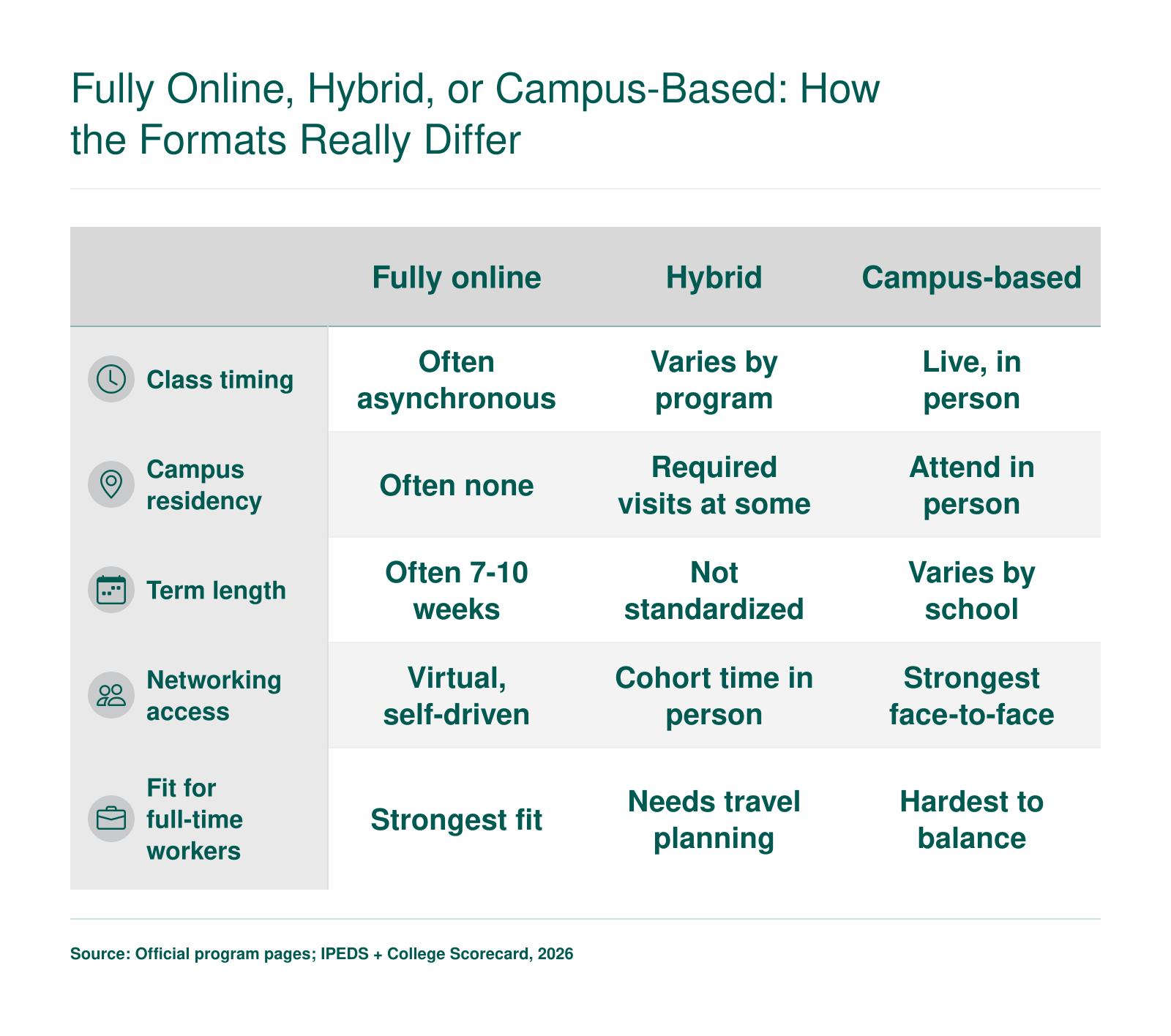
Fully Online, Hybrid, or Campus-Based: How the Formats Really Differ
The schools here span online, hybrid, and campus formats, and the details differ more than the labels suggest. If you work full-time, start with whether classes are asynchronous and whether any travel is required. Fully online programs like Denver's and Colorado State's offer the most scheduling freedom, while hybrid options such as McMaster's trade some of that flexibility for in-person cohort time.
Admissions Requirements: GRE, Work Experience, and English Scores
There is no field-wide standard for these programs, and the schools' official pages report requirements unevenly. Treat the details below as a starting point and confirm them on each program's admissions page before you apply.
- Bachelor's degree and GPAExpect a bachelor's degree from an accredited institution. Portland sets a 3.0 minimum, and North Florida looks at a 3.0 over the last 60 undergraduate credit hours. Denver's floor is 2.5, and an earned master's or higher can supersede it. Temple and USC do not state a minimum.
- GRE policyThe GRE is optional or not required at the schools that state a policy. Temple makes it optional but expects submitted scores at about the 65th percentile or higher. USC does not require or consider it for Fall 2027. At North Florida, a GRE score (153 verbal, 144 quantitative) can offset a missed GPA cutoff. Denver and Portland do not state a policy.
- Work experienceNone of these programs sets a preferred number of years. Even so, a résumé showing relevant professional work strengthens an application, so list internships and paid roles with dates.
- Application documentsUSC asks for a résumé, personal statement, writing sample, and letters of recommendation. One letter should come from an academic instructor and one from a professional supervisor. Complete document lists for the other schools are not published in the sources reviewed.
- English proficiency and transcriptsRequirements vary by school and test date. Portland asks for a TOEFL of 100 or an IELTS of 7.5. Temple and Denver accept a 6.5 IELTS. Temple's TOEFL iBT minimum is 79 and Denver's is 80 for tests taken before January 21, 2026, and the TOEFL scoring scale changed after that date. USC allows waivers for degrees earned entirely in an English-instruction country.
A 2026 study in the Journal of Public Relations Education counted just 11 graduate programs holding either ACEJMC accreditation or PRSA's Certification in Education for Public Relations (CEPR), with one program holding both. PRSA's own list shows 8 post-graduate entries, so counts vary by method.
Which Accreditation Actually Matters for Communication Management
For Communications & Media Master's Programs, a marketing page may advertise several accreditation seals, but only one of them affects whether your federal loans disburse and whether an employer takes the credential seriously. The rest are nice-to-have.
The baseline that isn't optional
The institution itself must hold accreditation from an agency recognized by the U.S. Department of Education or CHEA, such as HLC, MSCHE, or WSCUC. This is what makes a school eligible for federal Title IV aid and what most employers and graduate admissions offices actually check.1 Institutional accreditation does not extend automatically to any individual degree, so treat it as the floor, not proof of program quality.
Programmatic seals are voluntary signals
There is no required programmatic accreditor for communication management. ACEJMC accredits journalism and mass communication units at both the bachelor's and master's level, reviewing against eight standards on roughly a six-year cycle and covering face-to-face, online, and blended delivery. Its scope is the unit, so confirm your specific degree is included. PRSA's Certification in Education for Public Relations is a voluntary review built around eight areas, with a two-person team conducting a site visit of two to three days, and it is specific to public relations programs.2
Verify it in two steps
- Check DAPIP: Search the institution's exact legal name in the Department of Education's database and confirm the current accreditor, status, and dates.
- Check the program page: Ask the school directly which degrees, modalities, and dates any programmatic recognition covers.
If you may later pursue a doctorate or claim employer tuition reimbursement, avoid unaccredited schools and verify that a nationally accredited institution's credits will transfer first.
Communication Management programs by state
Communication Management Master's Questions, Answered
These are the questions prospective students ask most when comparing communication management degrees. Answers draw on program catalogs, federal data, and PRSA materials, and details vary by school, so confirm specifics with each admissions office.
How is a communication management master's different from a strategic communications degree?
What does a communication management master's typically cost from start to finish?
Which jobs can a communication management master's prepare you for?
Does a communication management master's pay off financially?
Can you complete a communication management master's entirely online?
How many credits and months does a typical communication management master's require?
Which ranked communication management programs are based in California?
Does a communication management master's count toward PR credentials like the APR?
Compare Communication Management programs on the data that matters
Explore more Communications & Media specializations or browse every graduate field.
All Communications & Media programs