Best Master's in Social Media Marketing Programs
Compare 14 accredited Social Media Marketing programs at 13 schools, with graduate earnings, cost, debt, and completion data from IPEDS and the U.S. College Scorecard.

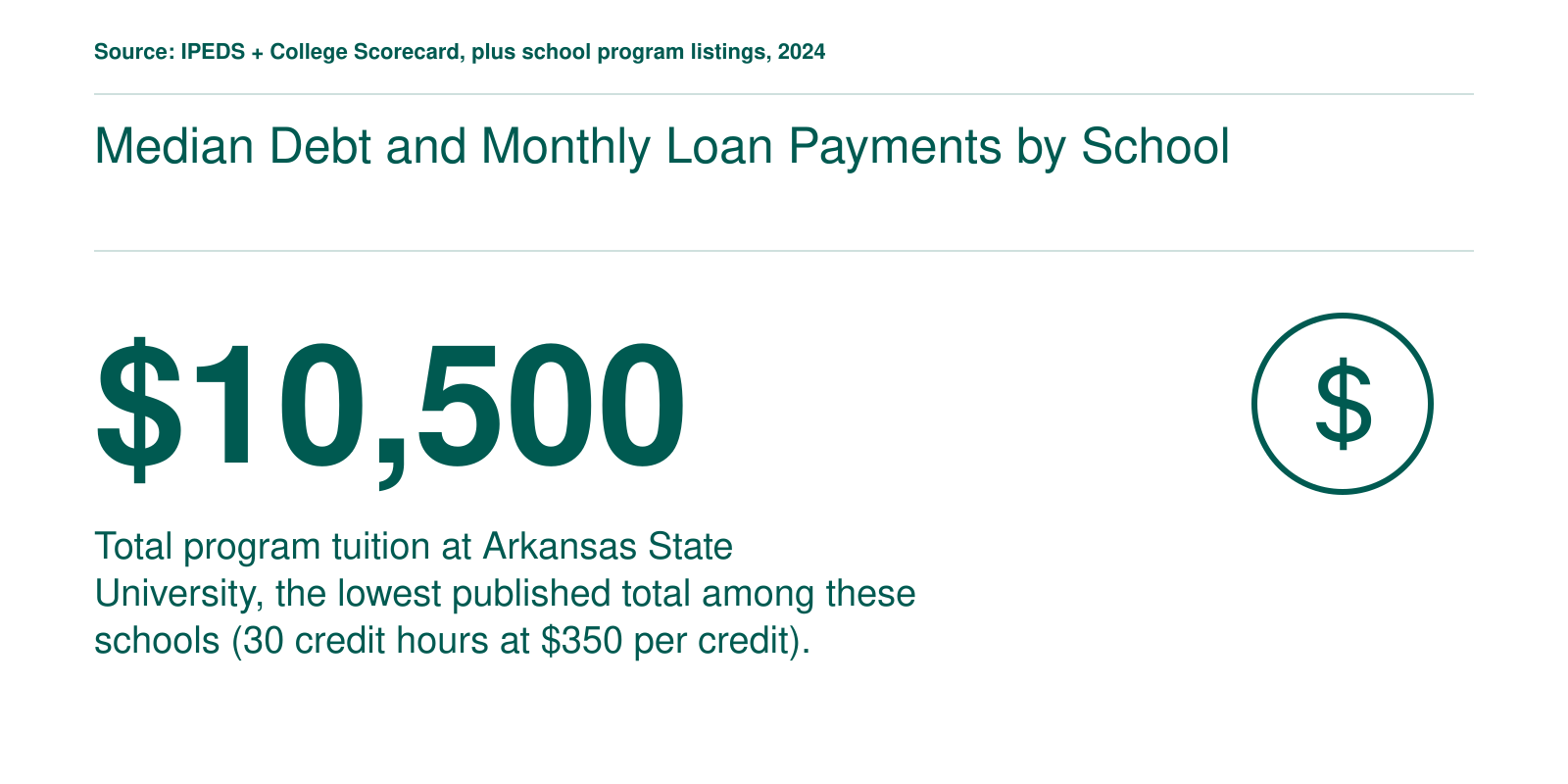
Arkansas State University lists its online strategic communications master's with a social media management track at $10,500 in total tuition. The University of Florida's online social media program lists $29,367. Same field, nearly three times the price.
That gap is the real dilemma. Employers want people who can run paid campaigns and read data analytics, but a master's is a large outlay, and brochure claims about "industry-ready" skills say little about payback. Most programs here are online. Pace University is the campus-based exception, and Valley Forge offers both formats.
Federal data cannot fully settle the question yet: program-level earnings are not published for these degrees, so price, completion, and debt carry more weight.
Key Points
- Pace University is the only campus-based option; most others run online.
- Net price blends all students, so treat it as an estimate.
- BLS: marketing managers earned a median $166,790 in May 2025.
Best Master's in Social Media Marketing Schools, Ranked for 2027
These nine programs span fully online, hybrid, and on-campus formats, with a mix of public and private institutions. Several are built as accelerated online degrees, while one New York City campus program leans into real-time industry projects. Use the cards below to compare focus areas such as mass communication, marketing, business communication, and MBA tracks.
University of Florida
#1Gainesville, FL · ~$13,000/yr (est.)
Best for: Online learners prioritizing flexible recorded and live classes
University of Florida's online Master of Arts in Mass Communication with a Social Media concentration is built for students who want to blend digital storytelling, brand marketing, and audience research without relocating. Full-time students can complete the 36-credit program in about 16 months, with recorded lectures and live sessions. The curriculum includes a capstone and is taught by industry professionals, making it a fit for students who want direct contact with practitioners.
- 36 total credit hours
- 16-month completion for full-time students
- Synchronous and asynchronous options
- Capstone project required
- Taught by industry professionals
- Advisory Council of industry experts
- Hands-on assignments with faculty feedback
Pace University
#2New York, NY · $30,000 – $35,000/yr (est.)
Best for: Campus learners seeking New York City marketing experience
Pace University's STEM-designated MS in Social Media and Mobile Marketing lives in the Lubin School of Business on the New York City campus, giving students access to real-world, real-time projects with industry practitioners. The program blends consumer behavior, social and mobile technologies, and database management with campaign planning and measurement. It is designed for students who want in-person study in a major media market and offers fall, spring, and summer entry points.
- STEM-designated program
- Real-world, real-time projects
- Full-time and part-time options
- Three start dates per year
- No GMAT or GRE with a 3.0 GPA or higher
- 96% job placement rate for Lubin master's graduates
- INSPIRE career program for international students
Fitchburg State University
#3Fitchburg, MA · ~$6,000/yr (est.)
Best for: Budget-minded communicators wanting no-exam accelerated study
Fitchburg State University's online MS in Applied Communication with a Social Media concentration is a rolling-admissions program for students who want an accelerated applied curriculum. The 36-credit degree covers new and emerging media, social media theory, integrated social media, and social media marketing, with a capstone tied to a real organizational need. The program is designed for working adults who want to complete in about two years without taking the GRE or MAT.
- No entrance exam required
- Rolling admissions
- 36 total credit hours
- Capstone project required
- Complete in as few as two years
- 3.0 GPA minimum
- 100% online accelerated program
Liberty University
#4Lynchburg, VA · ~$9,000/yr (est.)
Liberty University offers two online social media paths: a communication-focused MS in Social Media Management and a marketing-focused MS in Marketing with a Social Media Management concentration. Both use asynchronous 8-week courses with no set login times, and both accept transfer credits. The Christian university integrates faith with professional development, making it a fit for students who want online flexibility and an ethical leadership perspective.
- 33 total credit hours
- 8-week online courses
- No set login times
- No entrance exam required
- 3.0 GPA minimum
- Transfer up to 50% of credits
- Military tuition discount available
- Faith-oriented curriculum
- 36 total credit hours
- 100% online format
- 8-week courses
- Multiple start dates
- Transfer up to 50% credits
- Brand management strategies
- Social media campaign planning
- Consumer engagement focus
Arkansas State University
#5Jonesboro, AR · $7,000 – $13,000/yr (est.)
Arkansas State University's online MS in Strategic Communications with a Social Media Management concentration is built for working professionals who want a fast, affordable path. The 30-credit program uses accelerated 7-week courses and can be completed in as few as 10 months. Platform training in Google Ads, Nielsen, and HootSuite certification is embedded in the curriculum, giving students hands-on tool experience.
- 30 total credit hours
- Accelerated 7-week courses
- Complete in as few as 10 months
- Four start dates per year
- HootSuite certification included
- Google Ads and Nielsen training
- Capstone required
Lindenwood University
#6Saint Charles, MO · ~$11,000/yr (est.)
Lindenwood University's fully asynchronous MS in Social Media Marketing blends creativity with analytics, including social media strategy, data-driven decision-making, content creation, brand management, SEO, and AI applications. The program includes an applied project and thesis, which may appeal to students who want both practical and research experience. Working professionals can transfer up to nine credits and choose from multiple start dates.
- 30 total credit hours
- Fully asynchronous format
- AI-powered learning integration
- Thesis required
- Applied project
- 2.0 GPA minimum
- Transfer up to 9 credits
- Multiple start dates per year
Edgewood University
#7Madison, WI · $15,000 – $20,000/yr (est.)
Edgewood University's online MA in Business Communication and Leadership with a Social Media Marketing concentration emphasizes interpersonal influence, persuasive messaging, remote team leadership, and personal branding. The 30-credit program uses case studies and real-world projects focused on strategic marketing, media campaign execution, and digital literacy. It may fit students who want leadership communication skills alongside social media strategy.
- 30 total credit hours
- Remote team leadership focus
- Persuasive mediated messages
- Personal and professional brand development
- Strategic marketing decisions
- Media campaign execution
- Digital literacy for organizational goals
Saint Leo University
#8Saint Leo, FL · ~$13,000/yr (est.)
Saint Leo University's online MBA with a Social Media Marketing specialization combines traditional marketing with web analytics, digital storytelling, and crisis management. The 36-credit program offers experiential learning, one-to-one faculty support, and scholarships up to 45%. It is designed for students who want an MBA credential with a digital and social media focus.
- 36 total credit hours
- 12 total courses
- Digital storytelling and crisis management
- Web analytics and multichannel campaign optimization
- Scholarships available up to 45%
- Experiential learning and faculty support
University of Valley Forge
#9Phoenixville, PA · $10,000 – $15,000/yr (est.)
University of Valley Forge's MBA offers a Digital Marketing and Communications track with a Christian worldview, covering digital marketing strategy, social media tactics, and brand development. The 33-credit program uses 7-week courses and can be completed in about 18 months, with online or on-campus options. It may fit students who want an MBA concentration with hands-on learning and a faith-based perspective.
- 33 total credits
- Digital Marketing and Communications track
- Online or on-campus format
- 7-week course length
- 18-month completion time
- Christian worldview curriculum
- 2.75 GPA minimum
- Letter of recommendation required
Cost & outcomes by school
Federal data for the highest-earning Social Media Marketing programs, independent of the ranking above. Earnings are this field's master's graduates four years after completing, where the Scorecard reports them.
| School | Earnings | Tuition / yr | Debt | Grads/yr | Format |
|---|---|---|---|---|---|
| Emerson College MA | $93,412 | $35,382 | $41,000 | 54 | Online |
| The University of Alabama AL | $76,736 | $11,980 | $20,500 | 66 | Online |
| Southern New Hampshire University NH | $76,638 | $21,387 | $36,316 | 202 | Online |
| Liberty University VA | $63,586 | $8,730 | $34,165 | 47 | Online |
| Western Governors University UT | — | $9,320 | — | 188 | Online |
| Arkansas State University AR | — | $7,322 | — | — | Online |
| Fitchburg State University MA | — | $6,246 | — | — | Online |
| Edgewood University WI | — | $19,656 | — | — | Online |
| Bowling Green State University OH | — | $10,291 | — | 1 | Online |
| Lindenwood University MO | — | $11,246 | — | — | Online |
| University of Florida FL | — | $12,737 | — | — | Online |
| Saint Leo University FL | — | $12,870 | — | — | Online |
Sources: U.S. Department of Education. Tuition and graduates: IPEDS. Earnings and debt: College Scorecard, this field's master's graduates; a dash means no figure is reported.
Cost, debt & payoff
Median earnings of this field's master's graduates (4 yrs after completing) vs. their median federal loan debt · U.S. College Scorecard
Across these programs the median graduate earns about $76,638 and finishes with roughly $34,165 in debt — a ratio that clears a common rule of thumb (keep debt below first-year salary). Tuition and debt vary widely school to school, so check the per-school figures in the table above before you shortlist.
Inside Our Scoring: Net Price, Completion, and Graduate Earnings
How do you know whether a social media marketing master's will pay off before you enroll? Every school on this list had to prove its value with federal data, not brochure claims.
What the Data Covers
Four inputs shape where each school lands, and together they put cost, the odds of finishing, and the payoff on the same footing:
- Graduate tuition: Published rates reported to IPEDS.
- Net price: The institution-wide College Scorecard average after aid.
- Completion: Institution-wide graduation rates, a signal of whether students tend to finish what they start.
- Program-level outcomes: Median earnings and debt for graduates of the specific program, where the federal government publishes them.
Where the Data Runs Out
That figure is averaged across the whole institution after aid. It is not a figure calculated for master's students in a particular online master's in marketing program, so your own bill may differ. Completion rates work the same way: they describe the whole institution, not the social media program. Treat both as context, not a promise.
Some programs show no earnings or debt figures at all. Scorecard withholds results for small graduating cohorts to protect student privacy, so a blank means the data is suppressed, not that outcomes are poor.
How to Use the Rankings
Think of the order as a shortlist, not a verdict. Before you apply, confirm each school's current tuition page for per-credit rates, fees, and total credit requirements, since those change from year to year and drive your real cost. Then weigh your finalists on what you would owe against what graduates earn.
What You'll Pay: Graduate Tuition and Net Price at Ranked Schools
Published graduate tuition can overstate what students actually owe because the net price below is an institution-wide average after grants and scholarships, not a program-level quote. Online students at several schools here pay a single per-credit rate regardless of residency, although technology, distance-learning, or graduation fees often add to the total. A quick estimate for any program is per-credit rate times required credits plus fees.
| School | Format | In-State Graduate Tuition | Out-of-State Graduate Tuition | Net Price | Median Program Debt |
|---|---|---|---|---|---|
| University of Florida | Online | 6381 | 28659 | 6541 | 15000 |
| Arkansas State University | Online | 8090 | 14522 | 12366 | 20500 |
| Fitchburg State University | Online | 11346 | 17426 | 14262 | 24239 |
| Lindenwood University | Online | 21600 | 21600 | 19638 | 26000 |
| Saint Leo University | Online | 30000 | 30000 | 21293 | 25278 |
| Edgewood University | Online | 35860 | 35860 | 26113 | 24424 |
| Liberty University | Online | 22465 | 22465 | 29357 | 24500 |
| Pace University | On campus | 53290 | 53290 | 30892 | 23250 |
| University of Valley Forge | Online | 25240 | 25240 | 32265 | 27000 |
Graduate Earnings: What Program Completers Actually Make
Two master's programs can look identical on a brochure, but the one that leaves you with less debt and a clearer earnings path is usually the better value. For this section, the uncomfortable truth is that program-level median earnings are not yet available for any of the programs ranked below. No reliable one-year, two-year, or four-year program-specific earnings figure exists right now, so we will not pretend otherwise by ranking schools on pay.
Why Program-Level Earnings Matter More Than University Averages
A university-wide median earnings number can be misleading for a social media marketing graduate, because it blends medical, engineering, and business completers into one figure. That broader number does not tell you what a social media master's completer actually earns. We do not use that institution-wide figure as a stand-in for program outcomes. With program-level dollar figures absent, there is no defensible way to say which of the programs below delivers the strongest graduate pay.
What You Can Compare Right Now
Program-level earnings and the share of completers working one year after finishing are not reported for the programs in this section. In the meantime, median debt is the most useful stress test. A lower median debt gives you more breathing room if your first social media or digital marketing role lands on the modest end of the salary spectrum. The University of Florida's program reports a median graduate debt of $15,000, while Arkansas State is $20,500. By contrast, Pace University comes in at $23,250, Edgewood at $24,424, and Liberty at $24,500. That gap matters more when earnings data is still pending.
How to Use This Before Applying
Treat lower net price and lower median debt as the safest proxies until updated program-level earnings arrive. Ask any program for its own graduate outcome survey, but read institution-wide claims with caution. Once one-year and four-year program earnings are published, compare those numbers directly against median debt. A program where first-year earnings are less than the debt itself may be harder to justify, no matter how appealing the curriculum looks.
Median Debt and Monthly Loan Payments by School
We built this section to chart median federal debt at completion alongside the 10-year monthly payment. College Scorecard has not published program-level debt or payment figures for the schools here, and we exclude schools without published figures rather than estimate them. Until those numbers appear, the lowest published total tuition is the best cost benchmark available.
Related Articles
Asynchronous, Synchronous, or on Campus: How Delivery Formats Compare
Most programs here blend formats, so the real question is how much of your schedule the school controls. Asynchronous programs let you work on your own time, synchronous ones add live sessions, and low-residency options add a few in-person weekends. Course length and start dates vary by school, so confirm both with admissions before you apply.
| Factor | Asynchronous online | Synchronous online | On campus or low residency |
|---|---|---|---|
| Required login times | None. Liberty has no set login times, and West Virginia has no required live meetings. | Oklahoma requires weekly live sessions, typically weeknights 7 to 9 p.m. CT, with alternate assignments if you cannot attend. Wake Forest's live session is optional. | Manhattan requires three on-campus weekends per year in New York City. Rutgers residency is optional. |
| Typical course length | 8-week courses at West Virginia and Liberty; 7.5-week mini-sessions in Wake Forest's social media course. | Oklahoma offers 8- and 16-week formats. Manhattan runs 7-week sessions that blend live and self-paced work. | Manhattan's low-residency program also uses 7-week sessions, with campus weekends layered on top. |
| Start dates per year | Varies. West Virginia's next start is January 11, 2027. | Oklahoma starts in fall, spring, and summer. | Not specified in the program details we reviewed. Ask admissions. |
| Networking access | Lowest by design. Yeshiva adds occasional optional live reviews and guest speakers. | Regular face time with instructors and classmates through weekly sessions. | Strongest. In-person weekends build relationships in a way video cannot. |
| Fit for working professionals | Best for unpredictable schedules or travel, since you can study anywhere at any time. | Works if you can reliably block a weeknight evening each week. | Works if you can plan a few weekends a year, with no regular commute. |
| Ranked programs by format | Lindenwood, Liberty, West Virginia, Rutgers, and Yeshiva (primarily asynchronous). | Kansas offers both asynchronous and synchronous courses. Oklahoma and Manhattan include live components. | Manhattan (low residency) and Rutgers (optional residency). Other programs here are fully online. |
| Best fit by learner type | Full-time workers who need schedule control. | Career changers who want structure and instructor contact. | Recent graduates who want in-person networking. |
Admissions and Accreditation Checklist Before You Apply
Requirements vary by program and can change by application cycle, so confirm each school's current rules before you pay an application fee. Use this checklist to compare programs on equal terms.
- Check institutional and business accreditationConfirm the school holds regional accreditation from a U.S. Department of Education-recognized body such as HLC, MSCHE, SACSCOC, or WSCUC. Saint Leo, for example, lists SACSCOC and ACBSP accreditation. If the program sits in a business school, AACSB is a quality signal. Rutgers, East Tennessee State, and Eastern Washington all cite it. It is not an admission requirement, and not every social media marketing master's carries it.
- Confirm your bachelor's degree and GPAA bachelor's degree from an accredited institution is the baseline. Minimum GPAs differ: 3.0 is common (Rutgers, Liberty, Fitchburg State), while Cal Poly Pomona and Arkansas State list 2.5. Minnesota Carlson sets no minimum and reviews applications holistically. Some programs also expect prerequisites. Liberty's MS in Marketing, Social Media Management, for instance, asks for 27 hours of undergraduate business coursework, and Minnesota requires a statistics course.
- Look up GRE/GMAT policy and experience expectationsMany programs waive tests, but not all. East Tennessee State requires neither, and Pace waives them for applicants with a 3.0 or higher GPA. Temple requires GMAT or GRE scores if your GPA is below 3.0. Work experience is usually helpful rather than mandatory. Cal Poly Pomona does not require it, and Eastern Washington encourages three or more years, especially for sub-3.0 applicants. Career changers should prepare a résumé that makes the case.
- Prepare your personal statement and recommendationsExpect essays, a résumé, and recommendation letters. Rutgers and Minnesota Carlson each ask for two letters, and Fitchburg State asks for three. Rutgers requires two essays, with a third optional. Temple prefers a professional recommendation from a supervisor. Line up recommenders early.
- Plan for English proficiency and visa limitsInternational applicants typically submit TOEFL, IELTS, PTE, or Duolingo scores unless exempt, and exemptions depend on the school. Temple lists a TOEFL iBT 79 and IELTS 6.5 for 2026, and Cal Poly Pomona lists TOEFL iBT 80. Thresholds can change by test date, so check the current cutoff. Fully online programs generally do not support student visas, so international students who need one should look at on-campus options like Pace and confirm eligibility with the school.
Did you know? Marketing managers earned a median annual wage of $166,790 in May 2025, and the Bureau of Labor Statistics projects 7% job growth from 2025 to 2035, faster than average. For many social media marketing master's graduates, this senior role is the destination, not the starting salary.
Social Media Marketing programs by state
Social Media Marketing Master's Degree Questions, Answered
These are the questions prospective students ask most often about social media marketing master's programs. Each answer is brief, and the sections that follow cover costs, earnings, debt, and admissions in more detail.
How is a master's in social media marketing different from a master's in digital marketing?
What does a social media marketing master's degree cost from start to finish?
Does a master's in social media marketing pay off financially?
Which jobs do graduates of social media marketing master's programs typically land?
How many months does the degree take full-time vs. part-time?
Are there accredited online master's in social media marketing programs?
Can career changers without a marketing bachelor's get admitted?
How many graduate transfer credits do these programs usually accept?
Compare Social Media Marketing programs on the data that matters
Explore more Business & Management specializations or browse every graduate field.
All Business & Management programs