Best Online Master's in Marketing Programs
Compare 260+ accredited online Marketing programs, with graduate earnings, cost, debt, and completion data from IPEDS and the U.S. College Scorecard.

Quit to study full time, or keep the paycheck and study at night: for marketers aiming at strategy, analytics, or leadership roles, usually only the second option works. Online delivery makes it possible, though formats differ, from weekly live sessions at Texas A&M to flexible pacing at Rutgers.
Thirteen online and hybrid programs made our list. Annual graduate tuition runs from $10,051 at the University of Houston to $67,626 at Boston University. Cost per credit, earnings and debt, concentrations, and GMAT/GRE policies all shift the math.
A bigger price tag does not guarantee a better outcome. Baruch College graduates carry median debt of $11,512, roughly half of Boston University's $23,250.
Key Points
- BLS projects just 3% marketing manager job growth from 2024 to 2034.
- Even among the six cheapest programs, in-state and out-of-state tuition differ.
- Earnings-to-debt ratios use school-level data because program-level earnings aren't yet published.
10 Online Master's in Marketing Programs, Ranked
Every program below can be completed online; the order reflects a blended quality score, not cost or prestige. These ten schools pair marketing fundamentals with emphases such as analytics, digital strategy, brand management, and AI applications. Here is how they compare.
Florida International University
#1Miami, FL · ~$11,000/yr (est.)
Best for: Professionals seeking digital certifications and networking
Florida International University's online Master of Science in Marketing is a 30-credit, accelerated program with 10- or 16-month completion paths and fall or spring starts. The curriculum emphasizes digital marketing, branding, analytics, e-commerce, and social media, and students can earn Google Ads and Analytics certifications along the way. Applicants need three or more years of work experience to waive the test requirement. The business school is AACSB-accredited, and the university is regionally accredited by SACSCOC. Graduates report median earnings of about $62,135 one year after completion.
- Accelerated 30-credit program; 10 or 16 months
- Fall and spring start terms
- No entrance exam for applicants with 3+ years experience
- Earn Google Ads and Analytics certifications
- Industry certifications in sales and Lean Six Sigma
- Lock-step cohort builds professional network
- Digital marketing and analytics focus
- Professional development seminars embedded
Texas A&M University-College Station
#2College Station, TX · ~$12,000/yr (est.)
Best for: Data-driven marketers seeking executive mentorship
Texas A&M's Flex Online MS in Marketing is a two-year, part-time program built around synchronous weekly virtual sessions and a fall-start cohort. The quantitative-focused curriculum develops data analysis for strategic decisions, supported by career management services and corporate executive mentorships. The program reports median earnings of about $70,739 one year after completion. Mays Business School is AACSB-accredited, and the university is regionally accredited by SACSCOC.
- 36 total credit hours; two-year format
- Part-time schedule for working professionals
- Weekly live virtual sessions
- Synchronous and asynchronous options
- Quantitative-focused curriculum
- Career Management Center assistance
- Corporate Executive Mentorships
- All-inclusive tuition $45,000
Arizona State University
#3Tempe, AZ · ~$14,000/yr (est.)
Best for: Working professionals needing flexible online pacing
Arizona State University's W. P. Carey School of Business offers a fully online MS in Marketing with 10 classes and an applied project. The curriculum covers digital marketing strategies, marketing analytics, and customer insights, and students can earn industry certifications. The business school is AACSB-accredited, and ASU is regionally accredited by HLC.
- 100% online format
- 10 classes plus an applied project
- No GMAT or GRE required
- 1-2 year completion time
- Estimated cost $36,500
- August and January starts
- Industry certifications available
- Same faculty as campus program
William & Mary
#4Williamsburg, VA · $15,000 – $20,000/yr (est.)
William & Mary's online MS in Marketing is a 33-credit, part-time program that can be finished in as few as 16 months. Coursework centers on data analytics, marketing innovation, and integrated communications, and includes one on-campus residency and a real-world Marketing Challenge project. The Mason School of Business is AACSB-accredited, and the university is regionally accredited by SACSCOC.
- 33 credits; complete in 16 months
- Part-time schedule available
- No GRE or GMAT required
- 9 courses plus one on-campus residency
- Two start dates per year
- Real-world Marketing Challenge project
- Focus on data analytics and marketing innovation
- Military friendly and career support
North Carolina State University at Raleigh
#5Raleigh, NC · $12,000 – $33,000/yr (est.)
NC State's Master of Management in Marketing Analytics is a fully online program focused on business analytics, marketing strategy, and artificial intelligence. Students complete a hands-on practicum and can stack a Certificate in Business AI, with optional in-person networking events. Poole College of Management is AACSB-accredited, and the university is regionally accredited by SACSCOC.
- Fully online with optional in-person networking
- Core courses in business analytics and marketing strategy
- Electives in AI and consumer behavior
- Stackable Certificate in Business AI
- Self-paced analytics boot camp for foundations
- Hands-on practicum on real business problems
- Study abroad opportunity available
Rutgers University
#6New Brunswick, NJ · ~$23,000/yr (est.)
Rutgers Business School's online MS in Digital Marketing is a 30-credit program that can be completed in 9 to 12 months, though flexible pacing extends up to 4.5 years. The curriculum integrates Google Analytics certifications and hands-on experience, taught by industry practitioners. The business school is AACSB-accredited, and the university is regionally accredited by MSCHE.
- 30 credit hours
- 100% online program
- 9-12 months completion, flexible pacing
- Same tuition for all students
- Optional GMAT or GRE scores
- 3.0 GPA and two essays required
- Industry practitioner faculty
- Integrated certification options
University of Illinois Chicago
#7Chicago, IL · ~$18,000/yr (est.)
University of Illinois Chicago's online MS in Marketing offers digital marketing and customer-focused marketing concentrations, with flexible 8- and 16-week courses and multiple start dates. The curriculum includes generative AI, live client projects, and a capstone with live case studies. The university is regionally accredited by HLC.
- Online program format
- Flexible for working professionals
- Generative AI applications
- Real-world marketing challenges
- Interactive learning experiences
- Career advancement focus
- Marketing technology emphasis
- Sports marketing opportunities
- Digital Marketing concentration track
- No entrance exam required, test optional
- Complete in 12 to 24 months
- Capstone with live case studies
- Design and manage digital campaigns
- Flexible 8- and 16-week courses
- Experiential client projects
- Customer-Focused Marketing concentration track
- Multicultural marketing emphasis
- 32 total credit hours
- 8 total courses
- Three start dates per year
- AI technologies for content creation
- Alumni network of 53,000
- Top employers: Publicis Media, Circana
University of Kentucky
#8Lexington, KY · ~$15,000/yr (est.)
University of Kentucky's online MS in Marketing requires 30 credits and covers strategic marketing, consumer insights, digital marketing, and branding. Online real-time classes remove the need for on-campus visits. The university is regionally accredited by SACSCOC.
- 30 total credits
- Online real-time format
- No on-campus requirements
- Minimum 2.75 undergraduate GPA
- Covers strategic marketing and consumer insights
- Includes digital marketing and branding
- Marketing analytics coursework
- Tuition assistance options
Colorado State University Global
#9Denver, CO · ~$12,000/yr (est.)
CSU Global's Creative and Digital Marketing Graduate Specialization is a 12-credit add-on concentration for a master's degree, offering asynchronous 8-week courses with monthly starts. Coursework spans AI marketing optimization, e-commerce and mobile marketing, SEO, and digital storytelling. The university is regionally accredited by HLC.
- 12 total credit hours
- 4 total courses
- 12 start dates per year
- Asynchronous 8-week courses
- No set class times or locations
- AI marketing optimization coursework
- SEO and SEM comparison coursework
- Google Analytics Certificate preparation
The University of Texas Rio Grande Valley
#10Edinburg, TX · $5,000 – $10,000/yr (est.)
UTRGV's fully online MS in Marketing can be completed in as few as 10 months through 7-week mini semesters, with no GRE or GMAT required. The curriculum includes AI-powered marketing, data visualization, social media strategy, and Tableau dashboard design. The university is regionally accredited by SACSCOC.
- 100% online delivery
- Complete in as few as 10 months
- 7-week mini semesters
- No GRE or GMAT required
- 30 total credit hours
- Courses include AI-Powered Marketing and Data Visualization
- Tableau dashboard design and mobile commerce
- Financial aid and scholarships available
Cost & outcomes by school
Federal data for the highest-earning Marketing programs, independent of the ranking above. Earnings are this field's master's graduates four years after completing, where the Scorecard reports them.
| School | Earnings | Tuition / yr | Debt | Grads/yr | Format |
|---|---|---|---|---|---|
| Western Governors University UT | — | $9,320 | — | 188 | Online |
| Albright College PA | — | $1,540 | — | — | Online |
| University of the Cumberlands KY | — | $3,195 | — | — | Online |
| Columbia Southern University AL | — | $3,936 | — | — | Online |
| Park University MO | — | $4,783 | — | — | Online or campus |
| Southeastern Oklahoma State University OK | — | $5,220 | — | — | Online |
| Waldorf University IA | — | $5,340 | — | — | Online |
| Valdosta State University GA | — | $6,316 | — | — | Hybrid |
| United States University CA | — | $6,543 | — | — | Online |
| University of South Dakota SD | — | $7,118 | — | — | Online |
| Tarleton State University TX | — | $7,527 | — | — | Online |
| North Carolina Central University NC | — | $7,638 | — | — | Online |
Sources: U.S. Department of Education. Tuition and graduates: IPEDS. Earnings and debt: College Scorecard, this field's master's graduates; a dash means no figure is reported.
Cost, debt & payoff
Median earnings of this field's master's graduates (4 yrs after completing) vs. their median federal loan debt · U.S. College Scorecard
Across these programs the median graduate earns about $85,839 and finishes with roughly $36,019 in debt — a ratio that clears a common rule of thumb (keep debt below first-year salary). Tuition and debt vary widely school to school, so check the per-school figures in the table above before you shortlist.
Behind the List: What Our Scoring Rewards and What It Leaves Out
Online and hybrid delivery has made it easy to line up dozens of marketing master's programs side by side, but much harder to know what the numbers behind them describe.
What Qualifies and How the Order Is Set
Every program on this list has an online or hybrid delivery option. The order comes from a blended quality composite built from IPEDS and College Scorecard figures: graduate tuition, net price, graduation rate, and program-level earnings and debt where those figures are published.
Where the Numbers Are Broader Than They Look
Several inputs describe the whole institution, not the marketing program you would enroll in. Keep these limits in mind:
- Graduation rate: This is an institution-wide figure. It signals how well a school graduates its students overall, not how marketing master's students fare.
- Net price: This is an average across students. Your own cost will shift with residency, aid, transfer credit, and how many courses you take.
- Program-level earnings: These come from College Scorecard completer cohorts. Smaller programs often have too few completers to report, so the figures may be missing. For most programs in this ranking, they are not yet published.
When earnings data is absent, a program is not penalized as a poor performer. It simply has less evidence behind its position, and you should ask the school for outcomes directly.
What the Score Does Not Measure
The composite does not capture brand prestige, faculty ratings, or student satisfaction surveys. A program ranked lower may still fit you better if its curriculum, concentration, or schedule matches your goals. Treat the order as a starting point for comparison, then check the details that matter to you: your own expected net cost, the curriculum, and whether the school can show where its marketing graduates land.
Tuition, Fees, and Cost per Credit: The Full Price of an Online Marketing Master's
A per-credit rate means little until you multiply it by the credits a program requires, and that math reshuffles which degrees are actually affordable, whether you're comparing marketing master's or affordable MBA programs.
From Per-Credit Rate to Total Bill
Published 2026-27 rates and credit counts translate into these approximate totals:
- Champlain College: 24 credits at $608 comes to $14,592, plus a $150 graduation fee.1 The $450 rate is reserved for alumni, associate-degree graduates, service members, veterans, and their families, and would bring 24 credits to $10,800.2
- UW-Whitewater: 30 credits at $722 comes to $21,660 before additional fees. Non-resident tuition may apply.
- CU Denver: 30 credits at $795 would be $23,850, while the school's estimated total is $21,600, which implies about $720 per credit for lower-rate residency categories.3
- Indiana University Kelley: a $25,500 total over 30 credits works out to about $850 per credit.
- William & Mary: 33 credits at $1,125 comes to $37,125, before a $650 residency-course fee and a $150 graduation fee.
Residency Gaps and Flat Rates
At public schools, where you live can move the bill noticeably. FIU lists $27,500 for Florida residents and $31,500 for non-residents, a $4,000 difference.4 CU Denver prices residents and Western Regional Graduate Program students separately from non-residents. UW-Whitewater says non-resident tuition may apply.
The University of Houston Bauer College is the clearest flat-rate public in our set: it charges the same per-credit rate regardless of residence, with an estimated total of $25,983 over 30 credits.5 Texas A&M's Mays Business School describes its Flex Online pricing as all-inclusive, though we could not confirm the amount.
Fees That Inflate Sticker Prices
We did not find a mandatory online or technology fee at most of these programs, but coverage is uneven, so confirm on each bursar page. The charges that do show up include graduation fees ($150 at both Champlain and William & Mary), course materials and software, and residency requirements. William & Mary's residency course carries its own fee, and travel and lodging are on top of that. Programs that bundle e-textbooks and software into one price can be simpler to budget.
Net Price and One Way to Cut Cost
Federal net price figures are institution-wide and largely reflect undergraduate aid. FIU's, for example, sits around $9,300 a year. Treat such numbers as rough context, not a quote for this master's.
One general tactic worth pursuing before you enroll: ask your employer whether it offers tuition assistance. Some employers reimburse part of graduate coursework, and the same case often applies to online MBA programs or a marketing degree pursued while working. Confirm the terms in writing first.
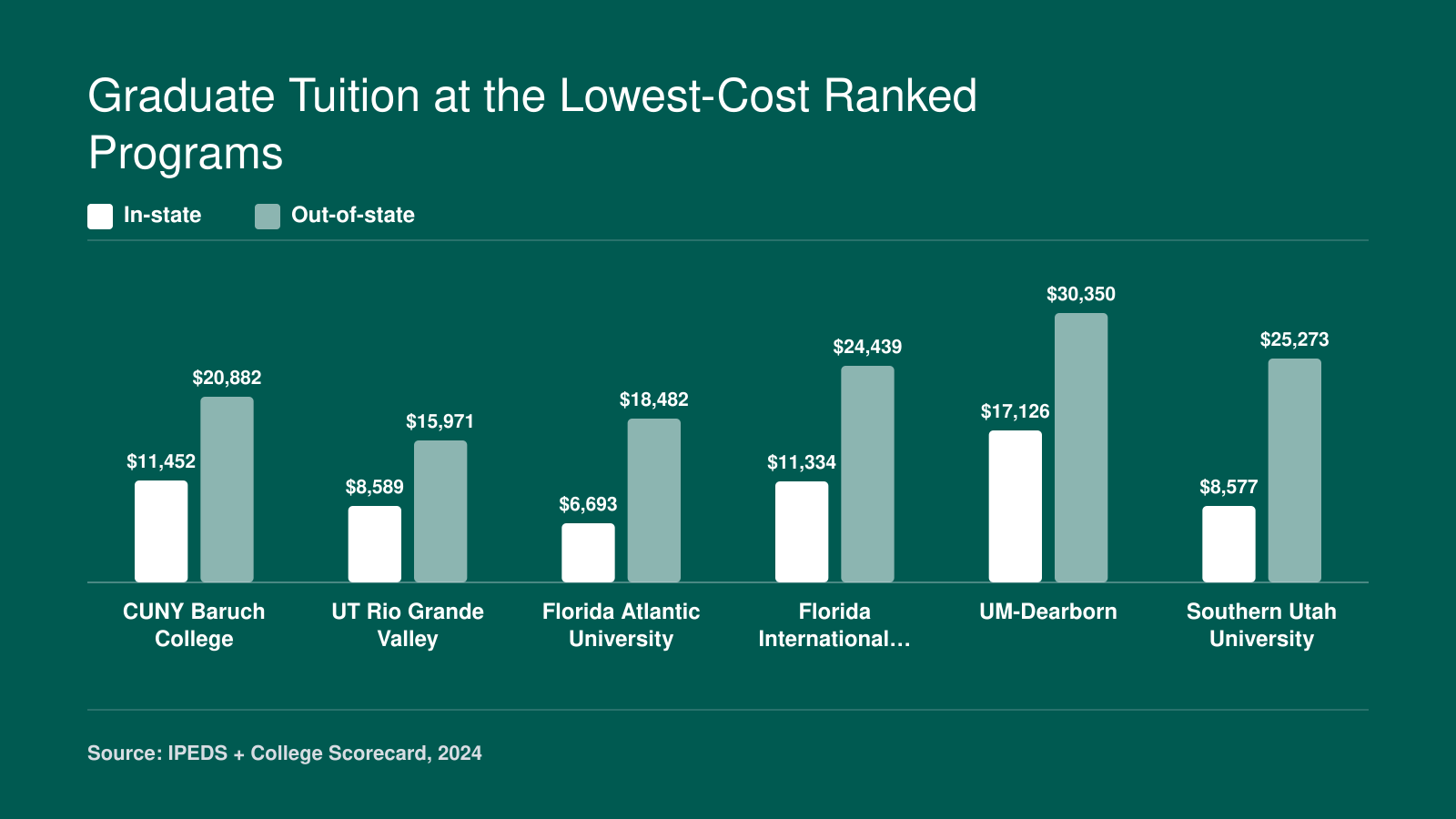
Graduate Tuition at the Lowest-Cost Ranked Programs
The chart shows annual graduate tuition and fees from federal data for the six lowest-cost schools on our list, with in-state and out-of-state rates side by side. Unlike many online programs, none of these six has a negligible residency gap. UT Rio Grande Valley is narrowest at about $7,400, while Southern Utah University is widest at about $16,700. Check each program's own page, since online rates can differ from the figures reported to the federal government.
Three Programs With the Strongest Earnings-to-Debt Ratio
The ratio below is a school-level proxy: each institution's ten-year earnings divided by its median graduate debt, not a marketing-program-only result. University of Illinois Chicago stands out for the strongest ratio and moderate debt; Texas A&M University-College Station follows with strong earnings and a similar debt load. Southern Utah University rounds out the group with the lowest median debt and lowest in-state tuition.
| School | Graduate Tuition (In-State) | Graduate Tuition (Out-of-State) | Median Graduate Debt | Earnings-to-Debt Ratio |
|---|---|---|---|---|
| University of Illinois Chicago | $14,338 | $29,884 | $16,704 | 4.12 |
| Texas A&M University-College Station | $13,154 | $40,124 | $17,804 | 4.05 |
| Southern Utah University | $6,962 | $21,192 | $12,500 | 4.02 |
Related Articles
A master's in marketing is only a good value when its total program cost makes sense next to what graduates of that specific program actually earn, so weigh the two together before you apply.
Applying: GMAT/GRE Policies, Prerequisites, and Deadlines
Requirements vary by program and change by cycle, so confirm each detail on the school's admissions page. Anything not listed here is unconfirmed, not necessarily absent.
- Bachelor's degree and GPARutgers lists a 3.0 GPA; Florida Warrington and Colorado Denver also cite 3.0 minimums, and Colorado Denver adds 3+ years of professional work or a graduate degree.
- GMAT/GRE policyRutgers calls scores optional but preferred; Boston University and William & Mary list no test requirement; Santa Clara accepts scores or a waiver; Alabama requires GRE or GMAT.
- Common waiver criteriaPurdue exempts applicants with a 3.0+ GPA; South Florida may waive scores for 3+ years of relevant work or a 3.5+ undergraduate GPA.
- Resume and work experienceSanta Clara asks for a resume but not work experience; William & Mary students average about eight years of experience, which is a class profile, not a requirement.
- Prerequisite coursesMinnesota Carlson requires a college statistics course with a C or higher; Florida Warrington expects a business major or minor; Santa Clara lists no prerequisites.
- Recommendations and essaysRutgers asks for two essays and two letters; Santa Clara asks for a personal statement and two letters.
- Start terms and deadlinesTexas A&M starts each fall with rolling admissions and a July 1 final deadline; Alabama accepts applications year-round; USC's 2026-27 first round closes November 1, 2026.
The Bureau of Labor Statistics Occupational Outlook Handbook reports that advertising, promotions, and marketing managers earned a median annual wage of $165,780 in May 2025, with projected employment growth of 3% from 2024 to 2034.
Marketing programs by state
Your Questions About Online Marketing Master's Degrees, Answered
These answers draw on program websites and published degree guides. Policies vary by school, so confirm details such as pacing, prerequisites, and transcript wording with each program before you apply.
Should I choose an MBA in marketing or a specialized master's in marketing?
Can I earn an online master's in marketing part-time while working full-time?
What jobs can a marketing master's lead to beyond traditional brand roles?
Can I get into a marketing master's without a business undergraduate degree?
Will employers know my marketing degree was earned online?
Compare Marketing programs on the data that matters
Explore more Business & Management specializations or browse every graduate field.
All Business & Management programs