Best Master's in Marketing Programs in Wisconsin
Compare 8 accredited Marketing programs in Wisconsin, with graduate earnings, cost, debt, and completion data from IPEDS and the U.S. College Scorecard.

In Wisconsin, the master's in marketing decision turns on format, test policy (Master's in Marketing Programs With No GMAT or GRE Required), and track type more than prestige. UW-Whitewater's 30-credit MS in Marketing is fully online and built for working professionals. UW-Madison's marketing master's is earned en route to a PhD in Business on campus. Concordia University-Wisconsin packages marketing as an MBA in Marketing concentration rather than a standalone MS. Those distinctions reshape cost, timeline, and who can enroll.
Early-career earnings show what is at stake: UW-Madison marketing master's graduates report median pay of $117,372 one year after finishing. A specialized online degree may fit a working marketer's budget and schedule, but a research-track or MBA route serves a different goal. Choose the track that matches the job you want next.
Key Points
- UW-Whitewater's online MS in Marketing runs 30 credits at $722 per credit for 2026-27.
- UW-Madison marketing master's graduates report median earnings of $117,372 one year after finishing.
- Check each school's admissions page for GRE or GMAT waiver rules before applying for 2027.
Wisconsin's Best Master's in Marketing Programs Ranked
Very few Wisconsin schools offer a dedicated master's in marketing, so each of the three cards below deserves a close read. Formats differ widely: one is a research-track degree on campus, one is fully online, and one is an MBA with a marketing focus. Graduation rates are institution-wide figures from federal data, not program completion rates.
University of Wisconsin-Madison
#1Madison, WI · ~$12,000/yr (est.)
Best for: PhD-bound business researchers
The University of Wisconsin-Madison offers its marketing master's as a named MS within the PhD in Business, so it is earned en route to the doctorate and there is no direct master's application. The university graduates about 90% of its students, and published graduate tuition is $10,728 in-state and $24,054 out-of-state. Federal data for the program show median earnings of $117,372 one year after completion and $166,668 four years after, based on a small group of 31 completers. It suits aspiring researchers more than students seeking a standalone professional degree.
- 30 credit hours, including 15 graduate-level credits
- Earned en route to the PhD in Business
- No direct master's application
- 3.0 GPA minimum
- Weekday face-to-face classes on campus
- Transfer up to 9 graduate credits
- No language requirement or extra exams
University of Wisconsin-Whitewater
#2Whitewater, WI · $10,000 – $15,000/yr (est.)
Best for: Working professionals needing fully online study
The University of Wisconsin-Whitewater runs a fully online Master of Science in Marketing aimed at current and aspiring digital marketers. Coursework covers social media and content marketing, consumer behavior, sports marketing, digital marketing and sales negotiation, with a focus on consumer insights and AI. Published graduate tuition is $9,256 in-state and $20,316 out-of-state, the lowest of the three schools. The university graduates about 59% of its students. No program-level earnings figure is available.
- Fully online option available
- Starts in spring, summer or fall
- Full-time students can finish in as few as three semesters
- Social media and content marketing coursework
- Consumer behavior and sports marketing courses
- Digital marketing and sales negotiation courses
- Consumer insights and AI for digital marketing
- Several alternatives to standardized tests, such as work experience or certification
Concordia University-Wisconsin
#3Mequon, WI · ~$13,000/yr (est.)
Best for: Marketers wanting a general business credential
Concordia University Wisconsin, in Mequon, offers an MBA in Strategic Marketing through its Batterman School of Business rather than a stand-alone MS. The 36-credit degree costs $730 per credit, the same for all students regardless of residency, and the university graduates about 68% of its students. Students can study online or in person on campus or at off-site locations. No entrance exam is required, which makes it practical for working marketers who want a broader business credential.
- 36 credit hours at $730 per credit
- No entrance exam required
- Fully online option, or on campus and off-site
- Segmentation, media, budgeting and evaluation
- Direct mail, lead generation, loyalty and social marketing
- Sales force management coursework
- Business foundations course for students without prior business credits
- Video introduction required to apply
- 12-credit graduate MBA certificate also available
Cost & outcomes by school
Federal data for the highest-earning Marketing programs, independent of the ranking above. Earnings are this field's master's graduates four years after completing, where the Scorecard reports them.
| School | Earnings | Tuition / yr | Debt | Grads/yr | Format |
|---|---|---|---|---|---|
| University of Wisconsin-Madison WI | $166,668 | $12,325 | — | 17 | Campus |
| University of Wisconsin-Oshkosh WI | — | $10,051 | — | — | Online or campus |
| University of Wisconsin-Platteville WI | — | $10,049 | — | — | Online |
| University of Wisconsin-Milwaukee WI | — | $12,728 | — | — | Campus |
| Edgewood University WI | — | $19,656 | — | — | Online |
| Marquette University WI | — | $24,680 | — | — | Campus |
| University of Wisconsin-Whitewater WI | — | $10,543 | — | 10 | Online |
| Concordia University-Wisconsin WI | — | $13,260 | — | 5 | Hybrid |
Sources: U.S. Department of Education. Tuition and graduates: IPEDS. Earnings and debt: College Scorecard, this field's master's graduates; a dash means no figure is reported.
MS in Marketing vs. MBA vs. Research-Track Master's in Wisconsin
The real choice is marketing depth versus management breadth, with a third path for people headed toward research.
A professional Master's in Marketing is specialized and often shorter than an MBA. UW-Whitewater's online MS in Marketing is a 30-credit example, covering consumer insights, strategy, AI for digital marketing, and global marketing. MBA programs in Wisconsin with a marketing concentration spread coursework across finance, operations, and leadership, and many programs prefer applicants with work experience. UW-Madison's Full-Time MBA offers marketing pathways in brand management and marketing research and insights.
UW-Madison does not list a standalone professional MS in Marketing. Its marketing research degree is the PhD, so confirm with the department whether a master's is awarded along the way or open to separate application. Its MS in Business Analytics also includes a digital marketing track.
- Career switcher: the professional MS.
- Mid-career manager: the MBA.
- Future academic: the PhD route.
Several Wisconsin business schools also offer MBA marketing programs or digital marketing options if a dedicated MS isn't a fit.
Online and Hybrid Master's in Marketing Options in Wisconsin
Which Wisconsin marketing master's can you finish while working full-time? Two of the schools here are built for that, and one is not.
UW-Whitewater's MS in Marketing is a fully online master's in marketing with asynchronous delivery and no campus attendance required. Part-time study is supported, and you can start in fall, spring, or summer. The degree is 30 credits, and full-time students can finish in as few as three semesters. Part-time completion time is not published. The 2026-27 online rate is listed at $722 per credit on the program page and $708 in the fee schedule, and either way residents and out-of-state students pay the same. Coursework includes digital marketing, social media and content marketing, and AI for digital marketing.
Concordia University-Wisconsin offers its 36-credit MBA in Strategic Marketing in hybrid form, with on-campus, off-site, and fully online options, at $730 per credit. It requires no entrance exam.
UW-Madison's marketing master's is a weekday, face-to-face campus program among Master's Programs in Wisconsin.
Related Articles
Which Wisconsin Master's in Marketing Programs Waive the GRE or GMAT?
Test waivers usually hinge on undergraduate GPA or professional experience, and policies change by term. Confirm current requirements and dates with each admissions office before you apply. For Concordia University-Wisconsin, check its graduate admissions page directly, since this table includes only policies we could verify.
| Program | GRE/GMAT Policy | Key Admission Requirements | Application Deadline |
|---|---|---|---|
| University of Wisconsin-Whitewater, Online Master of Science in Marketing | Waivable with criteria. Many applicants qualify without scores. Others may submit GMAT scores, and GRE scores are converted to comparable GMAT scores. | Bachelor's degree from a regionally accredited institution, graduate admission criteria, and one of the program's listed criteria. GPA of 3.0 for an AACSB- or ABET-accredited bachelor's, or 3.25 for a regionally accredited one. | Varies by term. See the UW-Whitewater graduate admission deadlines page. |
| University of Wisconsin-Madison, Wisconsin School of Business MS programs | Required. GMAT or GRE taken within five years of the starting term. | Minimum 3.0 undergraduate GPA. | Fall: December 15. No spring or summer admission. |
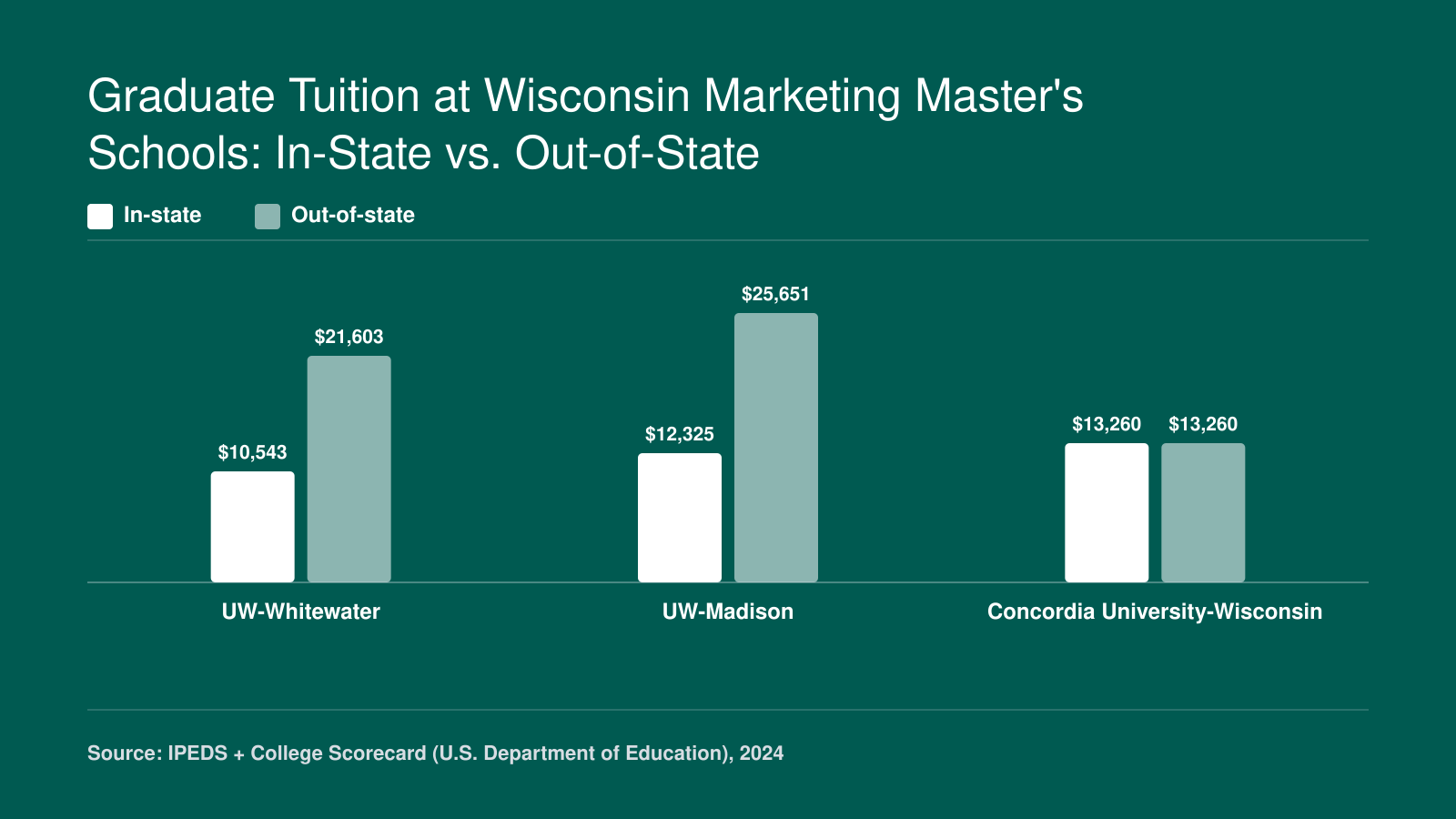
Graduate Tuition at Wisconsin Marketing Master's Schools: In-State vs. Out-of-State
These are annual published graduate tuition and fees, not the total cost of a degree, so multiply by the years or credits your program requires. Public universities charge residents less than nonresidents, while Concordia University-Wisconsin, as a private school, typically charges one rate regardless of residency.
What a Master's in Marketing Costs in Wisconsin and Which Certifications Add Value
The central tradeoff is online flexibility versus the aid package that actually lowers net price, an emphasis in our Most Affordable Master's in Marketing Programs ranking. UW-Whitewater's online MS in Marketing totals 30 credits at $722 per credit for 2026-27, about $21,660 before fees and books. Selected full-time students in good standing can apply for 50% assistantships working 14 to 20 hours per week, with a 2025-26 nine-month salary near $11,200 and possible nonresident tuition remission. Employer reimbursement, federal loans, and Minnesota reciprocity are also worth checking. UW-Madison's marketing master's is PhD-track, carrying 30 credits and listed annual tuition of $10,006 in state or $40,506 out of state, though how that annual figure maps to the degree should be confirmed.
Wisconsin requires no state license to practice marketing. Certifications are voluntary. HubSpot and Google Analytics credentials are typically free or low-cost. The AMA's Professional Certified Marketer is more formal; its exam and renewal fees vary by membership status, so verify current pricing.
The American Marketing Association's Professional Certified Marketer credential isn't a one-and-done exam: holders must renew every three years by completing 30 to 40 continuing education units, depending on the specialty track, and paying a $75 renewal fee.
Career and Salary Outcomes for Wisconsin Marketing Master's Graduates
University of Wisconsin-Madison's marketing master's graduates report median earnings of $117,372 one year after finishing, $166,668 four years after finishing, and $165,191 five years after finishing. The one-year figure is a useful near-term signal: a new marketing master's graduate can earn a six-figure salary in Wisconsin or the wider Midwest. For context, the university's median graduate debt across all fields is $20,484, not specific to marketing, but it suggests a typical borrower's monthly payment would be modest relative to these earnings. That spread between earnings and typical debt is the practical ROI question. Is a master's in marketing worth it? At programs with strong published earnings like UW-Madison, the answer is generally yes if you keep net price low, borrow conservatively, and choose in-state tuition when possible. Before enrolling elsewhere, ask for similar earnings disclosures and compare them against your expected debt.
How We Rank Wisconsin Master's in Marketing Schools
Marketing master's programs promote career results far more often than they publish them, so we lean on federal data instead. Rankings draw on IPEDS and College Scorecard figures: graduate tuition, average net price, institution-wide graduation rate, and program-level earnings and debt when programs report them. We weigh these factors qualitatively rather than using fixed percentages.
Treat the results with some caution. Net price averages across the whole institution, not marketing students alone. Graduation rates cover the whole university, not one program. Some programs have no published earnings, so those schools are compared on the measures that do exist.
Frequently Asked Questions About Master's in Marketing Programs in Wisconsin
Which Wisconsin universities offer a master's in marketing?
How much does a master's in marketing cost in Wisconsin?
Can I apply to a marketing master's without an undergraduate business degree?
Should I choose a digital marketing focus or a general marketing master's?
Compare Marketing programs on the data that matters
Explore more Business & Management specializations or browse every graduate field.
All Business & Management programs