Best Master's in IT Management Programs
Compare 200+ accredited Information Technology Management programs, with graduate earnings, cost, debt, and completion data from IPEDS and the U.S. College Scorecard.

Institution-wide net price for the schools ranked here runs from $12,116 at Georgia Tech to $40,815 at Georgetown, a gap of more than $28,000 before anyone compares curricula.
That spread is the central problem for anyone weighing an IT management master's. Programs differ in length, format, and focus, yet many rankings sort them by reputation rather than by what students pay. Federal data lets you compare cost directly, though program-level graduate earnings are published for only some programs.
A higher price does not guarantee a stronger payoff. Several public universities here cost far less than private peers, and prestige alone is a poor predictor of value.
Key Points
- BLS projects computer and information systems manager jobs to grow 16% from 2025 to 2035.
- Federal data does not yet publish program-level earnings, so school-wide figures are not treated as program results.
- California Baptist University offers a 12-month on-campus path and a 20-month online part-time option.
The 2027 Ranking: Top 10 Master's in IT Management Programs
This ranking compares master's in IT management programs on the numbers that shape your return on investment: tuition and net price, graduate earnings, debt, and completion rates. Instead of leaning on prestige or opinion surveys, we use federal data to show which schools deliver career value.
Georgia Institute of Technology
#1Atlanta, GA · ~$16,000/yr (est.)
Best for: Engineering and CS undergraduates seeking accelerated master's
Georgia Tech's Scheller College offers a Master of Science in Management with an Information Technology Management concentration that pairs core business training with deep IT strategy coursework. The on-campus, AACSB-accredited program spans 30 credits and includes a BSMS option for engineering and computer science undergraduates to double-count up to six credits. It is designed for both career-focused students and those considering doctoral study.
- AACSB-accredited program at Scheller College
- 30 total credit hours
- 7 concentration options
- BSMS option for engineering and CS undergrads to double-count up to six credits
- All courses completed for letter grade
- Concentration chosen with academic advisor
Columbia University in the City of New York
#2New York, NY · ~$58,000/yr (est.)
Best for: Career switchers wanting New York City residencies
Columbia University's School of Professional Studies offers a Master of Science in Technology Management that blends technology strategy, digital transformation, user-centric design, and emerging technologies such as AI, machine learning, and blockchain. Students can choose in-person study on the Morningside campus or a synchronous online format with two required in-person residencies in New York City. The STEM-designated program offers full-time and part-time options and is accepting applications for a spring 2027 start.
- 36 total credit hours
- Full-time and part-time options
- Synchronous online classes or in-person on campus
- Two in-person New York City residencies required for online students
- STEM-designated, F-1 visa eligible
- Four pillars: technology strategy, digital transformation, user-centric design, emerging tech
- Spring 2027 intake now accepting applications
Carnegie Mellon University
#3Pittsburgh, PA · ~$51,000/yr (est.)
Best for: Working IT professionals needing online part-time study
Carnegie Mellon's online Master of Science in Information Technology with an IT Management concentration prepares working professionals to lead at the intersection of technology and business. The part-time, fully online program covers core areas such as database management, telecommunications, and IT project management, with electives in cybersecurity, cloud computing, blockchain, and digital transformation. Pittsburgh-based students can cross-register for additional CMU courses.
- Fully online, part-time program
- Core courses in database management, telecommunications, and IT project management
- Electives in cybersecurity, cloud computing, blockchain, and digital transformation
- Designed for working professionals
- Pittsburgh students may cross-register for other CMU courses
University of Virginia
#4Charlottesville, VA · ~$24,000/yr (est.)
University of Virginia's one-year hybrid M.S. in the Management of Information Technology is built for working professionals who want to lead technology-driven change. The curriculum integrates digital transformation, enterprise architecture, business strategy, and product/project management with a focus on applying AI and machine learning. Students attend monthly in-person residencies in Arlington, VA, and complete online coursework between sessions, with dedicated career services and a diverse professional cohort.
- Complete in one year
- Monthly in-person residencies in Arlington, VA
- Work experience required
- 19% average salary increase reported
- 30% of graduates promoted
- 4 concentration options
- Tailored career guidance provided
University of Washington-Seattle Campus
#5Seattle, WA · ~$19,000/yr (est.)
University of Washington's STEM-designated Master of Science in Information Management develops data-driven leaders who can use information to set organizational goals and improve productivity. Offered online or on campus, the interdisciplinary program spans 36 to 65 credits and typically takes one to two years full-time. It is housed in a top-ranked iSchool and emphasizes ethics and social impact.
- STEM-designated MSIM curriculum
- 36 to 65 total credit range
- Online or residential format
- GRE required, waiver available for eligible students
- QS #1-ranked iSchool in the U.S.
- Data-driven, socially conscious leadership focus
Georgetown University
#6Washington, DC · $60,000 – $65,000/yr (est.)
Georgetown University's Master of Professional Studies in Information Technology Management blends technology with business essentials such as accounting, communications, and financial analysis. Students choose from four concentrations: AI and Digital Technology, Business Intelligence, Cybersecurity, or Project Management. Offered on campus or online with mostly asynchronous classes, the 30-credit program can be completed in two to five years and lets students earn a graduate certificate along the way.
- 30 total credit hours
- 4 concentrations: AI, Business Intelligence, Cybersecurity, Project Management
- No GRE or GMAT required
- No minimum GPA required
- On-campus or online with mostly asynchronous courses
- Earn a master's plus graduate certificate
- Faculty include CIOs and IT directors
The University of Texas at Austin
#7Austin, TX · ~$12,000/yr (est.)
The University of Texas at Austin's McCombs School offers a 10-month, full-time Master of Science in Information Technology and Management for early-career professionals and recent graduates. The STEM-designated program blends hands-on AI and cloud engineering with applied business strategy, including generative AI, cloud-native development, and cybersecurity. A required capstone project pairs students with corporate partners, and the small cohort is located in Austin's tech hub.
- 10-month full-time program
- Cohort-based with summer start
- Test optional (GRE/GMAT not required)
- STEM-designated
- Capstone project with company partners
- Median starting salary for Class of 2025: approximately $110,000
- Graduates work at Google, Deloitte, Salesforce
Washington University in St Louis
#8St. Louis, MO · ~$65,000/yr (est.)
Washington University in St. Louis offers a STEM-designated Master of Information Systems Management through the Sever Institute at McKelvey School of Engineering. The 30-unit program covers IT governance, architecture, infrastructure, data management, risk, and cybersecurity, with courses taught by practicing industry executives. Students can choose full-time or part-time schedules, with part-time enrollment for domestic students, and customize electives to match career goals.
- 30 credit hours / 10 courses
- STEM-designated
- On-campus only; full-time and part-time options (part-time for domestic students)
- Courses taught by practicing industry executives
- Customizable electives
- Covers cybersecurity, data strategy, and IT governance
Purdue University
#9West Lafayette, IN · ~$10,000/yr (est.)
Purdue University's fully online Master of Science in Computer and Information Technology with an IT Project Management concentration prepares working professionals to lead complex technology initiatives. The curriculum aligns with PMI standards and offers preparation for the Project Management Professional certification, with courses delivered in flexible eight-week formats. The 34-credit program requires at least one year of IT experience and allows stackable graduate certificates to transfer into the master's.
- 34 total credit hours
- 100% online with rolling eight-week courses
- Aligned with PMI standards; PMP certification prep offered
- Minimum one year IT experience required
- 3.0 minimum GPA and two recommendation letters
- Stackable graduate certificates available
- 24-month typical completion
New York University
#10New York, NY · ~$43,000/yr (est.)
NYU Tandon's Management of Technology, M.S. with a concentration in Technology Management and Innovation is designed for professionals who want to lead with technology rather than just build it. The STEM-designated on-campus program blends MBA-style courses in finance, marketing, and organizational leadership with tech-focused training in IT governance, data analytics, and product development. Evening classes accommodate working professionals, and the curriculum includes a capstone project.
- One and a half years, full-time or part-time
- Evening classes Monday through Thursday
- STEM-designated
- Capstone project required
- Blends MBA-style business courses with technology training
- Optional global start in Shanghai or London
- Elective tracks in Data Analytics and Project Management
Cost & outcomes by school
Federal data for the highest-earning Information Technology Management programs, independent of the ranking above. Earnings are this field's master's graduates four years after completing, where the Scorecard reports them.
| School | Earnings | Tuition / yr | Debt | Grads/yr | Format |
|---|---|---|---|---|---|
| University of North Carolina at Charlotte NC | $158,814 | $8,037 | $20,500 | 48 | Campus |
| Fordham University NY | $150,150 | $26,752 | $29,139 | 31 | Campus |
| Florida Institute of Technology FL | $144,218 | $24,320 | — | 10 | Hybrid |
| Western Governors University UT | $144,205 | $9,320 | $11,526 | 1,484 | Online |
| Fort Hays State University KS | — | $4,949 | — | — | Online |
| Midway University KY | — | $5,650 | — | — | Online |
| Wayne State College NE | — | $5,784 | — | — | Online |
| University of the Potomac-Washington DC Campus DC | — | $5,850 | — | — | Hybrid |
| University of the Potomac-VA Campus VA | — | $5,850 | — | — | Hybrid |
| Navajo Technical University NM | — | $6,520 | — | — | Online |
| Florida Atlantic University FL | — | $6,693 | — | — | Hybrid |
| New Mexico State University NM | — | $6,605 | — | — | Online |
Sources: U.S. Department of Education. Tuition and graduates: IPEDS. Earnings and debt: College Scorecard, this field's master's graduates; a dash means no figure is reported.
Cost, debt & payoff
Median earnings of this field's master's graduates (4 yrs after completing) vs. their median federal loan debt · U.S. College Scorecard
Across these programs the median graduate earns about $98,477 and finishes with roughly $53,674 in debt — a ratio that clears a common rule of thumb (keep debt below first-year salary). Tuition and debt vary widely school to school, so check the per-school figures in the table above before you shortlist.
How We Rank: Federal Data on Cost, Earnings, and Debt
Where do the cost and salary numbers in this ranking come from, and how far can you trust them? They come from two federal sources, and every figure is something you can check yourself.
The Federal Sources
IPEDS, the Integrated Postsecondary Education Data System, supplies tuition, net price, and the number of degrees each school awards. The College Scorecard supplies program-level earnings and federal debt, reported by field of study and credential level. That means a master's in information technology management is measured on its own, not blended with a school's other programs, including an MBA in Management Information Systems.
Why Program-Level Earnings Matter
A school-wide salary figure mixes nurses, English majors, and engineers into one number. It says little about what an IT management graduate earns. Program-level earnings are measured one, two, four, or five years after completion, depending on the program and what has been published. Some programs show no figure at all. Earnings are withheld when a graduating class is too small to report without identifying individuals, so a missing number is not a warning sign. It means the data is not public.
Caveats to Keep in Mind
- Net price: This is an institution-wide average after grants and scholarships, not a master's-specific cost, so your own bill may differ.
- Graduation rate: It covers the whole institution, not this particular degree.
- Earnings windows: They vary by program, so compare one-year figures with one-year figures, not with five-year ones.
What We Left Out
Prestige surveys, peer reputation scores, and marketing claims such as "top-ranked" or "career-ready" play no part here. None of them can be verified against public records, and a bigger name does not guarantee a better return on your tuition, a caution that also runs through the Best MBA Programs.
How to Use the Ranking
Shortlist by format and cost first: online, hybrid, or on campus, and what you can realistically pay. Then compare earnings and debt among the programs that fit. A lower-priced program with solid published outcomes will often serve you better than a famous name that costs far more.
IT Management Master's Tuition: Sticker Price vs. Net Price
Sticker tuition tells only part of the story. The table below lists the in-state and out-of-state graduate tuition, average net price after aid, and delivery format for each program shown here; net price is an institution-wide average after grant aid, not a personal quote, and graduate students often receive less grant aid than undergraduates, so your actual cost may be higher. Several online programs charge a flat per-credit rate regardless of residency, which can erase the in-state vs. out-of-state gap, and employer tuition assistance can further change the math for working IT professionals.
| School | Program | In-State Graduate Tuition | Out-of-State Graduate Tuition | Net Price | Format |
|---|---|---|---|---|---|
| California State University-San Bernardino | Master of Science in Information Systems Technology | $9,612 | $19,692 | $4,564 | Campus |
| Florida International University | Master of Science in Information Technology | $11,334 | $24,439 | $9,288 | Campus |
| Georgia Institute of Technology | Master of Science with a Major in Management | $15,962 | $32,144 | $12,116 | Campus |
| University of Washington-Seattle Campus | Master of Science in Information Management | $18,792 | $32,811 | $14,091 | Hybrid |
| Purdue University | MS in Computer and Information Technology | $9,992 | $28,794 | $14,600 | Online |
| Arizona State University | Information Technology, MS | $13,587 | $27,521 | $14,967 | Online |
| University of Oklahoma | Management of Information Technology | $9,353 | $26,142 | $15,300 | Campus |
| University of North Carolina at Charlotte | Information Technology, M.S. | $8,037 | $23,072 | $15,435 | Campus |
| Strayer University-Florida | Master of Science in Information Systems | $15,135 | $15,135 | $16,064 | Online |
| Indiana University-Bloomington | Master of Science in Information Technology Management | $11,756 | $33,454 | $16,264 | Hybrid |
Related Articles
Admission Requirements and Accreditation Checklist
Requirements vary by school, so confirm each detail on the program's own admissions page before you apply. These are the patterns we see across the programs here.
- Bachelor's degree and GPAMost programs want a bachelor's degree from a regionally accredited institution, and many accept any major. A 3.0 is the most common benchmark, often measured over your last 60 credits. Georgetown recommends a 3.0 but sets no minimum. Oakland sets no single cutoff.
- GRE/GMATTest requirements are loosening. Florida Atlantic's online program, Central Washington, and Georgetown don't require a test, and UT Austin McCombs makes it optional. Florida Atlantic's traditional program and Auburn offer waivers. Typical triggers are a strong GPA, work experience, or a prior graduate degree.
- Technical prerequisitesNon-IT majors are admitted at many schools. Some add foundation work. University of Wisconsin Extended Campus expects knowledge of object-oriented programming, databases, and networking, though certifications or experience may substitute. Webster expects a business-related degree or bridge coursework.
- Work experienceExpectations run from none to several years. Florida Atlantic's online program counts four years of professional experience among its criteria. Auburn desires it. Central Washington sets no minimum.
- Accreditation to verifyConfirm regional accreditation of the institution first. For business-school programs, look for AACSB; Georgia Tech lists it. Webster cites ACBSP. We did not find ABET accreditation listed for these programs.
- Application materialsExpect a resume, a statement of purpose, transcripts, and recommendations. Georgetown asks for two letters.
The Bureau of Labor Statistics projects employment of computer and information systems managers to grow 16% from 2025 to 2035, much faster than the average for all occupations, with about 53,500 openings expected each year over the decade.
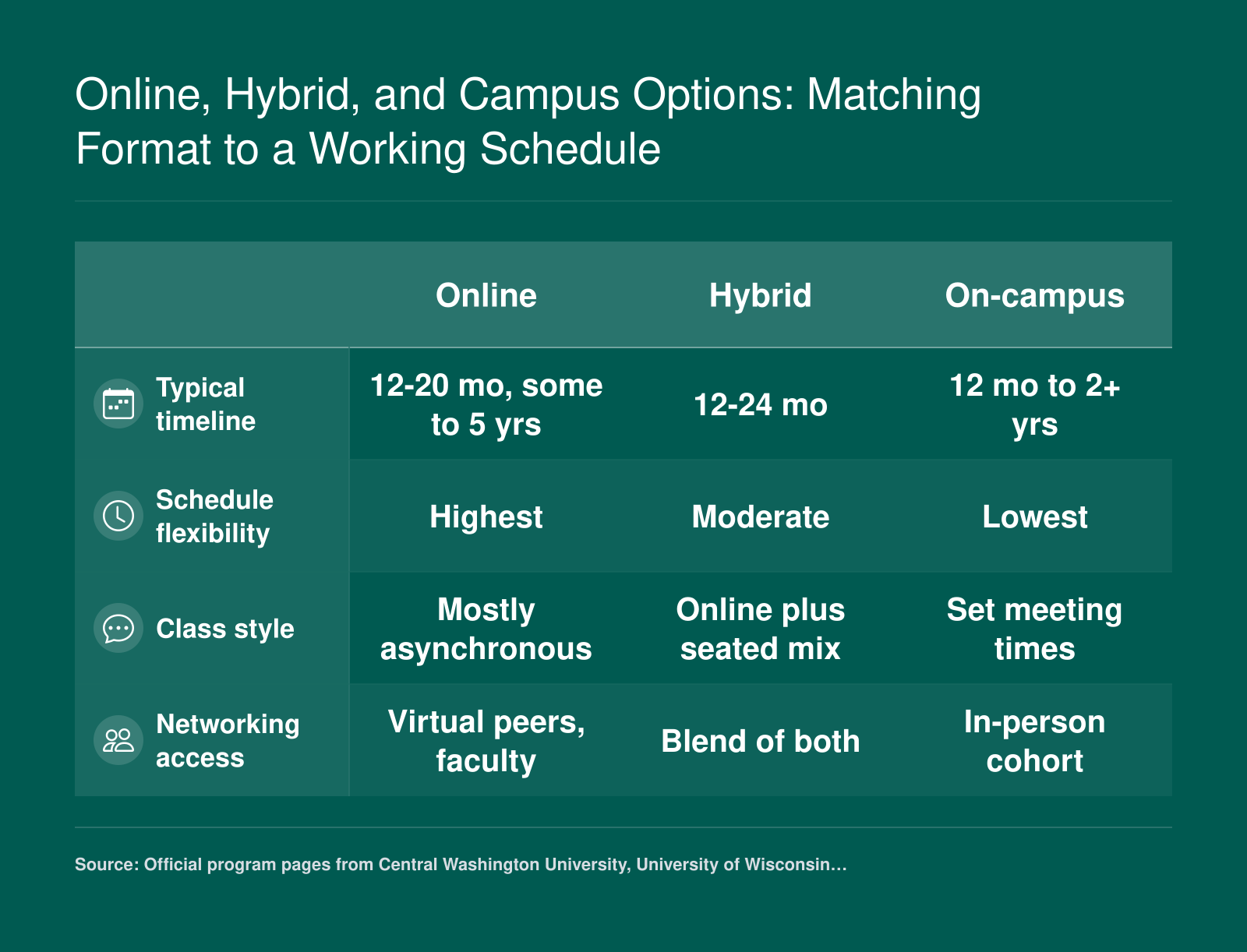
Online, Hybrid, and Campus Options: Matching Format to a Working Schedule
Most of the programs here are offered online or in both online and campus formats, and several publish accelerated tracks. California Baptist University lists a 12-month on-campus option and a 20-month online part-time path, while North Carolina Wesleyan University runs 12-18 months in 8-week terms. Stackable options can also break up the commitment: University of Wisconsin Extended Campus lets you finish one of three graduate certificates in about a year before the capstone, and Georgetown pairs its master's with a certificate in cybersecurity, business intelligence, or program management. For a full-time IT professional, a mostly asynchronous online program is the best fit; choose hybrid only if you value seated networking and can commit to set meeting times.
MBA vs. MS in IT Management: Which Degree Fits Your Career Path?
The choice between an MBA with an IT management concentration and a Master of Science in Information Technology Management usually comes down to breadth versus depth: broad business leadership versus specialized technical and systems management.
Curriculum Balance: Business Core vs. Technical Depth
An MBA with an IT management concentration typically balances accounting, finance, organizational behavior, and strategy with technology-focused electives. An MS in Information Technology Management inverts that formula, emphasizing IT governance, infrastructure, cybersecurity, data, and project delivery with fewer general business courses. The distinction is not absolute; both can adjust electives and projects.
Credit Hours, Length, and Admissions
Credit totals vary by school. Standalone MS programs often fall between 30 and 36 credits. Golden Gate University's MS in IT Management is 30 credits, while Rivier University's MBA in Information Technology Management is 36 credits and can take about 12 to 24 months. Many business schools hold AACSB accreditation for both degree types, but verify each program.
Admissions are not uniform: - MBA: Programs often welcome varied undergraduate backgrounds and may weigh work experience, essays, and test policy. Specific GMAT or work requirements vary by school. - MS: Golden Gate requires no GMAT or GRE but expects three years of relevant work experience or technical coursework.1 University of Wisconsin-Milwaukee lists GMAT.3 UT Dallas lists a 3.0 GPA expectation.4 Webster lists a 3.0 GPA expectation and also requires a business-related bachelor's degree and about 17 credits of prerequisite coursework.
Career Paths and Employer Perception
Typical MBA paths lean toward enterprise roles such as IT director, IT vice president, or general management with technology oversight. Typical MS paths lean toward IT project manager, systems manager, infrastructure manager, cybersecurity leader, or technical program manager. A Master of Science in Information Systems is a third adjacent option for readers comparing online master's in management information systems programs, with a stronger systems-analysis and data emphasis.
Employer perception is harder to pin down. Available university descriptions position the MBA for broad business-technology management and the MS for IT-business leadership, but published hiring-preference data is thin. Treat broad claims about employer preference cautiously.
Which Degree Should You Choose?
Choose the MBA IT route if you are moving toward enterprise leadership, budgeting, organizational management, consulting, or a future CIO track. Choose the MS in IT Management if you are a technologist who wants to manage technical teams and deepen knowledge in cybersecurity, infrastructure, data, Business Analytics, cloud, or digital platforms. The right fit depends on the specific course list, projects, and recruiter relationships, not just the degree name.
Specializations and Hands-on Experience: Cybersecurity, Analytics, Cloud, and AI
A specialization (or concentration) is a cluster of courses inside an IT management master's that lets you go deeper in one area, such as security or data analytics, on top of the shared core in strategy, project delivery, and enterprise systems. Programs structure this very differently, so read the curriculum, not just the marketing page.
What the Ranked Programs Actually Offer
Georgetown names four formal concentrations: AI and Digital Technology, Business Intelligence, Cybersecurity, and Project Management. Purdue's online program lists three concentration options, including IT Project Management, and Georgia Tech offers seven, chosen with an academic advisor. NYU frames its options as elective tracks in Data Analytics and Project Management. Columbia's Technology Management curriculum covers AI and other emerging tools in a dedicated course but does not call them formal concentrations.1
Outside this list, the pattern holds. Oakland University offers an optional Cybersecurity Analytics and Management concentration that appears on the transcript. East Tennessee State asks you to pick a concentration when you apply, including Cybersecurity Management and Data Analytics.2 Purdue Global's MS in Cybersecurity Management lists optional concentrations in AWS Cloud Technologies, Artificial Intelligence, Project Management, and Data Analytics.3
What Each Track Prepares You For
- Cybersecurity management: Builds toward leading security programs, managing risk, and translating threats into budget and policy decisions.
- Data analytics: Prepares you to run business intelligence teams and turn data into decisions for executives.
- Cloud: Focuses on migration planning, architecture tradeoffs, and vendor management for cloud infrastructure.
- AI and emerging technology: Centers on evaluating, governing, and deploying AI tools responsibly, not building models from scratch.
Capstones, Practicums, and Internships
Applied work is where career changers gain credibility. Carnegie Mellon's full-time MISM requires both an internship and a capstone project.4 Columbia requires a capstone built around a real-world challenge, with sponsors that vary by semester; its internship is an optional elective.1 UT Austin and NYU both require a capstone, and UT Austin's is completed with company partners. East Tennessee State's capstone is six credits drawn from one of three sequences2, while Golden Gate University requires a capstone and keeps its internship optional.5
If you lack IT work experience, favor programs with a required internship or a sponsored client project. If you already work in tech, a capstone tied to your current employer may serve you better.
Match Depth to Your Target Role
A single course titled "AI Strategy" will not qualify you for an AI governance role. Count how many courses a track actually requires, check whether the concentration appears on your transcript, and compare that depth to job postings for the role you want. A focused concentration in one area usually beats a scattering of trendy electives.
Information Technology Management programs by state
Frequently Asked Questions About IT Management Master's Programs
These answers draw on federal labor data and program-level information from the schools covered in this guide. Outcomes vary by institution, so check cost and earnings for any specific program before you commit.
Is a master's in IT management worth it?
What can you do with a master's in information technology management?
What is the difference between a master's in IT management and a master's in information systems?
Do I need a computer science or IT background to get into an IT management master's program?
Can I keep working full-time while earning a master's in IT management?
Compare Information Technology Management programs on the data that matters
Explore more Business & Management specializations or browse every graduate field.
All Business & Management programs