Best Master's in Communication Disorders Programs
Compare 330+ accredited Communication Disorders programs at 290+ schools, with graduate earnings, cost, debt, and completion data from IPEDS and the U.S. College Scorecard.

A master's degree in communication sciences and disorders is the required entry point to practicing as a speech-language pathologist. ASHA certification and state licensure both depend on a graduate degree that includes at least 400 supervised clinical hours. That makes program choice a financial decision as much as an academic one: sticker prices among the schools here run from under $7,000 a year to well over $60,000.
The programs below span campus, hybrid, and online delivery, and they differ sharply in clinical placements, thesis requirements, and cost to the student.
Two programs with the same CAA accreditation can leave a graduate with very different debt, and the licensure exam and certification standards are identical for both.
Key Points
- Graduation rates shown for each school are institution-wide, not specific to the speech-language pathology program.
- Program-level earnings are not yet published, so compare net price and debt instead of guessing at pay.
- Every format, online included, requires at least 400 supervised clinical hours before the Clinical Fellowship begins.
The 10 Best Speech-Language Pathology Graduate Programs for 2027
These programs combine strong institution-wide graduation rates with SLP-specific clinical training and federal earnings outcomes. We flag online and hybrid delivery so working students can find flexible options quickly, while campus programs emphasize hands-on practicum hours and licensure preparation.
Columbia University in the City of New York
#1New York, NY · ~$58,000/yr (est.)
Best for: Research-minded students wanting New York clinical placements
Columbia University's Teachers College program is a rigorous, campus-based master's in communication sciences and disorders. The 55-credit curriculum spans speech, language, hearing, literacy, bilingualism, and swallowing, with access to New York City's diverse clinical populations. Graduates are prepared for New York State licensure and careers in schools, hospitals, and private practice.
- Council on Academic Accreditation of ASHA accredited
- 55-credit, two-year full-time curriculum
- Campus-based in New York City
- Prepares for New York State SLP licensure
- Covers bilingualism and swallowing disorders
University of Virginia
#2Charlottesville, VA · ~$24,000/yr (est.)
Best for: Career changers needing two curriculum paths
The University of Virginia offers a full-time, in-person M.Ed. in communication sciences and disorders with a strong clinical sequence. Students follow either the Blue Path for those with a CSD background or the Orange Path for career changers, then complete three external placements and a full-time internship. The program's small cohort and on-campus clinic support a direct path to ASHA certification and the Praxis exam.
- CAA-ASHA accredited master's program
- 68 credits over five semesters
- Blue Path and Orange Path admission tracks
- Clinical training at on-campus Sheila C. Johnson Center
- Three external placements plus full-time internship
- Prepares for ASHA certification and Praxis
Florida State University
#3Tallahassee, FL · ~$11,000/yr (est.)
Best for: Working professionals needing online hybrid flexibility
Florida State University stands out for its part-time, online hybrid master's in communication science and disorders. The 61-credit program combines fully online classes with community-based clinical practicum sites across Florida, making it a strong fit for working students. A separate campus format offers in-person clinical placements and no GRE requirement.
- CAA-ASHA accredited program
- 61 credits in part-time online hybrid format
- Fully online classes with in-person clinical practicum
- Clinical sites across Florida
- Addresses speech-language pathologist shortage
- No GRE required
- Apply by January 15 for fall start
- 3.0 GPA minimum and three recommendation letters
- Hands-on clinical experience and full-time internship
- Small class sizes and community placements
University of Florida
#4Gainesville, FL · ~$13,000/yr (est.)
The University of Florida's master of arts in communication sciences and disorders is a campus-based SLP program with strong outcomes. Students complete 400 clinical hours in small cohorts of 25 to 30, and the program reports a 98% Praxis pass rate and 97.7% job placement. A thesis track is available for students interested in research.
- Council on Academic Accreditation in Audiology and Speech-Language Pathology accredited
- 93 credits over five semesters
- 400 clinical practicum hours
- 98% Praxis pass rate and 97.7% job placement
- Class sizes of 25 to 30 students
- Thesis track available
Brigham Young University
#5Provo, UT · $5,000 – $10,000/yr (est.)
Brigham Young University offers an affordable, faith-based master of science in communication disorders. The 63-credit campus program combines coursework, clinical practicum, and a required thesis, with placements in schools and hospitals. Applicants should note the ecclesiastical endorsement requirement in addition to standard prerequisites.
- CAA-ASHA accredited program
- 63 credits with required thesis
- Clinical practicum in schools and hospitals
- Cohort-based full-time campus format
- Ecclesiastical endorsement required
- Prepares for ASHA Praxis and SLP licensure
Northwestern University
#6Evanston, IL · ~$55,000/yr (est.)
Northwestern University's MS in speech, language, and learning is a campus-based professional program in speech-language pathology. Students train in the on-campus center for audiology and speech-language learning and learn from research-active faculty. Graduates pursue clinical certification and state licensure in medical, educational, or private practice settings.
- Campus-based in Evanston, Illinois
- Professional program in speech-language pathology
- Clinical experience at on-campus center
- Prepares for clinical certification and state licensure
- Research-university faculty in communication sciences
The University of Texas at Austin
#7Austin, TX · ~$12,000/yr (est.)
UT Austin's master of science in speech, language, and hearing sciences emphasizes bilingual, Spanish-English, and family-focused approaches. The program includes clinical practicum placements and options for a bilingual certificate or thesis specialization. Graduates are prepared to serve diverse populations in schools, hospitals, and clinics.
- CAA-ASHA accredited program
- Bilingual certificate in Spanish/English available
- Thesis specialization option
- Two concentration options
- Full-time campus format in Austin
- Prerequisite courses required
University of Wisconsin-Madison
#8Madison, WI · ~$12,000/yr (est.)
The University of Wisconsin-Madison offers a two-year MS in communication sciences and disorders with separate speech-language pathology and normal aspects tracks. The SLP track is CAA-accredited and reports a 100% Praxis pass rate, while the normal aspects track supports students aiming for doctoral study. No GRE is required, and students without a CSD background can complete prerequisites through the Capstone Program.
- 50 credits, two-year professional program
- No GRE required
- 3.0 GPA minimum and three recommendations
- Prerequisites available via Capstone Program
- Two concentration options
- CAA-ASHA accredited SLP track
- Prepares for ASHA CCC
- Qualifies for Wisconsin SLP license
- Teacher certification through Wisconsin DPI
- Clinical experiences on and off campus
- 2-year program for PhD preparation
- CAA-ASHA accredited
- Scholarships available
- Focus on normal communication processes
Boston University
#9Boston, MA · $65,000 – $70,000/yr (est.)
Boston University's MS in speech-language pathology is a full-time campus program with extensive clinical practica. The 68-credit curriculum includes voice, aphasia, dysphagia, autism, and motor speech disorders, and culminates in a capstone exam or thesis. Graduates are prepared for ASHA certification and roles in hospitals, schools, and rehabilitation centers.
- CAA-ASHA accredited program
- 68 credits over four semesters plus summer
- Clinical practica in healthcare, school, and community settings
- Capstone comprehensive exam or thesis
- Full-time campus study in Boston
University of Georgia
#10Athens, GA · ~$11,000/yr (est.)
The University of Georgia's M.Ed. in communication sciences and disorders is a full-time, two-year campus program with a strong telehealth and community outreach component. Students complete more than 400 clinical clock hours and two full-time internships in school and medical settings. The program begins with two online summer courses, making the transition easier for incoming students.
- ASHA CAA accredited program
- Full-time two-year cohort model
- More than 400 clinical clock hours
- Starts with two online summer courses
- Internships in school and medical settings
- No thesis or capstone required
Cost & outcomes by school
Federal data for the highest-earning Communication Disorders programs, independent of the ranking above. Earnings are this field's master's graduates four years after completing, where the Scorecard reports them.
| School | Earnings | Tuition / yr | Debt | Grads/yr | Format |
|---|---|---|---|---|---|
| California State University-Los Angeles CA | $101,094 | $8,688 | $40,968 | 23 | Campus |
| California Baptist University CA | $97,691 | $15,562 | $71,464 | 27 | Campus |
| San Francisco State University CA | $95,402 | $9,370 | $35,880 | 34 | Campus |
| California State University-East Bay CA | $93,943 | $9,107 | $39,757 | 26 | Campus |
| California State University-Sacramento CA | $91,632 | $9,542 | $33,556 | 39 | Campus |
| CUNY Hunter College NY | $91,520 | $11,398 | $41,000 | 18 | Campus |
| California State University-Fullerton CA | $90,382 | $8,994 | — | 34 | Campus |
| California State University-San Marcos CA | $88,196 | $9,606 | $70,750 | 28 | Campus |
| San Diego State University CA | $87,991 | $10,252 | $38,020 | 36 | Campus |
| University of Redlands CA | $87,942 | $25,172 | $79,953 | 22 | Campus |
| CUNY Lehman College NY | $86,743 | $11,570 | $38,404 | 3 | Campus |
| California State University-Long Beach CA | $86,502 | $8,898 | $21,738 | 47 | Campus |
Sources: U.S. Department of Education. Tuition and graduates: IPEDS. Earnings and debt: College Scorecard, this field's master's graduates; a dash means no figure is reported.
Cost, debt & payoff
Median earnings of this field's master's graduates (4 yrs after completing) vs. their median federal loan debt · U.S. College Scorecard
Across these programs the median graduate earns about $66,310 and finishes with roughly $41,000 in debt — a ratio that clears a common rule of thumb (keep debt below first-year salary). Tuition and debt vary widely school to school, so check the per-school figures in the table above before you shortlist.
What Puts a Communication Disorders Program on This List
Glossy viewbook or federal record: one shows you modern clinic suites and smiling cohorts, the other shows what students actually paid and what graduates went on to earn. So what separates a speech-language pathology program worth the tuition from one that only looks good on a brochure? On mastersprograms.com, outcomes come first, and a famous name earns no credit on its own.
What the Comparison Rests On
The programs below are compared using IPEDS and College Scorecard figures from the U.S. Department of Education rather than marketing claims. That includes:
- Graduate tuition: The published rate for master's-level study, not the undergraduate sticker price, with in-state and out-of-state figures shown separately at public universities.
- Average net price: The cost after grants and scholarships are subtracted, a more honest gauge than tuition alone.
- Earnings and debt: Program-level graduate earnings and median borrowing, where the federal government publishes them.
- Format: Whether a program runs on campus, hybrid, or online, since that shapes where you live during clinical training.
Read the Numbers With These Caveats
Some figures describe the whole university, not the SLP program. Graduation rates and average net price are institution-wide, so a school's strong completion rate doesn't guarantee the same result for its speech-language pathology cohort. Earnings windows also differ by school: one may report earnings shortly after completion while another reports a longer horizon, so compare like with like. For many communication disorders programs, program-specific earnings and debt simply haven't been published yet. Where that's the case, the article says so instead of filling the gap with guesses.
Verify Two Things Yourself
Accreditation through the Council on Academic Accreditation and Praxis exam performance both carry real weight for licensure, and each gets its own section below. Confirm both directly with any program before you submit an application.
Communication Disorders Master's Tuition: Sticker Price vs. What You'll Actually Pay
These figures are annual graduate tuition and required fees, not total program cost; most SLP master's programs run about two years, so plan to roughly double the figure and add clinical expenses such as background checks, liability insurance, and travel to placements. Net price is an institution-wide average after aid, not a graduate-specific quote. The largest in-state/out-of-state premiums among the programs below appear at Florida Atlantic, Central Florida, and Wisconsin, where out-of-state rates run about three and a half times in-state figures; Brigham Young lists the same in-state and out-of-state tuition because of its private structure, and Florida State's hybrid option still separates in-state and out-of-state rates.
| School | Format | Graduate In-State Tuition & Fees | Graduate Out-of-State Tuition & Fees | Net Price |
|---|---|---|---|---|
| CUNY Brooklyn College | Campus | $7,452 | $15,402 | $3,103 |
| University of Florida | Campus | $6,381 | $28,659 | $6,541 |
| California State University-Fullerton | Campus | $7,470 | $20,070 | $6,555 |
| California State University-Northridge | Campus | $7,458 | $20,058 | $7,021 |
| Florida Atlantic University | Campus | $4,879 | $17,324 | $8,752 |
| Florida International University | Campus | $6,565 | $18,964 | $9,288 |
| University of Central Florida | Campus | $6,368 | $22,467 | $10,411 |
| Florida State University | Hybrid | $5,656 | $18,786 | $11,297 |
| University of Georgia | Campus | $11,450 | $31,688 | $13,936 |
| University of Houston | Campus | $9,717 | $22,547 | $14,276 |
| Brigham Young University | Campus | $6,688 | $6,688 | $15,564 |
| University of Wisconsin-Madison | Campus | $11,603 | $42,103 | $17,354 |
| University of Delaware | Campus | $16,810 | $41,400 | $17,799 |
Related Articles
Online, Hybrid, or Campus SLP Programs: Clinical Access, Cost, and Flexibility
The word "online" describes how you take coursework, not how you complete clinical training. Every accredited speech-language pathology master's, regardless of format, must deliver the same supervised clinical education: ASHA requires at least 400 clock hours of supervised clinical practice, including 25 hours of observation. No format waives that number. What changes across online, hybrid, and campus programs is who finds your placement sites, how often you travel, and how much flexibility you actually have.
How the Three Formats Compare
- Clinical placements: On-campus programs typically route students through the university's own clinic and an established local network, so you rarely hunt for a site yourself. Online and hybrid programs vary. Some assist directly: the University of St. Augustine for Health Sciences reports in its Speech-Language Pathology Program Overview that faculty and staff help secure externships, targeting sites within 75 miles of a student's home, and Marymount's online SLP master's clinical placement page says 375 of the 400 hours can be completed near a student's community.
- Residency and immersion: Most online programs still require in-person time. USAHS schedules four on-campus residencies of roughly three days each4; Marymount holds two residencies in Arlington, Virginia5; Misericordia's online SLP master's program offers a summer on-campus option for hours not completed locally; West Coast University runs two weekend clinical intensives1; and Pepperdine lists three onsite immersions2.
- Schedule flexibility: Coursework may be asynchronous, but clinical placements follow professional hours. USAHS reports clinical availability of three to five days per week during standard site hours4, and CSU San Marcos runs final rotations of 14 to 16 weeks at four to five daytime days per week3. Plan around a near-full-time clinical commitment, not a flexible side schedule.
- Cost structure: Campus programs may carry lower in-state tuition but assume you can relocate. Online programs often charge a single rate regardless of residency, with travel to residencies as an added cost.
Who Arranges Placements, and Why It Matters
For students in rural areas or states with enrollment authorization limits, placement responsibility is the detail that can make or break a program. Distance programs must be legally authorized to operate and arrange clinical education in your state, and that authorization varies. Before enrolling, confirm whether the school guarantees placement, merely assists, or expects you to source your own site.
On-campus suits students who can relocate and want a built-in clinic. Hybrid fits those who need coursework flexibility but can travel for residencies. Fully online, program-assisted placement serves students tied to a specific community, provided the school is authorized where you live.
Why CAA Accreditation and the SLP Licensure Compact Should Shape Your Shortlist
Accreditation comes first, not last
If your goal is ASHA's Certificate of Clinical Competence in Speech-Language Pathology, the graduate coursework and clinical practicum you submit must be completed in a program that is CAA-accredited or admitted to CAA candidacy.1 State licensure boards in virtually every state build the same requirement into their rules, so a degree from an unaccredited program can leave you unable to apply for the credential employers expect. Before you invest in applications, confirm the program's status on ASHA EdFind, the official CAA list.2 Search the institution and the specific SLP degree; look for "Accredited" or "Candidate" and review the effective dates and next review year. Do not rely on a university website or a commercial directory, which can lag or summarize status imprecisely.
Candidacy is conditional, not a guarantee
Full accreditation means the program is fully operational and compliant with CAA standards.2 Candidacy means the program has been admitted to the CAA process but has not yet completed it.1 Candidacy can satisfy ASHA certification if your required graduate coursework and practicum are initiated and completed while the program is in candidacy, but it is time bounded.1 A program may convert to accredited or end without accreditation, so check the current window and decide whether you can live with that uncertainty. If a program lists Candidate status with an end date that predates your clinical sequence, that is a real risk.
The licensure compact is live, but rollout is staggered
The Audiology and Speech-Language Pathology Interstate Compact, known as ASLP-IC, had 37 enacted jurisdictions by 2026: 36 states and one territory.3 Privilege-to-practice became operational on October 28, 2025, but the rollout is not uniform. Initial applications were available between Louisiana, West Virginia, Ohio, and Tennessee. By spring 2026, registration was open in those four states and Tennessee was issuing compact privileges.3 Other enacted states are joining as the Compact Commission completes onboarding. For a moving applicant, that can reduce duplicate licensing costs, but it is not yet a single privilege that works in every member state.
State requirements still differ
Even with a compact in place, member states can add their own requirements. School-based credentials often require separate approval from a state education agency, and several states require a jurisprudence exam or another state-specific step before you can practice.3 Read the board rules for your target state rather than assuming compact membership covers everything.
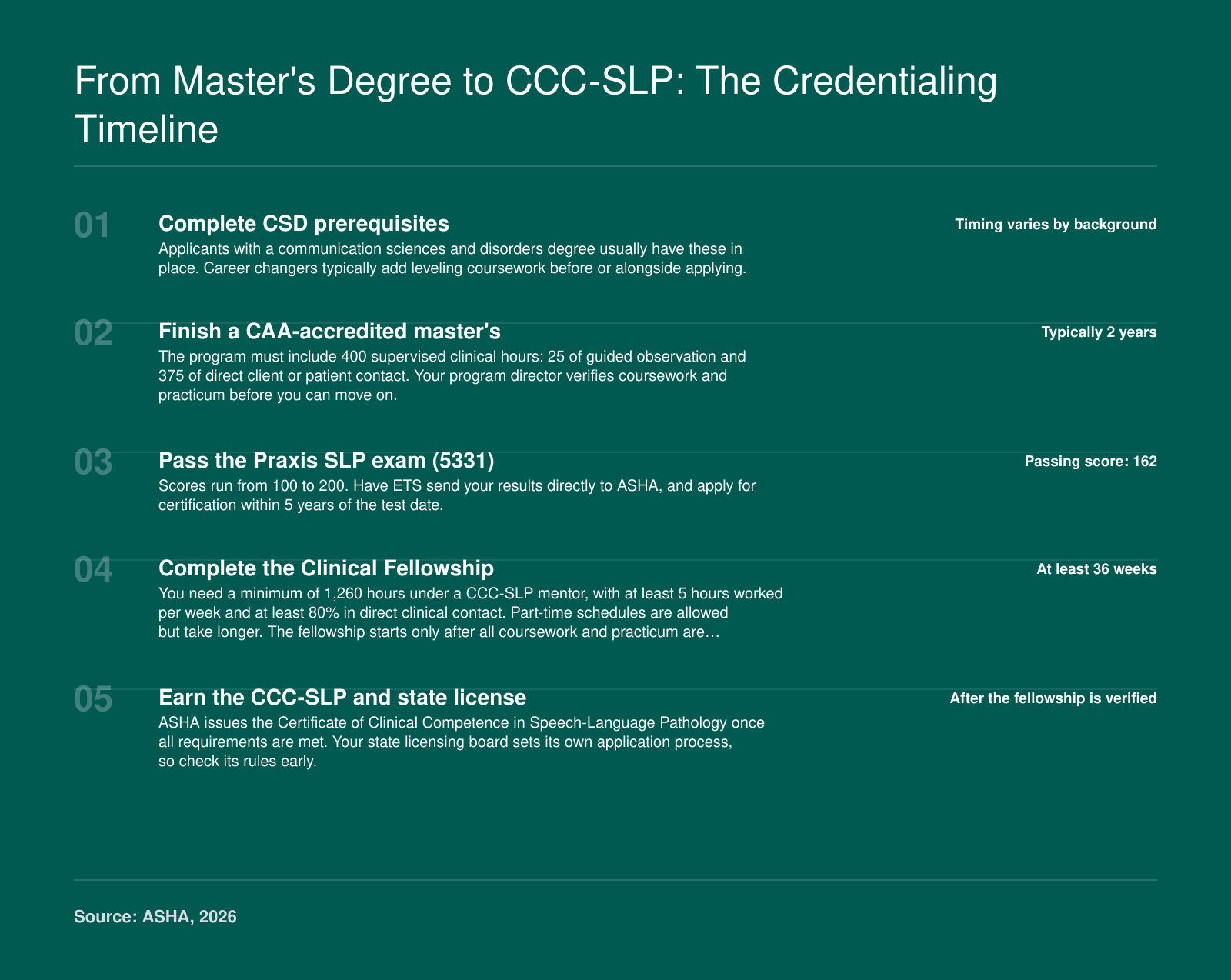
From Master's Degree to CCC-SLP: The Credentialing Timeline
Becoming a certified speech-language pathologist follows a fixed order, and each step depends on the one before it. Most graduates reach full certification about 3 years after starting a 2-year master's program, with the Clinical Fellowship making up much of the added time.
Prerequisites and Leveling Courses for Applicants Without a CSD Degree
If your bachelor's is in another field, you need two kinds of preparation: the science and statistics courses ASHA requires for certification, and CSD foundation courses that most master's programs expect. Exact lists vary by school, so confirm each program's requirements before you enroll in anything.
- ASHA-required foundation coursesASHA expects coursework in four areas: biological science, physical science, social/behavioral science, and a stand-alone statistics course. The physical science must be chemistry or physics. Social/behavioral science is commonly psychology or sociology. Courses must appear on an accredited institution's transcript and cannot be CSD coursework unless they count as a general-education option open to non-majors. For applications on or after August 1, 2027, a research methods course with qualitative and quantitative content may satisfy the statistics requirement. Some programs set their own floor, such as St. Bonaventure University's 3-credit minimum with a grade of C or better.
- Timing rules differ by schoolIdaho State University lets applicants finish biology, physics or chemistry, and psychology or sociology during the program if necessary, but requires statistics before enrollment. Check each program's deadline for every prerequisite.
- Common CSD leveling coursesTypical leveling coursework includes anatomy and physiology of speech and hearing, phonetics, speech and language development, speech science, hearing science, introduction to audiology, introduction to communication disorders, neural bases of communication, and language science. Non-CSD applicants commonly complete six to eight of these foundation courses. Grand Valley State University and Rockhurst University publish their own lists.
- Post-baccalaureate and online leveling optionsA full leveling package usually runs six to ten courses, or roughly 18 to 30 semester credits. Applicants with no CSD background often need the full 30. Missing science or statistics courses can add 3 to 4 credits each. Most plans take one to two years, and accelerated formats with 8-week sessions can compress that to two or three semesters. Online options include Sacred Heart University's online prerequisite series. Rockhurst University offers a post-bachelor's leveling program.
- Extended tracks for career changersSome master's programs fold leveling into the degree itself, creating a longer track, often about three years, for students without a CSD background. Ask admissions whether a program offers one. It can mean a single application and a guaranteed path, though total tuition may be higher than the standard track.
- Guided observation hoursMany programs expect 25 hours of guided clinical observation, completed before enrollment or early in the program. Confirm whether your program accepts hours you arrange yourself or requires them through a supervised course.
Communication Disorders programs by state
Quick Answers Before You Start Your SLP Applications
Most SLP master's programs apply through CSDCAS, the centralized application service, which lets you submit one application to any number of participating programs. Deadlines, fees, funding, and test policies still vary school by school, so treat the figures below as typical examples and confirm each program's current requirements.
When are CSDCAS deadlines for speech-language pathology master's programs, and how early should I apply?
Do SLP graduate programs offer graduate assistantships or tuition waivers?
Do most communication disorders master's programs still require the GRE?
Compare Communication Disorders programs on the data that matters
Explore more Communications & Media specializations or browse every graduate field.
All Communications & Media programs