Best Master's in Communication Disorders Programs in Texas
Compare 23 accredited Communication Disorders programs in Texas at 22 schools, with graduate earnings, cost, debt, and completion data from IPEDS and the U.S. College Scorecard.

Texas requires a master's degree from a program accredited by the Council on Academic Accreditation (CAA) before you can hold a speech-language pathology license, so the program you pick sets your route into practice. Annual tuition runs from roughly $6,150 in-state at public schools to $43,578 at Baylor University.
Campus and online master's programs are ranked together because the same accreditation standard applies to both.
One reality shapes every choice here: cohorts are small, and the top programs admit only a fraction of applicants.
Key Points
- Texas Tech University Health Sciences Center leads, reporting a 100% Praxis pass rate for 18 consecutive years.
- Most programs here are campus-only, and Texas State University states plainly that the GRE is not required.
- Texas licenses SLPs through TDLR, so ASHA certification alone doesn't authorize practice in the state.
Best Master's in Communication Disorders Schools in Texas: 2027 Ranking
Texas Tech University Health Sciences Center in Lubbock leads this list. The program reports a 100% Praxis pass rate for 18 consecutive years, and it pairs that with a lock-step cohort of about 40 students and more than 200 externship sites. Graduation rates shown for each school are institution-wide, not program-specific results. Accreditation status reflects the October 2026 ASHA and CAA directory extract, so confirm any program's current standing on EdFind before you apply.
Texas Tech University Health Sciences Center
#1Lubbock, TX · ~$7,000/yr (est.)
Best for: Career changers needing leveling coursework
Texas Tech University Health Sciences Center runs a residential, lock-step Master of Science in speech-language pathology on its Lubbock campus. Students log clinic hours each semester in the on-campus Speech and Hearing Clinic and complete externships through a network of more than 200 sites. The program reports a 100% Praxis pass rate for 18 straight years and a 100% employment rate over the past four years. Federal data show a median of $62,619 one year after completion.
- Residential, 2 years across 5 or 6 lock-step semesters
- Admits about 40 students each year
- Minimum 3.0 GPA and prerequisite courses required
- Letters of recommendation, essay and resume not required
- Thesis or written comprehensive exam option
- 24 credit hours of leveling for out-of-field applicants
- Externships at over 200 sites nationwide
- Rolling admissions, $75 application fee
The University of Texas at Austin
#2Austin, TX · ~$12,000/yr (est.)
Best for: Aspiring bilingual Spanish-English clinicians
UT Austin offers a Master of Science in Speech, Language, and Hearing Sciences with a strong emphasis on bilingual Spanish/English and family-focused practice. The university's institution-wide graduation rate is about 89%, among the highest in this group. Program-level data show a median of $61,400 one year after completion. UT Austin's CAA cycle runs 2025 to 2033, with the next review in August 2032.
- Two concentration options
- Bilingual certificate (Spanish/English) available
- Thesis specialization option
- Integrated clinical practicum
- Two letters of recommendation and prerequisite courses required
- Full-time enrollment
- Application deadline listed as December 15, 2026
The University of Texas at Dallas
#3Richardson, TX · ~$15,000/yr (est.)
Best for: Students wanting university clinic research access
UT Dallas in Richardson delivers its master's through the Callier Center, which combines clinical training with research and teaching. The program reports that 73 of 75 test-takers passed the Praxis in 2021-2022 and that 121 graduates were employed in 2020-2021. It cites a U.S. News ranking in the top five percent of graduate programs. The CAA cycle runs 2023 to 2031, with the next review in August 2030.
- Clinical training at the Callier Center
- Broad-based professional preparation in speech-language pathology
- 99% on-time completion reported for 2021-2022
- 97% Praxis pass rate reported for 2021-2022
- Federal data show a one-year median of $61,302 after completion
The University of Texas Health Science Center at San Antonio
#4San Antonio, TX · ~$5,000/yr (est.)
UT Health San Antonio sits inside the South Texas Medical Center, so its speech-language pathology master's includes interprofessional experiences alongside core coursework. The program spans five semesters and 66 credit hours. Its CAA cycle runs 2022 to 2027, with the next review in 2026 listed as in process. Median debt of $51,000 is higher than at most Texas public peers here, so weigh that against one-year earnings of about $61,300.
- Five semesters, 66 total credit hours
- Minimum of 400 supervised clinical hours
- Minimum 3.0 GPA and three letters of recommendation
- Interprofessional experiences and research opportunities
- Covers speech, voice, language, cognitive-linguistic and swallowing disorders
- Prepares for the ASHA Certificate of Clinical Competence
Baylor University
#5Waco, TX · ~$44,000/yr (est.)
Baylor's Waco program is a 16-month, four-semester, on-campus master's with more than 50 years of history. It reports a 96% average Praxis pass rate and a 99% placement rate for 2023-24. Baylor is private, with institution-wide graduation near 80%, so compare its price against the public programs. Federal data show a one-year median of $64,046.
- 16-month, four-semester on-campus format
- Renamed Master of Science in Speech-Language Pathology for Fall 2026 enrollees, with no curricular change
- Three letters of recommendation, personal statement and resume required
- Transcripts from every college attended required
- Departmental scholarships for on-campus graduate students
- 96% average Praxis pass rate and 99% placement reported for 2023-24
University of Houston
#6Houston, TX · $10,000 – $19,000/yr (est.)
The University of Houston offers a Master of Arts in Speech-Language Pathology built around a small cohort of 30 to 40 students each fall. Fourteen full-time professors bring depth in voice, motor speech, child language, literacy and bilingualism. Federal data show a one-year median of $64,151 and median debt of $38,484. The institution-wide graduation rate is about 65%.
- Cohort of 30 to 40 new students each fall
- 14 full-time academic professors
- Coursework spans voice, motor speech, child language, literacy and bilingualism
- Clinical training integrated with academic coursework
The University of Texas Rio Grande Valley
#7Edinburg, TX · $5,000 – $10,000/yr (est.)
UT Rio Grande Valley in Edinburg offers a master's in communication sciences and disorders that blends clinical research with patient care. It is one of the lower-cost options on this list, and federal data show median debt of $25,578, the lowest here. Median earnings one year after completion are $64,391. The institution-wide graduation rate is about 51%.
- Covers prevention, assessment and treatment of communication disorders
- Graduate Select Scholarship up to $1,000 listed
- $50 application fee and $250 enrollment deposit
- Prepares graduates for roles in schools, hospitals and private practice
Texas State University
#8San Marcos, TX · ~$9,000/yr (est.)
Texas State offers two master's tracks, taught full time and in person at its Round Rock campus in the Austin corridor. Students complete three semesters in the university clinic and two in full-time off-campus practicums. The department holds practicum agreements with more than 70 organizations in Central Texas. Federal data show a one-year median of $62,600.
- Non-thesis track requiring 63 credit hours
- Passing Praxis score can replace the departmental comprehensive exam
- Leveling coursework available for applicants from other majors
- Fall application deadline of January 31
- Thesis track requiring 66 credit hours
- Three clinic semesters plus two off-campus practicum semesters
- Over 70 practicum affiliation agreements in the Central Texas corridor
- Prepares for Texas SLP licensure and the ASHA certificate
The University of Texas at Tyler
#9Tyler, TX · ~$8,000/yr (est.)
UT Tyler's Master of Science in Speech-Language Pathology is a full-time, in-person program at its Health Science Center, serving East Texas. The program describes itself as a candidate for CAA accreditation, though some listing details conflict. Confirm its current status on ASHA EdFind before applying. Program-level earnings are not yet available.
- Two-year, five-semester full-time in-person format
- 400 clinical hours including the on-campus clinic
- Described as a CAA accreditation candidate; verify on EdFind
- Covers ASHA certification, state licensure and teacher certification
- Housed at the UT Tyler Health Science Center
Abilene Christian University
#10Abilene, TX · $25,000 – $30,000/yr (est.)
Abilene Christian University is a private, faith-based option with a Master of Science in Speech-Language Pathology offered at its Abilene and Dallas campuses. It stands out for flexibility, with two-year or three-year tracks and an online coursework option. The program reports a 100% employment rate over the past three years. Median debt of $54,837 is the highest in this group, against a one-year earnings median of $62,077.
- Two-year or three-year track at the Abilene or Dallas campus
- Online coursework option available
- 52 total credit hours at $1,105 per credit
- Up to five clinical practicums, including a hospital simulation lab
- Optional bilingual emphasis and international clinical placement
- Rolling admissions, open to applicants from any undergraduate background
Cost & outcomes by school
Federal data for the highest-earning Communication Disorders programs, independent of the ranking above. Earnings are this field's master's graduates four years after completing, where the Scorecard reports them.
| School | Earnings | Tuition / yr | Debt | Grads/yr | Format |
|---|---|---|---|---|---|
| The University of Texas Rio Grande Valley TX | $75,924 | $8,589 | $25,578 | 25 | Campus |
| The University of Texas at El Paso TX | $75,776 | $7,166 | — | 29 | Campus |
| Texas A&M University-Kingsville TX | $71,811 | $6,157 | $37,949 | 30 | Campus |
| Texas State University TX | $71,450 | $8,997 | $38,332 | 32 | Campus |
| Texas Christian University TX | $71,266 | $38,658 | $34,432 | 23 | Campus |
| Texas Woman's University TX | $71,234 | $8,520 | $44,636 | 142 | Hybrid |
| Texas Tech University Health Sciences Center TX | $69,914 | $7,153 | $37,499 | 41 | Campus |
| University of Houston TX | $69,451 | $10,051 | $38,484 | 20 | Campus |
| Lamar University TX | $68,173 | $8,642 | $36,553 | 21 | Campus |
| West Texas A & M University TX | $67,693 | $7,284 | — | 17 | Campus |
| Stephen F. Austin State University TX | $67,348 | $7,829 | $31,855 | 26 | Online |
| The University of Texas at Dallas TX | $67,338 | $15,168 | $34,275 | 107 | Campus |
Sources: U.S. Department of Education. Tuition and graduates: IPEDS. Earnings and debt: College Scorecard, this field's master's graduates; a dash means no figure is reported.
Cost, debt & payoff
Median earnings of this field's master's graduates (4 yrs after completing) vs. their median federal loan debt · U.S. College Scorecard
Across these programs the median graduate earns about $67,933 and finishes with roughly $37,499 in debt — a ratio that clears a common rule of thumb (keep debt below first-year salary). Tuition and debt vary widely school to school, so check the per-school figures in the table above before you shortlist.
Online and Hybrid Master's in Communication Disorders Options in Texas
Can you earn a Master's in Communication Disorders in Texas without moving to campus? For most of the programs ranked here, no. The majority are campus-only, in-person degrees, including the offerings at The University of Texas at Austin, The University of Texas at Dallas, The University of Texas at Tyler, Texas State University, University of Houston, and others on this list.
Where Distance Delivery Exists
Texas Woman's University runs a distance master's with most coursework delivered synchronously online, typically two or three evenings weekly. It admits two cohorts on alternating cycles: a schools-focused group in odd years and a healthcare-focused group in even years. The schools track requires school-district sponsorship and the healthcare track requires a qualifying healthcare-entity sponsor. Abilene Christian University publishes an online coursework option alongside its Abilene and Dallas campuses.
Clinical Work Still Happens In Person
Online delivery does not remove the hands-on requirements. Texas Woman's University students complete 18 credit hours of clinical practicum in local or sponsor-arranged sites and attend an on-campus residency of up to several days each summer across three summers. Whether a program guarantees a placement near every distance student is not something these schools uniformly publish, so confirm practicum logistics before you enroll.
A CAA-accredited program with strong clinical placements qualifies you for licensure and certification no matter whether you study on campus, online, or in a hybrid format.
Which Texas Master's Programs Waive or Make the GRE Optional
Among the schools in the table, Texas State University is the one that states plainly that the GRE is not required. The University of Texas at Dallas lists GRE scores as part of its admissions review and states no waiver. UT Austin, UT Health San Antonio, and Texas Tech University Health Sciences Center did not state a GRE policy in the admissions information we reviewed, so confirm directly with each program. Applicants without a communication sciences bachelor's should expect to complete prerequisite courses before admission.
| School | GRE Policy | Minimum GPA | Prerequisites / Leveling | Application Deadline |
|---|---|---|---|---|
| Texas Tech University Health Sciences Center | Not published | 3.0 cumulative and 3.0 in undergraduate audiology and speech pathology coursework | Bachelor's degree plus prerequisites completed before matriculation: physical science, life science, behavioral/social science, and statistics, each with a C or better | February 1 for Fall 2027 |
| The University of Texas at Austin | Not published | Not published | Undergraduate prerequisites required for applicants from other fields; 25 observation hours required before enrollment | December 15 for fall admission |
| The University of Texas at Dallas | Scores included in the application review; no waiver or optional policy stated | Not published | Prerequisites typically needed for students from other fields; all students complete four basic science courses required by ASHA | Fall: February 15; Spring: September 15; Summer: February 15 |
| The University of Texas Health Science Center at San Antonio | Not published | 3.0 overall | Introduction to audiology, phonetics, language development, speech and hearing anatomy and physiology, speech and hearing science, statistics, and behavioral/social, biological, and physical science; C or better in each | February 1 |
| Texas State University | Not required | 2.75 overall or in the last 60 undergraduate hours; program requirements also cite 3.0 overall or last 60 hours and 3.0 in undergraduate communication disorders courses | Not published | Not published |
Related Articles
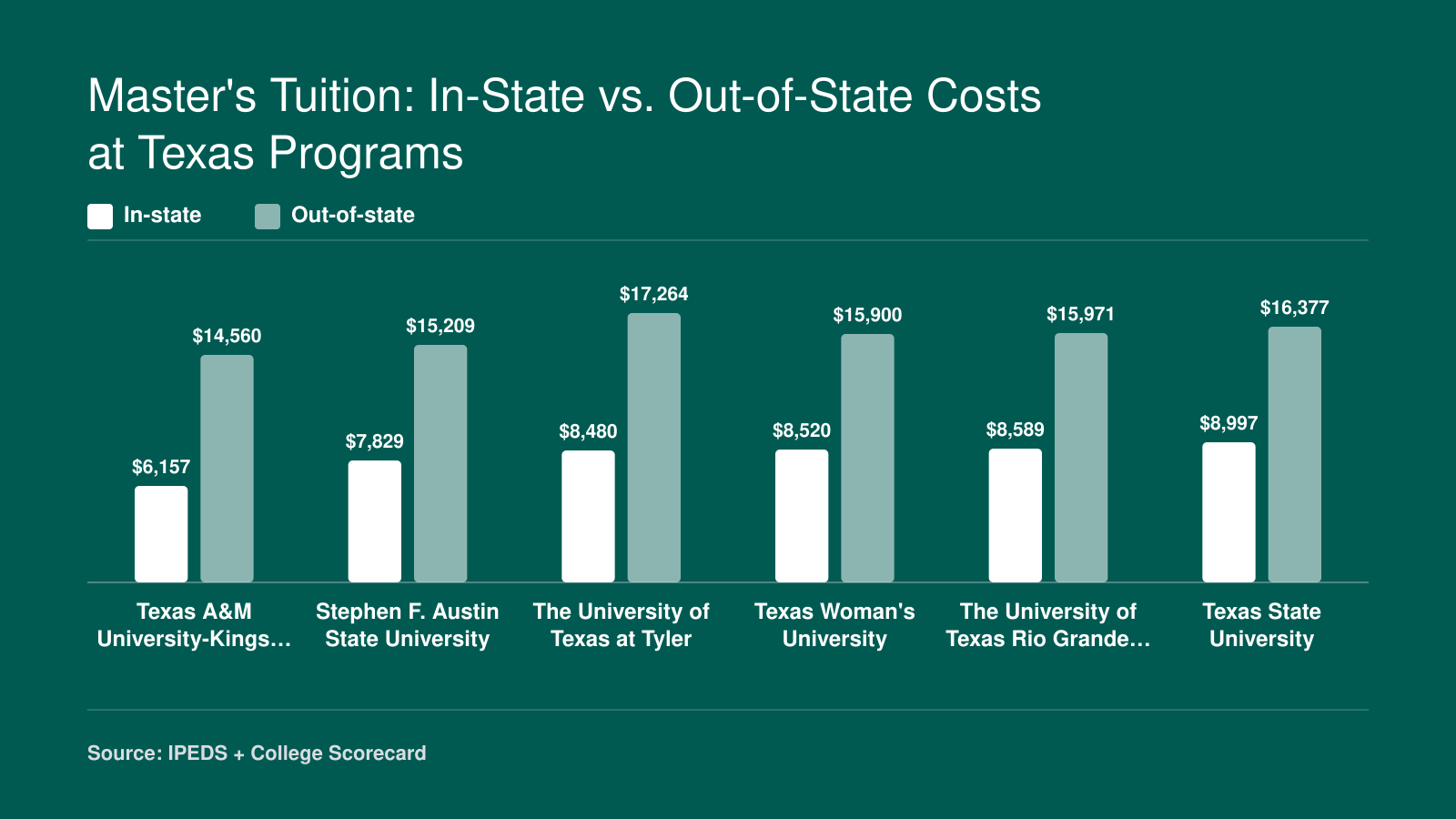
Master's Tuition: In-State vs. Out-of-State Costs at Texas Programs
Public Texas programs charge far less than private ones, but residency changes the bill sharply. The chart shows annual graduate tuition for the lowest-cost schools here. Doubling it for a two-year program gives a rough tuition-only total: Texas A&M University-Kingsville (53 credits) is about $12,300 in-state or $29,100 out-of-state, and Texas Woman's University (61-62 credits) is about $17,000 or $31,800. Fees, books and living costs are extra. Net price after aid is an approximate, institution-wide average, not specific to speech-language pathology. For 2026-27, Texas Tech University Health Sciences Center estimates $25,687 in-state and $52,651 out-of-state for 63 credits, calculated differently, so don't compare it directly with the chart. Limited assistantships there involve about 10 hours a week, with no published stipend. The University of Texas Rio Grande Valley lists a Graduate Select Scholarship of up to $1,000.
Texas SLP Licensure and ASHA Certification
How We Ranked These Programs
Rankings that lean on reputation alone can miss the tradeoff that matters most, even among master's in communication programs: whether a degree pays off after tuition and time. The programs below are compared across campus and online formats using measurable data, not name recognition. We look at graduate tuition and net price from IPEDS, institution-wide graduation rates, and program-level earnings where the College Scorecard publishes them. That means some schools may have strong tuition data but limited outcome data, so missing earnings does not equal poor performance. Because net price and graduation rates reflect the whole institution, not just the communication disorders program, treat them as context rather than proof. Always confirm accreditation and current admissions details, including any test policies, directly on each program's site.
Frequently Asked Questions About Texas Communication Disorders Master's Programs
These answers cover the questions applicants ask most often. Program length, cohort size, and deadlines vary by school, so confirm specifics on each program's admissions page before you apply.
How long does a Texas SLP master's take if my bachelor's isn't in communication sciences?
How competitive is admission to Texas SLP master's programs?
What is the difference between a CAA-accredited program and one in candidacy, and can candidacy graduates get licensed in Texas?
Are there fully online master's in communication disorders programs in Texas?
Compare Communication Disorders programs on the data that matters
Explore more Communications & Media specializations or browse every graduate field.
All Communications & Media programs