Accelerated Master's in Communication Disorders Programs
Compare 330+ accredited fastest Communication Disorders programs at 290+ schools, with graduate earnings, cost, debt, and completion data from IPEDS and the U.S. College Scorecard.

A combined bachelor's-to-master's pathway can shave a year or more off the path to becoming a certified speech-language pathologist, finishing graduate-only tracks in about 15 to 24 months.
The master's in speech pathology is the entry-level credential for SLP practice, so speed only matters if the program leads to ASHA certification and state licensure. A faster finish with no CAA-accredited degree behind it leaves a graduate unable to sit for the Praxis or practice.
That constraint, not the calendar, shapes which accelerated programs are worth the intensity.
Key Points
- CAA accreditation is required for ASHA certification and most state licenses.
- Every candidate must complete 400 supervised clinical clock hours.
- Accelerated graduate-only SLP programs typically run 15 to 24 months.
None of the ranked Communication Disorders programs match the fastest lens yet. The full ranking is at the link above.
How we rank. Each program is scored on graduate figures only: the field's master's earnings and debt, graduate tuition and the number of master's graduates, normalized across all programs in this field. Data comes from the U.S. Department of Education's IPEDS and College Scorecard; no school pays for placement.
Cost, debt & payoff
Median earnings of this field's master's graduates (4 yrs after completing) vs. their median federal loan debt · U.S. College Scorecard
Across these programs the median graduate earns about $66,310 and finishes with roughly $41,000 in debt — a ratio that clears a common rule of thumb (keep debt below first-year salary). Tuition and debt vary widely school to school, so sort the ranking by "Most affordable" or "Lowest debt" to weigh cost against outcomes.
What Is an Accelerated Master's in Communication Disorders?
Accelerated training is reshaping how many CSD students enter the field, but the label still covers two distinct formats. For current undergraduates, combined bachelor's-to-master's pathways (loosely called 3+2, 4+1, or 5-year) apply approved graduate credits toward both degrees. West Chester University's accelerated B.A./M.A., for example, lets seniors apply up to 12 graduate-level credits toward the bachelor's as electives while keeping undergraduate tuition rates and aid eligibility; the B.A. is conferred at the end of fall year four and the M.A. by the end of year five.1 UCF's accelerated B.S./M.A. does something similar, allowing up to 13 approved 6000-level credits with grades of B or better, which can shorten the master's by a semester.2 At UW-Stevens Point, the 3+2 program beginning fall 2026 completes the bachelor's during the first semester of graduate school.3
For students who already hold a bachelor's, fast-track or year-round master's formats compress the same graduate curriculum into fewer calendar months. In both models, the graduate credential is the same master's in communication disorders (MS or MA in CSD) that traditional students earn. The accelerated route changes timing and credit sharing, not the degree.
How Long Accelerated SLP Master's Programs Take, by Format
Most accelerated graduate-only SLP programs run about 15 to 24 months, while combined bachelor's and master's programs typically take five years total. The table below shows published durations and formats for accelerated and year-round options, sorted from shortest to longest. Online and hybrid programs still require in-person clinical placements; no ASHA-accredited program is fully remote.
| Program (School) | Model | Length | Format | In-Person Requirements |
|---|---|---|---|---|
| Wilson College | Accelerated hybrid curriculum | 16 months | Hybrid (online coursework with live interactive instruction, simulations, clinical preparation) | Two required on-campus residencies, separate from clinical placements |
| University of St. Augustine for Health Sciences | Accelerated full-time pathway | 1 year, 8 months | Hybrid online (online coursework with live virtual weekday sessions) | On-campus residencies in 4 of 5 terms, 3 days per residency |
| Indiana University of Pennsylvania | Full-time traditional two-year program | Two years, five semesters | Residential/on-campus for first three semesters; final two semesters include full-time internships and one online seminar each semester | On-campus classes and campus clinics during first three semesters; students may live away from campus during final year |
| Baldwin Wallace University | Accelerated 5-year combined program | 5 years | Not specified | Not specified |
| Marywood University | Accelerated combined bachelor's/master's program | 5 years | Residential/on-campus | Residential/on-campus program |
| La Salle University | Accelerated combined bachelor's/master's program | 5 years | Not specified | Not specified |
| Misericordia University | Combined five-year professional master's program with admission in the first year | 5 years | Not specified | Not specified |
| Lebanon Valley College | Combined bachelor's/master's accelerated pathway | 5 years | In-person | In-person program in Pennsylvania |
Are Accelerated Speech-Language Pathology Programs Accredited?
A five-year bachelor's-to-master's track and a standalone two-year master's are judged the same way. Accreditation belongs to the graduate SLP program, through ASHA's Council on Academic Accreditation (CAA). The bachelor's portion is not separately accredited by CAA, so the status that matters is the graduate program where your coursework and practicum happen.
Accredited vs. candidate
Accredited status goes to a fully operational program: up to 5 years initially, up to 8 years on reaccreditation, with annual review. Candidate status is preaccreditation for a developing program, capped at 5 years, and it is not full accreditation. Graduates of either can apply for the CCC-SLP once the program director confirms Standards I-V.
Verify the current status and history of ASHA accredited speech pathology master's programs in ASHA's EdFind directory before you apply.
After the degree
- Praxis: Pass the Praxis SLP exam (minimum score 162), with ETS sending scores to ASHA.
- Clinical fellowship: 36 weeks and 1,260 mentored hours, supervised by a CCC-SLP.
- Licensure: Apply to your state separately, since requirements vary.
Clinical Hours: Do Accelerated Students Get the Same Training?
An accelerated speech-language pathology master's does not change what you learn; it changes how much supervised clinical training you complete per term. ASHA's clinical practicum standards keep one CCC-SLP standard for every candidate: 400 supervised clinical clock hours. That total includes at least 25 guided observation hours and 375 hours of direct client and patient contact, with at least 325 of those hours completed within a graduate program. Up to 50 hours may transfer from undergraduate SLP or assistant coursework.
Accelerated programs fit the same total into fewer calendar breaks by running year-round terms, adding summer practicums, and scheduling full-time externships of roughly 12 to 16 weeks. Placements tend to be in schools, hospitals, rehabilitation centers, and private practice. Some schools place students through a clinical education coordinator or placement specialist.1 Students in online speech pathology master's programs in particular should confirm early who arranges the site and who approves the supervisor. The hour count is identical to a traditional program. What changes is intensity: fewer gaps between rotations, longer clinical days, and less room to catch up if a placement falls through.
Related Articles
Does Finishing Faster Actually Save Money?
Published figures rarely break out separate 4+1 or 3+2 totals, so direct comparisons are imperfect. Among schools that publish a full amount, University of St. Augustine's accelerated five-trimester M.S. SLP lists total tuition and fees near $78,342 for Fall 2026. That sits close to traditional two-year totals at Lebanon Valley College ($80,974), Temple University ($76,287 in-state to $103,545 out-of-state), and the University of Maryland ($48,985 in-state to $99,135 out-of-state).1 For students comparing the most affordable communication disorders master's schools, savings mostly come from double-counted credits in combined tracks, one fewer year of living costs, and earlier entry into SLP jobs.
But accelerated pacing has a catch. Year-round programs often charge for summer terms. Faulkner University, for example, lists a summer cost of $9,175 within its 66-credit plan, and many schools bill per credit rather than by semester. The intense schedule can also make holding a job difficult. If borrowing is needed, federal Direct Unsubsidized and Grad PLUS loans cover graduate study, though any program-specific scholarships require checking each school. Faster completion only saves money if the summer charges and lost income don't cancel the time advantage.
Admission and Progression Requirements
Requirements vary by school and accelerated track.
- Entry and progression GPAWest Chester's accelerated track requires 3.7 cumulative and major GPAs; Iowa looks for 3.5+. Once enrolled, Harding expects C academic and B clinical work with probation below 3.0, and South Carolina allows only 11 semester hours below a B.
- PrerequisitesNon-CSD majors may need phonetics, anatomy of speech and hearing, and language development, plus ASHA-required biological science, physical science, social/behavioral science, and statistics.
- Application materialsPlan on letters, a personal statement, and CSDCAS. GRE policies vary, South Carolina optional, Georgia State not required, Iowa not accepted.
- Falling belowStudents below the progression GPA usually finish the bachelor's and apply to the master's through the standard route.
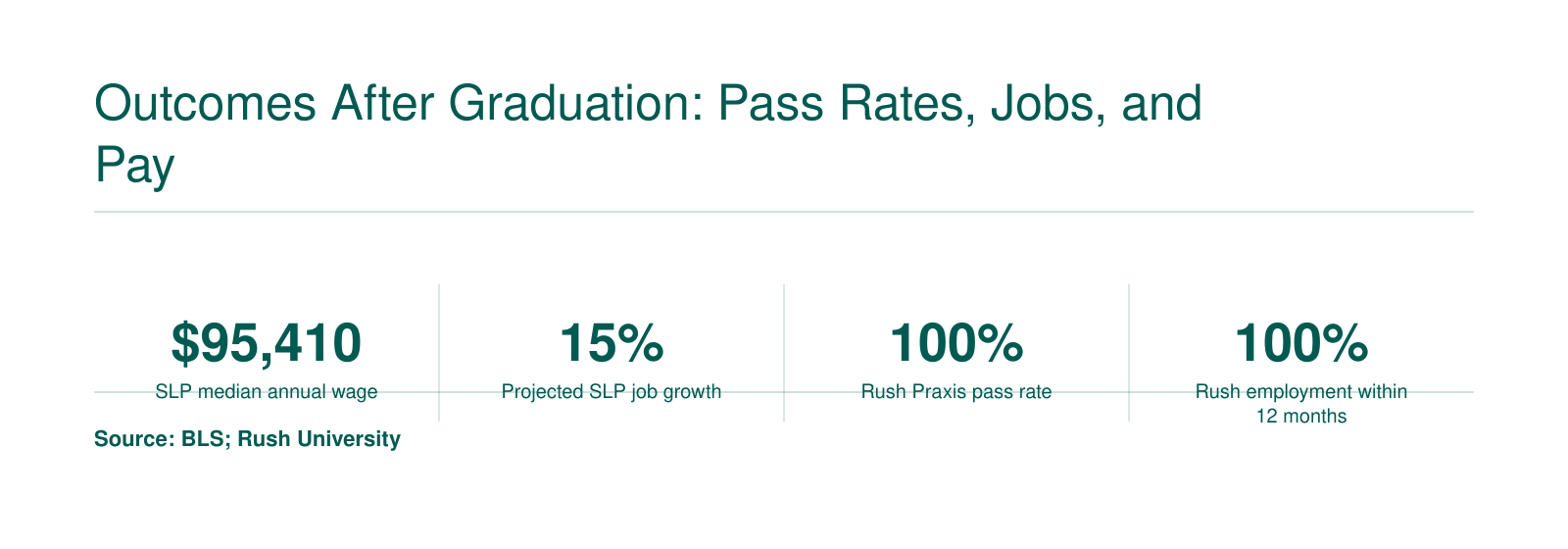
Outcomes After Graduation: Pass Rates, Jobs, and Pay
Every CAA-accredited program must publish three-year Praxis pass, completion, and employment rates, so you can compare programs directly.
Accelerated vs. Traditional Master's: Pros and Cons
Accelerated programs trade a more intense schedule for a faster return on your tuition. The same degree and certification eligibility are there, but you will need to manage a year-round pace. Students who are sure about speech-language pathology early on, and career-changers who can study full time, tend to benefit most from this route.
Pros
- You enter the field and start earning a salary earlier, which can reduce the opportunity cost of graduate study.
- Combined programs often let you count some undergraduate credits toward the master's, lowering total tuition and fees.
- You earn the same master's degree and remain eligible for the same certification and licensure paths as traditional students.
- A guaranteed or streamlined admission track in combined programs removes some of the uncertainty of applying separately.
Cons
- The year-round schedule leaves little room for part-time work, so you may need to rely more on loans or savings.
- You have less time to sample electives or clinical specialties before committing to a setting or population.
- A minimum progression GPA can push students out if grades dip during a compressed, high-intensity term.
- Fewer breaks between clinical rotations can increase burnout and make it harder to recover between placements.
Communication Disorders programs by state
Compare Communication Disorders programs on the data that matters
Explore more Communications & Media specializations or browse every graduate field.
All Communications & Media programs