Best Master's in Communication Disorders Programs in Massachusetts
Compare 10 accredited Communication Disorders programs in Massachusetts at 9 schools, with graduate earnings, cost, debt, and completion data from IPEDS and the U.S. College Scorecard.

Do you need a CAA-accredited master's to practice speech-language pathology in Massachusetts? Yes. State licensure also requires 400 documented clinical practicum hours, a passing Praxis score, and a clinical fellowship, so your program shapes cost, clinical training, and licensure timing.
Price varies sharply. Average annual net price runs from $13,381 at Worcester State University to $49,180 at Emerson College.
That gap does not match a gap in pay. Graduates of these programs earn roughly $60,000 to $66,000 in their first year, whatever the price.
Key Points
- Emerson College reports a 98% first-time Praxis pass rate on campus, 86% online.
- Massachusetts licensure requires 400 clinical practicum hours, Praxis scores sent to the Board, and a clinical fellowship.
- Several schools here have dropped the GRE, so check each admissions page for 2027 policy.
Ranked: Best Master's in Communication Disorders Programs in Massachusetts
This ranking weighs what graduates earn, how many finish, what the degree costs, and whether you can study on campus or online. Cost and graduation figures are institution-wide averages, while earnings and debt are program-level where published, with the time window stated.
Boston University
#1Boston, MA · $65,000 – $70,000/yr (est.)
Best for: Full-time students wanting a thesis option
Boston University offers an on-campus M.S. in Speech-Language Pathology in Boston, with tuition and fees of about $68,102 and an institution-wide average net price near $24,402. Schools offering this program have graduation rates of 89%. Program graduates reported median earnings of $60,038 one year after completion and $77,864 four years after, with median debt of $52,000. The program is CAA-accredited on a 2023 to 2031 cycle, with the next review in 2030.
- Two-year, full-time program of 68 credit hours
- Capstone by comprehensive exam or thesis
- Nine prerequisite courses required, grades of C or better
- Prepares for ASHA certification and Massachusetts licensure
- Clinical practica in healthcare, school and community settings
- Coursework includes dysphagia, aphasia, autism and voice disorders
Worcester State University
#2Worcester, MA · ~$7,000/yr (est.)
Best for: Cost-conscious in-state students
Worcester State University offers a campus-based M.S. in Speech-Language Pathology in Worcester, with in-state tuition and fees of about $11,786 (out-of-state about $17,866) and an institution-wide average net price near $13,381. Schools offering this program have graduation rates of 61%. Program graduates reported median earnings of $60,795 one year after completion, with median debt of $21,166. Its program materials describe it as ASHA accredited.
- Full-time or accelerated tracks with evening classes
- No GRE required
- 375+ clinical hours across 75+ placement sites
- Thesis or comprehensive exam option
- Eligible for CCC-SLP, Massachusetts licensure and DESE teacher certification
MGH Institute of Health Professions
#3Boston, MA · ~$69,000/yr (est.)
Best for: Aspiring medical SLPs seeking hospital training
MGH Institute of Health Professions is a Boston graduate school with an on-campus M.S. in Speech-Language Pathology tied to Mass General Brigham hospitals. Program graduates reported median earnings of $65,872 one year after completion, though median debt is the highest in this group at $87,213. Tuition, net price and graduation rate figures are not reported here for this institution. The program is identified as CAA-accredited.
- Two-year program of 69 credit hours, fall start
- Six concentration options, including autism and voice disorders
- 200+ clinical practicum sites, including Mass General Brigham
- Dual licensure in reading and speech-language pathology
- Entrance exam and prerequisite courses required
- Three letters of recommendation minimum
- School-reported 97% licensure pass rate
Emerson College
#4Boston, MA · $35,000 – $40,000/yr (est.)
Emerson College offers its Communication Disorders M.S. in Boston both on campus and online, with tuition and fees of about $57,056 and an institution-wide average net price near $49,180. Schools offering this program have graduation rates of 77%. Program graduates reported median earnings of $61,401 one year after completion and $74,005 four years after, with median debt of $54,435. The program is identified as CAA-accredited.
- No GRE required
- On-campus Robbins Center clinic
- 125+ external clinical placements
- Classes offered day and night
- Research opportunities in the CSD Suite
- 20-month program of 54 applied credit hours
- Rolling admissions with spring, summer and fall starts
- Two program tracks available
- 400 clinical hours, including 375 direct contact hours
- One on-campus immersion weekend
- Scholarships available
Cost & outcomes by school
Federal data for the highest-earning Communication Disorders programs, independent of the ranking above. Earnings are this field's master's graduates four years after completing, where the Scorecard reports them.
| School | Earnings | Tuition / yr | Debt | Grads/yr | Format |
|---|---|---|---|---|---|
| Boston University MA | $77,864 | $67,626 | $52,000 | 42 | Campus |
| Emerson College MA | $74,005 | $35,382 | $54,435 | 326 | Campus |
| MGH Institute of Health Professions MA | $72,730 | $69,158 | $87,213 | 62 | Campus |
| Northeastern University MA | $70,914 | $29,174 | $41,000 | 56 | Campus |
| Northeastern University MA | $70,914 | $26,020 | $41,000 | — | Campus |
| Worcester State University MA | $62,355 | $6,813 | $21,166 | 22 | Campus |
| Bridgewater State University MA | — | $9,297 | — | 13 | Campus |
| University of Massachusetts-Amherst MA | — | $17,410 | — | 27 | Campus |
| Regis College MA | — | $17,910 | — | 19 | Campus |
Sources: U.S. Department of Education. Tuition and graduates: IPEDS. Earnings and debt: College Scorecard, this field's master's graduates; a dash means no figure is reported.
Cost, debt & payoff
Median earnings of this field's master's graduates (4 yrs after completing) vs. their median federal loan debt · U.S. College Scorecard
Across these programs the median graduate earns about $72,730 and finishes with roughly $52,000 in debt — a ratio that clears a common rule of thumb (keep debt below first-year salary). Tuition and debt vary widely school to school, so check the per-school figures in the table above before you shortlist.
How to Compare Master's in Communication Disorders Programs in Massachusetts
Emerson College reports a 98% first-time Praxis pass rate for its residential program in 2024-2025, but 86% for its distance education track.1 One headline number never tells the whole story. Start with three checks before choosing a Master's in Communication Disorders program: CAA accreditation, total cost after aid, and graduate outcomes.
For outcomes, program-level Scorecard earnings show what completers make one to five years out. Five years after completion, median earnings are $74,902 at Boston University, $74,461 at Emerson, $72,223 at MGH Institute, and $57,523 at Worcester State University. Always name the window when you compare.
Then open each program's published CAA student outcome data and look for the Praxis pass rate, the on-time completion rate, and the employment rate. Note the reporting year and whether residential and online cohorts are split. Not every school posts all three.
Institution-wide graduation rates and net prices describe the whole college, not the speech-language pathology program, so treat them as context rather than results.
Online and Hybrid Master's in Communication Disorders Programs in Massachusetts
Emerson College runs the main online pathway among master's programs in Massachusetts: Speech@Emerson, a 54-credit M.S. in Communication Disorders delivered online with one required in-person immersion in Boston.
Duration and Cost
The online program runs 5 to 6 semesters (published tracks range from roughly 20 to 36 months, depending on your prior coursework). For 2026-27, online tuition is $1,551 per credit, a stated minimum of $83,754 across 54 credits when no foundational courses are required. That figure excludes travel and lodging for the Boston immersion, plus per-term and clinical fees (registration, materials, clinical tracking, and background check). Emerson's residential M.S. in Boston uses the same 5-to-6-semester structure and the Robbins Center for on-campus clinical training, but current residential per-credit tuition is not published, so a reliable dollar-for-dollar comparison is not possible.
Clinical Placements and Access
Online students complete at least 400 supervised hours through one virtual placement and four community placements at faculty-approved sites, generally within about 75 miles of home and typically 3 to 5 days a week. A placement team helps secure sites; a preferred location is not guaranteed. State-authorization rules can bar residents of certain states from enrolling, so confirm eligibility before applying.
Related Articles
Which Massachusetts Master's Programs Waive or Make the GRE Optional?
Standardized testing has lost ground across speech-language pathology admissions, and the shift is visible in the No-GRE master's programs ranked here. Where we could confirm a current policy, the trend is away from the GRE entirely, not merely making it optional.
- Boston University: The GRE is not required, and scores sent to the program will not be reviewed. No prerequisite coursework is needed to apply, but six field-specific courses (including Phonetics, Anatomy and Physiology of the Speech Mechanism, and Language Acquisition) are required, some before you start. The application deadline is January 5, 2026.
- UMass Amherst: The GRE is not required and will not be considered. Preparation covers seven CSD-style courses plus 25 hours of guided clinical observation, which helps out-of-field applicants meet prerequisites. Apply through CSDCAS by January 15; the cycle opens in mid-July.
- Worcester State University, MGH Institute of Health Professions, Emerson College: Confirm the current GRE policy directly on each admissions page rather than assuming, since published language can change between cycles.
For non-CSD majors, plan your leveling courses early; they often gate matriculation.
Massachusetts SLP Licensure at a Glance
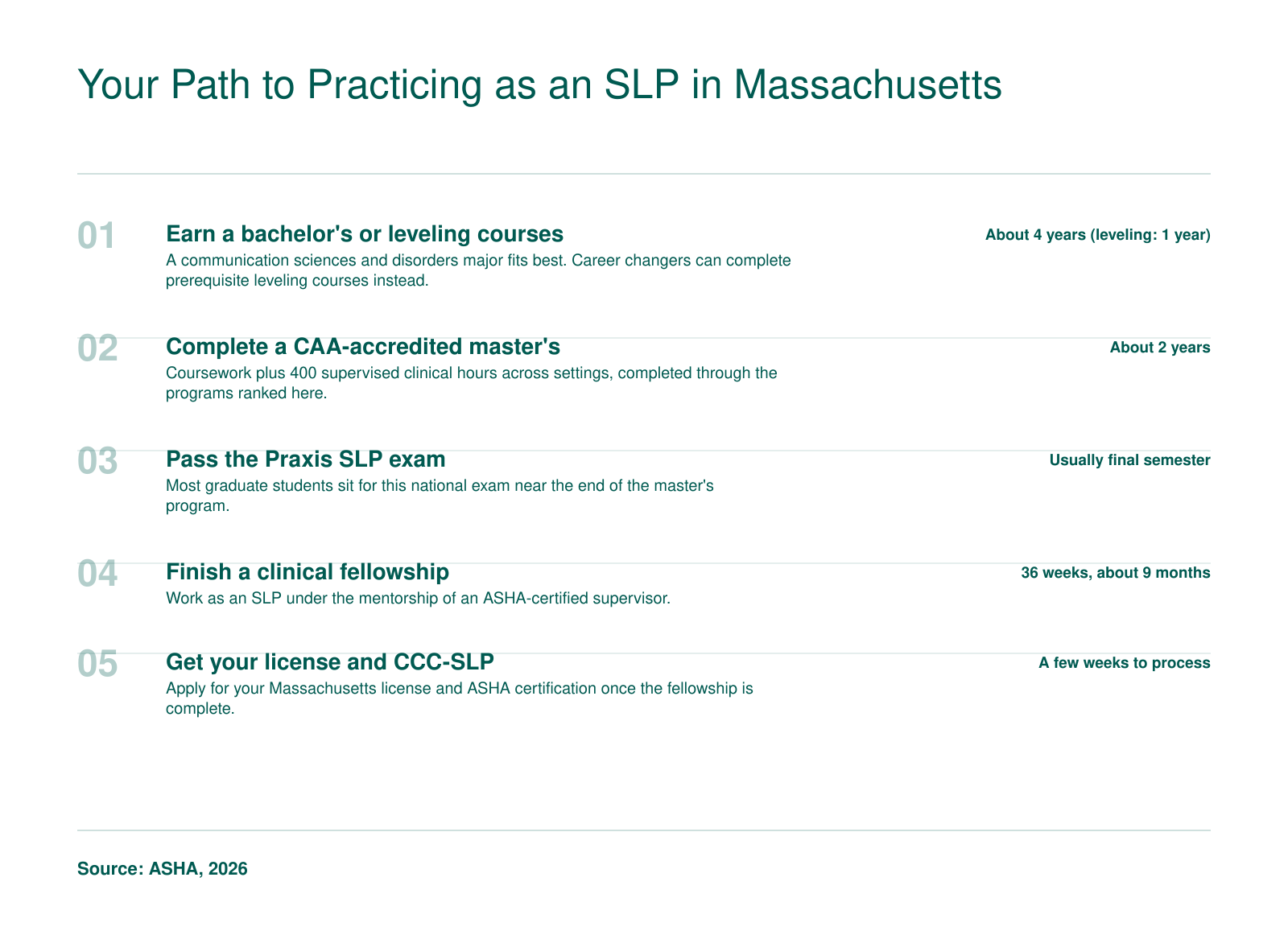
Your Path to Practicing as an SLP in Massachusetts
Becoming a speech-language pathologist follows a fixed order. Each step builds on the one before it, and the full route takes about 6-7 years from the start of college.
Frequently Asked Questions About Master's in Communication Disorders in Massachusetts
How long does it take to become a speech-language pathologist in Massachusetts?
Can I complete a master's in communication disorders online in Massachusetts?
Can I work in Massachusetts during my clinical fellowship before I'm fully licensed?
Do I need a separate license to work as an SLP in Massachusetts public schools?
Compare Communication Disorders programs on the data that matters
Explore more Communications & Media specializations or browse every graduate field.
All Communications & Media programs