Best Master's in Communication Disorders Programs in Minnesota
Compare 7 accredited Communication Disorders programs in Minnesota at 4 schools, with graduate earnings, cost, debt, and completion data from IPEDS and the U.S. College Scorecard.

Minnesota's graduate SLP pipeline runs through a small set of public universities, and seats are competitive: annual admission cycles, cohort caps, and residency-dependent tuition make the choice consequential. Median earnings four years after completing these programs range from $58,788 to $65,227, while program tuition swings by residency.
CAA accreditation, GRE policies, clinical hours, online options, and Minnesota licensure are practical filters. ASHA's 400 supervised clinical hours stay the same wherever you enroll, so placement quality often matters more than a program's name.
Key Points
- All three Minnesota campuses deliver the SLP master's in person, with no online option.
- Minnesota State University-Mankato is cheapest, at about $10,449 in program tuition for residents.
- ASHA certification requires 400 clinical hours, then a 1,260-hour fellowship before full licensure.
Ranked: Best Master's in Communication Disorders Schools in Minnesota
Three Minnesota campuses make this list, and all three deliver their speech-language pathology master's in person. Graduation rates shown on each card are school-wide, not specific to the program. Check each program's accreditation status with the ASHA Council on Academic Accreditation (CAA) before you apply, because it is required for ASHA certification and Minnesota licensure.
University of Minnesota-Duluth
#1Duluth, MN · $22,000 – $33,000/yr (est.)
Best for: Students drawn to assistive technology focus
The University of Minnesota Duluth offers a campus-based MA in Communication Sciences and Disorders with three concentration paths: assistive technology, language disorders and motor-speech disorders. Students train in the on-campus Robert F. Pierce Speech-Language-Hearing clinic and at affiliated internship sites, with an emphasis on individualized instruction. Our research did not confirm this program's CAA accreditation status, so verify it in the ASHA directory before applying.
- 2-year program, campus-based
- Affiliated internship sites available
- Prepares graduates for school, hospital or private practice careers
- One of 3 concentration options
- Coursework in assistive technology
- Clinical experience in the on-campus clinic
- Starts fall
- Coursework in language disorders
- Individualized instruction and mentoring
- No spring or summer admissions
- Courses in motor-speech disorders
- Training at the Robert F. Pierce Speech-Language-Hearing clinic
- Individualized instruction emphasized
Minnesota State University-Mankato
#2Mankato, MN · $10,000 – $20,000/yr (est.)
Best for: Residential students drawn to faculty research
Minnesota State University, Mankato offers a residential, 52-credit MS in Communication Sciences and Disorders over two years. CAA's most recent decision, in February 2026, continued the program's accreditation, with the next review set for 2033. Graduate assistantships and student research opportunities are available, and the program meets professional licensure requirements in Minnesota and neighboring states. Applicants without a CSD bachelor's degree complete a post-baccalaureate prerequisite sequence first.
- CAA accredited, continued accreditation decision February 2026
- 52 total credit hours over 2 years, on campus
- Fall start only; CSDCAS application required
- Posted fall deadline is January 15; confirm, as the catalog lists February 1
- 3 letters of recommendation (minimum)
- International applicants need a TOEFL iBT score of 80 or higher
- Graduate assistantships and student research opportunities
- Prepares for licensure and certification
Saint Cloud State University
#3Saint Cloud, MN · ~$11,000/yr (est.)
Best for: Career changers without a CSD degree
St. Cloud State University's MS in Communication Sciences and Disorders admits a small cohort of roughly 23 to 26 students each year. A two-phase structure lets students without a CSD undergraduate degree complete preparatory coursework before graduate study. Training happens in the on-campus Speech-Language and Hearing Clinic, and the program prepares graduates for Minnesota licensure and ASHA certification. The school describes the program as CAA accredited, but the CAA listings we reviewed did not confirm its status, so verify it directly with ASHA.
- 2 concentration options
- Two phases: Phase I for non-CSD backgrounds, Phase II graduate study
- Full-time enrollment required; admission once per year, fall start
- Fall deadline January 15; Phase I applicants may apply until July 1
- Admission includes recommendations and an interview
- Care in the on-campus Speech-Language and Hearing Clinic
- Prepares for Praxis and Minnesota licensure
- Program reports a 100 percent Praxis pass rate over the past two years
Cost & outcomes by school
Federal data for the highest-earning Communication Disorders programs, independent of the ranking above. Earnings are this field's master's graduates four years after completing, where the Scorecard reports them.
| School | Earnings | Tuition / yr | Debt | Grads/yr | Format |
|---|---|---|---|---|---|
| University of Minnesota-Duluth MN | $65,227 | $21,630 | $49,537 | 31 | Campus |
| Minnesota State University-Mankato MN | $62,812 | $10,449 | $34,700 | 32 | Campus |
| Saint Cloud State University MN | $58,788 | $10,924 | $41,000 | 22 | Campus |
| Minnesota State University Moorhead MN | $56,896 | $11,902 | $40,116 | 25 | Hybrid |
Sources: U.S. Department of Education. Tuition and graduates: IPEDS. Earnings and debt: College Scorecard, this field's master's graduates; a dash means no figure is reported.
Cost, debt & payoff
Median earnings of this field's master's graduates (4 yrs after completing) vs. their median federal loan debt · U.S. College Scorecard
Across these programs the median graduate earns about $65,227 and finishes with roughly $49,537 in debt — a ratio that clears a common rule of thumb (keep debt below first-year salary). Tuition and debt vary widely school to school, so check the per-school figures in the table above before you shortlist.
How We Rank Communication Disorders Master's Programs
We rank Master's in Communication Disorders programs on verifiable outcomes, not reputation surveys. The ranking weighs graduate tuition, net price, completion and outcome data, and how flexible each program's format is for working students.
Figures come from IPEDS and College Scorecard, paired with admissions and accreditation details checked against each program's own pages, including those for ASHA accredited speech pathology programs in Minnesota.
Two caveats matter. Graduation rates and net price describe the whole institution, not the speech-language pathology program alone, so treat them as context rather than a program-level promise. Net price is also an average across students who received aid, not a quote. Your actual cost depends on residency, assistantships, and aid, so confirm numbers with each admissions office before you decide.
Online and Hybrid Master's in Communication Disorders Programs in Minnesota
Every ranked communication disorders program here is campus based rather than online or hybrid. Saint Cloud State University describes its M.S. in Speech-Language Pathology as residential1, and the listings for Minnesota State University-Mankato and the University of Minnesota Duluth identify those master's programs as campus based. Published materials do not point to a fully online SLP master's among these options, and the available details suggest fixed fall starts with full-time cohort pacing. Even in the best online master's in communication disorders programs, clinical practicum hours must be completed in person, but that remote flexibility is not part of what these Minnesota campuses offer. Students who need asynchronous coursework or near-home clinical placement may find limited room in these ranked programs compared with other online master's programs in Minnesota, making them a less flexible choice for working professionals and career changers. The strongest fit is a student ready for in-person graduate training rather than a distance track.
Do Minnesota SLP Master's Programs Require the GRE?
Standardized testing has been losing ground in graduate admissions, including among master's in communication disorders programs with no GRE required, but the schools here do not all say so clearly. Here is what the published materials show.
- Minnesota State University-Mankato: The current catalog page for the master's in Communication Sciences and Disorders lists a bachelor's degree, a 3.00 minimum GPA, and a February 1 deadline. It publishes no GRE requirement, test-optional policy, or waiver. An older 2020-2021 catalog asked for a "competitive score," but that is not confirmed as current policy.
- Saint Cloud State University: We could not verify a current GRE requirement, optional status, or waiver from the program's official admissions page.
- University of Minnesota-Duluth: We found no published GRE policy we could confirm.
A missing policy is not the same as a waiver. Policies change between cycles, and conditions such as GPA thresholds can apply even among master's programs with no GRE required. Before you pay for a test, confirm the current rule on each program's admissions page or with the graduate coordinator.
Related Articles
Admission Requirements for Minnesota Speech-Language Pathology Master's Programs
A competitive applicant should aim for a 3.0 GPA or higher. Confirm every deadline on the program's current admissions page before you apply.
- Bachelor's degreeA communication sciences and disorders bachelor's is the direct route. Applicants from other majors usually complete leveling coursework first.
- Minimum GPAMankato's catalog lists 3.0 (2020-2021 edition). Treat 3.0 as the floor, and expect stronger applicants to exceed it.
- Leveling courseworkSaint Cloud State describes a Phase I post-baccalaureate track for foundational CSD work.
- ASHA-required coursesPlan on statistics plus biological, physical, and social/behavioral science credits.
- Letters and statementExpect recommendation letters and a personal statement through CSDCAS or the school's own portal.
- Deadlines and cohort sizeSaint Cloud State's deadline has historically been mid-January, and Mankato's catalog listed February 1. Saint Cloud State prepares 23-26 students a year, so admission is selective.
Clinical Training and Practicum Hours in Minnesota SLP Programs
ASHA's baseline for certification is 400 supervised clinical clock hours: 375 of direct client contact plus 25 of observation. Every accredited program has to deliver at least that. Published material for Minnesota State University-Mankato's M.S. in Speech-Language Pathology, Saint Cloud State University, and University of Minnesota-Duluth does not give a comparable total above the baseline, so ask each program for its current clinical handbook.
Most programs follow a similar sequence. Students start in an on-campus speech and hearing clinic under faculty supervision. They then move to external practicums in public schools and in medical settings such as hospitals, rehabilitation centers, and skilled nursing facilities. Placements can lie in the Twin Cities, in rural Minnesota, or out of state, depending on the program's site agreements.
The available sources do not show which of these schools offers the deepest medical SLP exposure. They also do not say whether placements are guaranteed or students must find their own sites. Ask admissions directly, especially if you want a hospital externship or need to stay near home.
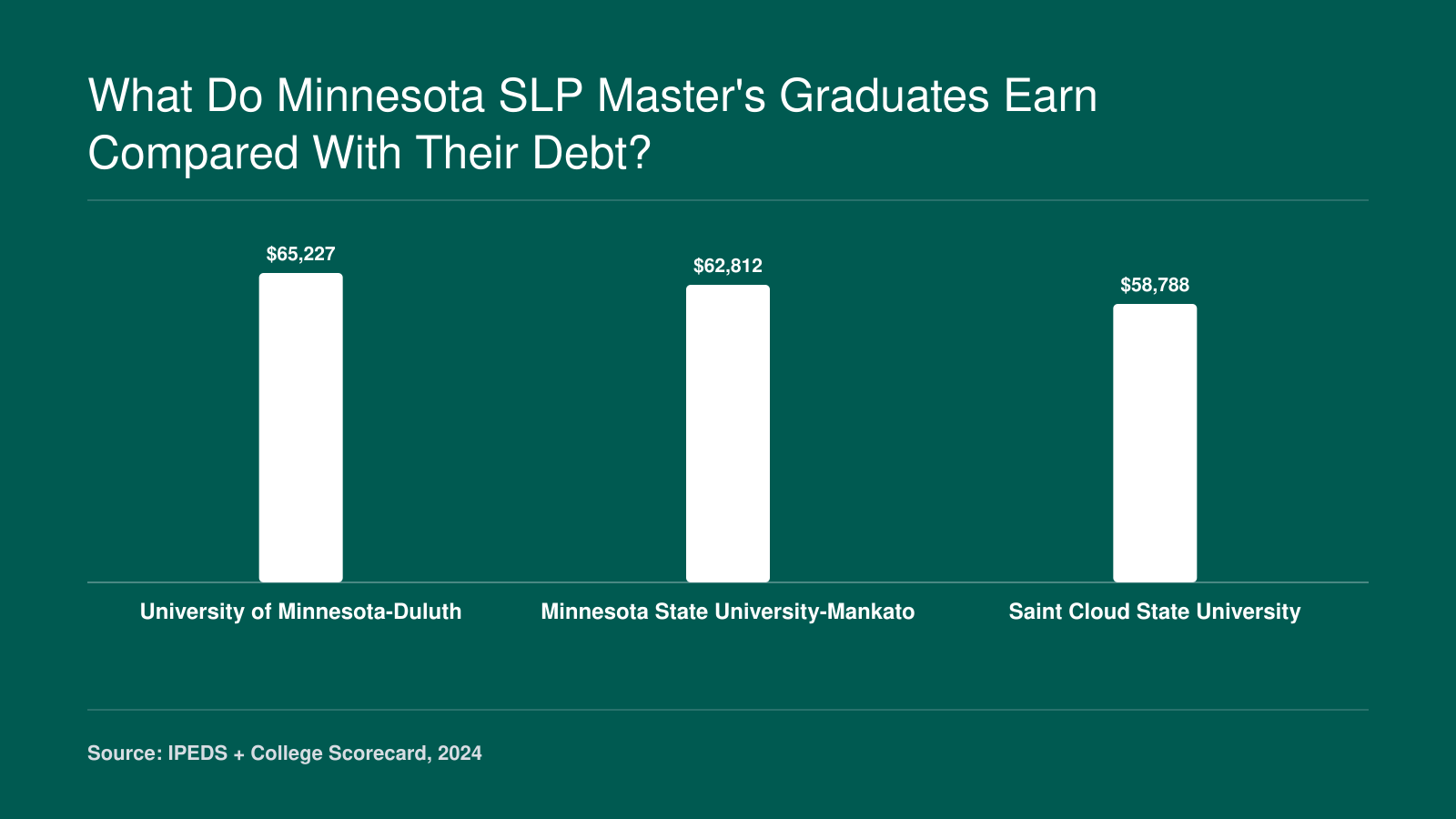
What Do Minnesota SLP Master's Graduates Earn Compared With Their Debt?
Median earnings are measured four years after completion for every school shown, so the bars compare like with like. Set them against median program debt: Minnesota State University-Mankato graduates carry $34,700, Saint Cloud State University graduates $41,000, and University of Minnesota-Duluth graduates $49,537. Duluth earns the most, but Mankato pairs the lowest debt with earnings only about $2,400 behind.
Minnesota Speech-Language Pathology Licensure at a Glance
Cost, Financial Aid, and Minnesota Licensure for Communication Disorders Master's Students
Residency decides the price at some schools and barely matters at others. Minnesota State University-Mankato is the least expensive option here, a distinction that matters in any ranking of the Most Affordable Master's in Communication Disorders Programs: its program tuition runs about $10,449 for residents against $19,989 for nonresidents. Mankato's published 2026-27 rates for most graduate programs are $570 resident and $826 nonresident per credit plus fees, though I could not confirm that the SLP program bills on that schedule. Saint Cloud State lists about $10,924 for both groups, and University of Minnesota-Duluth about $21,630 in-state and $32,862 out-of-state. I found no confirmed reciprocity terms for neighboring states; confirm current terms directly with each admissions office.
Aid
Saint Cloud State advertises scholarships and financial aid, and Mankato lists financial aid. Assistantship and scholarship amounts for SLP students were not published, so ask each department directly. School-based SLPs may also qualify for federal Public Service Loan Forgiveness, so check eligibility with your loan servicer.
After graduation
- Praxis: The exam fee is $135.
- Clinical fellowship: Complete it after your degree.
- Minnesota license: The Minnesota Department of Health charges $200 plus a $10.50 surcharge,1 or $210.50.2 Renewal is $200 every two years.2 With the Praxis, one 2026 summary totals $345.50.
- ASHA CCC-SLP: Apply after the fellowship. I could not verify the current fee.
Compare Communication Disorders programs on the data that matters
Explore more Communications & Media specializations or browse every graduate field.
All Communications & Media programs