Best Master's in Speech-Language Pathology Programs in Michigan
Compare 12 accredited Speech Pathology programs in Michigan at 9 schools, with graduate earnings, cost, debt, and completion data from IPEDS and the U.S. College Scorecard.

Which Michigan speech-language pathology master's gets you licensed for the least money and disruption? Every route runs through a graduate degree from a CAA-accredited program (or one in candidacy), a supervised clinical fellowship, and a state license from LARA before you can practice.
The schools ranked here put campus and online formats on one list, though Calvin University is the only one with a distance option.
Price varies more than payoff. Graduates of programs reporting earnings posted median pay between $56,756 and $65,951 one year out, so a higher sticker price rarely buys a bigger paycheck.
Key Points
- Calvin University is the only school here with a distance option.
- Northern Michigan remains a Candidate for Accreditation, so verify status before applying.
- A Michigan LARA license and ASHA CCC-SLP are separate credentials.
Ranked Michigan Speech-Language Pathology Master's Programs
Eight Michigan campuses offer a speech-language pathology master's in the data we reviewed, and only Calvin also offers a distance option. Seven are listed as ASHA accredited. Northern Michigan is still a Candidate for Accreditation, which is preaccreditation, so confirm its status on the ASHA site before you apply. Graduation rates quoted below describe each university overall, not the SLP program.
Calvin University
#1Grand Rapids, MI · ~$11,000/yr (est.)
Best for: Distance learners outside West Michigan
Calvin is a private, faith-based university in Grand Rapids that offers its SLP master's in residential and distance formats, with clinical placements arranged by the program. ASHA lists it as accredited for 2024 to 2032, with the next review in 2031. The university's overall graduation rate is 74%, and it publishes no GRE requirement for admission.
- 72 credits with five clinical practicums
- Residential and distance education modes
- Clinical placements arranged by the program
- Applications through CSDCAS with three recommendation letters
- Typically two to three years full-time
- Faith-based perspective integrated into the curriculum
Wayne State University
#2Detroit, MI · ~$18,000/yr (est.)
Best for: Metro Detroit students seeking public tuition
Wayne State is a public research university in Detroit whose campus-based MA prepares graduates for ASHA certification and Michigan licensure. Federal data lists the program as ASHA accredited, though the retrieved research did not confirm its current review cycle. The university's overall graduation rate is 58%. Out-of-state students pay a reduced graduate rate.
- Meets Michigan licensure requirements and prepares for ASHA certification
- Plan A, B and C degree options
- Clinical training and research opportunities
- Post-baccalaureate prerequisites required if your degree is not in CSD
- Coursework covers language, voice, fluency and neuroscience
Andrews University
#3Berrien Springs, MI · $25,000 – $30,000/yr (est.)
Best for: Career changers needing a prerequisite pathway
Andrews is a private university in Berrien Springs with an on-campus MS in SLP, plus a three-year transitional track for students without a communication disorders background. ASHA lists it as accredited for 2024 to 2032, with the next review in 2031. The university's overall graduation rate is 72%.
- 60 credits on campus, with thesis or standard track
- 400 clinical hours, 325 at the graduate level
- 3.25 GPA requirement and comprehensive exam
- Meets ASHA certification and Michigan licensure requirements
- Three-year campus-based track
- Designed for students from other undergraduate backgrounds
- 33% tuition reduction during the two prerequisite semesters
Grand Valley State University
#4Allendale, MI · $20,000 – $25,000/yr (est.)
Grand Valley State in Allendale runs an intensive 16-month, four-semester on-campus program. Clinical work moves from faculty-led placements in the first semester to community preceptor-led sites, ending in a full internship. Federal data lists it as ASHA accredited, though the retrieved research did not confirm its review cycle. The university's overall graduation rate is 67%.
- 16-month, four-semester terminal professional degree
- First-semester clinicals are faculty-led
- Later semesters use community preceptor-led placements
- Full internship in the final semester
- Prepares for the Praxis exam
Western Michigan University
#5Kalamazoo, MI · $20,000 – $25,000/yr (est.)
Western Michigan in Kalamazoo offers a two-year residential MA built around the Charles Van Riper Language, Speech & Hearing Clinic. ASHA lists it as Accredited with Monitoring for 2024 to 2032, so check the current status with the program. The university's overall graduation rate is 58%.
- Two-year full-time residential program
- Mentored clinical work at the on-site Van Riper clinic
- Apply through CSDCAS by January 15, with a $50 supplemental fee
- Graduate assistantships and departmental scholarships, about 20% of incoming students funded
- Courses in dysphagia, stuttering, voice and augmentative communication
Central Michigan University
#6Mount Pleasant, MI · ~$17,000/yr (est.)
Central Michigan in Mount Pleasant offers a residential MA with on-campus and off-campus clinical placements working with clients of all ages. ASHA lists the program as accredited, but the retrieved research did not confirm its current review date. The university's overall graduation rate is 59%.
- Residential campus format
- Clinical placements on and off campus, supervised by clinical instructors
- Speech, voice, language and augmentative communication labs
- Opportunities to take part in research
Northern Michigan University
#7Marquette, MI · $12,000 – $16,000/yr (est.)
Northern Michigan in Marquette offers a cohort-based MS that begins each summer. It is a Candidate for Accreditation, which is preaccreditation and can last up to five years, and its next CAA review date was not established. Weigh that carefully if ASHA certification timing matters to you. The university's overall graduation rate is 52%.
- Candidate for Accreditation, not yet fully accredited
- Cohort starts each summer with a prescribed course sequence
- Six semesters: 59 credits non-thesis, 65 credits thesis
- Clinical practicum at the on-campus Speech, Language, and Hearing Clinic
Eastern Michigan University
#8Ypsilanti, MI · $15,000 – $20,000/yr (est.)
Eastern Michigan in Ypsilanti offers an MA in communication sciences and disorders leading to SLP practice, with two semesters of practicum at its on-campus clinic followed by off-campus internships. ASHA lists the program as accredited, but the retrieved research did not confirm its current review date. The university's overall graduation rate is 46%.
- Two semesters of practicum at the on-campus Speech and Hearing Clinic
- Off-campus internships with children and adults
- Post-baccalaureate certificate option listed
- Pediatric focus within the MA
- Off-campus internship experience with children
- Adult focus within the MA
- Hands-on training across a wide variety of settings
Cost & outcomes by school
Federal data for the highest-earning Speech Pathology programs, independent of the ranking above. Earnings are this field's master's graduates four years after completing, where the Scorecard reports them.
| School | Earnings | Tuition / yr | Debt | Grads/yr | Format |
|---|---|---|---|---|---|
| Western Michigan University MI | $64,565 | $20,103 | $41,608 | 24 | Campus |
| Grand Valley State University MI | $64,351 | $20,030 | $59,065 | 45 | Campus |
| Central Michigan University MI | $63,316 | $17,187 | $58,342 | 39 | Campus |
| Calvin University MI | $63,146 | $11,113 | $36,079 | 41 | Online |
| Wayne State University MI | $63,124 | $17,960 | $46,173 | 38 | Campus |
| Michigan State University MI | $62,529 | $21,772 | $51,250 | 27 | Campus |
| Andrews University MI | $60,673 | $29,156 | $66,491 | 21 | Campus |
| Northern Michigan University MI | — | $12,196 | — | — | Campus |
| Eastern Michigan University MI | — | $17,968 | — | 34 | Campus |
Sources: U.S. Department of Education. Tuition and graduates: IPEDS. Earnings and debt: College Scorecard, this field's master's graduates; a dash means no figure is reported.
Cost, debt & payoff
Median earnings of this field's master's graduates (4 yrs after completing) vs. their median federal loan debt · U.S. College Scorecard
Across these programs the median graduate earns about $63,146 and finishes with roughly $48,712 in debt — a ratio that clears a common rule of thumb (keep debt below first-year salary). Tuition and debt vary widely school to school, so check the per-school figures in the table above before you shortlist.
Online and Hybrid SLP Master's Options in Michigan
Calvin University's 72-credit, CAA-accredited Master of Arts in Speech-Language Pathology runs in both residential and distance modes. Distance students typically finish in 2 to 3 years instead of 2. Coursework is online, mixing asynchronous classes with some synchronous or hybrid evening sessions.
Clinical training is where distance study gets specific. Calvin's five-semester clinical sequence includes 5 required practicums. Distance students begin with telepractice, treating real patients via telehealth for three semesters, then move to in-person work with a local SLP provider. A placement coordinator helps each student secure 2 placements in their own community. Calvin describes these local placements rather than a mandatory campus residency, but confirm before enrolling.
Wayne State's program is campus-based in Detroit, with more than 40 off-campus clinical sites. For Central Michigan, Western Michigan, Grand Valley State and the other schools ranked here, ask admissions directly whether any hybrid format exists.
Can Michigan students complete one of the Best Online Master's in Speech-Language Pathology Programs fully online? The coursework can be, but clinical hours always end in person. Out-of-state applicants should also check state authorization, since some online programs cannot place students in every state.
Related Articles
Michigan SLP Master's Programs That Waive or Don't Require the GRE
Most Michigan SLP master's programs say little about the GRE, so silence on an admissions page is the norm rather than the exception; a national list of Master's in Speech-Language Pathology Programs With No GRE Required can help identify schools that do publish a waiver.
- Not required: Calvin University does not require the GRE.
- Optional or waivable: No program here clearly publishes this middle policy.
- No policy stated: Central Michigan, Western Michigan and Grand Valley State publish no GRE requirement on the pages reviewed. Wayne State, Andrews, Northern Michigan and Eastern Michigan were not verified, so confirm directly.
Central Michigan asks for a 3.0 in the last 60 semester hours and a 3.00 in CSD prerequisites, with no prerequisite grade below C. Other schools did not state a minimum, and competitive admits usually exceed whatever is published.
Central Michigan, Western Michigan and Calvin use CSDCAS, with January 15 deadlines (January 15, 2027 for Central Michigan and Calvin). Submit two to four weeks early, since verification takes time. Grand Valley lists December 1, January 15 and April 1 dates, but its CSDCAS use was not stated.
Career changers have options among speech-language pathology graduate programs: Western Michigan offers an undergraduate certificate, Grand Valley has a track for non-CSD bachelor's holders, and Calvin accepts any bachelor's degree. Central Michigan expects a CSD bachelor's.
Cost of a Speech-Language Pathology Master's in Michigan
On the federal figures, Northern Michigan University shows the lowest graduate tuition here ($12,196 in-state), so it is the most affordable option on paper. That figure has no clear reporting basis, so confirm it with the program before budgeting. Net price is an institution-wide average after aid, not specific to this master's. A full SLP master's usually runs five to six semesters including summers, so per-credit rates matter more than annual figures. Western Michigan says all applicants are considered for graduate assistantships, enrolled students can apply for departmental scholarships, and about 20% of incoming students receive some funding.
| School | Tuition (in-state) | Tuition (out-of-state) | Net price after aid (institution-wide average) | Per-credit rate and credits (researched, unconfirmed) |
|---|---|---|---|---|
| Andrews University | $29,156 | $29,156 | $12,547 | $966 per credit; 72 credits listed by one source (about $67,680 estimated) |
| Wayne State University | $17,960 | $36,542 | $12,766 | $956.21 per credit out-of-state reduced rate (2026-27); credit total unconfirmed |
| Northern Michigan University | $12,196 | $15,652 | $14,085 | 59 to 67 credits depending on thesis option; per-credit rate N/A |
| Western Michigan University | $20,103 | $29,681 | $15,273 | $832.70 in-state, $1,803.63 out-of-state; credits unverified |
| Eastern Michigan University | $17,968 | $30,978 | $15,407 | Per-credit rate and credit total N/A |
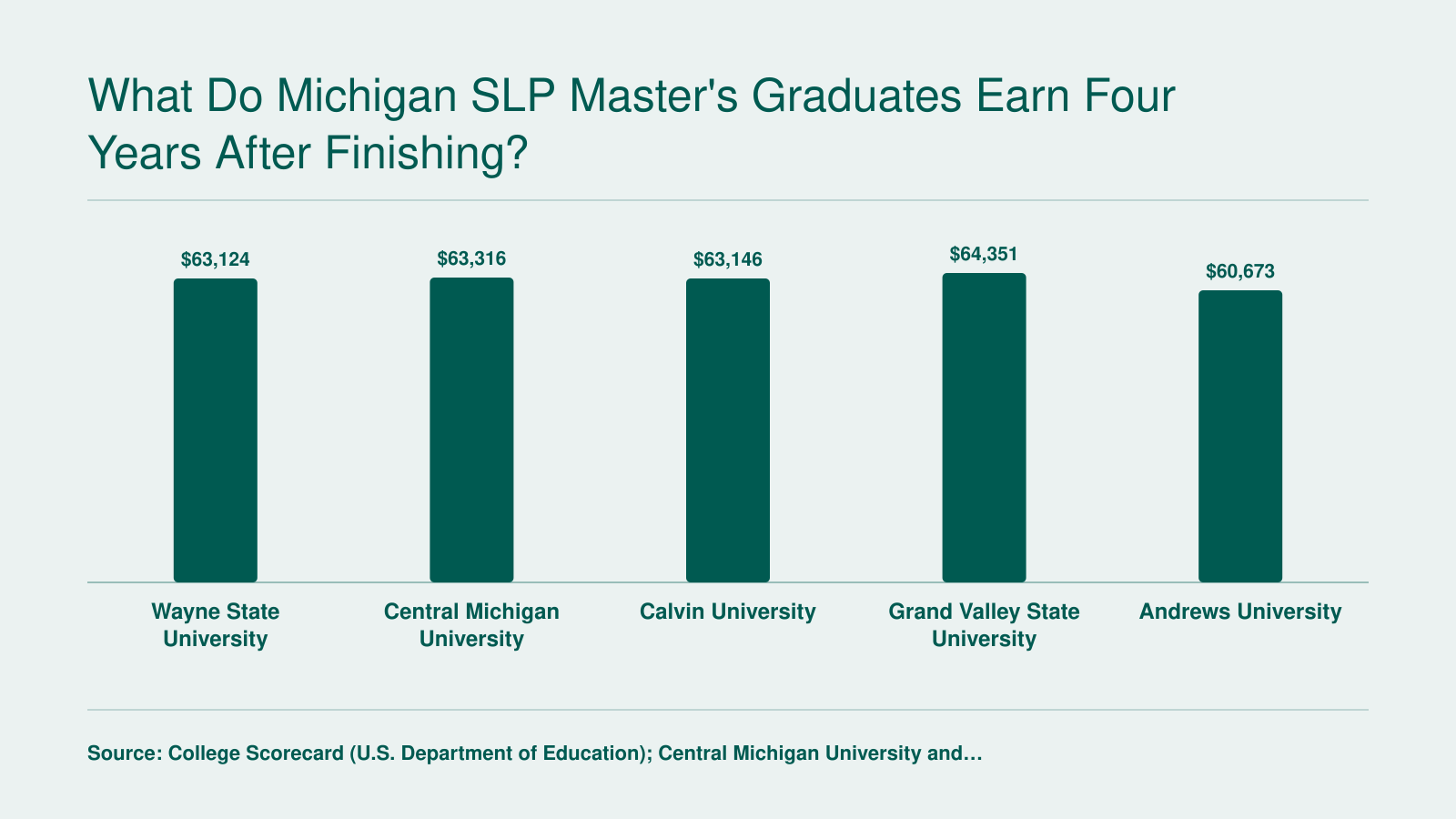
What Do Michigan SLP Master's Graduates Earn Four Years After Finishing?
Median earnings of graduates four years after finishing their speech-language pathology master's are shown below for the top programs by graduate earnings, in the order they are ranked on this page. For licensure-exam and completion context, Central Michigan University reports a three-year Praxis SLP pass rate of 85.7% and an on-time completion rate of 96.7%. Western Michigan University reports a 94.1% Praxis pass rate and 100% completion for 2023-2024. Both figures come from each program's own student outcome data page, and Praxis periods refer to the testing cycle, not necessarily graduation year.
Michigan SLP Licensure and ASHA Certification Steps
Michigan licensure and ASHA certification are separate credentials. The state license, issued through LARA with the Michigan Board of Speech-Language Pathology, is what lets you practice in Michigan. The ASHA CCC-SLP is a national certification. Most clinicians pursue both, and the steps overlap.
- Earn a CAA-accredited master'sASHA's standards call for 400 supervised clinical hours: 25 observation and 375 direct contact.
- Pass the Praxis SLP examMichigan adopts ASHA's recommended passing score. Confirm the current number with ASHA or ETS.
- Complete required trainingsThese include human trafficking training and 2 hours of implicit bias training within 5 years before issuance. LARA also lists 1 hour of pain and symptom management.
- Get a limited license if neededIf your degree lacked 9 months of supervised clinical experience, you need an Educational Limited Temporary license. It runs 24 months, with one 12-month extension.
- Complete the postgraduate experienceThe Clinical Fellowship is 1,260 hours over at least 36 weeks. Michigan requires at least 1,008 clinical contact hours, supervised by a fully licensed Michigan SLP.
- Targeting school jobs?Michigan has a separate school-based limited authorization through the Michigan Department of Education. Check its current requirements before you apply.
- Realistic timelineExpect about 2 years of graduate study plus a 9-12 month fellowship after your bachelor's.
Frequently Asked Questions About Michigan SLP Master's Programs
Does the University of Michigan offer a speech-language pathology master's?
How long does it take to become a speech-language pathologist in Michigan?
What GPA do you need for SLP grad school in Michigan?
Can out-of-state students get in-state tuition or reciprocity for Michigan SLP programs?
Compare Speech Pathology programs on the data that matters
Explore more Communications & Media specializations or browse every graduate field.
All Communications & Media programs