Best Master's in Communication Disorders Programs in Wisconsin
Compare 13 accredited Communication Disorders programs in Wisconsin at 9 schools, with graduate earnings, cost, debt, and completion data from IPEDS and the U.S. College Scorecard.

A master's in communication disorders is the entry credential for speech-language pathology practice: a CAA-accredited degree, supervised clinical hours, the Praxis exam, and a Wisconsin DSPS license before you can bill for your own caseload.
Wisconsin's options are few, and they diverge on the things that cost you money. Published graduate tuition at the state's public programs runs from roughly $9,000 to about $12,700 for residents, and well into the $40,000s at the high end for others. One online path exists, part-time and three years, with in-person clinical requirements.
The GRE, meanwhile, has mostly disappeared from these admissions files.
Key Points
- UW-Eau Claire offers an online part-time M.S. requiring 54 credits, including 14 clinical.
- UW-Madison permanently dropped the GRE, with a January 15 application deadline.
- Wisconsin licensure runs through DSPS, and school SLPs also need a DPI license.
Best Master's in Communication Disorders Schools in Wisconsin
Wisconsin has a compact set of master's programs in speech-language pathology, and all of the schools below are on the same ASHA Council on Academic Accreditation (CAA) track toward ASHA certification and state licensure. None is flagged as a candidate for accreditation, but one carries a monitoring condition, and the status of a few programs could not be confirmed in the directory excerpts we reviewed. Each card notes what the sources do and do not establish, so check the ASHA EdFind directory before you apply.
University of Wisconsin-Madison
#1Madison, WI · ~$12,000/yr (est.)
Best for: Research-minded students considering doctoral study
UW-Madison's MS in Communication Sciences and Disorders offers a Speech-Language Pathology track and a Normal Aspects track built for students heading toward a PhD. The ASHA CAA lists the program as accredited for 2020-2028, with the next review in 2027. Graduates earned a median of about $52,000 one year after completion. The university has an institution-wide graduation rate of 89.5% and an approximate average net price after aid of $17,354. The program asks for no entrance exam, and students without a communication disorders background can complete prerequisites through the Capstone Program.
- 50 credit hours with a minimum 3.0 GPA and three letters of recommendation
- No entrance exam required
- Applications due January 15 for a fall start
- Capstone required; Praxis II exam required for graduation
- Prerequisite coursework available through the Capstone Program
- Financial aid via assistantships and fellowships
- Two-year professional program
- Qualifies graduates for the Wisconsin SLP license
- Prepares for ASHA clinical certification (CCC)
- Teacher certification available through the state DPI
- Clinical experiences on and off campus
- Two-year track for students aiming at PhD study
- Scholarships available
- Non-clinical alternative to the SLP track
University of Wisconsin-Eau Claire
#2Eau Claire, WI · ~$11,000/yr (est.)
Best for: Working professionals needing part-time online study
UW-Eau Claire runs its master's in communication sciences and disorders as both a two-year residential program and a three-year part-time online program within the same accredited graduate program. ASHA's CAA recorded a continued accreditation decision dated February 13, 2026, though the directory excerpt reviewed does not establish the current cycle or next review year. Graduates earned a median of about $56,983 one year after completion. The university has an institution-wide graduation rate of 63.8% and an approximate average net price after aid of $16,550. Both paths are structured to meet national credentialing and Wisconsin DPI licensure requirements.
- Offered in online and residential options
- Clinical training in the UWEC Speech & Language Clinic
- Thesis or research project opportunities
- Four-semester program, 54 credit hours
- Full-time and part-time options; fall start
- Minimum 3.3 GPA and three letters of recommendation
- Thesis or capstone option; oral comprehensive exam required
- About 18 students admitted annually
- Clinical externships in schools and hospitals; approved by WI DPI
- Three-year part-time cohort with a fixed June start
- Ten terms across fall, spring, summer and winterim
- One-week residency each summer
- Kira Assessment required as part of the application
- Comprehensive exam required for graduation
Viterbo University
#3La Crosse, WI · ~$10,000/yr (est.)
Best for: Career changers entering speech pathology
Viterbo University in La Crosse offers a full-time, face-to-face MS in Speech-Language Pathology with a distinctive emphasis on Deaf culture and serving diverse communities. It is a private school, with an approximate average net price after aid of $21,260 and an institution-wide graduation rate of 68.4%. Program materials describe it as ASHA accredited, but its current directory status and review date were not confirmed here. A post-baccalaureate certificate path serves career changers.
- Two years, five semesters, year-round and full-time
- 58 credit hours of face-to-face coursework
- Emphasis on Deaf culture and diverse communities
- Clinical experiences in health care facilities and schools
- Post-baccalaureate certificate pathway for career changers
- Eligible for Wisconsin licensure and ASHA certification
University of Wisconsin-Whitewater
#4Whitewater, WI · $10,000 – $15,000/yr (est.)
UW-Whitewater's full-time, on-campus MS in Communication Sciences and Disorders is a small-cohort program with an on-campus center for communicative disorders and external clinical sites. ASHA's CAA lists it as accredited for 2022-2030, with the next review in February 2030. Graduates earned a median of about $58,302 one year after completion. The university has an institution-wide graduation rate of 58.9% and an approximate average net price after aid of $14,158. Applicants without an undergraduate communication disorders degree can enter after completing prerequisite coursework.
- Two-year, full-time program with 48 credit hours
- No entrance exam required
- 400 clinical hours across on-campus and off-site settings
- Three letters of recommendation; prerequisites required
- Applications due February 1 for a fall start
- Graduate assistantships and scholarships available
University of Wisconsin-River Falls
#5River Falls, WI · $10,000 – $15,000/yr (est.)
UW-River Falls offers a full-time, five-semester MS in Communication Sciences and Disorders, with first-year clinic work on campus and two 12-week externships in the second year. Its location near the Twin Cities opens urban, suburban or rural placement options. Graduates earned a median of about $61,494 one year after completion. The university has an institution-wide graduation rate of 57.0% and an approximate average net price after aid of $14,054. Program materials describe it as ASHA accredited, though its current directory status and next review date were not established in the sources reviewed.
- Full-time, five-semester program
- Hands-on clinic experience in the first year
- Two 12-week externships, one pediatric and one adult
- Urban, suburban or rural practicum sites
- Location near the Twin Cities metro area
University of Wisconsin-Milwaukee
#6Milwaukee, WI · $13,000 – $26,000/yr (est.)
UW-Milwaukee's MS in Communication Sciences & Disorders is a campus-based program with training in its own Speech and Language Clinic and two full-semester community placements. ASHA's CAA lists it as accredited with monitoring for 2026-2034, with the next review in 2033. The July 18, 2026 decision continued accreditation with monitoring because standard 6.4, Program Equipment and Materials, was found noncompliant. Graduates earned a median of about $56,128 one year after completion. The university has an institution-wide graduation rate of 49.3% and an approximate average net price after aid of $15,014.
- Six semesters, 60 credit hours, fall start only
- Applications verified through the CSD centralized application by January 15
- Three letters of recommendation; TOEFL or IELTS for international applicants
- Thesis or capstone option
- Two full-semester community placements, plus an optional third mini-placement
- Training in the on-campus CSD Speech and Language Clinic
University of Wisconsin-Stevens Point
#7Stevens Point, WI · ~$10,000/yr (est.)
UW-Stevens Point offers an MS in Speech-Language Pathology with an on-campus clinic and more than 100 medical and educational affiliations across Wisconsin and the Midwest. Beginning fall 2026, it also launches a five-year 3+2 bachelor's-to-master's pathway that skips the separate graduate application. Graduates earned a median of about $55,083 one year after completion. The university has an institution-wide graduation rate of 50.8% and an approximate average net price after aid of $14,559. Program materials describe it as CAA accredited, but its current directory status was not confirmed here.
- Six-semester program with 57 credit hours
- Thesis or capstone option
- Full-time clinical externship in the final semester
- On-campus Speech, Language and Hearing Clinic
- Over 100 medical and educational clinical affiliations
- Fall 2027 applications due January 15, 2027
- DPI licensure preparation available; scholarships offered
Cost & outcomes by school
Federal data for the highest-earning Communication Disorders programs, independent of the ranking above. Earnings are this field's master's graduates four years after completing, where the Scorecard reports them.
| School | Earnings | Tuition / yr | Debt | Grads/yr | Format |
|---|---|---|---|---|---|
| Marquette University WI | $69,306 | $24,680 | $41,428 | 44 | Campus |
| University of Wisconsin-Milwaukee WI | $64,875 | $12,728 | $37,397 | 25 | Campus |
| University of Wisconsin-Madison WI | $64,515 | $12,325 | $39,736 | 34 | Campus |
| University of Wisconsin-River Falls WI | $62,481 | $10,357 | $41,000 | 20 | Campus |
| University of Wisconsin-Whitewater WI | $61,200 | $10,543 | $41,000 | 16 | Campus |
| University of Wisconsin-Eau Claire WI | $59,887 | $10,665 | $41,000 | 44 | Hybrid |
| University of Wisconsin-Stevens Point WI | $57,093 | $10,374 | $38,238 | 30 | Campus |
| Viterbo University WI | — | $9,888 | — | — | Campus |
| Concordia University-Wisconsin WI | — | $13,260 | — | 24 | Campus |
Sources: U.S. Department of Education. Tuition and graduates: IPEDS. Earnings and debt: College Scorecard, this field's master's graduates; a dash means no figure is reported.
Cost, debt & payoff
Median earnings of this field's master's graduates (4 yrs after completing) vs. their median federal loan debt · U.S. College Scorecard
Across these programs the median graduate earns about $62,481 and finishes with roughly $41,000 in debt — a ratio that clears a common rule of thumb (keep debt below first-year salary). Tuition and debt vary widely school to school, so check the per-school figures in the table above before you shortlist.
Online and Hybrid SLP Master's Programs in Wisconsin
For students comparing the best online master's in communication disorders programs, UW-Eau Claire anchors Wisconsin's online route, and it is not fully remote. Its online M.S. in speech-language pathology is part-time, typically three years, and requires 54 credits: 40 of coursework and 14 of hands-on clinical work. It also requires three in-person residencies, a weeklong orientation at the start and two more over the summers. That makes it a hybrid in practice. UW-Eau Claire also runs a residential track, full-time and on campus, over four semesters.
Campus-based options
UW-Madison, UW-Milwaukee, UW-River Falls, and UW-Stevens Point are on-campus Master's Programs in Wisconsin in 2026. UW-Stevens Point is a six-semester, 57-credit degree with an on-campus clinic and more than 100 clinical affiliations. The other three list no hybrid or online sections for their accredited communication disorders programs.
Questions to ask before you apply
Published details on live-versus-recorded class meetings are thin, so ask UW-Eau Claire whether lectures are synchronous or asynchronous and how that fits your work schedule. Also ask whether it admits students living outside Wisconsin, and whether it can place you for clinical hours in your home state.
The practical takeaway: an online SLP master's still requires in-person clinical hours. Ask each program exactly how placements are secured, who arranges them, and what happens if no site near you is available.
Which Wisconsin Master's Programs Waive or Make the GRE Optional?
The GRE has largely faded from speech-language pathology admissions, as the Master's in Communication Disorders Programs With No GRE Required page documents, though not every Wisconsin school says so publicly. Here is what each admissions page shows. Confirm current terms before you apply.
- UW-Madison: GRE permanently removed. Deadline January 15. CSDCAS use: not established (as of 2026).
- UW-Milwaukee: GRE: No published policy. Deadline January 15 for the expected admission year, with materials verified by that date. CSDCAS is mandatory, and the portal opens August 1.
- UW-Stevens Point: GRE not required. For Fall 2026, the deadline is January 15, 2027. Applicants use CSDCAS and the UW online application, and both are required.
- UW-Eau Claire: GRE: No published policy. Deadline and CSDCAS use not confirmed.
- Viterbo University: GRE: No published policy. Deadline and CSDCAS use not confirmed.
- UW-Whitewater: GRE: No published policy. Deadline and CSDCAS use not confirmed.
- UW-River Falls: GRE: No published policy. Deadline and CSDCAS use not confirmed.
Among schools that state a position, the direction is clear: Madison and Stevens Point have dropped the GRE, and January 15 is the common fall deadline. "No published policy" means we found nothing stated, not that a school requires the test, so check those admissions pages directly.
Where the GRE is gone, GPA and prerequisite coursework carry more weight. Applicants from outside the field should plan to finish those courses before the deadline.
Related Articles
What a Master's in Communication Disorders Costs in Wisconsin
Tuition is where the public and private options split most sharply. Among the UW System schools here, published graduate rates run from roughly $9,000 to about $12,700 for Wisconsin residents and from the high teens into the low $40,000s for nonresidents, depending on campus and credit load, a spread reflected in the Most Affordable Master's in Communication Disorders Programs. UW-River Falls and UW-Whitewater sit at the lower end for in-state students, while UW-Madison carries the steepest nonresident rate, well into the $40,000 range.
Public Versus Private
Viterbo University, the private option, charges the same per-year tuition (around $34,000) to residents and nonresidents alike, which can actually favor out-of-state students over paying nonresident public rates. For a clearer total-cost picture, remember these programs vary in length: Viterbo's degree spans 58 credits, while UW System programs range from roughly 48 to 60 credits, a timeline the Accelerated Master's in Communication Disorders Programs can shorten. Multiply credits by the per-credit rate and add program fees to estimate your real bill.
Debt and Aid
Median program debt for graduates clusters between about $20,500 and $25,000 across these schools. These are program-level medians, not what any single student will owe. Several UW campuses advertise graduate assistantships, tuition remission, and departmental scholarships, and UW-Madison notes aid through assistantships and fellowships. If you are a Minnesota resident eyeing UW-River Falls, ask the program directly whether tuition reciprocity applies to your enrollment, since terms shift and are worth confirming before you commit.
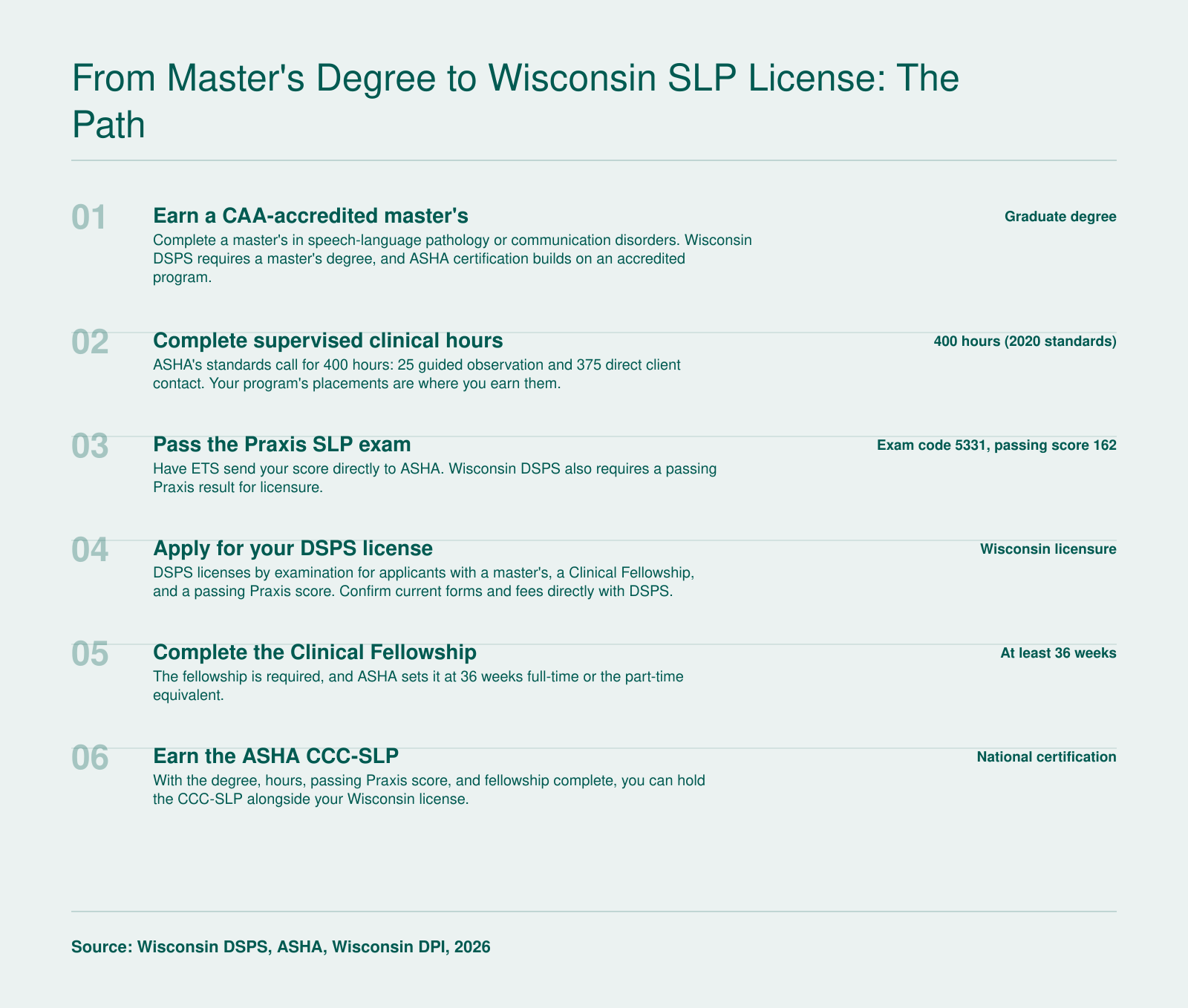
From Master's Degree to Wisconsin SLP License: The Path
Wisconsin licenses speech-language pathologists through the Department of Safety and Professional Services (DSPS), while ASHA awards the national CCC-SLP. Public-school SLPs also need a separate Wisconsin DPI license, and the Tier I version requires a current DSPS license and a master's degree. Because every step starts with the degree, choose a program that is CAA-accredited and offers the clinical placements you need.
Clinical Placements and Bilingual Specializations at Wisconsin SLP Programs
Where You Will Train
UW-Madison structures clinical work in stages. First-years need 25 documented observation hours, then accrue roughly 50 supervised hours per semester, and at least 100 first-year hours are required before a second-year placement. The second year adds a school placement and a medical practicum at sites such as the UW Voice and Swallow Clinics, American Family Children's Hospital, UW Rehab Hospital, Encompass Rehab, UnityPoint Meriter Hospital, and the William S. Middleton VA Hospital.
UW-Eau Claire's catalog estimates 50+ hours and 100+ hours for specific practicum courses, plus a nine-week educational externship and a separate non-school externship.
UW-River Falls runs five semesters over two years. Year one is in its on-campus Speech-Language-Hearing Clinic. Year two brings two 12-week externships, one pediatric and one adult, at urban, suburban, or rural sites.
Bilingual and Other Specializations
None of the schools ranked here advertises a formal bilingual English-Spanish specialization that we could confirm. If bilingual practice matters to you, ask each admissions office whether Spanish-speaking clients and bilingual supervisors are available. Likewise, medical and school work at these programs appears as placements, not formal concentrations or certificates. Telepractice placements are not documented for the schools above, so confirm them directly.
A Practical Tip
Pick placements to match the job you want after licensure. A hospital or VA rotation suits medical work, an educational externship suits school employment, and a rural externship shows what a smaller-community caseload looks like.
Compare Communication Disorders programs on the data that matters
Explore more Communications & Media specializations or browse every graduate field.
All Communications & Media programs