University of Southern California Master's in Marriage and Family Therapy
Los Angeles, CA · Private nonprofit · Master's · Online
1Program track
64Master's degrees awarded (2025)
<1%Of University of Southern California master's degrees
$72,615Median earnings in the field, 4 yrs after
$130,999Median debt in the field
$71,515Avg. graduate tuition and fees / yr
USC's Master of Science in Marriage and Family Therapy awarded 64 degrees in 2025, about 1% of the 9,331 master's degrees the university conferred that year, per federal IPEDS data. The program runs 60 units at $2,539 per unit, a sticker price well above what most California MFT students pay.
The question in front of a prospective student is narrower than a prestige comparison: does that price buy a smoother route to the 3,000 supervised hours and the California MFT licensure that follows?
Admission is one summer cohort a year, no GRE. Cost and licensure are what matter here; a famous name is not.
Key Points
USC's MFT master's lists $152,340 in tuition for 2026-2027.
Graduates earn $72,615 four years out, above the $59,932 national median.
Median federal debt of $130,999 far exceeds the $53,484 national median.
The program
Master of Science in Marriage and Family Therapy Master'sOnline
The University of Southern California offers a Master of Science in Marriage and Family Therapy online program. This program prepares students for licensure as Marriage and Family Therapists in California and other states. It requires a bachelor's degree for admission, letters of recommendation, transcripts, a resume, and a personal statement. The full-time program takes two years to complete. It includes field work in the student's state of residence. Tuition and fee details are available in the USC Catalogue. Financial aid options are also accessible through the USC Financial Aid website.
How University of Southern California compares in Marriage and Family Therapy
181 schools in our directory offer a master's in Marriage and Family Therapy, 69 of them with an online or hybrid option.
University of Southern California
National median (210 schools)
Median earnings, 4 years after the degree
$72,615
$59,932
Median federal debt
$130,999
$53,485
Source: U.S. Department of Education, College Scorecard field-of-study data for master's graduates. Figures cover the whole field family at each school, not one program alone.
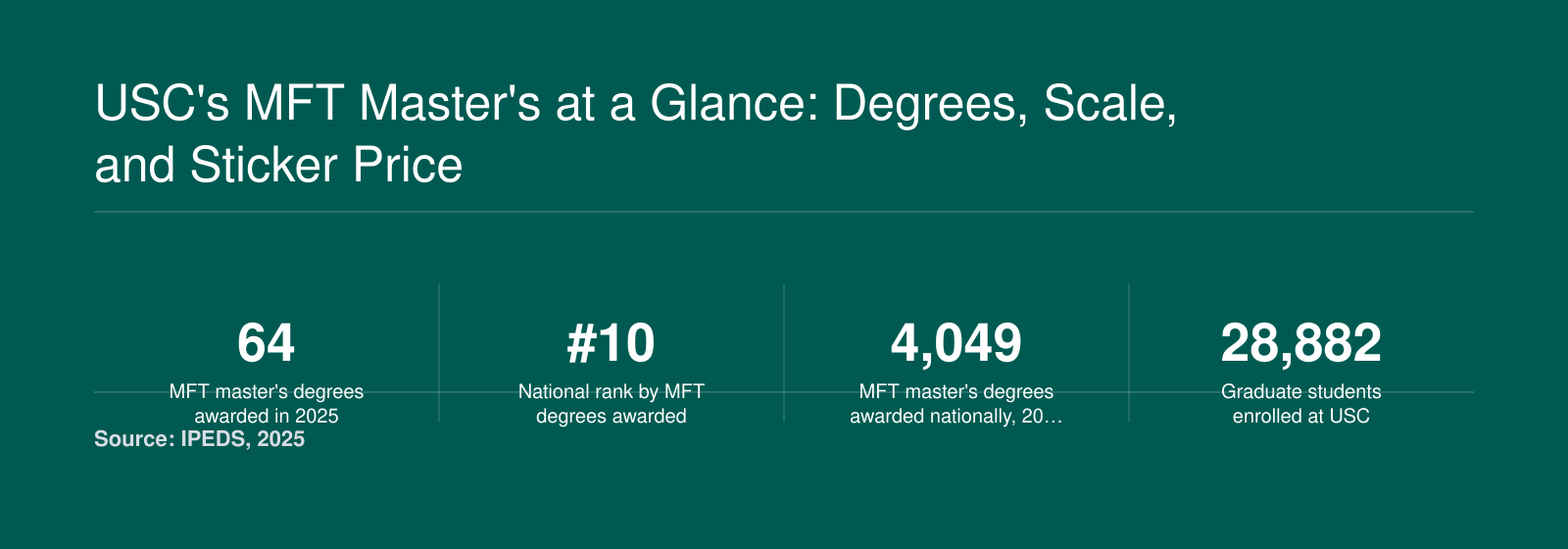
USC's MFT Master's at a Glance: Degrees, Scale, and Sticker Price
USC's marriage and family therapy master's is a small program inside a very large graduate school: 64 degrees in 2025, about 1% of the 9,331 master's awards the university handed out that year. Every figure below comes from IPEDS, the federal data collection run by the U.S. Department of Education's National Center for Education Statistics. The tuition figure is an institution-wide graduate average; individual programs set their own rates.
Inside USC's MFT Program: Tracks, Coursework, and Accreditation
The live debate in marriage and family therapy master's programs is whether national program accreditation or state licensure should carry the weight, and USC's degree sits squarely on the licensure side of that question. The Master of Science in Marriage and Family Therapy is administered by the USC Rossier School of Education, an affiliation worth confirming early, since applicants routinely assume the degree sits in a psychology or social work department. It is a single degree offered through two delivery tracks: on-campus in Los Angeles and online.
One Degree, Two Delivery Tracks
Both routes end at the same MS credential and the same California LMFT pathway, so the practical difference is where you study and where you complete clinical placement. The on-campus track puts you in Los Angeles for coursework and local fieldwork; the online track delivers the academic sequence remotely, a format used by many fully online MFT programs. USC describes a cohort model with small classes but does not publish a current cohort size. Federal completions data is the clearest measure of size: USC awarded 64 master's degrees in this field in 2025, the tenth-highest total among the 131 institutions nationally that awarded master's degrees under the same classification that year, per IPEDS.
A Fixed 60-Unit Sequence
The 2026 catalogue sets a minimum of 60 units across 20 required course components, paced as a two-year, 24-month full-time program. It documents one MFT degree built from required coursework rather than concentration tracks, so do not expect a formal specialization in couples therapy, trauma, or child and family practice inside the degree. Breadth is the design: the clinical units count toward the same 60 rather than stacking on top of them. USC publishes full-time pacing only, and no official part-time completion schedule appears in the requirements. If you plan to keep working, ask admissions directly instead of assuming an evening or extended option exists.
Accreditation: Regional Yes, COAMFTE No
USC holds institutional accreditation from the Western Association of Schools and Colleges Senior Colleges and University Commission, which covers the university as a whole. At the program level, the MFT master's does not appear in the COAMFTE accredited-programs directory. That is not a barrier to practicing in California, because the curriculum is built to meet the California Board of Behavioral Sciences LMFT requirements. It becomes a real issue only if you intend to move to a state whose board requires graduation from a COAMFTE program, so check that state's rules before you enroll rather than after.
Where the Clinical Hours Come From
Clinical training is woven into the degree rather than bolted on after it. The sequence accounts for 13 academic units across a Practicum and Traineeship progression, with the first year centered on supervised practice and videotaped work in class and the second year moving into fieldwork. Students spend roughly 20 hours a week in practicum and can draw placements from more than 130 external training sites across Southern California. The degree can support up to about 1,300 supervised clinical hours before licensure, a ceiling rather than a guarantee.
Admission Requirements and Deadlines for USC's MFT Master's
USC Rossier's Master of Science in Marriage and Family Therapy admits one cohort a year, for a summer start, and the file it asks for is smaller than most applicants expect, no GRE, no prerequisite courses, no minimum GPA.
Bachelor's degree
A bachelor's from a regionally accredited college or university, or one recognized by a ministry of education, accredited at the time the degree was conferred. Submit registrar-issued transcripts from every institution through the USC portal; official transcripts go separately to the Office of Graduate Admissions only after you accept.
Prerequisite coursework
None. USC does not list required psychology, counseling, or statistics courses, so there is no post-bac sequence to complete before applying.
Minimum GPA
USC states there is no minimum GPA to apply. Competitive applicants typically present a 3.0 or above, but GPA is one element of a comprehensive review rather than a cutoff.
GRE
Neither required nor accepted. No standardized entrance exam of any kind is part of the file.
Letters of recommendation
Two. One from a current or former supervisor addressing the value you added at work; one from a current or former professor addressing your capacity for graduate-level coursework.
Statement, resume, and assessment
A personal statement (roughly 2,000 words covering your background, why MFT, suitability for the work, and a social-justice perspective), a resume or CV, and a 30-minute timed writing assessment; interviews are by invitation.
Deadlines
Summer start only. The Summer 2027 application opened August 1, 2026, with an earliest deadline of November 1, 2026 and interview dates on November 30, 2026; the final deadline is March 15, 2027.
Selectivity and track differences
USC publishes no acceptance rate or applicant volume, so treat the program as competitive on the strength of the file itself; it awarded 64 master's degrees in this field in 2025 (IPEDS). Online and on-campus applicants submit the same materials, but online-track applicants record a video response and interview on separately scheduled dates.
Online or On-Campus at USC: Where the Formats Really Diverge
The online-versus-on-campus question in MFT training is no longer whether distance learning can deliver clinical preparation; it is how much of the in-person cohort and local placement network a student trades for geographic flexibility.
At USC, both formats of the M.S. in Marriage and Family Therapy run the same 24-month, 60-unit curriculum at $2,539 per unit for 2026-2027, or $152,340 in tuition before fees. That part of the marketing holds up. The differences sit in four places.
Scheduling: Synchronous, Not Self-Paced
USC describes the online format as fully online and synchronous; program materials do not establish an asynchronous option. The 24-month calendar is identical, so "flexible" means no commute and no relocation, not an open schedule. Students who work full time get hours back but still attend live class sessions.
Residencies and Campus Time
Program pages identify no required campus residency, in-person intensive, or campus visit for online students. They also leave open whether any orientation or clinical activity must happen on USC's campus, so confirm that before enrolling. On-campus students are in Los Angeles, in person, throughout.
What the Fees Actually Show
USC lists fee totals of $977 on-campus and $31 online, but its fee page does not clearly state how many semesters those cover, so neither is a complete program figure. On campus, the total includes a $720 per-semester health center fee for students at 6 or more units, $151 per semester in transportation, and a $55 new graduate fee in the first semester only. Online, the $720 health fee is optional and excluded, and there is no transportation or new-student fee. Tuition is expected to rise 3 to 5 percent a year in both formats.
Fieldwork, and What Online Students Give Up
Both formats include clinical training: first-year practice with videotaped sessions and faculty feedback, then a second-year practicum at selected sites under supervision. Online students must complete that fieldwork in their own state. USC describes selected sites and supervision but does not establish a separate online placement policy, a guaranteed placement, or that the university assigns the site.
Online students give up the Los Angeles-area placement network and the daily in-person cohort. They keep their jobs and their geography. The diploma and accreditation are identical either way, so the choice comes down to logistics and a modest fee gap, not the credential.
What USC's MFT Master's Costs: Tuition, Fees, and Total Attendance
USC Rossier's MFT master's carries a published tuition of $152,340 for 2026-2027, and that figure is only the starting point of what attendance actually costs. The on-campus and online tracks charge the same $2,539 per unit and require the same 60 units, so the tuition line does not change with format.
The per-unit math
At 60 units, $2,539 per unit multiplies to $152,340. That is the published tuition before any mandatory fees, health insurance, parking, tuition-refund insurance, living costs, or other expenses. USC expects tuition to rise roughly 3% to 5% annually, so applicants starting in later cycles should plan for a higher figure, not treat the 2026-2027 number as fixed.
Fees and the published totals
USC publishes mandatory fee totals of $977 for the on-campus track and $31 for the online track. The on-campus total includes a $55 new graduate student fee in the first semester, a $720 student health center fee each semester for students enrolled in 6 or more units, a $40 graduate student programming fee each semester, the $11 Norman H. Topping student aid fund fee, and a $151 transportation fee each semester. Online students pay the $20 programming fee and the $11 Topping fee; the health center fee is optional online, and the new-student and transportation fees are on-campus charges.
Adding the published fee totals to published tuition produces $153,317 on campus and $152,371 online. Those are arithmetic totals from USC's published rates, not a university-labeled total cost of attendance.
What the totals leave out
Neither total includes health insurance, parking, tuition-refund insurance, books and materials, travel to placements or any required in-person elements, or the income you forgo while completing practicum hours. Those items can move the real cost materially, especially for students who leave full-time work to complete clinical training. Someone who steps out of paid work can forgo salary that rivals the scholarship award, so do not treat aid as a full offset.
Aid and a school-wide benchmark
USC's MFT merit scholarships range from $15,000 to $30,000. All applicants are reviewed during admissions, with no separate scholarship application, but admission does not guarantee an award, and applying earlier may increase consideration. Even the top award covers roughly one-fifth of published tuition. USC does not publish a separate MFT assistantship or need-based grant range.
For external context, IPEDS / U.S. Department of Education College Scorecard reports USC's average graduate tuition and fees at $71,515 per year for full-time students in 2024. That is a school-wide average across graduate programs, not the MFT program's rate, and it should not be used to budget for this degree.
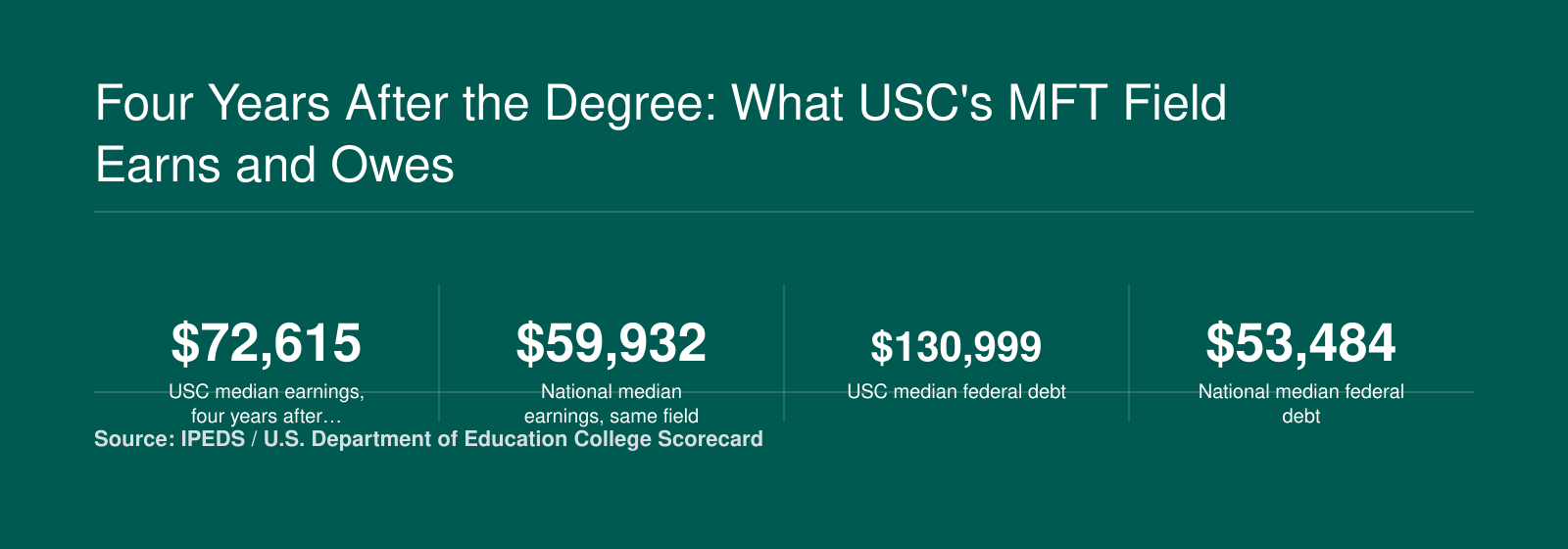
Four Years After the Degree: What USC's MFT Field Earns and Owes
Measured four years after completion, graduates of USC's master's programs in this field report median earnings of $72,615, comfortably above the $59,932 national median across the 210 schools that report. Their median federal borrowing of $130,999 runs about two and a half times the $53,484 national median. The pair is the honest version of the story: strong absolute pay, carried on unusually heavy debt. Figures come from IPEDS and the U.S. Department of Education College Scorecard.
Benchmarking: USC's MFT Price Against Other California Programs
The hardest part of pricing a California MFT master's is not finding numbers. It is finding numbers that describe the same thing. One program quotes a single year, another a three-year sequence, a third only an institution-wide average. Our directory lists marriage and family therapy master's programs at 181 schools nationally and 39 of them in California, which is why comparison needs a common lens before it needs a verdict.
Four Programs, Three Pricing Formats
Program
Format
Published cost
University of Southern California (private)
On campus, Los Angeles
$71,515 average graduate tuition and fees per year, institution-wide (IPEDS 2024); the program's own rate differs
The Loma Linda online sequence adds to $90,000 across three years1, a real total you can set beside a per-year rate. USC's $71,515 is a school-wide graduate average drawn from federal data, not a program quote, so treat it as a figure to confirm with the program rather than the bill you will receive.
Where a program does not publish a comparable figure, the table says so rather than estimating.2 A missing number is itself information: it tells you how the program presents its cost, and it is a question worth putting to an admissions office directly.
The range is the point. Across Master's Programs in California, a public Cal State route and a private online route can diverge substantially in both total cost and time to completion, and that gap rarely tracks reputation. None of this ranks the four. It tells you what to ask each one: what is the total, over how many years, and does the quoted figure cover the entire sequence?
Practicum at USC vs. California's Post-Degree Supervised Hours
Two different hour counts sit between you and a California LMFT license: the clinical hours you complete while enrolled at USC, and the supervised hours you log after the degree. They are set by different authorities, follow different rules, and are tracked in different ledgers.
What USC Requires Inside the Degree
USC's MFT master's requires 240 practicum hours. The first year centers on videotaped practice with faculty feedback; the second moves into fieldwork at practicum sites. Beyond that minimum, the program says students may complete up to 1,300 supervised clinical hours across the degree. Read that as a ceiling on what the program can support, not a promise that every student reaches it.
Placement is coordinated, not assigned. USC runs fieldwork through Tevera, the platform used to log hours and document sites, and gives students access to affiliated and selected practicum sites. Students may also propose their own site with program approval. What the published information does not show is a guarantee of placement for every student.
Where Online Students Do Their Hours
USC's online MFT program requires fieldwork in your state of residence, so clinical training is never fully remote. If you live outside Los Angeles, or outside California, you secure an approved in-person placement near you that satisfies both USC's requirements and your state's rules. Treat your location as a planning item: confirm early that approved sites and qualified supervisors exist within reach, and check with your own state board before enrolling, since hours earned under an arrangement a board does not recognize rarely transfer cleanly.
The 3,000 Hours Are a Separate Ledger
California's BBS requires 3,000 hours of post-degree supervised experience across at least 104 weeks. At least 1,750 must be direct clinical counseling, including 500 hours involving diagnosis and treatment of couples, families, or children. No more than 1,250 can be nonclinical, and no more than 40 hours count in any week. You generally must be registered as an AMFT before accruing, with a 90-day window after graduation as the exception.
The most common misread is treating the USC practicum as the first installment of that 3,000. It is not. Practicum hours are earned before the degree; the 3,000 are earned after it, as a registered associate. BBS does allow up to 1,300 pre-degree hours to be credited toward the total when its rules are met, but that credit is reviewed, not automatic for every hour logged.
USC's 240-hour requirement also clears the state's current 225-hour practicum benchmark for a qualifying degree. A 2026 BBS agenda item proposes raising that benchmark to 240, but it remains a proposal, not a rule in force.
California LMFT Licensing at a Glance
Exam Sequence, Pass Rates, and Carrying Your License to Another State
The California LMFT sequence is fixed, and taking either exam out of order costs months. Get the order right once and the rest of the timeline follows.
The Order of Events
Degree conferral comes first: the Board of Behavioral Sciences registers you as an Associate Marriage and Family Therapist only after your qualifying master's is posted, and that registration starts the clock on supervised experience. The standard pathway calls for 3,000 hours of supervised clinical and non-clinical work.
The Law and Ethics Examination can be taken while you are still accruing hours, which is why associates often sit it early. The Clinical Examination is the second gate; eligibility depends on passing Law and Ethics and finishing the required hours. Each exam carries its own fee, generally $260 to $300.
What the Pass Rates Show
BBS reports pass rates quarterly and separates first-time candidates from everyone retaking. In the third quarter of fiscal 2025/2026, 78% of first-time Law and Ethics candidates passed against 71% overall; the Clinical exam ran 80% first-time and 65% overall. That gap is the retake effect, and it is the best argument for not booking either exam early.
USC publishes its own numbers: a 92%+ Clinical exam pass rate for its MFT graduates against roughly 70% typically, and pass rates of 95 to 100% in each of the past 26 years. Those are program claims, not BBS quarterly figures, and USC does not publish completion, employment, or overall licensure rates alongside them.
Carrying the License Out of State
California has no automatic reciprocity. A California LMFT applying elsewhere goes through the destination state's process, whether endorsement, reciprocity, or a fresh out-of-state application, and most states still want their own supervised hours plus a coursework review. Online students should pick the state where they intend to practice before picking a program. COAMFTE accreditation is the variable that most often smooths an out-of-state application, because it gives a board a recognized standard to check against. A California license also does not authorize telehealth into another state on its own.
What the Debt Buys Back
USC's MFT field earns well above the national field median, but the debt load is what decides whether the degree pays off.
Marriage and Family Therapist Pay in California and Its Metro Areas
Occupational wage data from the Bureau of Labor Statistics (2025) put the median annual wage for marriage and family therapists at $66,940 nationally and $67,300 in California, with 66,740 U.S. jobs and 34,970 California jobs. The statewide median is essentially at parity with the national figure. Among California metros with a published median in this slice, Riverside-San Bernardino-Ontario stands at $68,570; Los Angeles, San Diego, San Francisco, and Sacramento did not have reported 2025 medians, so they are not shown. These are wages for licensed MFTs across all settings, not the College Scorecard program-completer earnings cited earlier in this guide, which track graduates of USC's broader mental and social health services field four years after completion. Setting can matter as much as geography: private practice offers fee control but carries overhead and insurance-panel pressure, while community mental health, school-based roles, and healthcare systems tend to follow salary schedules, public funding, and benefit structures. Treat metro medians as a starting point, not a guarantee.
Location
Median Annual Wage
Employment
United States
$66,940
66,740
California
$67,300
34,970
Riverside-San Bernardino-Ontario, CA
$68,570
N/A
USC MFT Questions, Answered Before the Details
Most prospective students want five answers before reading anything else: accreditation, clinical hours, online format, total cost, and fit with California licensure. Here is the short version of each, drawn from USC's published program information and the state's licensing rules. The sections that follow expand on every point.
Is USC's marriage and family therapy program COAMFTE accredited?
The available documentation does not show COAMFTE accreditation for USC's M.S. in Marriage and Family Therapy. USC's program page does not state it, and secondary sources report that the program does not hold it. USC as an institution is regionally accredited by the WASC Senior College and University Commission. If you need COAMFTE status for another state's license, confirm with the program directly before applying.
How many clinical hours does the USC MFT program require?
The practicum requires at least 240 direct, face-to-face client contact hours, which exceeds the 150-hour minimum California sets for master's in counseling programs in California. USC says students commonly log 400 to 500 of the state's required supervised hours during the final year, depending on placement and schedule. A secondary description mentions up to 1,300 supervised clinical hours in the degree, but USC does not present that as guaranteed.
Can you complete USC's MFT master's fully online?
Coursework is fully online and, per USC, requires no campus visits. The clinical portion works differently: students complete in-person fieldwork and experiential learning at a clinical site in their state of residence. The degree is therefore online in delivery but not in practice. Confirm that a suitable placement site exists in your state before you enroll.
How much does USC's marriage and family therapy master's cost in total?
At the 2026-2027 rate of $2,539 per unit, the 60-unit degree comes to $152,340 in tuition before mandatory fees and living costs. USC lists mandatory fees of $31 for online students and $977 for on-campus students. Expect roughly a 3 to 5 percent tuition increase each year, since the degree is usually billed across more than one academic year.
How does USC's MFT program prepare you for California LMFT licensure?
The curriculum is structured around California's degree requirements for MFT programs in California, including supervised practicum units and at least 150 face-to-face counseling hours. USC states that in-degree practicum hours count toward the state's 3,000 supervised hours, which must be completed over at least 104 weeks after graduation, and toward eligibility for the LMFT Clinical Exam.
Other master's programs at University of Southern California