Best Master's in Social Psychology Programs
Compare 20+ accredited Social Psychology programs, with graduate earnings, cost, debt, and completion data from IPEDS and the U.S. College Scorecard.

Average annual net price in this ranking ranges from roughly $12,300 at San Francisco State University to about $33,800 at Walden University, and the priciest option is not the best value. The real question is which social psychology master's programs build research skills and career traction at a price you can recover, not which carry the biggest name.
Most programs below are campus-based and thesis-driven. Walden's is fully online, and Missouri's is earned only en route to a PhD.
One constraint shapes every choice: this is a research degree. On its own, a social psychology master's does not qualify you for clinical licensure as a counselor or psychologist.
Key Points
- Program-level graduate earnings are not yet published for the social psychology master's programs ranked here.
- Only counseling-oriented degrees, ideally CACREP or MPCAC accredited, typically lead to LPC licensure.
- Assistantships, not sticker tuition, often decide what a social psychology master's costs you.
The Best Social Psychology Master's Programs, Ranked by Outcomes
These are the social psychology master's programs that made the current ranked list, with each card showing in-state and out-of-state tuition, net price, format, and concentration. The entries range from thesis-heavy doctoral preparation tracks to a fully online specialization for working professionals. Use the bullets under each program to quickly compare credit requirements, deadlines, and distinctive emphases.
University of Missouri
#1Columbia, MO · ~$14,000/yr (est.)
Best for: Doctoral-bound researchers seeking social-personality depth
The University of Missouri's MA in Psychology with an emphasis in social/personality psychology is an integrated, thesis-required route designed to be earned alongside PhD study rather than as a terminal degree. The program blends individual, contextual, and person-situation lenses with applications in health psychology and research on motivation, meaning-making, and group dynamics. It is strongest for students who already see doctoral training as the next step.
- 30 total credit hours
- Thesis required
- Integrated social and personality psychology
- Health psychology applications
- Research on motivation and meaning-making
- Earned en route to PhD
San Francisco State University
#2San Francisco, CA · $5,000 – $10,000/yr (est.)
Best for: Data-minded learners wanting quantitative thesis training
San Francisco State's Master of Arts in Psychological Science with a concentration in Social, Personality, and Affective Science prepares students for research, teaching, applied social psychology, and doctoral study. The two-year sequence emphasizes quantitative research design, supervised research, and a required thesis, with graduate teaching assistantships available to offset costs. Its fall-only admission and February 1 deadline make it a structured, cohort-centered choice.
- Two-year completion timeline
- 35 total credit hours
- Quantitative research design focus
- Required thesis
- Supervised research and applied experience
- Graduate teaching assistantships available
- Fall-only entry, February 1 deadline
University of Northern Iowa
#3Cedar Falls, IA · $12,000 – $23,000/yr (est.)
Best for: Research associate hopefuls needing empirical project work
The University of Northern Iowa's Psychology MA with a social psychology concentration is built for students aiming at a PhD or roles such as research analyst, research associate, or community college instructor. Students complete two research projects plus a thesis, with faculty involvement in ongoing research and a strong empirical methods core. Admission requires a minimum GPA of 2.75, three recommendation letters, and a statement of purpose.
- Two-year completion timeline
- Two research projects plus thesis
- Strong empirical and research methodology focus
- Faculty involve students in ongoing research
- Full consideration deadline February 1
- 2.8 minimum GPA
Ball State University
#4Muncie, IN · $10,000 – $15,000/yr (est.)
Ball State's Master of Arts in Social Psychology examines attitudes, persuasion, social cognition, prejudice, and interpersonal relationships through a multicultural and social-justice lens. Housed in a counseling psychology department, the program lets students choose a thesis or internship and offers graduate assistantships that can offset much of the tuition. It is a strong fit for market research, human resources, nonprofit work, or doctoral preparation.
- Only program housed in counseling psychology department
- Social justice, diversity, equity emphasis
- Assistantships offset most of tuition
- Small classes with individualized faculty interaction
- Join faculty research labs
- Thesis or internship option
Miami University
#5Oxford, OH · $17,000 – $38,000/yr (est.)
Miami University's MA in Psychology with a social psychology concentration combines statistics, research methods, and proseminars with hands-on thesis or non-thesis options. The terminal non-thesis track supports immediate professional application, while the thesis path prepares students for doctoral study. Small cohorts and faculty mentorship are central to the program.
- 30 total credit hours
- Thesis option for PhD-bound students
- Non-thesis terminal MA available
- GRE required
- Statistics and Methods I & II required
- Proseminar in Psychology I & II
- Fall-only admission
Illinois State University
#6Normal, IL · ~$10,000/yr (est.)
Illinois State University's Industrial/Organizational-Social Psychology master's trains scientist-practitioners with a social psychology concentration focused on interpersonal influence, social cognition, group dynamics, and applied research. The two-year, full-time program prepares graduates for research, consulting, and human services roles. Its applied framing is useful for students wanting a social psychology foundation inside organizational and real-world problem-solving contexts.
- Two concentration options
- Two-year completion timeline
- Prepares scientist-practitioners
- Focus on industrial/organizational or social psychology
- Applies psychological theory and methodology
- On-campus full-time enrollment
Walden University
#7Minneapolis, MN · ~$11,000/yr (est.)
Walden's online MS in Psychology with a Social Psychology specialization is fully online, 48 quarter credits, and can be finished in as few as 15 months. Graduates report median earnings of $46,371 one year after completion and $53,809 four years after completion. A doctoral preparation track and transfer-credit options add flexibility for working students.
- $24,105 total program tuition
- $610 per credit
- 48 total credit hours
- 15-month completion track
- Fully online option
- Accepts up to 24 transfer credits
- Doctoral preparation track
- HLC accredited university
Cost & outcomes by school
Federal data for the highest-earning Social Psychology programs, independent of the ranking above. Earnings are this field's master's graduates four years after completing, where the Scorecard reports them.
| School | Earnings | Tuition / yr | Debt | Grads/yr | Format |
|---|---|---|---|---|---|
| New York University NY | $82,490 | $42,726 | $124,403 | 390 | Campus |
| Kansas State University KS | $74,638 | $12,089 | — | 13 | Hybrid |
| University of California-Davis CA | $62,626 | $15,141 | — | — | Campus |
| Walden University MN | $53,809 | $10,885 | $41,000 | 54 | Online |
| University of Nevada-Reno NV | — | $7,032 | $30,750 | 12 | Campus |
| California State University-Sacramento CA | — | $9,542 | — | — | Campus |
| San Diego State University CA | — | $10,252 | — | — | Campus |
| Illinois State University IL | — | $10,218 | — | — | Campus |
| University of Arizona AZ | — | $14,856 | — | — | Campus |
| University of Hawaii at Manoa HI | — | $16,502 | — | — | Campus |
| Miami University OH | — | $16,751 | — | — | Campus |
| New Mexico State University NM | — | $6,605 | — | 18 | Campus |
Sources: U.S. Department of Education. Tuition and graduates: IPEDS. Earnings and debt: College Scorecard, this field's master's graduates; a dash means no figure is reported.
Cost, debt & payoff
Median earnings of this field's master's graduates (4 yrs after completing) vs. their median federal loan debt · U.S. College Scorecard
Across these programs the median graduate earns about $68,632 and finishes with roughly $41,000 in debt — a ratio that clears a common rule of thumb (keep debt below first-year salary). Tuition and debt vary widely school to school, so check the per-school figures in the table above before you shortlist.
Our Outcome-First Approach to Ranking Social Psychology Master's Degrees
Prestige tells you who gets in; we wanted to know who comes out ahead. A famous name on a diploma does not shrink a loan balance, and reputation-based lists of the best master's in psychology programs rarely say what a social psychology master's student pays or earns afterward.
What We Looked At
For each school, we weighed the figures that shape a graduate student's finances and odds of finishing:
- Graduate tuition: The published price of the degree itself.
- Net price: The institution-level average cost after grant aid.
- Earnings and debt: Program-level figures from College Scorecard, where they are published.
- Completions: How many students finish the program each year.
- Graduation rates: Institution-wide completion rates.
Where the Data Runs Out
Some limits matter. Both figures describe the whole institution, mostly undergraduates, rather than this master's program. Treat them as context, not a promise. Some programs also have no published earnings data, usually because they are small or new. We say so plainly instead of estimating, and a missing figure is a prompt to ask the admissions office, not a mark against the program.
Why This Suits Cost-Conscious Students
Reputation rankings reward research output, selectivity, and peer opinion. Those signals matter for a PhD, but they say little about whether a one- or two-year master's pays off, even for a master's in clinical psychology. Outcome data lets a lower-priced public university with solid earnings stand beside a pricier name, and it shows when the bigger name is not the better value.
Check Accreditation Yourself
Before you apply, confirm that each school holds regional accreditation using the U.S. Department of Education's database or the CHEA database. It takes a few minutes and protects your credits, your financial aid eligibility, and any later doctoral application.
What a Social Psychology Master's Really Costs: Tuition, Net Price, and Funding
How much does a social psychology master's actually cost once you account for residency, fees, and funding? The published numbers are only a starting point, and the real figure depends heavily on whether you land an assistantship.
Sticker Tuition and the Residency Gap
Among the programs ranked here, published graduate tuition spans a wide band. At the low end, San Francisco State University lists roughly $7,950 for in-state students; at the high end, Miami University posts about $18,161 in-state and more than $41,000 out-of-state. That out-of-state penalty is the single biggest cost variable at public schools: University of Missouri, for example, more than doubles from roughly $14,837 in-state to about $36,056 out-of-state. If you can establish residency after year one, the second-year savings can be substantial. Private and online options price differently again: Saint Louis University charges around $1,450 per credit, and Walden University runs the same rate regardless of where you live.
Net Price and Debt: Treat Both as Approximate
Sticker tuition is not what most students pay. Net price is an institution-wide average of total cost after grants and scholarships, drawn across all programs at a school, so it is a rough proxy rather than a line-item quote for your specific degree. Program-level earnings and median debt figures for these social psychology tracks are not yet published, so there is no reliable 10-year monthly payment estimate to cite here. Ask each department what recent graduates actually borrowed.
Funding: Expect Less Than a PhD Track
Terminal master's programs are funded far less often than doctoral tracks, and the packages that exist are competitive and limited. A few patterns from these schools:
- Full waivers tied to appointments: Illinois State University offers a 100% tuition waiver during assistantship semesters, plus up to 12 summer credits, for students enrolled in at least 9 credits.
- Stipend plus waiver: University of Memphis pays assistants $18,000 to $19,000 over 12 months for 20 hours a week and exempts out-of-state tuition.
- Partial or no funding: Western Washington University is explicitly not fully funded and may require self-funding one or two quarters, while UNC Greensboro states terminal M.A. students generally receive no departmental assistance.
One practical move before you commit: email the graduate director and ask directly how many TA and RA lines the department funds each year, and whether terminal master's students are eligible. The answer often matters more than sticker price.
Related Articles
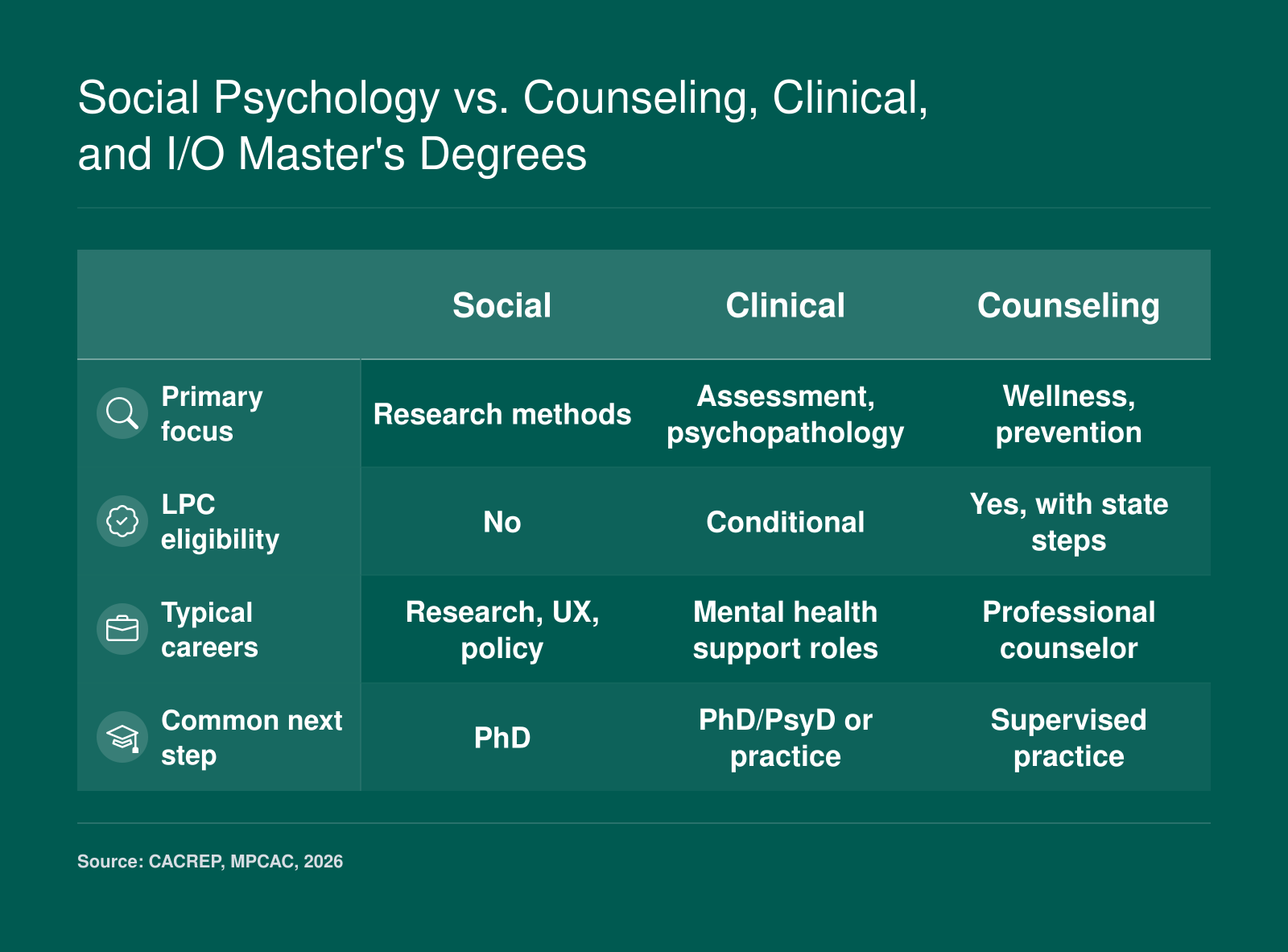
Social Psychology vs. Counseling, Clinical, and I/O Master's Degrees
These four master's degrees sound similar but lead to different careers and licenses. Only counseling-oriented programs, ideally with CACREP or MPCAC accreditation, typically lead to LPC licensure, and even then state rules, supervised hours, and an exam decide eligibility. Use the comparison below to match the degree to your goal.
Online or on Campus? Weighing Social Psychology Master's Formats
Most of the programs below are delivered on campus, a smaller group is fully online, and a few offer both. The right format depends less on convenience than on what you want the degree to do: move you into a job quickly or position you for doctoral research.
Pros
- Online study fits around a full-time job and removes relocation, so working adults can keep their income while earning the degree.
- Many online programs charge one flat per-credit rate regardless of residency, which avoids the out-of-state premium at public universities.
- On-campus students can complete a thesis in a faculty lab, the strongest credential for PhD applications in social psychology.
- Campus programs make it easier to present at conferences and to land assistantships that cover tuition or pay a stipend.
Cons
- Online students usually find fewer lab placements and research-assistant openings, which limits the research record that doctoral admissions committees weigh most.
- Faculty mentorship tends to be thinner online, so strong letters of recommendation for PhD applications can be harder to secure.
- Online formats offer less in-person networking with peers, visiting scholars, and local employers than a residential cohort does.
- Campus attendance means relocation costs, a rigid class schedule, and out-of-state tuition at public schools if you are not a resident.
Getting in: GPA, GRE, Deadlines, and Selectivity at Social Psychology Graduate Schools
Admission standards for social and experimental psychology master's programs vary widely, so treat the figures below as examples and confirm each program's current requirements before you apply.
- Bachelor's degree and prerequisitesA psychology major is preferred but not always required. RIT expects 15 semester hours including experimental psychology and statistics. UCF prefers psychology majors and looks for five undergraduate psychology courses, but it admits other majors with specific coursework. Sam Houston State evaluates your GPA in specific courses and considers research experience.
- Minimum GPAA 3.0 is the usual floor at Florida State, Sam Houston State, Illinois State, UCF, and RIT, though RIT recommends it rather than requiring it. Some schools apply it to your last 60 credits, as Illinois State and UCF do. Averages run higher: admitted students average about 3.7 at Florida State and 3.60 at Sam Houston State.
- GRE statusPolicies are split. Penn State makes the GRE optional, and Illinois State does not require it. Sam Houston State recommends it, and Florida State offers waivers. San Diego State requires it for the M.S. only, and Rochester requires it for 2027.
- DeadlinesFall deadlines run from December to April. San Diego State's document deadline is December 15, 2026, and Florida State's is January 15, 2027. Sam Houston State and RIT set February 15 priority dates, and Sam Houston State's final deadline is April 15. Michigan School of Psychology's deadline is in March. Check whether a date is a priority, final, or rolling deadline, because the labels differ.
- International applicantsFlorida State lists a minimum TOEFL iBT of 80. Michigan School of Psychology asks for 79–80 TOEFL iBT or an IELTS of 6.5, and it admits F-1 students who provide proof of financial support, health insurance, and a transcript evaluation. RIT's Experimental Psychology M.S. is STEM-OPT eligible. Fully online programs usually cannot sponsor student visas, so confirm eligibility before applying.
- Statement and recommendationsYour personal statement and letters of recommendation carry the most weight when they show research experience. Lab work, a thesis, or a faculty mentor who can speak to your methods and statistics skills will help you more than a general endorsement.
Where a Social Psychology Master's Leads: PhD Programs, UX Research, and Beyond
The real decision is between a terminal applied credential and a research apprenticeship that will carry you into a doctoral program. Both paths are legitimate, but they reward different choices during the master's.
The doctoral track
Several programs in this list make the PhD pathway explicit: the University of Missouri describes its MA as earned en route to a PhD, and San Francisco State and Northern Iowa require a thesis. Admission committees look for evidence that you can complete independent research, so a well-designed thesis is more persuasive than extra coursework. Conference posters, co-authored publications, and faculty letters that speak to your ability to manage a study can outweigh a slightly lower GPA. If a PhD is the goal, prioritize programs where you join an active lab early and leave with written research products.
The applied track
Outside academia, graduates land in roles that use social psychology's experimental, statistical, and data analytics toolkit without requiring a license.2 UX researcher is a common destination, but no single federal occupation captures that title. Market research analyst is a closer benchmark: the national median wage was $78,760 in May 2025, with the 10th percentile at $43,390 and the 90th at $155,480. Industry matters. Market research analysts in information earned a median of $102,670, compared with $77,820 in consulting services. Survey researchers ($69,460) and training and development specialists ($69,280) are adjacent options.1 Organizational consultant, program evaluator, DEI analyst, and HR analyst titles also appear, though no separate federal median isolates them. Industrial-organizational psychology roles report a high median ($193,950), but that occupation is tiny, with about 4,000 jobs nationally, and typically requires a doctorate.
What the salary data does and does not show
Program-level earnings for the social psychology master's programs ranked here are not yet published in federal data. Occupational medians are context, not a salary promise. The broad psychologist median of $99,110 in May 2025 includes licensed and doctoral-level roles and is not a realistic terminal master's forecast. The more relevant figures for a master's-level graduate are the market research, survey research, and training specialist ranges above.
The bottom line
- What you can do: Use the degree as a PhD springboard or pursue applied research roles in UX, market research, organizational consulting, program evaluation, DEI, or HR analytics.
- Where pay lands: Market research analysts show the clearest salary signal, with a $78,760 national median and wide industry variation.
- What moves PhD odds: Thesis work, conference presentations, publications, and strong faculty letters carry more weight than any single metric.
- What to verify: Check whether a program publishes placement rates and define what that rate counts before treating it as a promise.
Accreditation and Licensure: What a Social Psychology Master's Can and Can't Qualify You For
Can you become a licensed psychologist with a master's in social psychology? No. In most states the title "psychologist" requires a doctorate (PhD, PsyD, or sometimes EdD), roughly two years of supervised experience, and a passing score on the EPPP. Hour requirements differ by state: California asks for 3,000 supervised hours, including 1,500 postdoctoral, while Florida asks for 4,000, including 2,000 postdoctoral.
The Counseling Route Is a Different Degree
Licensed professional counselor (LPC) credentials are also out of reach with a social psychology master's alone. Boards generally require a counseling or closely related degree with specific coursework, a practicum or internship, and supervised clinical hours. Many states look for a CACREP- or MPCAC-accredited program of about 60 credits, though acceptance rules vary by state. If you want to practice, you will likely need a different or additional degree, such as one in Counseling Psychology.
Limited Master's-Level Exceptions
A minority of jurisdictions license master's-level psychology practitioners. A 2026 APA presentation counts 19 of them, split between independent and supervised practice.
- Independent practice: Texas (Licensed Psychological Associate), North Carolina (Licensed Psychological Associate), Arkansas, Louisiana, Vermont, Virginia, and West Virginia.
- Supervised practice: Alaska (Psychological Associate), Tennessee (Licensed Psychological Assistant), and others such as Ohio and Maryland.
- Other titles: Kansas issues a Licensed Master's Level Psychologist credential, and Delaware requires a psychology master's plus two years of supervised experience.
These boards typically specify coursework, practicum, or supervised experience, and a non-clinical social psychology curriculum may not satisfy them. No state-by-state analysis confirms that it does, so ask the board directly.
Verify Before You Enroll
- Regional accreditation: Confirm the university holds it. Most master's-license states require it.
- Program-level accreditation: If a counseling track is offered, check for CACREP or MPCAC status and whether your target state accepts it.
- State board rules: Read the board's requirements for degree content, practicum, supervised hours, and exams in the state where you plan to work.
Your long-term goal should drive the choice. A terminal master's suits research, UX, and applied roles. A direct-entry PhD is the route to the psychologist title. A counseling degree is the route to clinical practice, including an online master's in clinical mental health counseling.
Social Psychology programs by state
Social Psychology Master's Programs: Your Top Questions Answered
These are the questions prospective students ask most often when comparing social psychology master's degrees. Answers draw on 2026 program information and the outcome data used in our ranking on mastersprograms.com.
Is a social psychology master's worth the investment?
How many years does a social psychology master's take, full time vs. part time?
Do employers and PhD programs respect online social psychology master's degrees?
Is the GRE still required for social psychology master's admission?
Does APA accreditation apply to social psychology master's programs?
Compare Social Psychology programs on the data that matters
Explore more Psychology specializations or browse every graduate field.
All Psychology programs