Best Master of Arts in Teaching (MAT) Programs in Michigan
Compare 20 accredited Teaching programs in Michigan at 12 schools, with graduate earnings, cost, debt, and completion data from IPEDS and the U.S. College Scorecard.

A bachelor's degree in history or biology does not qualify someone to lead a Michigan classroom, but an MAT can turn that degree into an initial teaching certificate in roughly one to two years.
Career changers use the MAT as the fastest structured route; some campus and online options serve practicing teachers adding endorsements.
In-state tuition across the ranked programs runs from $11,113 at Calvin University to $29,156 at Andrews University, so the cost gap is real before student teaching begins.
Key Points
- Michigan State and Saginaw Valley State deliver online coursework, but student teaching always happens in a real classroom.
- Wayne State and Eastern Michigan both set a 2.75 undergraduate GPA floor for admission.
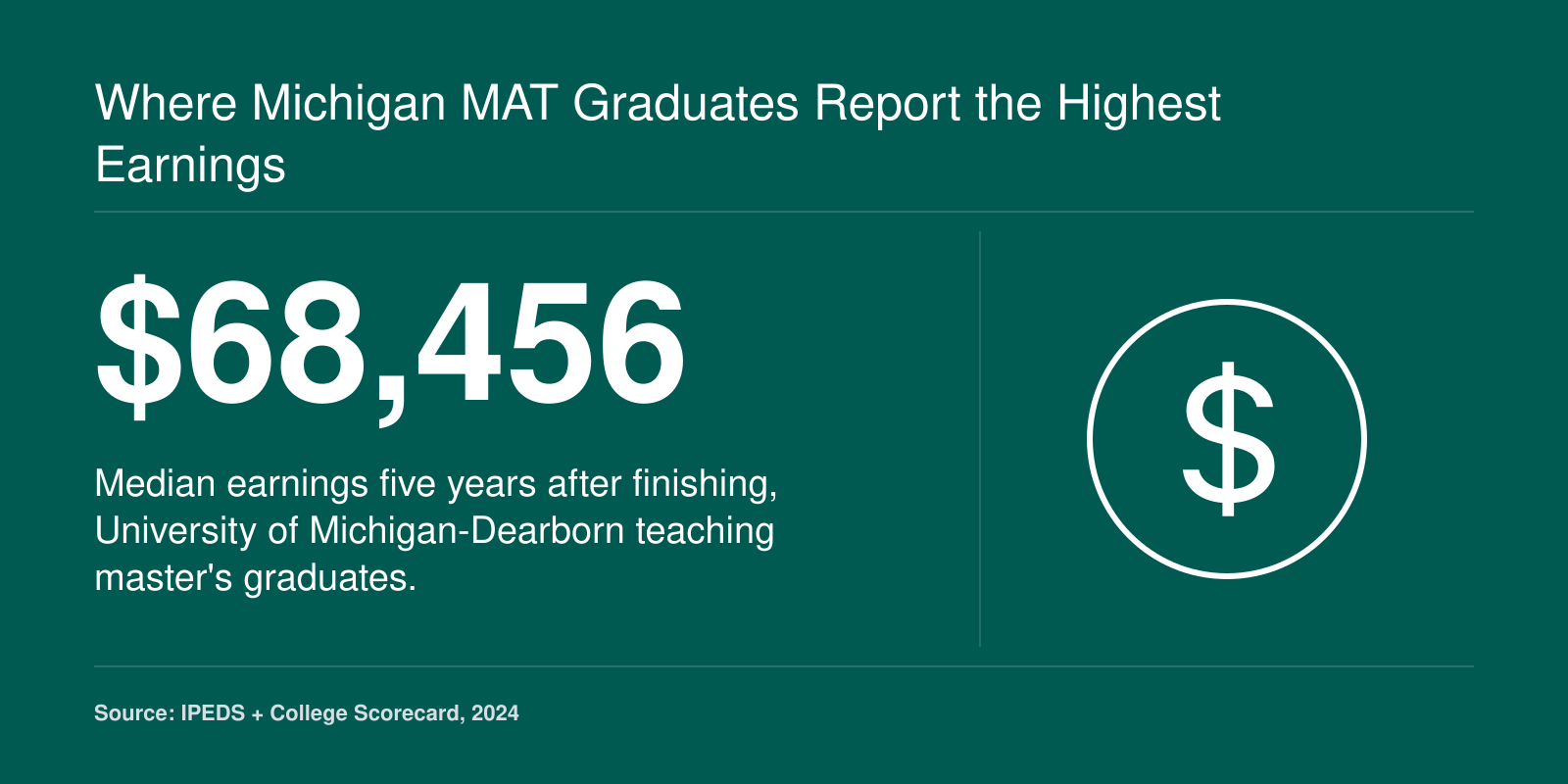
- University of Michigan-Dearborn's teaching master's earnings are federal program-level data, so treat them as directional given district pay schedules.
Top 10 MAT Programs in Michigan, Ranked
These ten Michigan schools offer Master of Arts in Teaching programs across campus, hybrid, and online formats. Concentrations range from elementary and secondary certification to special education and literacy. Where a school publishes application deadlines or start terms, they are noted below. Where it does not, we say so rather than guess.
Michigan State University
#1East Lansing, MI · $22,000 – $42,000/yr (est.)
Best for: Working teachers needing fully online study
Michigan State's Teaching and Curriculum M.A. is a 30-credit, fully online degree with eight concentration options, including Literacy and Language and K-12 ESL. It suits educators who want a research-university credential without leaving the classroom. Published deadlines are July 15 for fall (classes begin late August), November 1 for spring (January), and April 1 for summer (May).
- 30 credit hours, 100% online coursework
- Starts summer, fall, or spring
- Eight concentration options
- Includes a K-12 ESL specialization
- Prepares for the Michigan Test for Teacher Certification
- One-on-one academic advisement
- Online degree programs offered since 1998
- Literacy and Language Instruction concentration
- 30 credit hours, can be completed in about two years
- Fully online delivery
- Financial aid available
Calvin University
#2Grand Rapids, MI · ~$11,000/yr (est.)
Best for: Career changers seeking secondary certification in a cohort
Calvin's MAT is an on-campus, cohort-based route to secondary certification, designed for career changers and graduates whose undergraduate subject matches a certification field. The program is taught from a Reformed Christian perspective and includes a full year of field experience in local schools. It begins in summer and runs under 12 months across three consecutive terms. The MI Future Educator stipend and fellowship are Michigan state aid tied to teaching in a Michigan public school, not Calvin-exclusive awards.
- Summer start, cohort-based structure
- Completed in under 12 months across summer, fall, and spring
- Year-long student teaching internship
- Applicants take the MTTC in their intended area during the application process
- Prepares for Michigan teaching certification
- Courses include Curriculum, Instruction, and Content Area Literacy
- Faculty mentorship and career connections
Andrews University
#3Berrien Springs, MI · $25,000 – $30,000/yr (est.)
Best for: Elementary-track students wanting flexible start terms
Andrews offers three MAT tracks (elementary, secondary, and secondary content area), each 32 credits and listing CAEP accreditation. Graduates can earn both North American Division and Michigan certification. Admissions are rolling with fall, summer, and spring starts. The school publishes no fixed 2026-2027 deadline dates in the sources we reviewed, so confirm timing with the School of Education.
- 32 credit hours, about two years full-time
- Covers child development, curriculum design, and classroom management
- Earns North American Division and Michigan certification
- 2.6 GPA minimum and two recommendations
- Field placements with district partners
- Approved by the state of Michigan
- Certification with the master's degree
- Partnerships with districts and unions
- TOEFL or IELTS for non-native English speakers
- Subject-area track within the secondary MAT
- Rolling admissions across fall, spring, and summer
- Scholarships and financial aid available
- International students welcome
University of Michigan-Dearborn
#4Dearborn, MI · ~$17,000/yr (est.)
UM-Dearborn's MAT is an initial-certification route for career changers with a bachelor's degree who want to teach middle or high school. Students pick a concentration (English/language arts, integrated science, mathematics, or social studies) and a grade band. The GRE is not required, admissions are rolling, and some courses have hybrid sections. Graduates who pass the Michigan Test for Teacher Certification are recommended for a Michigan Standard Teaching Certificate.
- 37 graduate credits plus undergraduate concentration coursework
- Four concentrations: English/language arts, integrated science, math, social studies
- Grade bands of 5 to 9 or 7 to 12
- 3.0 GPA, two recommendations, and a statement of purpose
- No entrance exam required
- Full-time student teaching in the final semester
- Early clinical work in secondary classrooms
Wayne State University
#5Detroit, MI · ~$18,000/yr (est.)
Wayne State pairs a CAEP-accredited secondary MAT with an early and elementary option, both with multiple start terms each year. The secondary route leads to grades 7-12 certification in English, math, science, or social studies and includes a full-time student teaching semester. Published secondary deadlines are August 15 for fall, December 15 for winter, and April 15 for spring/summer. Applicants must complete content-area coursework before admission.
- Grades 7-12 certification in English, math, science, or social studies
- 30 credit hours with a full-time student teaching semester
- 3.0 GPA for the degree; 2.50 suffices for the certificate
- Content-area prerequisites required before admission
- Fall, winter, and spring starts
- Grade bands of PK-3 or 3-6
- 30 credit hours with clinical experiences and student teaching
- Prepares for Michigan teacher certification exams
- Transcript evaluation and prerequisite courses required
Oakland University
#6Rochester Hills, MI · ~$22,000/yr (est.)
Oakland offers three MAT options: secondary and elementary programs for career changers, and a reading and language arts degree for certified teachers. The secondary and elementary programs are hybrid, cohort-based, and meet evenings, which suits working professionals. The secondary program starts each fall, and the reading program leads to a Michigan reading endorsement.
- Grades 6-12 Michigan certification plus a master's degree
- 44 credit hours, two-year cohort with evening classes
- Fall start only
- Prerequisites and 30 hours of youth experience required
- No GRE or GMAT required
- Hybrid, cohort-based, two evening classes per week
- 3.0 GPA minimum and one recommendation
- 100 field hours and 15-week full-time student teaching
- Two location options
- 32 credit hours with thesis or capstone option
- Designed for already certified teachers
- Earns a Michigan reading endorsement
- Summer Reading Clinics for hands-on training
Madonna University
#7Livonia, MI · $15,000 – $20,000/yr (est.)
Madonna's MAT with a specialization in Autism Spectrum Disorders is built for certified teachers who want to move into special education or autism-focused roles. It requires 41 credit hours and supervised practicum placements in local schools and agencies. Graduates work as special education teachers, autism specialists, consultants, and behavior interventionists.
- Minimum 41 credit hours
- Valid teaching certificate required for admission
- Coursework in assessment and curriculum development for ASD
- Supervised practicum in schools and agencies
- Graduate certificate in Effective Inclusionary Practices also offered
Western Michigan University
#8Kalamazoo, MI · $20,000 – $25,000/yr (est.)
Western Michigan's secondary MAT is a campus-based, cohort program that leads to grades 7-12 certification in about 18 months. It centers on a full-year co-teaching internship with mentor support and a culturally responsive, justice-informed curriculum. Military benefits and employer tuition reimbursement are supported. The graduate catalog lists general deadlines, but we found no MAT-specific 2026-2027 dates, so check with the program.
- 18-month cohort program, campus-based
- Certification for grades 7-12
- Full-year co-teaching internship with mentor support
- Culturally responsive, justice-informed curriculum
- Military benefits and employer reimbursement supported
- Scholarships and financial aid available
Saginaw Valley State University
#9University Center, MI · $15,000 – $20,000/yr (est.)
Saginaw Valley State offers three MAT options: an online early childhood program, a hybrid special education program, and an online K-12 literacy specialist degree. The early childhood program leads to Michigan certification for birth through kindergarten, and its page cites the lowest graduate tuition in Michigan. The literacy track adds a Reading Specialist Endorsement and suits working educators.
- 30 credit hours, online with synchronous and asynchronous sessions
- Prepares for Michigan certification, birth through kindergarten
- Aligned with NAEYC standards
- Lists CAEP accreditation
- 37 credit hours with a required capstone
- Three concentration options, hybrid delivery
- Foundation courses within the first 15 credits
- Graduate Certificate in ABA also available
- Non-certified candidates need coordinator approval
- Two-year online program for working educators
- Earns a Reading Specialist Endorsement
- Lists CAEP and IRA accreditation
- Prepares for the Michigan Test for Teacher Certification
Eastern Michigan University
#10Ypsilanti, MI · $15,000 – $20,000/yr (est.)
Eastern Michigan's online MAT in Special Education is for people without a teaching certificate who want to enter special education. Students choose autism, cognitive impairment, emotional impairment, learning disabilities, or physical/other health impairment. Admissions are rolling with six entry points each year. It leads to an initial K-12 special education endorsement, not elementary or secondary certification.
- Five concentration options, fully online
- Rolling admissions with six starts: Summer A/B, Fall A/B, Winter A/B
- 2.7 cumulative GPA, or 3.0 in the final half of the degree
- Two references required
- Supervised student teaching internship
- Initial special education endorsement only
Cost & outcomes by school
Federal data for the highest-earning Teaching programs, independent of the ranking above. Earnings are this field's master's graduates four years after completing, where the Scorecard reports them.
| School | Earnings | Tuition / yr | Debt | Grads/yr | Format |
|---|---|---|---|---|---|
| Wayne State University MI | $66,118 | $17,960 | $41,009 | 47 | Campus |
| Saginaw Valley State University MI | $60,900 | $18,360 | $37,239 | 7 | Online |
| University of Michigan-Flint MI | $60,469 | $14,473 | $33,121 | 12 | Hybrid |
| Oakland University MI | $57,431 | $21,960 | $38,801 | 56 | Hybrid |
| Eastern Michigan University MI | $57,394 | $17,968 | — | 19 | Online |
| Western Michigan University MI | $56,135 | $20,103 | $31,253 | 38 | Campus |
| Aquinas College MI | — | $12,844 | — | — | Campus |
| Michigan State University MI | — | $21,772 | — | — | Online |
| Calvin University MI | — | $11,113 | — | 2 | Campus |
| University of Michigan-Dearborn MI | — | $17,126 | — | 7 | Campus |
| Madonna University MI | — | $18,000 | — | 2 | Campus |
| Andrews University MI | — | $29,156 | — | 1 | Campus |
Sources: U.S. Department of Education. Tuition and graduates: IPEDS. Earnings and debt: College Scorecard, this field's master's graduates; a dash means no figure is reported.
Cost, debt & payoff
Median earnings of this field's master's graduates (4 yrs after completing) vs. their median federal loan debt · U.S. College Scorecard
Across these programs the median graduate earns about $60,685 and finishes with roughly $37,239 in debt — a ratio that clears a common rule of thumb (keep debt below first-year salary). Tuition and debt vary widely school to school, so check the per-school figures in the table above before you shortlist.
What Earned a Spot on This List of MAT Programs in Michigan
Cost and outcomes come first because Master's Programs in Michigan matter only if they lead to a classroom. Placement reflects graduate tuition, net price after aid, and whether a program is offered on campus, online, or hybrid. Graduation rates are also considered, but they describe each university as a whole, not the MAT alone.
Accreditation of the educator preparation unit is a separate check:
- Verified: Wayne State and Michigan State (CAEP, initial and advanced levels)1, and University of Michigan-Dearborn (AAQEP, first accredited in 2026)2.
- Needs a current check: Eastern Michigan reported CAEP accreditation through June 30, 2025, and was in reaccreditation.3 Its 2026 status could not be confirmed.
- Not confirmed: Calvin's accreditation covers a Master of Education, not the Master of Arts in Teaching (MAT). Andrews and Saginaw Valley State cite CAEP on their program pages, but we could not verify it in a directory.1 Oakland, Western Michigan, and Madonna could not be confirmed either.1
Online and Hybrid MAT Programs in Michigan
Online delivery in Michigan education and teaching master's programs covers coursework only; student teaching always happens in a real classroom. Michigan State University and Saginaw Valley State University (early childhood) deliver online. Eastern Michigan University offers a fully online special education option. Oakland University runs a hybrid secondary program and a mostly online special education MAT with evening synchronous sessions. University of Michigan-Dearborn mixes evening and online courses, with most coursework asynchronous. Calvin University and Wayne State University are campus-based; Western Michigan's special education MAT is fully online.
Published detail on residencies is thin, so ask each admissions office whether any campus visits are required. Saginaw Valley's early childhood program is described as combining live virtual sessions with self-paced work.
Universities arrange placements through a field-experience office; verify early that it can place you near home. Oakland requires 100+ clinical hours before a 15-week internship.
Tip: if your employer won't release you for a full-time internship, choose the program whose clinical calendar you can actually meet, not the one with the most flexible lectures.
Michigan Teacher Certification at a Glance
Which Michigan Master's in Teaching Programs Waive or Skip the GRE?
Wayne State and Eastern Michigan both set a 2.75 undergraduate GPA floor, and that number usually matters more than any test score. Michigan State does not require the GRE but reviews scores you send, placing it among No-GRE master's programs, and wants a 3.0 in your final two years. University of Michigan-Dearborn and Oakland University do not require the GRE or GMAT, though Dearborn will consider scores you choose to submit. Wayne State, Eastern Michigan, Andrews, Madonna, Western Michigan and Saginaw Valley state no testing policy in their admissions material, so ask rather than assume a waiver. Calvin's listing mentions an entrance exam, and Oakland's secondary track lists SAT, so confirm what each means.
Content prerequisites are the real gatekeeper for secondary candidates. Wayne State requires prerequisites of every applicant, and its English Language Arts 7-12 path lists extensive coursework. Eastern Michigan requires C or better in deficiency courses and a passing MTTC subject test before certification. Expect a background check before classroom placements.
Tip: before applying, request a transcript evaluation and written prerequisite plan, so missing credits do not delay your admission.
Related Articles
What a Michigan MAT Costs and What Certification Requires
The table shows the most affordable programs here, using federal estimates of total program tuition (in-state and out-of-state) beside each institution's average net price. Net price is an institution-wide average, not a quote for a master's student, and per-credit rates change, so confirm both with the school. Certification adds costs: MTTC test fees, a Michigan Department of Education application fee (valid 24 months from payment), and a full-time student-teaching semester that can limit paid work. Dollar amounts for those fees were not confirmed, so check current figures. Aid can offset them: the MI Future Educator Fellowship ($10,000 for tuition and required fees, with a Michigan public school service commitment), the Student Teacher Stipend (up to $9,600 for a required semester of at least 300 hours), the federal TEACH Grant (service obligation applies), and graduate assistantships.
| School | Program | Total credits | Est. program tuition, in-state | Est. program tuition, out-of-state | Avg. net price (institution-wide) |
|---|---|---|---|---|---|
| Oakland University | MAT in Secondary Education (hybrid) | 44 | $21,960 | $24,648 | $9,120 |
| University of Michigan-Dearborn | Teaching, MA (campus) | 37 | $17,126 | $30,350 | $9,492 |
| Saginaw Valley State University | MAT, Early Childhood Classroom Teaching (online) | 30 | $18,360 | $18,360 | $10,775 |
| Andrews University | MAT, Elementary Education (campus) | 32 | $29,156 | $29,156 | $12,547 |
| Wayne State University | MAT, Secondary Education (campus) | 30 | $17,960 | $36,542 | $12,766 |
Where Michigan MAT Graduates Report the Highest Earnings
The figure below comes from federal College Scorecard data for graduates of the University of Michigan-Dearborn teaching master's program, not from an institution-wide average. A teacher's earnings depend heavily on district salary schedules, so treat this number as directional.
Choosing Your Master's in Teaching Pathway: Elementary, Secondary, or Special Education
Wayne State's elementary education MAT (PreK-3 or 3-6) and Western Michigan's 16-month elementary cohort are designed for non-education bachelor's holders, while Saginaw Valley State offers an early childhood MAT spanning birth to age 8. Secondary education options at Wayne State, Western Michigan, and Andrews University require undergraduate content-area credits that match the endorsement, including English, math, science, social studies, biology, and world languages. Eastern Michigan's special education MAT is explicitly for non-certified teachers and leads to an initial special education endorsement; Western Michigan also offers a fully online K-12 master's in special education online program.
Michigan's 2026 vacancy data shows elevated rates in special education (5.2%), world languages (3.3%), and science (2.6%). Those shortage patterns make STEM, special education, and world languages a practical tiebreaker. Match your undergraduate transcript to an endorsement area before you apply.
Michigan MAT Questions, Answered
These answers draw on Michigan Department of Education guidance for certification, out-of-state applicants, and alternative routes. Program-specific details such as cost, format, and deadlines vary by school, so confirm them on each admissions page.
Which Michigan MAT program is best for initial teacher certification?
What is the total cost of a MAT program in Michigan?
Which Michigan MAT programs are fully online?
Can I teach in Michigan with an out-of-state bachelor's degree?
Can I enroll in a Michigan MAT if my bachelor's degree isn't in education?
When are 2026-2027 application deadlines for Michigan MAT programs?
Does a Michigan MAT program need CAEP accreditation for my certificate to count?
Can I work as a paid teacher while finishing a Michigan MAT?
Compare Teaching programs on the data that matters
Explore more Education & Teaching specializations or browse every graduate field.
All Education & Teaching programs