Best Master's in Finance Programs in Colorado
Compare 6 accredited Finance programs in Colorado at 4 schools, with graduate earnings, cost, debt, and completion data from IPEDS and the U.S. College Scorecard.

Published tuition for a Colorado master's in finance runs from $23,850 in-state at CU Denver to $51,090 a year at the University of Denver, for degrees that feed the same investment, corporate finance, and risk roles.
Format varies too. Boulder's nine-month on-campus format fits the Accelerated Master's in Finance Programs category, Colorado State's is a 30-credit year, and CU Denver offers hybrid and fully online routes. Testing rules differ as well; several programs appear on our list of Master's in Finance Programs With No GMAT or GRE Required.
Of everything separating these degrees, price is the widest gap.
Key Points
- CU Denver's tuition starts at $9,298 in-state, while the University of Denver charges $42,173.
- Both CU Boulder Leeds finance programs make GMAT and GRE scores optional; Colorado State asks for one unless waived.
- CU Denver offers hybrid and fully online study; only 43% passed the August 2026 CFA Level I exam.
Top-Ranked Master's in Finance Programs in Colorado
Colorado's finance master's options range from a one-year, campus-based program in Boulder to a hybrid and fully online degree in Denver. Each school below sits in a business school with AACSB accreditation, which is an institution-level credential rather than proof of separate program-level accreditation. Compare the tuition figures, formats, and fit notes against your own budget and schedule.
University of Colorado Boulder
#1Boulder, CO · $15,000 – $20,000/yr (est.)
Best for: Recent graduates wanting an immersive campus year
The University of Colorado Boulder houses its Master's in Finance in the Leeds School of Business, which holds AACSB accreditation. The school graduates about 74% of its students, and federal data lists graduate tuition of $14,970 in-state and $37,138 out-of-state. Leeds reports a #43 U.S. News 2026 finance specialty ranking, which is a business-school measure rather than a standalone ranking of this master's. The program is a nine-month, on-campus course of study with three concentrations.
- Nine-month on-campus program in Boulder, starting in August
- Focuses on evaluating investments and building financial models
- Targets investment analyst and financial planner roles
- 3.0 GPA minimum; GMAT and GRE are optional
- Leads toward corporate finance and consulting careers
- Applications for the 2026 cycle were due October 5
- Automatic admission offered to CU seniors
- Applies financial modeling and investing training to sustainable finance
- Leeds is ranked for faculty research contributions
- Mentorship from industry experts; alumni include Morgan Stanley staff
University of Denver
#2Denver, CO · ~$42,000/yr (est.)
Best for: Quant-minded students aiming for CFA credentials
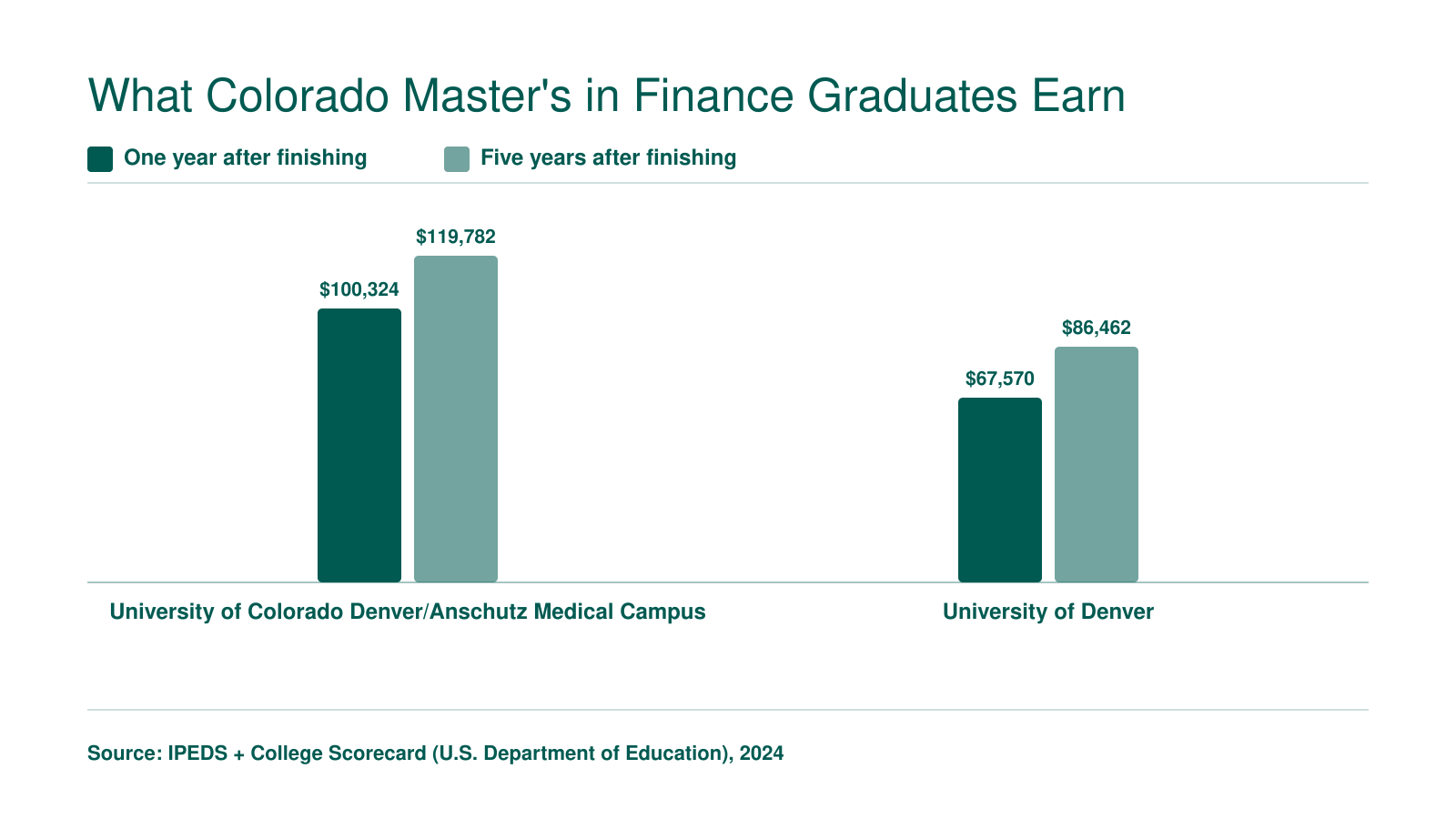
The University of Denver teaches its MS in Applied Quantitative Finance through the Daniels College of Business, which holds AACSB accreditation. The school graduates about 76% of its students. Graduate tuition is the same $40,885 for residents and nonresidents, the highest sticker price among Colorado's four options. The degree is STEM-designated and quantitative, with a hands-on investment course and CFA exam preparation. College Scorecard shows median earnings of $67,570 one year after completion for a small graduate cohort.
- Business Finance track covers corporate finance, FP&A, and treasury
- 45 credit hours, finishable in about 10 months
- Full-time or part-time, with day or evening options
- Fall and spring starts; prerequisite courses required
- STEM-designated, with a 24-month OPT extension for F-1 students
- Manage real money through the Marsico Investment Center
- Prepares for CFA exams, with CFA scholarships sponsored
- Complimentary S&P Capital IQ subscription
Colorado State University-Fort Collins
#3Fort Collins, CO · ~$14,000/yr (est.)
Best for: Budget-minded students from Western states
Colorado State University in Fort Collins offers a Master of Finance through its AACSB-accredited College of Business. The school graduates about 67% of its students, and federal data lists graduate tuition of $11,494 in-state and $28,182 out-of-state. Western Regional Graduate Program eligibility can extend resident rates to students from other Western states. The STEM-designated program is quantitative and runs on campus.
- One-year, 30-credit on-campus program, with a two-year option
- STEM-designated, with a 24-month OPT extension for internationals
- Finance lab with 16 Bloomberg terminals
- Student-managed stock portfolio worth over $400,000
- Teaches VBA, R, and Stata
- Prepares for the CFA and FRM exams
- Dual degree available with the Impact MBA
- Fall admission only; 2026 cycle deadline of December 1 is listed
University of Colorado Denver/Anschutz Medical Campus
#4Denver, CO · $5,000 – $10,000/yr (est.)
CU Denver's business school is AACSB-accredited and offers the most flexible format here, including a fully online option and evening hybrid classes. The school graduates about 46% of its students, a lower institution-wide rate than the other three, but it has the lowest graduate tuition in the group at $8,352 in-state and $26,208 out-of-state. CU Denver cites TFE Times 2026 as naming it the #1 MS Finance program in Colorado and #46 nationally, though that page describes its current degree as an MS in FinTech, so the label may not match this program. College Scorecard shows median earnings of $100,324 one year after completion.
- 30 credit hours with five specializations, including commodities and risk management and insurance
- Fully online asynchronous option, or hybrid evening classes once weekly
- Eight-week sessions with fall, spring, and summer starts
- Affiliated with the CFA Institute University Affiliation Program
- Commodities and Finance Lab with Bloomberg, Morningstar, and CQG
- 3.3 GPA minimum; GMAT and GRE are optional
- In-state tuition offered to students from western states
- MBA dual degree options
Cost & outcomes by school
Federal data for the highest-earning Finance programs, independent of the ranking above. Earnings are this field's master's graduates four years after completing, where the Scorecard reports them.
| School | Earnings | Tuition / yr | Debt | Grads/yr | Format |
|---|---|---|---|---|---|
| University of Colorado Denver/Anschutz Medical Campus CO | $134,158 | $9,298 | $23,376 | 28 | Hybrid |
| University of Denver CO | $97,649 | $42,173 | — | — | Campus |
| Colorado State University-Fort Collins CO | — | $14,125 | — | — | Campus |
| University of Colorado Boulder CO | — | $16,634 | — | 35 | Campus |
Sources: U.S. Department of Education. Tuition and graduates: IPEDS. Earnings and debt: College Scorecard, this field's master's graduates; a dash means no figure is reported.
Online and Hybrid Master's in Finance Options in Colorado
The main trade-off for Master's Programs in Colorado is scheduling flexibility versus the recruiting access that an in-person Denver finance network provides.
Yes, you can earn a master's in finance in Colorado fully online. CU Denver's Master's in Finance and Risk Management is the hybrid option here, with a fully online track and once-weekly evening hybrid classes, and it's one of the Best Online Master's in Finance Programs. Online tuition is not a single flat rate. CU Denver publishes resident/WRGP and nonresident online per-credit rates, and out-of-state students in eligible western states may qualify for the Western Regional Graduate Program discount.
CU Boulder's MS in Finance is a nine-month in-person program, and Colorado State University's Master of Finance is an on-campus 30-credit program. For those, residency-based tuition applies to in-person enrollment rather than a separate online format.
For working professionals, the practical trade-off is clear. Online and evening formats make it easier to keep a job while studying. In-person Denver-area programs tend to offer closer access to local firms, alumni events, and internship pipelines. If flexibility is the priority, the fully online route covers the degree. If you want face-to-face recruiting, the campus programs may be the stronger fit.
Which Colorado Master's in Finance Programs Waive or Make the GRE Optional
Both CU Boulder Leeds finance programs make GMAT and GRE scores optional, while Colorado State asks for a score unless you petition for a waiver. The table reflects each school's own admissions pages. No cohort size or selectivity figure appears on those pages, so none is listed. If your GPA is near a school's threshold or your background is not quantitative, a strong score (especially the quantitative section) can still strengthen your file even where it is optional.
| School | Program | GMAT/GRE Policy | Waiver Criteria | Application Deadline |
|---|---|---|---|---|
| University of Colorado Boulder | Master's in Finance (Leeds) | Test scores optional | Automatic admission for currently enrolled CU undergraduate seniors with a Leeds major or minor and a GPA of 3.0 or higher | Round 2: Nov. 30, 2026; Round 3: Feb. 1, 2027; final international: Mar. 3, 2027; final domestic: June 1, 2027 (Round 1 closed Oct. 5, 2026) |
| University of Colorado Boulder | MS Finance PPC Comp (Leeds) | Test scores optional | Automatic admission for Business Minors, Leeds graduates, and CU graduates with a GPA of at least 3.0 | No current deadline published (last posted: final international May 29, 2023; final domestic July 3, 2023) |
| Colorado State University-Fort Collins | Master of Finance | GMAT or GRE accepted; recommended GMAT Focus 555 or above or combined GRE 320 or higher; quantitative section is critical | Petition for a GMAT waiver after applying online. Generally required: GPA above 3.2, good grades in prerequisites, and a business or quantitative degree or relevant finance work experience. Prerequisites: calculus, business statistics, and accounting | Fall admission only: Feb. 1 (full financial consideration); May 1 international; July 1 U.S. |
| Colorado State University-Fort Collins | Impact MBA and Master of Finance dual degree | GMAT or GRE accepted; recommended GMAT Focus 555 or above or combined GRE 320 or higher; scores required of all Impact MBA applicants for Fall 2026 | Waiver petition filed after the online application. Generally required: GPA above 3.2, good prerequisite grades, and a business or quantitative degree or relevant finance work experience. Statistics prerequisite not needed on the recommended dual-degree roadmap | May 1 international; July 1 U.S. |
Related Articles
Cost of a Master's in Finance in Colorado and CFA/FRM Certification Prep
What the degree costs
Published tuition for Colorado's master's in finance programs runs from $23,850 in-state at CU Denver, the cheapest option here, to $51,090 a year at the University of Denver, the most expensive. DU charges residents and non-residents alike. The residency gap is widest at Colorado State: $25,198 in-state versus $42,387 out-of-state.
The full degree is a better yardstick than one year, especially among the most affordable master's in finance programs. All three public programs below require 30 credits:
- CU Boulder: About $38,759 for residents and $53,609 for non-residents over two semesters, including $953 in required fees.
- Colorado State: About $25,198 for residents and $42,387 for non-residents, with fees included.
- CU Denver: $23,850 for residents (or western-state WRGP participants) and $27,870 for online non-residents, before fees and prerequisite courses.
DU's $51,090 per year comes from a third-party listing, so confirm it with the school. Institution-wide average net price after aid is only a rough guide, roughly $11,900 at CU Denver and $36,000 at DU, and says little about a master's student's actual bill.
Certification prep
Colorado has no state license tied to a finance degree, so the credentials that matter are professional ones: the CFA and FRM. Colorado State advertises preparation for both the CFA and FRM exams. DU advertises CFA exam preparation and sponsored CFA exam scholarships.
If you plan to sit for those exams, weigh that support against the price gap. A cheaper in-state degree with exam-aligned coursework can beat a costlier program that offers little certification help.
Only 43% of candidates passed the August 2026 CFA Level I exam, the most recent published result, and first-time test takers did better at 49%. With odds like that, a master's in finance whose coursework tracks the CFA body of knowledge can give students a real head start.
What Colorado Master's in Finance Graduates Earn
Median earnings for graduates of the finance master's programs below, shown one year and five years after finishing. At the University of Colorado Denver/Anschutz Medical Campus, median program debt is $23,376, which works out to about $266 a month over 10 years. Compare that borrowing against the earnings gain shown here.
Master's in Finance in Colorado: Common Questions
Which Colorado Master's in Finance program is best for investment banking?
What jobs can I get with a Master's in Finance in Colorado?
Are there online Master's in Finance programs in Colorado?
Compare Finance programs on the data that matters
Explore more Business & Management specializations or browse every graduate field.
All Business & Management programs