Master's in Finance Programs With No GMAT or GRE Required
Compare 340+ accredited no-gre Finance programs at 290+ schools, with graduate earnings, cost, debt, and completion data from IPEDS and the U.S. College Scorecard.

An MS in Finance built on a GMAT score means months of prep and a test fee, but a growing share of programs now let you skip that step. The catch is that "no GMAT" covers three different policies: no test at all, test-optional, or a waiver granted only to applicants with strong GPAs or work experience.
The ranking below includes test-optional programs at schools such as Florida State, Johns Hopkins, and Northeastern, each with different costs. Total tuition runs from roughly $15,000 at a public flagship to well over $100,000 at a private program. Skipping the exam does not make admission easier, so a strong quantitative record still decides who gets in.
Key Points
- Graduate tuition ranges from $11,524 at CUNY to $64,730 at Johns Hopkins.
- GMAT and GRE waivers are common for finance master's in 2027.
- Online no-GMAT finance timelines range from 12 to 24 months.
Top 10 No-GMAT Master's in Finance Programs for 2027
These finance master's programs waive or make the GMAT or GRE optional, letting you apply without an exam score. The list orders schools by a balance of test-waiver eligibility, student retention, completion, and institutional quality. We also weigh cost and earnings, but the main filter is no-test admission.
Florida State University
#1Tallahassee, FL · ~$11,000/yr (est.)
Best for: CFA-focused learners wanting trading-room experience
Florida State's MSF pairs rigorous finance training with real money management. Students use Bloomberg terminals and FactSet workstations in a trading room and help run an $11 million student-managed fund. The curriculum aligns with CFA and CAIA exams and offers STEM designation. Small classes and assistantships that include tuition waivers add value for applicants skipping the GMAT or GRE.
- No GMAT or GRE required; test-optional
- 32 credits across three semesters
- CFA and CAIA aligned curriculum
- Bloomberg terminals and FactSet workstations
- $11 million student-managed investment fund
- STEM-designated degree
- Assistantships include tuition waiver
- Small, interactive class sizes
- Real estate concentration: analysts, lenders, asset managers
- Internship can replace in-person course
Lehigh University
#2Bethlehem, PA · ~$29,000/yr (est.)
Best for: Aspiring quants wanting applied finance projects
Lehigh's MS in Quantitative Finance is a 36-credit, three-semester cohort program that blends math, statistics, and finance. Students study stochastic calculus, portfolio optimization, fixed income and FX markets, and AI programming for finance. The curriculum includes derivatives, blockchain foundations, and a two-part industry capstone. It is designed for careers in asset management, risk, trading, and financial data science.
- No GMAT or GRE required; test-optional
- 36 credits over three semesters
- Cohort-based structure
- Two-part industry capstone
- AI programming for finance
- Rigorous quantitative methods training
- Computational tools for modern finance
- Financial data analytics emphasis
Rutgers University
#3New Brunswick, NJ · ~$23,000/yr (est.)
Best for: Future CFA charterholders seeking New York proximity
Rutgers Business School's Master of Financial Analysis is a one-year, 33-credit program built around the CFA curriculum. As a CFA Institute-affiliated school, it covers all three exam levels and offers full-time or part-time study on the Livingston campus near New York City. The STEM designation provides up to 36 months of practical training for international students. Graduates typically pursue financial analyst, investment associate, and portfolio manager roles.
- No GMAT or GRE required; test-optional
- One-year, 33-credit program
- CFA Institute-affiliated school
- Prepares for all three CFA exam levels
- Full-time and part-time options
- STEM program with 36-month OPT
- Classes on Livingston campus, 25 miles from NYC
- Career management and services
Johns Hopkins University
#4Baltimore, MD · ~$65,000/yr (est.)
Johns Hopkins' MS in Finance is taught through the Carey Business School and pairs financial theory with data science and AI. The curriculum aligns with the CFA exams and includes Python-based courses like Financial Data Analytics and Machine Learning for Finance. Students can study fully online or on campus and can participate in the Student Managed Investment Fund. The STEM-designated program offers fall, spring, and summer starts and typically takes two to three years part-time.
- Fully online option
- No GMAT or GRE required; test-optional
- $2,060 per credit, 30 credits
- Three start dates per year
- CFA-aligned curriculum
- Python-based finance courses
- Student Managed Investment Fund
- Employer tuition reimbursement supported
- Campus format with Financial Econometrics focus
- $94,500 total program tuition, 36 credits
- 12-month program
- Manage a $500k+ student portfolio
- Electives in fintech and machine learning
- STEM-designated program
- Baltimore and Washington, D.C. campuses
Northeastern University
#5Boston, MA · ~$29,000/yr (est.)
Northeastern's part-time MS in Finance is an evening program in Boston designed for working professionals. The curriculum prepares students for the CFA exams and includes access to the student-managed 360 Huntington Fund and Bloomberg Certification. AACSB accreditation signals program quality. Graduates have been hired by Fidelity Investments, State Street, IBM, and Raytheon.
- No GMAT or GRE required; test-optional
- $57,930 total program tuition
- Part-time evening classes in Boston
- Prepare for CFA designation
- Student-managed 360 Huntington Fund
- Bloomberg Certification available
- Graduates hired at Fidelity Investments
- AACSB accredited
University of Miami
#6Coral Gables, FL · ~$47,000/yr (est.)
University of Miami's online MS in Finance is a 33-credit, 16-month cohort program with three start dates per year. Core courses cover asset pricing, corporate finance, business valuation, derivatives, and quantitative portfolio management. Electives include fixed income, private equity, and financial analytics using AI and machine learning. The program emphasizes quantitative and analytical skills and is designed for careers like financial analyst, financial manager, and personal financial adviser.
- No GMAT or GRE required; test-optional
- 16-month program, 33 credits
- Three start dates per year
- Cohort-based structure
- Electives in fintech and machine learning
- Quantitative and analytical skills focus
- One letter of recommendation
- Integrates modeling and data analytics
University of Minnesota-Twin Cities
#7Minneapolis, MN · ~$22,000/yr (est.)
The Carlson School's MS in Finance is a full-time, on-campus program with four concentrations, including Asset Management, Corporate Finance, Healthcare Finance, and Finance Research. Students manage one of the nation's largest student-run investment funds, the David S. Kidwell Funds Enterprise, with over $50 million in real assets. The STEM-designated degree runs 10 or 16 months and is cohort-based. The program reports a 91% job placement rate and a $76,545 average starting base salary.
- Asset Management concentration
- No GMAT or GRE required; test-optional
- 10-month or 16-month track
- Manages over $50 million in real assets
- 2nd largest student-managed investment fund
- 91% job placement rate
- Average starting base salary $76,545
- STEM-designated degree
- Corporate Finance concentration
- Internship option in 16-month track
- Daytime on-campus classes
- Top employers: Citibank, Deloitte, U.S. Bank
- Guaranteed scholarship for early applicants
- Personalized 1:1 career coaching
- Healthcare Finance concentration
- Guaranteed scholarship for Nov 1 applicants
- Classes held during the day
- Recruiters include Piper Sandler and Deloitte
- Finance Research concentration
- Research track prepares for PhD
- CapIQ and Bloomberg Terminal access
- Hired by Piper Sandler and Citibank
- Cohort-based learning model
George Washington University
#8Washington, DC · ~$36,000/yr (est.)
GW's MS in Finance is a 48-credit, STEM-designated degree with a strong quantitative focus. Students learn Python, MATLAB, and SAS and use Bloomberg Terminals in the Capital Markets Room. Each course is co-taught by an industry practitioner and an academic researcher. The D.C. campus places students near the IMF, World Bank, and major banks, with many graduates entering financial analysis, trading, and risk management.
- No GMAT or GRE required; test-optional
- $111,500 total program tuition
- 48 credits, 12-month program
- CFA Institute accredited
- Courses co-taught by industry professionals
- Hands-on Bloomberg Terminal training
- Cohorts of 40-46 students
- Saturday classes for working professionals
Case Western Reserve University
#9Cleveland, OH · ~$54,000/yr (est.)
Case Western's Master of Finance at the Weatherhead School combines financial theory with hands-on practice. The 30-credit core can be completed in two semesters, with optional specializations like Financial Big Data Analytics, Corporate Financial Analytics, and Risk Management Analytics. Students work on corporate projects, attend executive seminars, and use the Bloomberg Lab. Graduates move into M&A, valuation, private equity, and analytics roles.
- No GMAT or GRE required; test-optional
- 9-month program, 30 credits
- 5 concentration options included
- STEM-eligible Master of Finance degree
- Bloomberg Lab for investment research
- Corporate projects and internships
- Seminars in private equity, REITs
- Digital banking and fixed-income hedging
New York University
#10New York, NY · ~$43,000/yr (est.)
NYU Tandon's MS in Financial Engineering focuses on finance and risk engineering, combining derivative securities modeling, quantitative methods, and machine learning. The 33-credit program includes a summer boot camp, applied lab, and capstone that can be a project, internship, or thesis. Full-time students finish in four semesters, with part-time options available. Graduates pursue roles as quant strategists, risk analysts, traders, and fintech data scientists.
- No GMAT or GRE required; test-optional
- 33 credits across four semesters
- Finance and Risk Engineering concentration
- Summer boot camp before coursework
- Bloomberg Market Concepts certification required
- 240-hour internship capstone option
- Cross-register up to 9 credits at NYU
- Ranked #11 by QuantNet for 2026
Cost & outcomes by school
Federal data for the highest-earning Finance programs, independent of the ranking above. Earnings are this field's master's graduates four years after completing, where the Scorecard reports them.
| School | Earnings | Tuition / yr | Debt | Grads/yr | Format |
|---|---|---|---|---|---|
| University of South Dakota SD | — | $7,118 | — | — | Hybrid |
| Concordia University-Saint Paul MN | — | $8,550 | — | — | Online |
| Columbia College MO | — | $8,477 | — | — | Online |
| American Public University System WV | — | $8,700 | — | — | Online |
| California State University-Fullerton CA | — | $8,994 | — | — | Campus |
| Indiana University-Northwest IN | — | $8,925 | — | — | Online |
| Herzing University-Birmingham AL | — | $9,370 | — | — | Online |
| Herzing University-Atlanta GA | — | $9,370 | — | — | Online |
| Herzing University-Madison WI | — | $9,370 | — | — | Online |
| Herzing University-Orlando FL | — | $9,370 | — | — | Online |
| Herzing University-New Orleans LA | — | $9,370 | — | — | Online |
| Herzing University-Kenosha WI | — | $9,370 | — | — | Online |
Sources: U.S. Department of Education. Tuition and graduates: IPEDS. Earnings and debt: College Scorecard, this field's master's graduates; a dash means no figure is reported.
Cost, debt & payoff
Median earnings of this field's master's graduates (4 yrs after completing) vs. their median federal loan debt · U.S. College Scorecard
Across these programs the median graduate earns about $113,855 and finishes with roughly $39,725 in debt — a ratio that clears a common rule of thumb (keep debt below first-year salary). Tuition and debt vary widely school to school, so check the per-school figures in the table above before you shortlist.
No-Test, Test-Optional, or Waiver: What 'No GMAT' Really Means
Entrance exams have quietly stopped being the gatekeeper for specialized master's in finance programs, but "no GMAT" is marketing shorthand covering three different policies.
The three policies
- No test required: Scores are not part of the decision. Iowa's Tippie College of Business states the GMAT or GRE is not required for admission at any point, though a score can still strengthen an application or scholarship case.1 Arizona State's W. P. Carey School takes a similar line.2
- Test-optional: You may submit if a score helps you. The University at Buffalo, USC Marshall, Texas McCombs, and MIT Sloan all accept applications without one, and McCombs says omitting a score does not disadvantage you.345 San Diego accepts scores only from the last five years.6
- Waiver-based: The exam is expected unless you meet stated conditions. Boston University Questrom reviews no-score applicants case by case, weighing academic record and relevant full-time work, and may still request a score later.7
When to submit anyway
If your transcript is light on calculus, statistics, or econometrics, a strong quantitative score is the cheapest way to answer that doubt. MIT Sloan encourages score-holders to send results as additional evidence.5
Check the program page, not the school page
So, do you need the GMAT or GRE? Usually no. But an MBA in Finance and a master's in finance at the same university often follow different rules, as can online and on-campus versions. Some programs also set a floor on GPA: USC Marshall and Iowa both reference a 3.0 minimum.31
What You'll Need Instead of a GMAT or GRE Score
Most no-test finance master's programs replace the GMAT or GRE with a closer look at your academic record and quantitative preparation. Typical requirements include:
- Bachelor's degreeA U.S. bachelor's or equivalent from an accredited institution is required.
- Minimum GPAUsually around 3.0, though some programs review upper-division or quantitative grades and ask 3.2-3.3.
- Quantitative prerequisitesCalculus and statistics are common; linear algebra, finite math, or precalculus may also appear, with strong grades supporting a waiver.
- Resume or work experienceNot always required, but relevant finance or analytical experience can substitute for a test score at several programs.
- Letters of recommendationTypically expected; the number and preferred recommenders vary by school.
- Personal statement or interviewAn essay usually explains your goals and, if relevant, why a waiver is justified; some programs may also interview.
- International applicantsEnglish proficiency via TOEFL, IELTS, or Duolingo with program-specific minimums, plus WES or ECE credential evaluation if your degree is from outside the U.S.
Related Articles
Tuition, Net Price, and Earnings at No-Test Finance Schools
Graduate tuition across these No-GRE master's programs runs from $11,524 for New York residents at CUNY Brooklyn College to $64,730 at Johns Hopkins, a spread of more than five to one for degrees that often sit at the same 30 to 36 credit length.
Residency can swing the bill by $22,000
At public universities, residency drives most of the master's in finance cost difference. University of Colorado Boulder charges residents $16,634 against $38,802 for everyone else. University of Illinois Chicago runs $17,550 in-state versus $27,748. Private programs (Lehigh at $28,840, Northeastern at $29,174, Case Western at $53,980) charge one rate regardless.
Net price figures you may see quoted for these institutions, such as roughly $60,800 at CUNY Brooklyn College or about $87,600 at Johns Hopkins, are campus-wide averages after aid weighted heavily toward undergraduates. Use them as context, not as a quote for a finance master's.
What graduates actually earn and owe
Northeastern finance master's graduates post a median of $119,202 one year after finishing and $169,234 four years out, against median program debt of $36,150 and a ten-year payment near $411 a month. Johns Hopkins graduates show $99,791 one year after finishing and $152,415 at four years, with $50,975 in debt and roughly $580 monthly. Case Western reports $86,483 one year out; Miami, $107,285.
Before applying, set that monthly payment against a realistic first-year salary. At both Hopkins and Northeastern it lands under 8 percent of first-year median earnings, which is manageable. Anything approaching 15 percent deserves a harder look.
Finance programs in CFA Institute's University Affiliation Program commonly report covering 70 percent or more of the CFA curriculum. Students enrolled at an affiliated university can apply for a CFA Institute Student Scholarship, which, for awards made since March 2026, reduces CFA exam registration to $600. Before you enroll, ask any no-GMAT program whether it holds affiliation.
Online vs. On-Campus No-GRE Finance Master's: How the Formats Compare
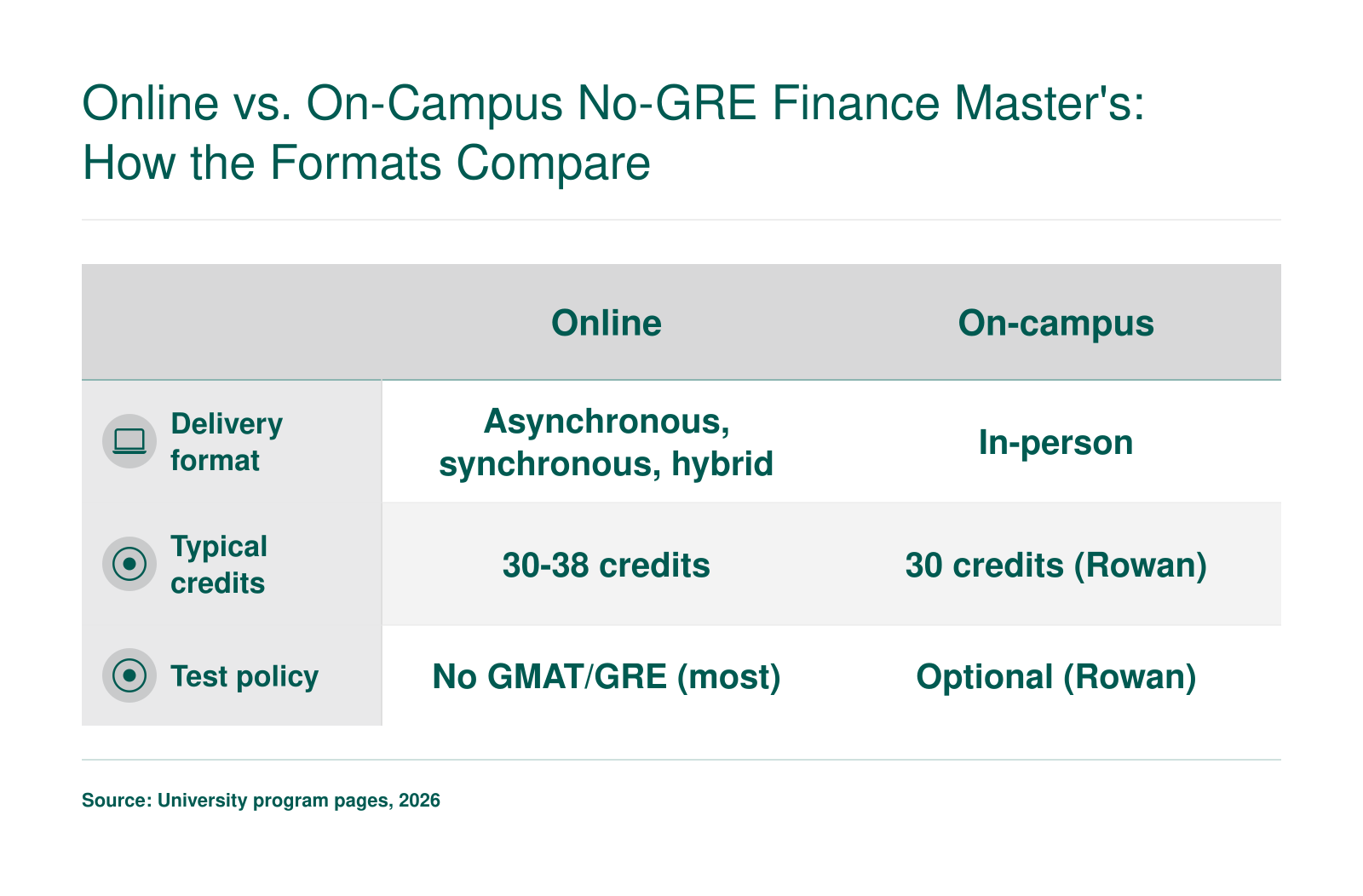
Online no-GMAT finance master's timelines vary by pace. Accelerated paths can run about 16 months at William & Mary, while the University of Cincinnati describes a 12-24 month range and Washington University in St. Louis runs 24 months. Delivery differs too: Golden Gate and the University of Arizona are asynchronous, Washington University mixes live and self-paced work, and Marquette offers both fully online and online/on-campus options. On-campus programs such as Rowan make the GMAT or GRE optional, so students can often choose the format that fits a full-time job.
Finance programs by state
Frequently Asked Questions About No-GMAT Finance Master's Degrees
Common questions about test-optional admission, accreditation, international waivers, and employer expectations, answered briefly for prospective students.
What is the difference between test-optional and no GMAT required?
Are no-GMAT finance master's programs accredited?
Can international students get a GMAT waiver for a master's in finance?
Will skipping the GMAT hurt my chances with finance employers?
Compare Finance programs on the data that matters
Explore more Business & Management specializations or browse every graduate field.
All Business & Management programs