Best Master's in Finance Programs in Oregon
Compare 5 accredited Finance programs in Oregon, with graduate earnings, cost, debt, and completion data from IPEDS and the U.S. College Scorecard.

Resident tuition for an Oregon master's in finance runs from $16,206 at Oregon State University to $50,164 at Willamette University. The real question is which program earns back that price, on campus, online, or hybrid, even among the most affordable master's in finance programs.
Every ranked Oregon program appears here on one page, campus and online together, led by University of Portland. Tuition, graduate salaries, the availability of master's in finance programs with no GMAT or GRE required, and CFA preparation differ more than the short list suggests.
Online flexibility is scarce: Oregon State is the only school here with a fully online route.
Key Points
- University of Portland tops the 2027 ranking with a STEM-designated, AACSB-accredited MS.
- Oregon State University offers the only fully online finance master's path.
- University of Oregon's ten-month MSF uses a CFA-aligned curriculum.
Best Master's in Finance Schools in Oregon: 2027 Rankings
University of Portland leads this list for its STEM-designated, AACSB-accredited MS in Finance that pairs CFA-aligned coursework with small Portland classes. Below are five Oregon finance master's options compared across campus and online delivery, tuition, and institution-wide graduation rates.
University of Portland
#1Portland, OR · ~$27,000/yr (est.)
Best for: Campus-based quantitative finance students
University of Portland's Master of Science in Finance offers a STEM-designated, AACSB-accredited curriculum that combines quantitative methods with ethical leadership rooted in the Holy Cross tradition. The 30- to 33-credit program allows a thesis or non-thesis path, with electives in real estate finance and sports finance sponsorship. Classes are small, and coursework aligns with CFA exam material.
- 30- to 33-credit curriculum
- STEM-designated finance program
- Prepares for CFA
- AACSB accredited
- 3.2 GPA minimum
- Entrance exam required
Oregon State University
#2Corvallis, OR · $15,000 – $20,000/yr (est.)
Best for: Online learners wanting high job placement
Oregon State University delivers a 45-credit finance master's fully online or in Corvallis through its AACSB-accredited College of Business. The curriculum spans investments, portfolio analysis, derivatives, and financial modeling, capped by a required project. Students can join the student-run Oregon State Investment Group, which manages over $4 million, and the program reports a 97% job placement rate.
- Fully online option with Corvallis in-person track
- 97% job placement rate
- AACSB accredited
- 45 total credit hours
- Student-run fund manages over $4 million
- Capstone required
- Investments, derivatives, financial modeling
Portland State University
#3Portland, OR · ~$18,000/yr (est.)
Best for: Accelerated full-time career switchers
Portland State University's STEM-designated Master of Science in Finance is a 12-month full-time program based in Portland's financial district, with part-time options running up to 24 months. Students gain Bloomberg Terminal certification, work with AI-supported finance tools, and manage a student stock fund. The program holds AACSB accreditation and CFA Institute University Affiliate status, and a dual MSF/MBA option is available.
- STEM-designated master's degree
- CFA Institute University Affiliate
- Bloomberg Terminal certification
- AI-supported finance curriculum
- 12-month full-time or 18-24 month part-time
- Student-managed stock fund
- Dual MSF and MBA degree option
University of Oregon
#4Eugene, OR · ~$19,000/yr (est.)
The University of Oregon's Master of Science in Finance is an intensive 10-month, 45-credit program taught in person in Eugene. The CFA Institute-recognized, STEM-certified curriculum covers investments, corporate finance, and wealth management, and students manage over $1 million through the Cameron Center. The program reports an 88% job placement rate and $76K average starting salary.
- 10-month full-time program
- 45 total credit hours
- CFA Institute-recognized curriculum
- STEM-certified; 36-month OPT work option
- Manage over $1 million in real money
- 88% job placement rate
- $76K average starting salary
- Study tours to financial hubs
Willamette University
#5Salem, OR · $50,000 – $55,000/yr (est.)
Willamette University's MS in Accounting and Finance blends both disciplines into a 40-credit, 12-month Salem program. Students evaluate Pacific Northwest startups through the Angel Investing class, manage a live portfolio in the O'Neill Student Investment Fund, and use AI and coding tools. The curriculum prepares graduates for CPA and CFA pathways.
- 40 total credit hours
- Prepares for CPA and CFA
- Manage real money in student fund
- Evaluate startups in Angel Investing class
- Curriculum includes AI and coding
- 12-month full-time or 24-month option
Cost & outcomes by school
Federal data for the highest-earning Finance programs, independent of the ranking above. Earnings are this field's master's graduates four years after completing, where the Scorecard reports them.
| School | Earnings | Tuition / yr | Debt | Grads/yr | Format |
|---|---|---|---|---|---|
| Portland State University OR | $113,459 | $17,745 | — | — | Campus |
| Oregon State University OR | — | $16,206 | — | — | Online |
| University of Oregon OR | — | $19,474 | — | 1 | Campus |
| Willamette University OR | — | $50,164 | — | — | Campus |
| University of Portland OR | — | $27,000 | — | 4 | Campus |
Sources: U.S. Department of Education. Tuition and graduates: IPEDS. Earnings and debt: College Scorecard, this field's master's graduates; a dash means no figure is reported.
How We Rank Oregon Master's in Finance Programs
What makes one Oregon master's in finance a better choice than another? We look at results you can verify, not reputation surveys. Rankings weigh tuition, net price, graduation rate, and, where available, program-level earnings and debt for graduates.
The figures come from the federal College Scorecard and IPEDS, using the latest snapshot available for each school.
A few limits are worth knowing. Graduation rate and net price are school-wide figures, not finance-program results, so treat them as context rather than a promise about one cohort. Some smaller programs have too few graduates for the federal government to publish program-level earnings. In those cases we rely on the remaining measures instead of guessing. Use the rankings to build a shortlist, then confirm current tuition and requirements with the admissions office at any school on our Master's Programs in Oregon list.
Online and Hybrid Master's in Finance Programs in Oregon
Working professionals want flexibility, but Oregon offers little of it in finance, and the options that exist differ a lot in format.
Oregon State University is the only school here with a fully online master's in finance program. Its Specialized Master's in Finance can be completed 100% online or in person in Corvallis. The program's pages do not state a completion time or specific start terms, so confirm both before applying, along with whether any on-campus requirement applies online.
Portland State University is the best fit for part-time study. Its Master of Science in Finance is 45 credits, with classes typically on weekday evenings starting at 5:30 p.m. Full-time students finish in about 12 months, and part-timers in 18 to 24 months depending on electives. Fall is the preferred start, and Winter is more limited. Portland State's pages do not clearly establish an online format, so treat it as an evening program.
University of Oregon's MSF is an accelerated master's in finance program in person in Eugene, full time, 10 months, with a fall start. University of Portland and Willamette University are listed as campus programs, so working professionals should look at Oregon State or Portland State first.
Oregon Master's in Finance Tuition Comparison: Resident vs. Nonresident
Tuition figures below use IPEDS and College Scorecard data for each school. Resident and nonresident graduate tuition show the residency gap at public universities, while private institutions list the same rate in both columns. Average net price is an institution-wide figure after aid, not a program-level quote. For University of Oregon, the business school lists full-time 2026-27 MSF tuition at $37,056 resident and $48,424 nonresident, with separate graduate student fees of $3,780 and a $570 matriculation fee; this differs from the institution-wide graduate tuition shown here. Willamette University describes its Accounting and Finance program as 40 credits over 12 months, but the sources reviewed do not publish a program-specific 2026-27 tuition total. Funding is generally not fully funded: University of Oregon offers merit-based MSF scholarships up to $5,000, Oregon State University offers a one-time Beaver for Life scholarship up to $3,000 for qualifying alumni with a 3.0 GPA, and Willamette University says no separate scholarship application is required. Graduate assistantships and tuition remission are not consistently published for these programs.
| School | In-state graduate tuition | Out-of-state graduate tuition | Average net price | Format |
|---|---|---|---|---|
| Portland State University | $11,679 | $31,074 | $9,552 | Campus |
| Oregon State University | $14,400 | $38,190 | $19,604 | Online, with in-person option in Corvallis |
| University of Oregon | $16,137 | $44,598 | $22,182 | Campus |
| Willamette University | $51,156 | $51,156 | $25,121 | Campus |
| University of Portland | $58,100 | $58,100 | $28,210 | Campus |
Related Articles
From Master's in Finance to CFA Charter: The Credential Path
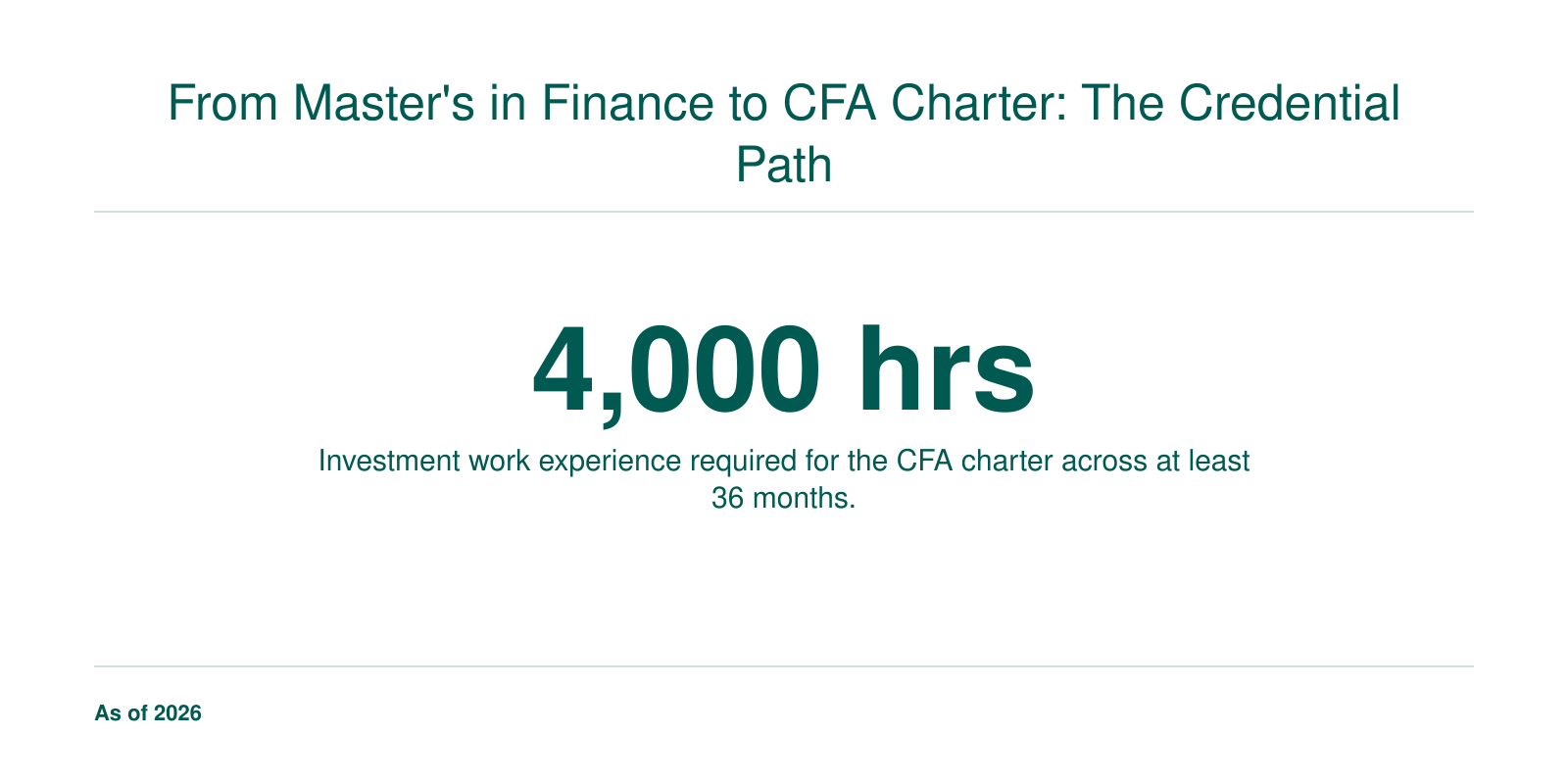
The CFA charter path runs through a finance master's program, then CFA Levels I, II, and III, then at least 4,000 hours of investment work experience over a minimum of three years. University of Oregon's ten-month MSF uses CFA-aligned curriculum and offers students two chances to manage more than $1 million in real money, with more than 70% receiving a scholarship.
Oregon Licensing for Finance Careers
Questions About Master's in Finance Programs in Oregon
These answers cover common questions about Oregon finance master's programs, including admissions, deadlines, international enrollment, and degree prerequisites. Specific requirements change, so confirm details with each program before applying.
Which Oregon universities offer a master's in finance?
Can international students enroll in Oregon master's in finance programs, and are any STEM-designated for OPT extension?
When are application deadlines for Oregon finance master's programs?
Can I start a master's in finance without a business undergraduate degree?
Compare Finance programs on the data that matters
Explore more Business & Management specializations or browse every graduate field.
All Business & Management programs