Best Online Master's in Finance Programs
Compare 140+ accredited online Finance programs, with graduate earnings, cost, debt, and completion data from IPEDS and the U.S. College Scorecard.

Many graduate finance programs use the word "online" while still requiring an in-person orientation, a campus weekend, or a live exam site. The filter here is stricter: every program below can be completed without a single required campus visit.
Across the schools ranked here, in-state graduate tuition runs from $9,353 to $64,730 a year, so the all-in cost gap is substantial before fees and books. The real decision factors are concrete: true 100% online delivery, net price versus early finance earnings and debt, admission paths that require no GMAT or GRE, CFA or financial-planning alignment, and weekly workload. Fit usually depends on how much live class time a working schedule can absorb.
Key Points
- Fordham University reports the highest published median earnings among ranked programs.
- Most programs require 30 to 36 total credits though pacing varies.
- Several online programs add distance learning technology and software fees beyond tuition.
Best Fully Online Master's in Finance Programs for 2027
These are the top fully online master's in finance programs for 2027, with hybrid and in-person-residency formats excluded. The order reflects a blend of fully online delivery, baseline quality signals such as cost and institution-wide completion, and program-level outcomes where published. No single measure drives the ranking.
Florida International University
#1Miami, FL · ~$11,000/yr (est.)
Best for: CFA-focused fully online learners
Florida International University's online Master of Science in Finance is built around financial innovation, with coursework in FinTech, Python coding, big data, and core areas like corporate finance, investment banking, and fund management. The program is a CFA Institute University Affiliation Program and prepares students for Level I of the CFA exam. Recent program-level outcomes data show median earnings around $74,348 one year after finishing. The 12-month, fully online format has two starts per year and a total tuition of $30,000 for Florida residents or $33,600 for nonresidents and international students.
- $30,000 total program tuition for Florida residents; $33,600 for nonresidents and international students.
- Complete in about 12 months with a one-year format and two start dates per year.
- CFA Institute University Affiliation Program with Level I exam preparation.
- Curriculum covers FinTech, Python coding, big data, corporate finance, and investment banking.
- Fully online option with spring and fall starts.
- Online students can add Bloomberg Market Concepts certification remotely.
Johns Hopkins University
#2Baltimore, MD · ~$65,000/yr (est.)
Best for: Data-science-minded working professionals
Johns Hopkins University's online MS in Finance through the Carey Business School pairs financial theory with data science and AI, including Python-based courses and electives in fintech, private equity, blockchain, and mergers and acquisitions. The program is STEM-designated and aligned with the CFA exams, and students can join the Student Managed Investment Fund. Recent outcomes data show median earnings near $99,791 one year after finishing. A part-time, fully online format with three start dates suits working professionals.
- CFA-aligned curriculum with Python-based financial data analytics and machine learning courses.
- No entrance exam required; GMAT and GRE are optional.
- $2,060 per credit for 30 total credit hours.
- Full-time and part-time options with fall, spring, and summer starts.
- STEM-designated program with Student Managed Investment Fund participation.
- Scholarships up to $25,000 and employer reimbursement supported.
- Class sizes of 28 to 60 with AI tools integrated into coursework.
Auburn University
#3Auburn, AL · $13,000 – $34,000/yr (est.)
Best for: Online learners wanting campus parity
Auburn University's MS in Finance in the Harbert College of Business delivers the same curriculum online as on campus, centered on financial theory, quantitative methods, and valuation. The program adds leadership workshops, professional development training, and a global business immersion trip to prepare students for risk management, trading, and corporate finance roles. Dual MBA and graduate certificate options allow stacking credentials without much additional time. The fully online option carries the same expectation of quality as the campus path.
- Fully online option with the same curriculum as the on-campus program.
- Financial theory, quantitative methods, and valuation focus.
- Careers preparation for risk management, trading, and investments.
- Exclusive leadership workshops and global business immersion trip.
- MBA dual degree option and stackable graduate certificates available.
- Financial aid available.
William & Mary
#4Williamsburg, VA · $15,000 – $20,000/yr (est.)
William & Mary's Online Master of Science in Finance is a 32-credit, 16-month program organized around four pillars: principled value creation, financial modeling and analysis, global financial strategy, and communication of complex financial information. The fully online format requires no GMAT or GRE and includes case analysis, simulations, and Excel modeling. Students can add Corporate Finance or Investment Management certificates, and an optional residency weekend offers face-to-face networking. The program targets corporate finance, investment management, commercial banking, and CFO tracks.
- No GMAT or GRE required for admission.
- 32 total credit hours, 8 total courses, and 16-month completion.
- Four-pillar curriculum covering value creation, modeling, global strategy, and communication.
- Optional weekend residency for face-to-face networking.
- Stackable Corporate Finance or Investment Management certificates available.
- 7.5-week course format with three start dates per year.
- One-on-one faculty office hours and academic advisor support.
University of Oklahoma – Hudson College of Public Health
#5Norman, OK · ~$9,000/yr (est.)
The University of Oklahoma's online MS in Finance is offered through the AACSB-accredited Price College of Business and takes 32 credit hours, typically finishing in as little as 16 months with two classes every eight weeks. The format combines synchronous and asynchronous learning, including required live Zoom lectures twice a week, and the curriculum holds CFA Institute University Affiliation Program recognition. Admission requires a bachelor's degree with a 3.0 GPA, a resume, a personal statement, two letters of recommendation, and GRE or GMAT scores that are waived at a 3.0 GPA. Total tuition is $32,480, at $1,015 per credit, plus a $350 admission deposit.
- AACSB-accredited Price College of Business program.
- $1,015 per credit and $32,480 total program tuition.
- 16 courses, 32 credit hours, and completion in as little as 16 months.
- Live Zoom lectures twice weekly at 7 pm CT plus asynchronous sessions.
- CFA Institute University Affiliation Program recognition.
- Requires GRE or GMAT scores, waived with a 3.0 GPA.
- Transfer up to 12 credit hours.
University of Miami
#6Coral Gables, FL · ~$47,000/yr (est.)
The University of Miami's online Master of Science in Finance is a 33-credit, 16-month lock-step cohort program with starts in August, January, or May. Core courses cover asset pricing, corporate finance and governance, business valuation, financial derivatives, and quantitative portfolio management, while electives can add fixed income, private equity, or AI and machine learning-based financial analytics. The program threads modeling, data analytics, and technology throughout the curriculum. Recent program-level outcomes data report median earnings around $107,285 one year after finishing, and admission is test optional with one recommendation and a personal statement.
- No entrance exam required; GMAT and GRE are optional.
- 33 total credit hours and 16-month cohort-based lock-step sequence.
- Core courses include asset pricing, corporate finance, valuation, derivatives, and portfolio management.
- Electives in fixed income, private equity, venture capital, and AI-driven financial analytics.
- Three start dates in August, January, and May.
- One letter of recommendation and a personal statement required.
- Curriculum integrates modeling, data analytics, and technology throughout.
Saint Joseph's University - Philadelphia
#7Philadelphia, PA · ~$20,000/yr (est.)
Saint Joseph's University's Master of Science in Finance is a 30-credit, AACSB-accredited, 100% online program with courses in portfolio management, security analysis, and mergers and acquisitions. Students can finish in 1 to 1.5 years full time or about two years part time, and rolling admissions offer fall, spring, and summer starts. Small virtual classes connect students to faculty and classmates, while the location in Philadelphia links the program to the city's financial network and Fortune 500 employers. Tuition starts at $1,240 per credit.
- AACSB accredited and 100% online.
- $1,240 per credit with 30 total credit hours.
- Full-time completion in 1 to 1.5 years or part-time in about 2 years.
- Rolling admissions with fall, spring, and summer starts.
- Courses include Portfolio Management, Security Analysis, and Mergers and Acquisitions.
- Small virtual class sizes and career counseling for graduate students.
- Military benefits, employer reimbursement, and 10% alumni discount available.
Marquette University
#8Milwaukee, WI · ~$25,000/yr (est.)
Marquette University's Master of Science in Finance blends theory with technical skills, including advanced financial management, financial econometrics, and hands-on training in R, Python, and SQL. Electives let students explore fintech, sustainable finance, investment banking, behavioral finance, and real estate finance. A capstone professional project pairs each student with a faculty mentor to apply econometric methods to real finance questions. The degree can be completed fully online with full-time, part-time, or a one-year accelerated pathway.
- Fully online option with full-time, part-time, and accelerated pathways.
- Curriculum covers advanced financial management, financial econometrics, and investments.
- Hands-on training in R, Python, and SQL.
- Electives in fintech, sustainable finance, investment banking, behavioral finance, and real estate.
- Capstone professional project with one-on-one faculty mentoring.
- One-year accelerated pathway available.
University of Dayton
#9Dayton, OH · ~$20,000/yr (est.)
University of Dayton's Master of Finance is a 30-credit, STEM-designated program with a fully online, self-paced track for working professionals, requiring 12 to 24 months. The curriculum aligns with CFA Level I and can include a FinTech certificate in blockchain, machine learning, and algorithmic trading. Students get access to two investment centers with Bloomberg, FactSet, and Morningstar Direct for hands-on portfolio and ESG investing work. Graduates pursue banking, investment management, private equity, and corporate finance roles.
- AACSB accredited and STEM-designated finance program.
- 30 total credit hours and completion in 12 to 24 months.
- Asynchronous online classes for working professionals.
- CFA Level I prep course and CFA Institute affiliated curriculum.
- Access to two investment centers with Bloomberg, FactSet, and Morningstar Direct.
- Optional FinTech certificate in blockchain, machine learning, and algorithmic trading.
- 24-month OPT extension available for international graduates.
- Requires GMAT or GRE; no thesis or capstone required.
Golden Gate University
#10San Francisco, CA · ~$17,000/yr (est.)
Golden Gate University's MS in Finance is a 30-credit, STEM-designated degree built for working adults and available fully online. The curriculum covers corporate finance, investment analysis, financial modeling, valuation, forecasting, and risk management, and weaves in AI tools and CFA exam preparation. No GMAT or GRE is required. Recent program-level outcomes data show median earnings around $80,748 one year after finishing.
- No GMAT or GRE required; test optional admission.
- $1,090 per credit, 30 total credit hours, and 16-month completion.
- STEM-designated with 24-month STEM OPT extension available.
- CFA exam preparation built into the curriculum.
- Core courses cover corporate finance, investment analysis, valuation, forecasting, and risk management.
- Fully online asynchronous classes with fall, spring, and summer starts.
- Finance internship course elective and San Francisco Financial District networking access.
- Military benefits, financial aid, and scholarships available.
Cost & outcomes by school
Federal data for the highest-earning Finance programs, independent of the ranking above. Earnings are this field's master's graduates four years after completing, where the Scorecard reports them.
| School | Earnings | Tuition / yr | Debt | Grads/yr | Format |
|---|---|---|---|---|---|
| University of South Dakota SD | — | $7,118 | — | — | Hybrid |
| Wichita State University KS | — | $7,986 | — | — | Hybrid |
| New Mexico Highlands University NM | — | $8,016 | — | — | Hybrid |
| Abraham Lincoln University CA | — | $8,160 | — | — | Online |
| Concordia University-Saint Paul MN | — | $8,550 | — | — | Online |
| Columbia College MO | — | $8,477 | — | — | Online |
| The University of Texas Rio Grande Valley TX | — | $8,589 | — | — | Online |
| The University of Texas at Tyler TX | — | $8,480 | — | — | Hybrid |
| American Public University System WV | — | $8,700 | — | — | Online |
| Indiana University-Kokomo IN | — | $8,925 | — | — | Online |
| Indiana University-South Bend IN | — | $8,925 | — | — | Online |
| Indiana University-Northwest IN | — | $8,925 | — | — | Online |
Sources: U.S. Department of Education. Tuition and graduates: IPEDS. Earnings and debt: College Scorecard, this field's master's graduates; a dash means no figure is reported.
Cost, debt & payoff
Median earnings of this field's master's graduates (4 yrs after completing) vs. their median federal loan debt · U.S. College Scorecard
Across these programs the median graduate earns about $113,855 and finishes with roughly $39,725 in debt — a ratio that clears a common rule of thumb (keep debt below first-year salary). Tuition and debt vary widely school to school, so check the per-school figures in the table above before you shortlist.
How We Ranked These 100% Online Finance Master's Programs
The best master's in finance programs below are ranked on verifiable outcomes, not prestige. Every school was evaluated through the same federal data pipeline, and the goal is to make the cost-to-earnings tradeoff across most affordable master's in finance programs easy to see before you enroll.
Fully Online Only
Only programs that can be completed entirely at a distance qualified for this comparison. Hybrid formats that require campus residencies, on-site intensives, or required in-person sessions were removed before any scoring happened. That keeps the list focused on learners who need a truly remote finance master's, not a mostly remote program with exceptions.
The Inputs That Matter
We pull from federal IPEDS and U.S. Department of Education College Scorecard data, not school self-reports or opinion surveys. The factors that carry weight are graduate tuition, average net price after aid, institution-wide completion rate, and program-level earnings and debt where the Scorecard publishes them. A school does not get bonus points for selectivity or brand.
Honest Limits
Completion rate and net price describe the entire institution, not just its finance master's, so a large university may look different from a small graduate business school for reasons outside the program. Some online finance cohorts are too small for federal reporting, and in those cases program-level earnings are simply not available. We leave that figure out rather than estimate it. The result is a ranking that rewards programs with manageable net price, solid completion, and, where published, strong post-graduation earnings.
Is It Really 100% Online? Live Sessions, Residencies, and Format Fine Print
The word “online” now covers delivery models that differ more than most applicants expect. Official program pages show three distinct formats, and they affect your work schedule more than the course catalog does.
Three Formats You Will Run Into
- Fully asynchronous: No set meeting times. Indiana Kelley's online MS in Finance is asynchronous with optional biweekly live faculty sessions.1 LSU's online MS in Finance reports no scheduled class times, no required login times, and no campus attendance. William & Mary classes are asynchronous2, and its Residency Weekend is optional.
- Online with scheduled live sessions: MTSU's cohort mixes self-paced work with live Zoom sessions, typically Tuesday and Thursday, 6:00 to 9:00 p.m. Central.3 FAU describes live Monday and Wednesday evening sessions, 6:30 to 9:30 p.m.4 Miami uses live virtual classes alongside on-demand work, though its page does not make clear whether attendance is required.
- Online with required travel: Georgetown's 2026-2027 Bulletin classifies its program as “Blended Online,” with weekly live case discussions and three in-person residencies in Washington, D.C., and internationally.
George Mason lets students finish fully online, in person, or hybrid, but its page does not say whether online students attend live. Its tuition rates for 2026-2027 also depend on residency status.5
Three Questions to Ask Before You Apply
- Are any campus visits required, including residencies, immersions, or orientation weekends, and who pays for travel?
- Are live sessions mandatory, and in which time zone? Ask whether recordings count as attendance if work conflicts arise.
- Are exams proctored online, and with what tools? The official pages reviewed here do not clearly spell out proctoring rules, so get the answer in writing from admissions.
Accreditation Applies Either Way
Check AACSB accreditation and the university's regional or institutional accreditation, exactly as you would for a campus degree or an MBA in Finance. The standards cover the school, not the delivery mode, and diplomas from accredited universities typically do not say “online.”
Total Cost: The Most Affordable Online Finance Master's, All Fees Included
Published tuition rarely tells the whole story. Online programs may charge per credit or a flat rate, and several also add distance-learning, technology, book, software, or proctoring fees that do not appear in the headline price. The table below shows the three lowest-cost fully online finance master's programs in this ranking, with each program's published in-state and out-of-state graduate tuition and the net price after grants and scholarships.
| School | In-State Graduate Tuition | Out-of-State Graduate Tuition | Net Price After Aid |
|---|---|---|---|
| The University of Texas Rio Grande Valley | $8,589 | $15,971 | $4,831 |
| Florida International University | $11,334 | $24,439 | $9,288 |
| University of Michigan-Dearborn | $17,126 | $30,350 | $9,492 |
Is an Online Master's in Finance Worth It? Earnings vs. Debt
For finance master's programs with published federal outcomes, the answer leans yes, especially when borrowing stays moderate. The clearest test is to compare what graduates owe at completion, and the standard 10-year monthly payment on that debt, against what they earn one year after finishing.
Loan Payments as a Share of Pay
- Johns Hopkins University: Graduates finish with median debt of $50,975, which works out to a payment of about $580 a month. Median earnings one year out are $99,791, roughly $8,316 a month, so the loan takes about 7% of gross pay. Four years out, the median climbs to $152,415.
- Walsh College: Median debt of $30,500 means a payment of about $347 a month against one-year median earnings of $89,325. That payment is under 5% of monthly gross income, and the four-year median reaches $102,515.
- Florida International University: Debt of $30,705 translates to a payment near $349 a month. With one-year earnings of $74,348, that's about 5.6% of gross pay, and four-year earnings rise to $109,647.
At all three schools, first-year median earnings exceed total median debt. That is a strong signal that graduates can retire the loan well within the standard 10-year term.
Are Graduates Actually Working?
Employment figures support the earnings picture. One year after completion, 100% of FIU graduates, 96% of Johns Hopkins graduates and 90% of Walsh graduates were employed. The University of Miami (95.7% employed, $107,285 median one-year earnings) and Saint Joseph's University (97.4% employed, $95,782) show similarly strong placement. Three years after completion, earnings above 150% of the poverty line are near universal too: 100% at Saint Joseph's, 96.8% at Walsh and 92.7% at Johns Hopkins.
Read the Return Order as School Context
The return-sorted order of these programs relies on each school's institution-wide earnings ten years after entry, not on finance master's graduates specifically. Treat it as a read on the school overall, not a promise about your paycheck. The program-level debt and earnings figures above are the better guide to what this particular degree is likely to pay back, and a lower sticker price with comparable outcomes, as at Walsh and FIU, can beat a bigger name on value.
Top Program-Level Earnings Among Ranked Online Finance Master's
Among the online finance master's programs ranked here, Fordham University shows the highest published program-level median earnings.
No-GMAT Online Master's in Finance: Admission Requirements to Expect
- Bachelor's degreeA completed bachelor's degree from an accredited institution is the baseline requirement across online finance master's programs.
- Minimum GPAGolden Gate University and University of Nebraska–Lincoln recommend a 3.0 undergraduate GPA; Rowan University waiver thresholds range from 3.0 to 3.5 depending on background.
- GMAT/GRE policyJohnson & Wales, University of Cincinnati, American Military University, Golden Gate University, George Washington University, and Nebraska–Lincoln make GMAT/GRE optional or not required. Rowan awards automatic waivers; University of Arizona Eller generally requires the exam, but its admissions page notes a waiver for Spring 2027–Spring 2028, confirm applicability.
- Common waiver triggersWaivers often hinge on GPA (3.0–3.5), substantial work experience (7–10 years at Rowan), a CFA designation or level, a prior graduate degree with a 3.0 GPA, or membership in Beta Gamma Sigma.
- Quantitative prerequisitesCheck each program's stated prerequisites; many finance master's expect coursework in statistics, calculus, or accounting, but policies vary.
- Work experienceGolden Gate University prefers full-time work experience (many students have 1–3 years) but does not require it; Nebraska–Lincoln weighs length of work experience in holistic review; Rowan may use 7–10 years for a waiver.
- Résumé, essay, recommendationsMost applications include a résumé, a statement of purpose or essays, and letters of recommendation; Golden Gate asks applicants with below 3.0 GPA to address academics in the statement of purpose.
- Confirm before applyingAdmissions policies change annually, and waiver criteria vary by program; verify current GMAT/GRE rules and waivers on the program's official admissions page.
Related Articles
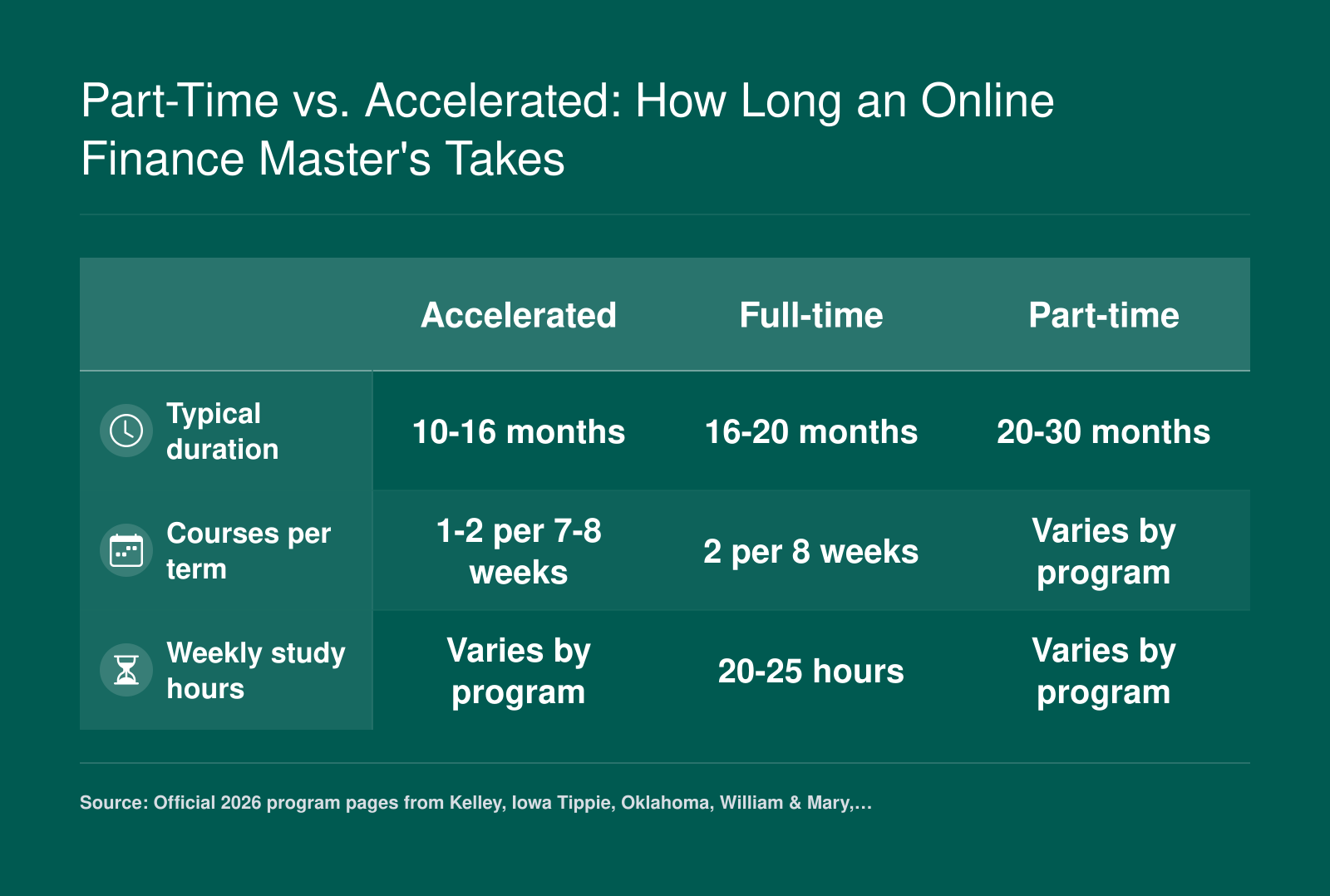
Part-Time vs. Accelerated: How Long an Online Finance Master's Takes
Most online finance master's programs require 30-36 total credits, though pacing changes how quickly you move through them. Accelerated and full-time tracks trade more courses and study hours per term for a faster finish, while part-time tracks stretch completion to fit a full-time job.
Finance programs by state
Frequently Asked Questions About Online Master's in Finance Programs
Is an online Master's in Finance worth it?
Can international students enroll in a fully online US master's in finance?
Does a diploma from an online MS in Finance say "online"?
What is the difference between an online MS in Finance and an MBA with a finance concentration?
Compare Finance programs on the data that matters
Explore more Business & Management specializations or browse every graduate field.
All Business & Management programs