Best Master's in Finance Programs in New Hampshire
Compare 8 accredited Finance programs in New Hampshire at 4 schools, with graduate earnings, cost, debt, and completion data from IPEDS and the U.S. College Scorecard.

In New Hampshire, the main choice is fully online versus a one-year finance master's on campus. Southern New Hampshire University's MS in Finance runs 36 credits at $659 per credit, about $23,724 in tuition, while the University of New Hampshire's AACSB-accredited M.S. in Finance packs 30 credits into roughly 9 to 18 months in Durham.
With so few options in the state, format, residency status and sticker price separate them more than reputation does. SNHU reports median earnings near $82,000 a year after graduation, a reminder that the cheaper path is not automatically the weaker one.
Key Points
- In 2027, UNH's MS Finance requires no GMAT or GRE.
- Southern New Hampshire University's online MS Finance totals $23,724 before transfer credits.
- UNH Durham and Manchester offer campus MS Finance, while SNHU offers online.
Best Master's in Finance Schools in New Hampshire: Ranked List
We ranked New Hampshire finance master's programs by cost, outcomes, and format availability, so online and on-campus options sit side by side. Each card highlights graduate tuition, net price after aid, and a program rationale emphasizing accreditation, CFA alignment, and career preparation. The result is a practical shortlist for students weighing affordability against long-term financial careers.
Southern New Hampshire University
#1Manchester, NH · ~$21,000/yr (est.)
Best for: Working professionals needing fully online
Southern New Hampshire University's online Master of Science in Finance is a flexible, ACBSP-accredited program built around corporate finance, investments, and portfolio management. Students choose from Corporate Finance or Investments & Securities concentrations and can transfer up to 12 credits into the 36-credit degree. The curriculum aligns with CFA competencies, and the program requires no entrance exam or application fee, which keeps the path open for working professionals.
- ACBSP accredited
- 36 total credit hours, 12 total courses
- Fully online with 10-week terms
- No entrance exam or application fee required
- Transfer up to 12 credits
- CFA-aligned curriculum and capstone required
- $659 per credit; $23,724 total program tuition
- Military benefits and employer reimbursement supported
- Concentration in Corporate Finance
- Careers: treasurer, controller, financial analyst
- Prerequisite courses required
- Case studies mirror real-world reports
- Eligible for AFA Accredited Financial Analyst
- Concentration in Investments & Securities
- Careers: broker, investment banker, trader
- Taught by finance professionals
- 24/7 online support
- Aligned with CFA Institute standards
- Counts toward AFA credential eligibility
University of New Hampshire
#2Durham, NH · ~$17,000/yr (est.)
Best for: Career changers targeting CFA exam
The University of New Hampshire's Peter T. Paul College of Business and Economics offers a full-time M.S. in Finance that combines financial modeling, investment analysis, and data programming in an AACSB-accredited program. Students can complete the 30-credit degree in 9 or 18 months and choose from Investments, Financial Analytics & Fintech, or a student-designed track. The curriculum prepares students for the CFA exam, and a STEM designation can extend work authorization for eligible graduates.
- AACSB accredited
- 30 total credit hours, 10 total courses
- Complete in 9 or 18 months
- Track: Investments
- Prepares for CFA exam
- 24-month STEM OPT extension
- No entrance exam required; GMAT optional
- $65 application fee; scholarships available
- Track: Financial Analytics & Fintech
- STEM-designated finance focus
- Curriculum covers financial modeling and programming
- Open to any undergraduate major
- STEM OPT up to 36 months
- Exams: GMAT, GRE; test optional
- Accelerated option for UNH undergrads
- Track: Student-designed
- 9-month program option
- Careers in investment banking and risk management
- Foundation courses can be taken before entry
- Spring start with flexible summer
University of New Hampshire at Manchester
#3Manchester, NH · ~$15,000/yr (est.)
Best for: Manchester-area learners needing in-person
At UNH Manchester, students can pursue the same M.S. in Finance offered by the Peter T. Paul College of Business and Economics, with a campus location convenient to Manchester. The program emphasizes financial modeling, investment analysis, and ethical decision-making, and full-time students typically finish in one year. Foundation courses help career changers without a business background move into the 30-credit curriculum, and UNH undergraduates may use an accelerated path.
- Three concentration options available
- 30 total credit hours, 10 total courses
- One year of full-time study
- Prerequisite or foundation courses available
- Emphasis on ethics and professional standards
- Accelerated option for UNH undergraduates
- Electives in finance, economics, and statistics
New England College
#4Henniker, NH · ~$14,000/yr (est.)
New England College offers an MBA with a Finance concentration for students who want a broader business degree with finance depth. The concentration covers financial management, investment analysis, modern portfolio theory, valuations, and financial modeling. Graduates commonly pursue roles as financial analysts or investment brokers in banking, hedge funds, and corporate finance.
- Finance concentration within the MBA
- Covers financial management and investment analysis
- Modern portfolio theory and risk-return balance
- Financial modeling and valuations
- Prepares for investment broker and financial analyst roles
Cost & outcomes by school
Federal data for the highest-earning Finance programs, independent of the ranking above. Earnings are this field's master's graduates four years after completing, where the Scorecard reports them.
| School | Earnings | Tuition / yr | Debt | Grads/yr | Format |
|---|---|---|---|---|---|
| Southern New Hampshire University NH | $100,914 | $21,387 | $41,257 | 91 | Online |
| University of New Hampshire at Manchester NH | — | $14,876 | — | — | Campus |
| University of New Hampshire NH | — | $16,932 | — | — | Campus |
| New England College NH | — | $14,213 | — | — | Campus |
Sources: U.S. Department of Education. Tuition and graduates: IPEDS. Earnings and debt: College Scorecard, this field's master's graduates; a dash means no figure is reported.
Cost, debt & payoff
Median earnings of this field's master's graduates (4 yrs after completing) vs. their median federal loan debt · U.S. College Scorecard
Across these programs the median graduate earns about $100,914 and finishes with roughly $41,257 in debt — a ratio that clears a common rule of thumb (keep debt below first-year salary). Tuition and debt vary widely school to school, so check the per-school figures in the table above before you shortlist.
Online and Hybrid Master's in Finance Options in New Hampshire
Across New Hampshire's master's programs, finance master's options split cleanly by format, and no true hybrid exists among them.
Campus programs
Both University of New Hampshire campuses, Durham and Manchester, list campus delivery: 30 credits and 10 courses. Durham starts in fall (about 9 months full-time) or spring (about 18 months), and the Durham program adds Bloomberg Terminal training and executive guest speakers. Manchester's catalog describes one year of full-time study. New England College offers an MBA in Finance concentration, also on campus.
Online program
Southern New Hampshire University's online MS in finance is the only fully online listing. It runs 12 courses in 10-week terms, with the next start on December 7, 2026. It requires no entrance exam, accepts employer reimbursement and military benefits, and lets you transfer up to 12 credits. That structure suits people already working.
Career access for online students
None of the schools publishes a required internship, a placement rate, or a separate recruiting policy for online students. Whether SNHU's online students can attend the same career fairs or employer events as campus students is not documented, so ask admissions directly before enrolling.
Rule of thumb: choose campus if you want in-person networking and can study full-time; choose online if you need to keep your job.
Which New Hampshire Master's in Finance Programs Waive the GMAT or GRE?
The University of New Hampshire does not require the GMAT or GRE for its Master's in Finance. The program lists the GMAT as optional, and its graduate FAQ says standardized tests are not required, a Master's in Finance With No GMAT or GRE Required. Applicants may still submit scores to strengthen a file or to be considered for department scholarships. No minimum score is set, and no GPA or work-experience waiver applies because there is nothing to waive.
Other admission conditions at UNH
Test-optional does not mean low-barrier. Applicants need a 3.2 cumulative GPA, two letters of recommendation, and at least 90 undergraduate credits completed before starting graduate 800-level courses. The application fee is waived.
Admitted students must also complete foundation courses before entry or within the program: ADMN 570, ECON 401 or 402, and ADMN 510 or MATH 425. Published pages do not say whether equivalent undergraduate courses count course-for-course, so ask the department.
Deadlines
The program lists June 1 for fall and December 1 for spring. UNH notes that dates can differ for current UNH undergraduates and international students, so confirm yours.
Other schools
Southern New Hampshire University publishes a no-GMAT policy for its online MS in Finance; University of New Hampshire at Manchester and New England College do not publish finance-specific test policies, prerequisite lists, or deadlines that we could confirm. Check each admissions office directly before planning your application timeline.
Related Articles
What Do Master's in Finance Programs in New Hampshire Cost?
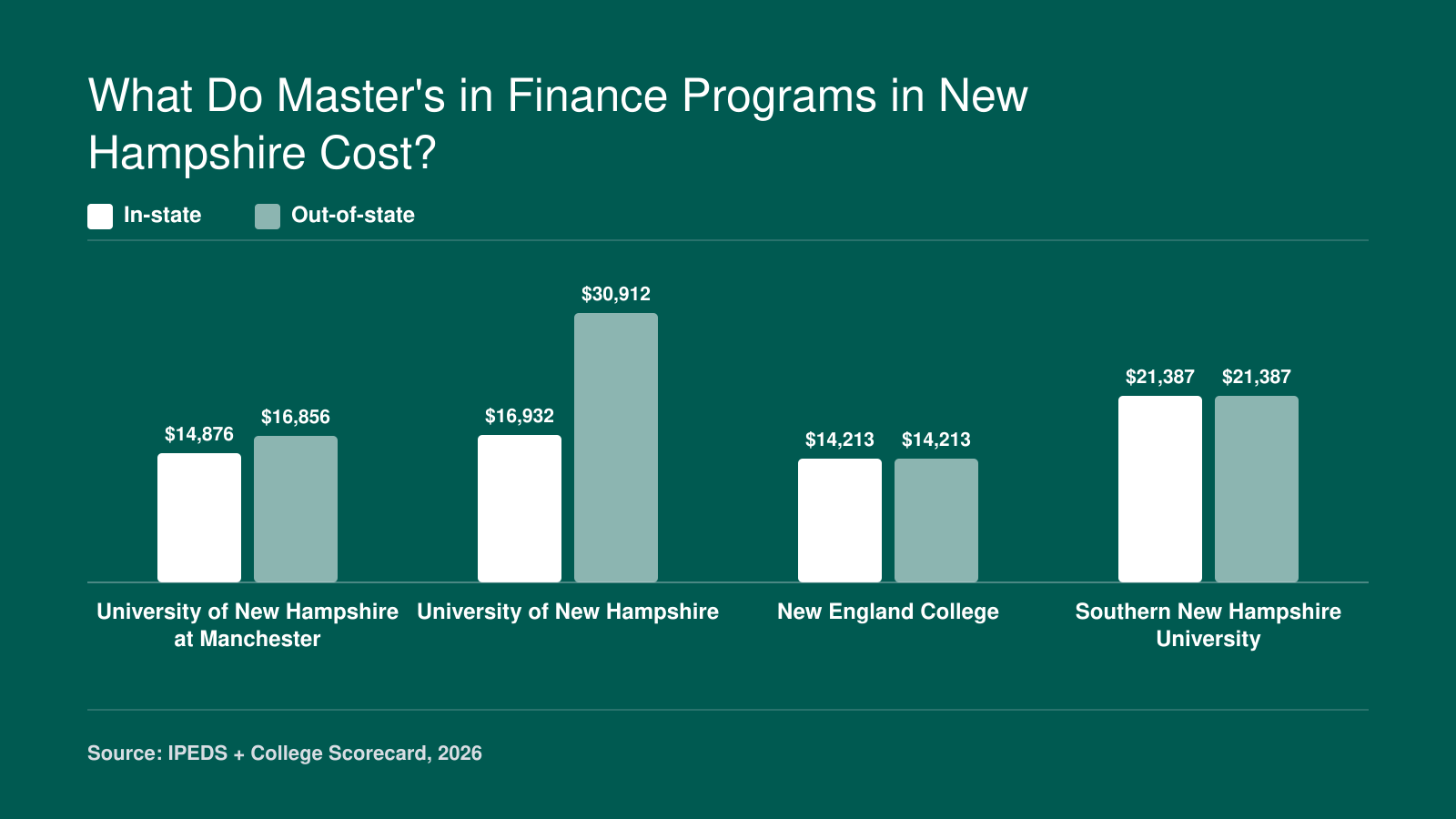
Tuition depends heavily on residency, so the chart below compares the published in-state and out-of-state rates for each listed program. Southern New Hampshire University's online MS in Finance charges $659 per credit for 36 credits, totaling $23,724 before any transfer credit, and online students pay one flat rate regardless of state. University of New Hampshire's finance MS requires 30 credits (33 for the Financial Analytics & Fintech or Investments specializations), but its per-credit rate was not clearly published in the available sources, so the chart uses the program's listed annual tuition figures. New England College shows the lowest listed tuition for both in-state and out-of-state students. The institution-wide average net price after aid is a broad benchmark, not a finance master's specific figure.
New Hampshire Licensure and Certification for Finance Careers
Career Outcomes and Return on Investment for Master's in Finance Graduates in New Hampshire
Corporate finance and asset management employers increasingly treat a specialized master's as an MBA substitute, raising the stakes on what each program returns.
What the earnings data shows
Graduates of the Southern New Hampshire University MS in Finance report median earnings of about $106,600 five years after finishing, $100,900 four years out, and roughly $82,400 one year after completion. Close to 95 percent of completers were working a year after graduating, and about 97 percent earned above the poverty threshold. Those are the only program-level earnings figures published among the finance master's options here; the University of New Hampshire, UNH Manchester, and New England College programs are evaluated on cost, accreditation, and format rather than reported salary.
Weighing debt against pay
SNHU graduates carry a median program debt near $41,300, which works out to roughly $469 a month on a standard 10-year repayment plan. Against a first-year median above $82,000, that payment is a manageable share of income, and it shrinks further as earnings climb.
The practical read
In-state students get the cheapest route to an AACSB accredited finance master's through UNH at about $16,900 in tuition, with UNH Manchester lower still. Out-of-state and working students generally do better online, where tuition does not change with residency and the earnings record is documented.
Master's in Finance in New Hampshire: Common Questions
Is UNH the only New Hampshire institution offering a standalone master's in finance?
How does UNH compare with SNHU's online master's in finance on cost and outcomes?
Can I earn an online MS in finance in New Hampshire without taking the GMAT?
Should I choose a master's in finance or an MBA with a finance concentration in New Hampshire?
Compare Finance programs on the data that matters
Explore more Business & Management specializations or browse every graduate field.
All Business & Management programs