Best Master's in Finance Programs in Tennessee
Compare 6 accredited Finance programs in Tennessee, with graduate earnings, cost, debt, and completion data from IPEDS and the U.S. College Scorecard.

Graduate tuition for a finance master's in Tennessee runs from $9,370 to $76,700, a spread of more than eight times for degrees in the same field. Only a handful of schools in the state offer one, which keeps the comparison manageable: campus, online, and hybrid formats all sit together here, as they do for Best MBA in Finance Programs in Tennessee.
The question is not which program looks strongest on paper, but which one pays back what it costs. The highest-priced option also reports the highest graduate earnings, which is exactly what makes the tradeoff hard.
Key Points
- Vanderbilt's MSF costs $57,868 in tuition, several times the public in-state range.
- Vanderbilt's Class of 2025 reported an average base salary above $94,000.
- Middle Tennessee State University offers a fully online M.S. in Finance with evening synchronous classes.
Best Master's in Finance Schools in Tennessee: The Rankings
Tennessee offers a mix of true MS in Finance degrees, finance-adjacent concentrations, and online formats. Check each card for delivery format, accreditation, and STEM status before you compare tuition. Graduation rates shown are each school's overall rate, not a rate for the finance program.
The University of Tennessee-Knoxville
#1Knoxville, TN · ~$16,000/yr (est.)
Best for: Economics undergrads wanting an accelerated 4+1 path
The University of Tennessee, Knoxville offers finance study as a Master of Arts in Economics with a Financial Economics concentration, not a standalone MS in Finance. The 4+1 path adds just two semesters for economics or finance undergraduates and requires no GRE or GMAT. The university is AACSB-accredited, though the AACSB listing we reviewed names a business analytics master's rather than a finance degree. No STEM designation is published for this program. The school's overall graduation rate is about 74%.
- Accelerated 4+1 format adds only two semesters
- Apply in junior year; 9 credits count toward both degrees
- 15 finance credits: 6 required, 9 electives
- 3.3 GPA minimum; prerequisites in theory, statistics, calculus
- No GRE or GMAT, no recommendation letters, $0 application fee
- Rolling admissions with decisions in 2 to 3 weeks
Middle Tennessee State University
#2Murfreesboro, TN · ~$12,000/yr (est.)
Best for: Working professionals needing online flexibility
Middle Tennessee State University delivers its 33-credit MS in Finance online and can be completed in about one calendar year. The curriculum covers corporate finance, investments, financial modeling, and econometrics, with electives in mergers and acquisitions and real estate finance. The Jones College of Business is AACSB-accredited. MTSU does not publish a STEM or OPT designation for this degree, so international applicants should confirm with the school. The university's overall graduation rate is about 54%.
- 33 credit hours: 24 core and 9 elective
- Online delivery; one-year program
- GMAT or GRE test optional; may be waived for experienced applicants
- 3.0 GPA minimum
- Electives in M&A, real estate finance, international finance
- Financial aid and scholarships available
University of Memphis
#3Memphis, TN · $10,000 – $15,000/yr (est.)
Best for: International students seeking STEM work authorization
The University of Memphis MS in Finance is a 33-hour, evening-friendly campus program that typically takes about two years. Electives include Portfolio Management, Financial Derivatives, and Python for Finance, and students can use the Cook Analytics and Trading Lab. The Fogelman College is AACSB-accredited, and the degree is STEM-designated, giving international graduates up to 36 months of OPT. The university's overall graduation rate is about 51%.
- 33 credit hours, typically about two years
- STEM-designated; three years of OPT for international students
- GRE or GMAT required; $35 application fee
- Evening classes for working students; fall and spring starts
- CFP Board approved program
- CFA Institute and TVA Investment Challenges
- Accelerated BBA/MS pathway
- Up to 3 hours of internship credit
Austin Peay State University
#4Clarksville, TN · ~$11,000/yr (est.)
Austin Peay State University places finance inside its MS in Quantitative Methods, with a Mathematical Finance concentration housed in the Department of Mathematics and Statistics. It leans toward the math, statistics, and modeling side of finance rather than a business-school curriculum. Classes can be face-to-face, online, or hybrid. Our research did not confirm AACSB status for this program, and no STEM designation is published. The school's overall graduation rate is about 40%.
- One of three concentration options
- Online, on-campus, or hybrid formats; fully online available
- Graduate assistantships: about 20 hours a week with tuition waiver
- Annual assistantship stipend of $5,800
- Dedicated Mathematical Finance coordinator
Vanderbilt University
#5Nashville, TN · ~$58,000/yr (est.)
Vanderbilt's MS in Finance is a nine-month, full-time program at the Owen Graduate School of Management in Nashville, with up to half the curriculum open to electives. The Class of 2025 reported an average base salary above $94,000, and 97% received an offer within six months. The school is AACSB-accredited, and the program is STEM-designated, providing 36 months of total OPT including a 24-month extension. Vanderbilt has the highest overall graduation rate on this list, at about 94%, and also the highest tuition.
- Nine-month, full-time program in Nashville
- Personalize up to 50% of the curriculum with electives
- STEM-designated; 36 months of total OPT
- Class of 2025: $94K+ average base salary
- 97% received an offer within six months
- Dedicated career coaching and alumni network
Herzing University-Nashville
#6Nashville, TN · ~$9,000/yr (est.)
Herzing University's Nashville campus offers a 30-credit MS in Finance that is delivered fully online and can be finished in 12 months. It covers corporate finance, risk management, fintech, and blockchain, and ends with a capstone or internship. There is no entrance exam, and rolling admissions with six start dates a year suit part-time students. Our research did not confirm AACSB accreditation or a STEM designation for this program. The school does not report an overall graduation rate in our data.
- 30 credit hours; 12-month program
- 100% online, full-time or part-time
- No entrance exam; 2.7 GPA minimum
- $630 per credit
- Six start dates a year with rolling admissions
- Capstone project or internship option
- Prepares for AAMS and FBS certifications
- Transfer up to 12 approved credits
Cost & outcomes by school
Federal data for the highest-earning Finance programs, independent of the ranking above. Earnings are this field's master's graduates four years after completing, where the Scorecard reports them.
| School | Earnings | Tuition / yr | Debt | Grads/yr | Format |
|---|---|---|---|---|---|
| Vanderbilt University TN | $198,584 | $57,868 | $76,096 | 2 | Campus |
| Herzing University-Nashville TN | — | $9,370 | — | — | Online |
| Austin Peay State University TN | — | $10,518 | — | — | Online |
| University of Memphis TN | — | $11,628 | — | — | Campus |
| The University of Tennessee-Knoxville TN | — | $15,972 | — | — | Campus |
| Middle Tennessee State University TN | — | $11,718 | — | 36 | Online |
Sources: U.S. Department of Education. Tuition and graduates: IPEDS. Earnings and debt: College Scorecard, this field's master's graduates; a dash means no figure is reported.
How We Rank Tennessee Master's in Finance Programs
Where do the numbers behind these rankings come from? They come from federal sources: IPEDS and the College Scorecard. For the master's in finance programs ranked here, we look at graduate tuition, average net price, graduation rate, and, where published, earnings and debt for graduates of the specific program.
Each measure has limits worth knowing. Net price is an institution-wide average after aid, not a quote for your situation, so your own cost may differ. Graduation rate describes the whole school, not the finance program.
Program-level earnings come from Scorecard's tracking of actual completers of each program. Small programs may not have published figures, and we leave those out rather than estimate. We don't rely on prestige or advertising, and we don't apply weighting formulas the data can't support.
Online and Hybrid Master's in Finance Options in Tennessee
Choosing between online and in-person delivery among Master's Programs in Tennessee is a tradeoff between scheduling flexibility and the structure of a fixed campus cohort. Middle Tennessee State University publishes the clearest fully online path in the Best Online Master's in Finance Programs: its M.S. in Finance meets on Tuesday and Thursday evenings from 6 to 9 p.m. CT, requires no campus residency, and takes as little as 12 months full time or two years part time. The University of Memphis lists its 33-credit program as campus based, and its page does not describe a fully online or hybrid option. Austin Peay State University and Herzing University-Nashville do list online or hybrid formats, but they publish fewer delivery specifics.
For international students, MTSU requires F-1 visa documentation and one year of financial certification before an I-20, but online-only enrollment from abroad may not qualify because F-1 status generally requires on-campus attendance. Memphis does not state I-20 eligibility for online study, though its STEM designation allows international graduates three years of optional practical training. Online and hybrid formats fit best for mid-career professionals in Nashville, Memphis, or Chattanooga who cannot relocate.
Related Articles
Which Tennessee Master's in Finance Programs Waive or Make the GRE Optional
Test-optional programs and test-required programs sit side by side in Tennessee, and the gap between No-GRE master's programs and test-required tracks affects how fast you can apply.
- Vanderbilt: The MSF is test-optional. Submitting a GMAT or GRE is allowed but not required, and no GPA cutoff or work-experience waiver is published. No specific prerequisite courses are listed.
- MTSU: The online MS in Finance is one of the Master's in Finance Programs With No GMAT or GRE Required. You need a bachelor's in any field, a 3.0 cumulative GPA, and no prerequisite courses.
- Herzing University-Nashville: The program lists no entrance exam and a 2.7 GPA minimum.
- University of Memphis: The GRE or GMAT is required, and a GMAT score must be five years old or less. Waivers are considered case by case after your file is reviewed, with no automatic GPA, CFA, or experience trigger. Plan for MATH 1830 or equivalent, since calculus is assumed.
- UT Knoxville and Austin Peay: We found no clear published test policy for a finance master's at either school, so we won't guess.
Calculus and statistics gaps trip up applicants more often than test scores. Confirm the current policy on each admissions page before applying, because requirements change from cycle to cycle.
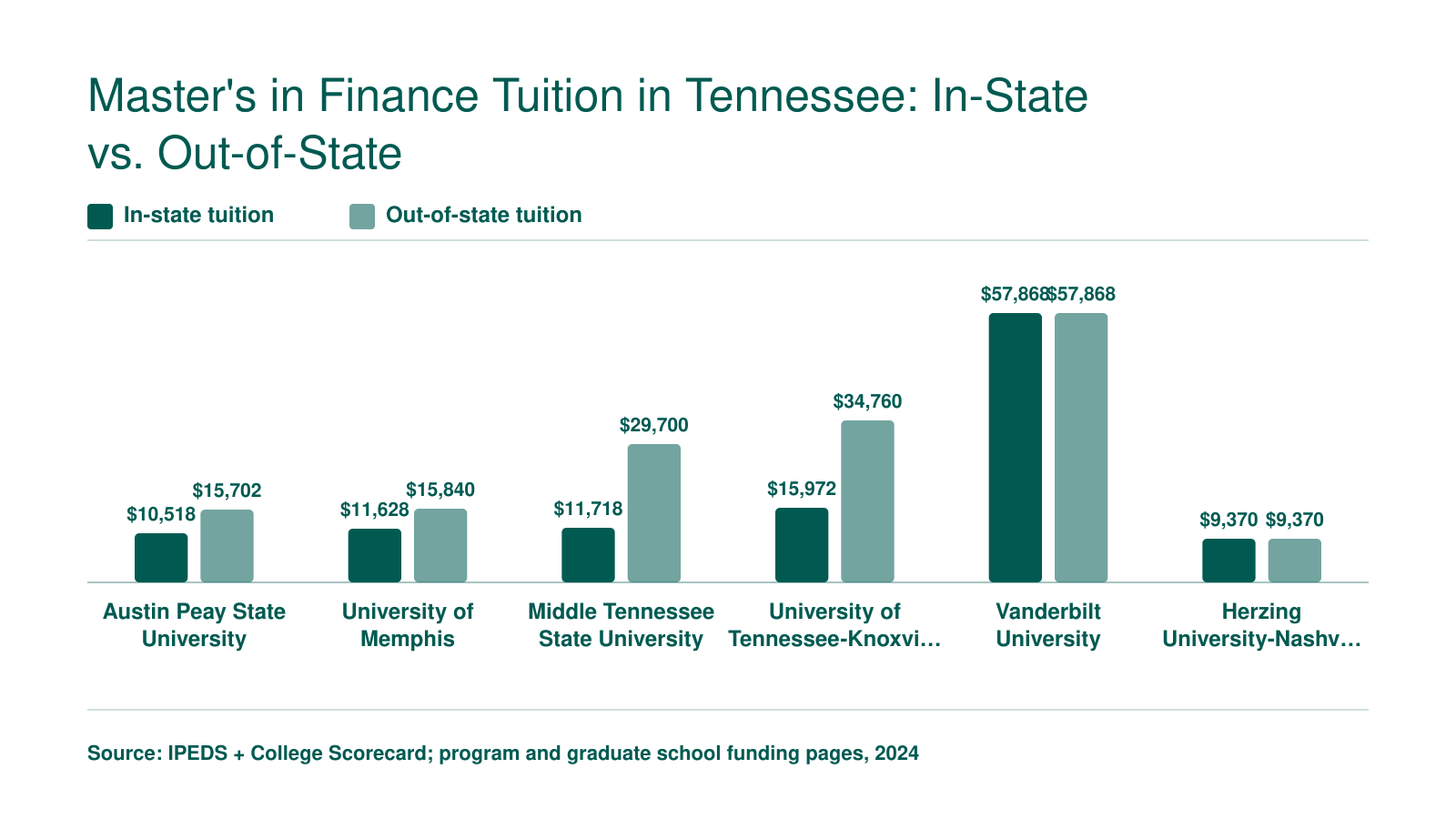
Master's in Finance Tuition in Tennessee: In-State vs. Out-of-State
Public in-state tuition here runs roughly $10,500 to $16,000, while Vanderbilt's private tuition is $57,868, several times higher. Herzing University-Nashville, also private, lists $9,370. Institution-wide average net price is a rough after-aid guide and is not specific to a finance program: it runs from $9,735 at Austin Peay to $18,976 at Knoxville. Vanderbilt considers every admitted applicant for partial merit awards automatically and has an Accelerator Summer Business Immersion worth up to $5,000. MTSU offers five finance assistantships each fall to Tennessee residents, covering tuition plus a stipend for about 20 hours a week of remote work. Austin Peay lists graduate teaching assistantships with a tuition waiver, and Knoxville assistantships (about 10 hours a week) carry a stipend and tuition waiver, though that funding detail comes from its economics program. Memphis publishes no finance-specific aid terms we could confirm. Ask each school about waivers for Tennessee residents or state employees.
That mapping can also open the door to student exam scholarships.
Master's in Finance Salary in Tennessee: What Graduates Earn
What does a finance master's actually pay in Tennessee? The clearest picture comes from Vanderbilt, where graduates in the Class of 2025 reported an average base salary above $94,000, with 97 percent of job-seeking graduates holding a full-time offer within six months and 94 percent accepting one. Investment banking absorbed 46 percent of that class, with smaller shares heading into investment management and private equity or venture capital. The largest share stayed regional: 43 percent landed in the South, 25 percent in the Northeast.
Earnings Against Debt
Vanderbilt graduates carry a median program debt of roughly $14,000, which works out to about $866 a month on a standard 10-year schedule. Against a mid-career median near $172,700 five years out, that is an unusually favorable finance MBA ROI. Public programs in Tennessee publish less program-level earnings detail, so judge those on tuition and placement; the Most Affordable Master's in Finance Programs list can help.
Where Graduates Work
Named hires in Vanderbilt's most recent class included Wells Fargo, JPMorgan Chase, KPMG, Cain Brothers, Brookwood Associates, and First Trust Capital Management, spread across more than 50 employers. Memphis positions its finance graduates toward analyst and manager roles, and MTSU's 2026 career fair drew over 170 employers.1 Corporate finance, commercial banking, and investment analysis remain the common paths.
How to Choose the Right Master's in Finance Program in Tennessee
The real decision is whether the name or the credential you can repay matters more. Run every option, including Accelerated Master's in Finance Programs, through four filters: total cost after aid, format fit (can you keep working?), test policy (including MBA in Finance no GMAT no GRE alternatives), and whether STEM designation or CFA alignment actually matters for your career path.
Deadlines and materials
- Vanderbilt: The first round for Fall 2027 entry closes September 10, 2026, with a $100 fee. Expect essays, one recommendation, and unofficial transcripts; an application is only reviewed once every item is in.
- MTSU: January 5, 2027 is the priority date for a January 19, 2027 start. A 3.0 GPA and a bachelor's degree are the baseline, with no entrance exam required.
- University of Memphis: July 1 for fall entry, a $35 fee through the applicant portal, and GRE or GMAT scores.
International applicants should weigh STEM-designated options first, since the OPT extension can buy meaningful post-graduation work time. Shortlist two or three programs now and request information before the earliest deadline passes.
Compare Finance programs on the data that matters
Explore more Business & Management specializations or browse every graduate field.
All Business & Management programs